

Yes, California corporations and LLCs can act by written consent instead of holding a meeting, but the rules tighten depending on who's signing. Board consents require unanimous written agreement from every director then in office under Corporations Code §307. Shareholder consents follow separate, more flexible thresholds. Every signed consent must be filed with the corporate minutes, and electronic signatures generally satisfy the writing requirement.
TL;DR:
- Written consent from directors must be signed by all in office and filed with the corporation's minutes, with electronic signatures generally accepted.
- Shareholder consents can often be obtained from the minimum votes needed for approval at a meeting, not necessarily 100%, depending on governing documents.
- Disclosures are required for interested-director transactions, with attachments and possibly a memo or opinion, to withstand court scrutiny.
- Consents must be stored in the minute book and retained for the life of the entity, with digital copies being acceptable if reproducible as legible paper.
- Routine approvals suit written consent, but complex or high-conflict decisions should still be handled via meeting to ensure proper documentation and disclosures.
Table of Contents
- Who Can Use Written Consent Instead of a Meeting
- The Statutes Behind California's Written Consent Rules
- How to Draft, Collect, and File a Valid Written Consent
- Interested-Director Transactions Carry Extra Risk
- Where Signed Consents Belong and How Long to Keep Them
- What Every Written Consent Document Should Include
- How Legalstepz Helps You Get This Right
- Meetings Still Beat Consent for the Hard Decisions
- Get Your Consents and Minutes Filed Correctly
- Sources
- FAQ
Who Can Use Written Consent Instead of a Meeting
Directors, shareholders, and nonprofit members each operate under different consent rules, and mixing them up is one of the most common mistakes small business owners make when skipping a meeting.
For boards, §307(b) sets a strict bar: written consent only works if every single director then in office signs it. One holdout director, and the consent fails entirely. There's no majority shortcut here, unlike a live meeting where a quorum can act.

Shareholders get more breathing room. Under §603, a corporation can often act with consent from holders representing the minimum number of votes needed to approve the action at an actual meeting, not necessarily 100% of shares. Nonprofit corporations follow parallel provisions under §7516 for members.
A few practical wrinkles matter before you rely on any of this:
- Bylaws or articles of incorporation can restrict or eliminate written consent entirely for certain actions, so check your governing documents first.
- Some transactions (certain mergers, dissolutions) carry additional notice requirements even when done by consent.
- If unanimity among directors isn't realistically attainable, you're better off calling a meeting rather than chasing a signature that may never come.
The Statutes Behind California's Written Consent Rules
Three code sections do most of the work here, and knowing what each one actually requires keeps you out of trouble.
Corporations Code §307(b) governs board action. It demands unanimous written consent from directors currently serving and requires that the signed document be filed with the corporation's minutes. There's no partial version of this rule. Miss one signature and the action never took legal effect.
Corporations Code §603 covers shareholder consents in for-profit corporations, with §7516 doing similar work for nonprofit members. These sections address not just who must sign, but timing: consents can have effective dates, and notice to non-consenting shareholders may be required depending on the action taken.
Corporations Code §195 answers a question that trips up a lot of boards: does an emailed PDF count as a "writing"? Generally, yes. California treats corporate records broadly, and a consent transmitted electronically and capable of being reproduced in physical form typically satisfies the statute, according to §195's form and records provisions.
- §307(b): unanimous director consent, filed with minutes
- §603 / §7516: shareholder and member consent thresholds and timing
- §195: broad definition of "writing" covering electronic transmission
How to Draft, Collect, and File a Valid Written Consent
- Draft the resolution first. Include a clear title, brief recitals explaining the background, and a specific "resolved" clause stating exactly what's being approved. Vague language here creates ambiguity later.
- Set an effective date. State whether the action takes effect on the last signature date or a specified future date.
- Circulate for signatures. For board actions, every director then in office must sign, per §307. Counterparts are fine. So is a signature collected by email or e-signature platform, as long as it's reproducible.
- Attach disclosures where required. If you're soliciting shareholder consent for a major transaction, include the information shareholders would receive before voting at a meeting.
- File the signed original (or reproducible copy) with the minute book. This isn't optional paperwork. It's the record that proves the action happened.
- Keep a duplicate outside the physical binder. A scanned PDF stored securely protects you if the paper copy is lost or damaged.
Pro Tip: Number your consents sequentially and cross-reference them in your next set of meeting minutes. When a lender or buyer's counsel reviews your minute book during due diligence, a consent that's hard to find looks a lot like a consent that never existed.
Interested-Director Transactions Carry Extra Risk
Written consent gets riskier fast when a director has a personal financial stake in the transaction being approved. Corporations Code §310 requires disclosure of material facts about the interested director's relationship and the terms of the deal before other directors can rely on statutory safe harbors.
The problem with written consent in these situations isn't the statute. It's the absence of a record showing what was actually discussed and disclosed. A meeting creates minutes reflecting debate, questions, and pushback. A consent form just shows signatures.
- Attach a written disclosure statement describing the interested director's relationship and financial interest before circulating the consent.
- Get a contemporaneous memo or counsel opinion confirming the disclosure was adequate, dated the same day as the consent.
- Consider holding an actual meeting for high dollar or high conflict transactions, even if consent would technically work.
Courts scrutinize whether disinterested directors had the full picture when they signed. Skip that step, and you lose the protection §310 is designed to offer.
Where Signed Consents Belong and How Long to Keep Them
Every signed consent gets filed with the corporation's minutes, not tucked in an email folder somewhere. That's the rule under §307(b), and it applies with equal force to shareholder consents under §603. A governance analysis of §307(b) compliance notes that consents left out of the minute book are a recurring failure point during litigation and due diligence review.
- Store signed consents (paper or electronic) in the same minute book as your meeting minutes, in chronological order.
- Electronic storage is acceptable if the document remains reproducible as a legible paper copy on demand.
- Retain consents for the life of the entity at minimum. Some transactions (stock issuances, mergers) may need records available well beyond dissolution for tax or claims purposes.
- Attach any referenced disclosures, exhibits, or waivers to the consent itself rather than storing them separately.
Reviewing your process for signing minutes promptly helps make sure consents don't sit unsigned or unfiled for months.
What Every Written Consent Document Should Include
Before you send a consent out for signature, run it against this checklist:
- Title and date. Identify the entity and the date of preparation.
- Recitals. Brief background explaining why the action is being taken.
- Resolved clause(s). The specific action being approved, stated plainly.
- Effective date language. Clarify when the action takes legal effect.
- Signature block. Language expressly permitting counterparts and electronic signatures.
- Attached disclosures, when the action involves an interested director or a shareholder solicitation.
Pro Tip: Before circulating anything, confirm your bylaws don't require a higher signature threshold or prohibit written consent for that specific category of action. A consent that violates your own bylaws can be challenged even if it technically satisfies the Corporations Code.
A drafting guide for annual minutes offers useful reference language for how consents should read when they get incorporated into your permanent corporate record.
How Legalstepz Helps You Get This Right
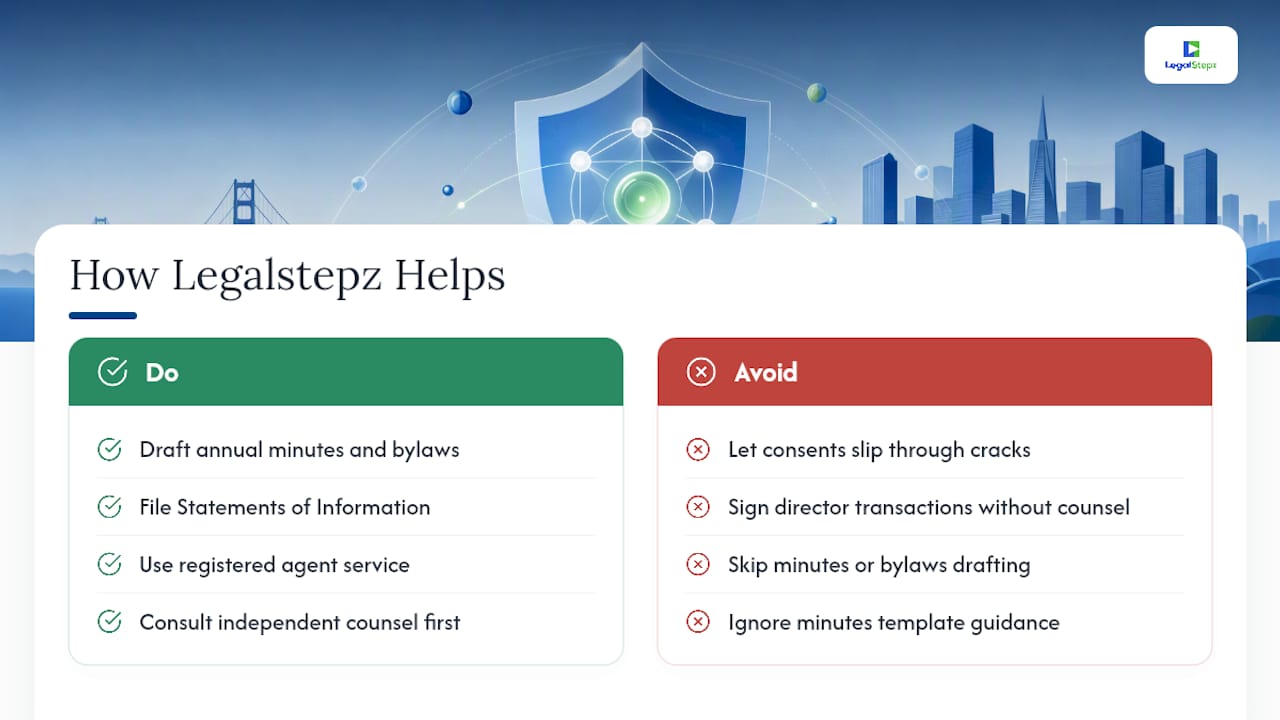
Annual corporate minutes and bylaws can be drafted, Statements of Information filed, and registered agent services provided to help ensure consents and other filings don't slip through the cracks. Our minutes template resources walk through common initial actions. For complex or interested-director transactions, loop in independent counsel before you sign.
Meetings Still Beat Consent for the Hard Decisions
Written consent works well for routine matters: approving standard resolutions, ratifying prior actions, ordinary banking authorizations. Anything involving an interested director, a contested vote, or a transaction someone might challenge later deserves an actual meeting. Documentation and disclosure, not speed, should drive the decision.
— Peter
Get Your Consents and Minutes Filed Correctly
Chasing down director signatures is one thing. Making sure the consent actually holds up if a bank, buyer, or court ever looks at your minute book is another. Compliance services for California corporations include drafting annual minutes and bylaws, filing Statements of Information, and registered agent support to help ensure important documents are handled properly.

If your last written consent never made it into the minute book, or your bylaws haven't been checked against current consent practices, that's a gap worth closing before it becomes someone else's discovery request. Visit Legalstepz to see current service options for minutes drafting, bylaws, and registered agent support, and get your corporate records back in order.
Sources
- California Corporations Code § 307 — Directors and Management (Justia)
- California Corporations Code § 603 — Action by Written Consent of Shareholders (FindLaw)
- Cal. Code Regs. Tit. 17 § 50429 — Documentation of Informed Consent (LII / Cornell)
This article is general information, not a substitute for advice from a qualified lawyer. Consult a qualified legal professional about your own circumstances before acting on anything here.
FAQ
What are the requirements for action by written consent in a California corporation?
Board written consent requires unanimous signatures from every director then in office, filed with the corporate minutes under §307(b). Shareholder consent thresholds under §603 are typically lower and don't require unanimity.
Do California written consents need to be unanimous?
Only for board action. Director consents under §307(b) require every sitting director's signature, while shareholder or member consents under §603 and §7516 generally need only the minimum votes required to approve the action at a meeting.
Are electronic signatures valid for California corporate written consents?
Yes. Under §195, California treats "writing" broadly, and consents transmitted electronically that can be reproduced as legible copies generally satisfy the statutory requirement.
Is informed consent the same as corporate written consent in California?
No. Informed consent rules under Cal. Code Regs. Tit. 17 §50429 govern medical and research contexts with IRB requirements, which are entirely separate from corporate governance consent rules.
Where should signed written consents be filed?
Signed consents must be filed with the corporation's minutes and stored in the minute book, whether in paper or reproducible electronic form, so they're available for inspection and due diligence review.