

Every new U.S. business faces the same annual compliance tasks, and missing even one can trigger administrative dissolution, IRS penalties, or the loss of liability protection you formed the entity to get. Here is the prioritized checklist to keep your entity in good standing this year.
Your annual compliance checklist at a glance:
- File your state annual report or Statement of Information with your Secretary of State (due dates vary by state and entity type)
- Pay state franchise taxes where applicable (California's minimum is $800 per year for most LLCs and corporations)
- Verify your registered agent name, address, and contact details are current
- Hold your annual meeting and prepare minutes (corporations and most multi-member LLCs)
- File federal tax returns appropriate to your entity (Schedule C, Form 1120, Form 1120-S)
- Handle payroll obligations: deposit withheld taxes on schedule, file Form 941 or 944 quarterly/annually, issue W-2s and 1099-NECs by January 31
- File Form 940 for federal unemployment tax (FUTA) by January 31
- Renew local and state business licenses and permits before expiration
- Update your cap table and ownership records whenever equity changes hands
- Check good standing on your state Secretary of State site
- Review BOI (Beneficial Ownership Information) obligations under the Corporate Transparency Act if ownership changed
- Renew business insurance (general liability, workers' compensation where required)
Your next 7 days: Log into your state's Secretary of State portal, confirm your registered agent details are accurate, and add every filing deadline to a shared calendar. That single step prevents the most common compliance failure founders experience.
Pro Tip: Administrative dissolution is the most underestimated risk for new businesses. Missing a state annual report can result in dissolution after a grace period, and reinstating a dissolved entity typically costs more in fees, attorney time, and lost contracts than the original filing ever would have.
Table of Contents
- What does each entity type actually need to file?
- What state filings do you need to complete each year?
- What federal tax and payroll filings does your business owe?
- Which licenses and permits do you need to renew annually?
- Why do annual meetings and corporate records matter so much?
- How do you verify your registered agent and good standing status?
- What does a realistic annual compliance calendar look like?
- How do you prepare for this year's compliance tasks right now?
- How Legalstepz helps California businesses stay compliant
- Key Takeaways
- What most founders get wrong about annual compliance
- Legalstepz compliance packages for California businesses
- Authoritative sources for filing and templates
What does each entity type actually need to file?
Filing responsibilities differ significantly by entity structure. The table below maps the most common annual tasks to each entity type so you can focus on what applies to you.
| Task | Sole Proprietor | Single-Member LLC | Multi-Member LLC | S Corp | C Corp |
|---|---|---|---|---|---|
| State annual report / Statement of Information | No | Yes (most states) | Yes (most states) | Yes | Yes |
| State franchise tax | No | Yes (where applicable) | Yes (where applicable) | Yes | Yes |
| Annual meeting + minutes | No | No (recommended) | Recommended | Required | Required |
| Bylaws / operating agreement update | No | Recommended | Yes | Yes | Yes |
| Federal income tax return | Schedule C (Form 1040) | Schedule C or Form 1065 | Form 1065 | Form 1120-S | Form 1120 |
| W-2 issuance (employees) | Yes, if employees | Yes, if employees | Yes, if employees | Yes | Yes |
| 1099-NEC (contractors) | Yes, if applicable | Yes, if applicable | Yes, if applicable | Yes, if applicable | Yes, if applicable |
| BOI report (ownership changes) | No | Yes | Yes | Yes | Yes |
| Registered agent verification | No | Yes | Yes | Yes | Yes |
Action items by entity:
- Sole proprietor: File Schedule C with your personal return by April 15; renew local licenses; issue 1099-NECs to contractors by January 31.
- LLC (single or multi-member): File your state annual report; verify registered agent; pay franchise tax where your state requires it; file the appropriate federal return.
- S Corp / C Corp: All of the above, plus hold a documented annual meeting, prepare minutes, and file the correct corporate return (Form 1120-S or 1120).
What state filings do you need to complete each year?
Most U.S. states require an annual or biennial report, often called a Statement of Information in California, and fees and due dates vary widely. Getting this wrong is one of the fastest ways to lose good standing.
How due dates are set
States use three different systems. Some tie the due date to your entity's anniversary of formation (the month you originally registered). Others use a fixed calendar date, such as April 1 for all entities. A third group staggers filings alphabetically or by entity type. The only reliable way to confirm your deadline is to check your state's Secretary of State website directly, since the rules change and online databases are updated more frequently than third-party guides.
Typical fees and examples
Filing fees range from $0 to $800+ depending on the state. Several states charge no fee at all; others, like Massachusetts, charge $500 for corporations. California stands apart: in addition to the Statement of Information filing fee, most LLCs and corporations owe an $800 minimum franchise tax annually, regardless of revenue or profit. That $800 is due even in years when the business earns nothing.
| State | Filing Name | Frequency | Typical Fee |
|---|---|---|---|
| California | Statement of Information | Every 1–2 years (entity-dependent) | $800 franchise tax |
| Delaware | Annual Report | Annual | $50–$500 (varies by state and type) |
| Texas | Public Information Report | Annual | No fee (franchise tax separate) |
| Florida | Annual Report | Annual | — |
| Wyoming | Annual Report | Annual | $60 minimum |
Pro Tip: Before you file your annual report, log into your state SOS portal and verify your registered agent name and address. A mismatch between your filing and the agent of record can delay processing or trigger a deficiency notice.
What federal tax and payroll filings does your business owe?
Federal obligations split into two categories that new business owners routinely confuse: periodic deposits (which happen throughout the year) and annual returns (which summarize what you deposited). Mixing up deposits and returns is the leading source of payroll errors for new employers.
Key IRS forms for new businesses
- Schedule C (attached to Form 1040): sole proprietors and single-member LLCs report business profit and loss here
- Form 1065: partnership and multi-member LLC annual return, due March 15
- Form 1120-S: S corporation annual return, due March 15
- Form 1120: C corporation annual return, due April 15
- Form 941: quarterly payroll tax return (filed four times per year)
- Form 944: annual payroll tax return for very small employers (IRS must designate you for this)
- Form 940: annual FUTA (federal unemployment) return, due January 31
- W-2: issued to each employee by January 31
- 1099-NEC: issued to each contractor paid $600 or more, by January 31
Annual tax and payroll timeline
| Period | Task | Due Date |
|---|---|---|
| January | Issue W-2s and 1099-NECs; file Form 940 | January 31 |
| March | File Form 1065 or 1120-S (partnerships, S corps) | March 15 |
| April | File Form 1120 (C corps) or personal return with Schedule C | April 15 |
| Quarterly | File Form 941; make payroll tax deposits per IRS schedule | April 30, July 31, Oct 31, Jan 31 |
| Year-round | Make federal income tax estimated payments (if self-employed) | April 15, Sept 15, Jan 15 |

Pro Tip: Payroll deposit schedules (monthly vs. semi-weekly) are assigned by the IRS based on your lookback period. A payroll service or CPA handles the deposit calendar automatically and eliminates the most common penalty trigger for new employers.
Which licenses and permits do you need to renew annually?
A business license is not a one-time purchase. Many cities and counties require general business licenses that renew annually, and professional licenses at the state level often follow their own renewal cycles. Letting one lapse can mean fines, forced closure, or personal liability.
Who typically needs local permits
- Restaurants and food businesses: health department permits, food handler certifications, liquor licenses (where applicable)
- Contractors and tradespeople: state contractor licenses, local business licenses, bonding requirements
- Home-based businesses: many cities require a home occupation permit even for businesses with no foot traffic
- Professional service providers: attorneys, CPAs, real estate agents, and healthcare providers hold state-issued licenses with their own renewal windows
- Businesses with employees: workplace poster requirements from the Department of Labor must be kept current
Your permit inventory checklist
Copy this into your compliance calendar and fill in the blanks for your business:
- General business license (city/county): renewal date , fee $
- State professional license (if applicable): renewal date , fee $
- Health or safety permit (if applicable): renewal date , fee $
- Zoning or home occupation permit (if applicable): renewal date , fee $
- Industry-specific federal permit (e.g., FAA certificate, TTB license): renewal date , fee $
- State sales tax permit: confirm no renewal required in your state
Local business licenses commonly cost $50–$500 per year, with penalties for late renewal ranging from small fines to suspension of the right to operate.
Pro Tip: Set a calendar reminder 60 days before each permit's expiration and keep the payment method on file with the issuing agency. Most cities now allow auto-renewal online, and a lapsed payment method is the most preventable cause of an expired license.
Why do annual meetings and corporate records matter so much?
Corporate minutes and formal governance records are not just paperwork. They serve as evidence that your entity operates as a separate legal person, which is the foundation of the liability protection you formed the entity to get. Without documented minutes, a creditor or plaintiff can argue the business is an alter ego of its owners, a legal theory called "piercing the corporate veil."

Clean minutes, bylaws, and ownership records also speed investor due diligence. A founder who can produce three years of organized minutes, a current cap table, and a signed operating agreement closes funding rounds faster than one who has to reconstruct records under deadline pressure.
Minimum documents every entity should maintain
- Bylaws (corporations) or operating agreement (LLCs): current, signed, and updated after any structural change
- Annual meeting minutes: date, attendees, resolutions passed, and any votes recorded
- Equity records / cap table: every issuance, transfer, and cancellation of shares or membership interests
- BOI report filed with FinCEN under the Corporate Transparency Act, updated within 30 days of any ownership change
- Resolutions: major decisions (opening bank accounts, authorizing loans, approving contracts) documented in writing
How to hold a simple annual meeting
You do not need a conference room. A written consent signed by all owners satisfies the meeting requirement in most states. Record the date, the names of participants, the agenda items discussed, and any resolutions adopted. File the signed document in your minute book.
Pro Tip: Keep a single versioned digital folder as your source of truth for all governance documents. Name files with the date and document type (e.g., "2026-01-15_AnnualMeeting_Minutes.pdf") and back up to a second location. A physical minute book is still worth maintaining for California corporations.
How do you verify your registered agent and good standing status?
A "set-it-and-forget-it" approach to your registered agent is one of the riskiest habits a new business owner can develop. Outdated registered-agent contact details are a frequent cause of missed service of process and compliance notices, and you can lose good standing without ever knowing a notice was sent.
Annual registered agent verification checklist
- Log into your state Secretary of State's online portal.
- Pull up your entity's current record and confirm the registered agent name and address match your actual agent.
- If you use a commercial registered agent, log into their portal and confirm your contact email and forwarding preferences are current.
- If the agent has changed, file a Statement of Change of Registered Agent before your next annual report is due.
- Order a Certificate of Good Standing (also called a Certificate of Status in some states) to confirm your entity is active and in compliance.
- If you operate in more than one state, repeat this process for each state where you are registered as a foreign entity.
When does foreign qualification apply?
If your business has a physical presence, employees, or regular sales activity in a state where you are not formed, that state likely requires you to register as a foreign entity. Foreign qualification typically requires a one-time filing plus ongoing annual reports in the new state, the same as a domestic entity.
Consequences of falling out of good standing
Administrative dissolution is the most severe outcome, but it is not the only one. A business that is not in good standing cannot obtain a Certificate of Good Standing, which is required to open certain bank accounts, sign commercial leases, or close a financing round. Reinstatement fees and back-filing penalties add up quickly.
Pro Tip: A commercial registered agent monitors your entity's compliance calendar and forwards service of process reliably. For California businesses especially, this is worth the annual cost.
What does a realistic annual compliance calendar look like?
Compliance costs money and time, but the costs of non-compliance are higher. The table below pairs common tasks with typical due-date rules, cost ranges, and example penalties to help you build a realistic annual budget.
| Task | Typical Due Date | Estimated Cost | Penalty for Failure |
|---|---|---|---|
| State annual report / Statement of Information | Anniversary or fixed date (varies by state) | $0–$800+ filing fee | Late fees; administrative dissolution |
| California franchise tax | 15th day of 4th month of tax year | $800 minimum | Penalties + interest; suspension |
| Federal income tax return | March 15 (pass-through) or April 15 (C corp / individual) | CPA fees vary | Failure-to-file penalty (5% per month) |
| Form 941 (quarterly payroll) | April 30, July 31, Oct 31, Jan 31 | Payroll service fees | Failure-to-deposit penalty (2%–15%) |
| Form 940 (FUTA) | January 31 | Included in payroll service | Penalty + interest |
| W-2 / 1099-NEC issuance | January 31 | Payroll service or DIY | $60–$100 per form (IRS) |
| Local business license renewal | Varies (often annual) | $50–$500 | Fines; suspension of operations |
| Registered agent verification | Annually (before annual report) | $0 (DIY) or agent fee | Missed notices; dissolution risk |
| Annual meeting + minutes | Within 12 months of prior meeting | $0 (DIY) or attorney fee | Veil-piercing risk; investor issues |
| Business insurance renewal | Policy anniversary | Premium varies | Lapse in coverage; contract breach |
Prioritizing when time or cash is tight: Start with the state annual report and franchise tax (dissolution risk), then federal payroll deposits (IRS penalties escalate fast), then local licenses (operational risk). Corporate minutes can follow, but do not skip them entirely.
A virtual CFO or CPA can own the federal tax calendar. Your registered agent handles state notices. An attorney or compliance service handles governance documents. Splitting ownership this way prevents tasks from falling through the cracks.
How do you prepare for this year's compliance tasks right now?
The goal is to get everything organized before deadlines arrive, not the week before. Here is a practical sequence.
30/60/90-day preparation plan
- Days 1–7: Pull your entity's current record from your state SOS portal. Confirm your registered agent, address, and entity status. Add every known deadline to a shared calendar with 30-day and 7-day reminders.
- Days 8–30: Gather your core documents: prior year tax returns, current operating agreement or bylaws, cap table, and last year's meeting minutes. Identify any gaps.
- Days 31–60: Assign an owner to each compliance task. Use the delegation matrix below. Confirm your payroll deposit schedule with your payroll provider or CPA.
- Days 61–90: Complete any overdue filings. Order a Certificate of Good Standing. Schedule your annual meeting (or prepare a written consent) and draft minutes.
Delegation matrix
- Founder / owner: annual meeting, minutes, cap table updates, BOI report updates
- CPA or tax professional: federal and state tax returns, estimated tax payments, payroll deposit schedule
- Registered agent service: state annual report reminders, service of process, good-standing monitoring
- Attorney or compliance service: bylaws/operating agreement updates, foreign qualification filings, complex governance matters
Your permit inventory (copy into your calendar):
- Confirm all local and state licenses are current
- Confirm business insurance policies renew before expiration
- Confirm registered agent details match SOS records
- Confirm BOI report is current if ownership changed
- Confirm payroll tax deposits are on schedule
Pro Tip: A monthly 15-minute calendar check, reviewing upcoming deadlines and confirming nothing has lapsed, prevents the year-end scramble that causes most compliance failures. Set it as a recurring first-Monday-of-the-month task.
How Legalstepz helps California businesses stay compliant
Legalstepz is built specifically for California entrepreneurs who need to stay on top of annual compliance without hiring a full-time legal team. The services map directly to the tasks in this checklist.
What Legalstepz handles:
- Statement of Information filings: Legalstepz prepares and files your California Statement of Information, the annual or biennial state filing that keeps your entity in good standing with the California Secretary of State
- Annual corporate minutes: Professionally prepared minutes and resolutions for your annual meeting, ready to sign and file in your minute book
- Bylaws and operating agreements: Drafted and updated to reflect your current ownership structure and governance needs
- Registered agent services: Reliable service of process and compliance notice forwarding, with current contact details maintained on file
- Step-by-step formation and compliance courses: Video courses covering LLC and corporation formation, trademark registration, and ongoing compliance for founders who want to understand the process, not just outsource it
Sample workflow for a California corporation:
- Verify entity status on the California Secretary of State portal
- Confirm registered agent details are current
- Prepare and file the Statement of Information
- Prepare annual meeting minutes and resolutions
- Deliver signed documents and filing confirmations to the client's records
California-specific notes: The $800 minimum franchise tax applies to most LLCs and corporations regardless of revenue. The Statement of Information is due every year for corporations (within 90 days of formation, then annually) and every two years for LLCs. Missing either triggers late fees and, eventually, suspension by the Franchise Tax Board.
Legalstepz integrates with your CPA or business attorney for full compliance coverage. The brand handles the state filings and governance documents; your tax professional handles the federal returns. Together, that covers the full annual compliance checklist for most California small businesses.
Key Takeaways
Staying compliant as a new U.S. business requires completing state, federal, and governance tasks on a documented annual schedule, with California businesses facing additional franchise tax and Statement of Information obligations that carry real penalties for missed deadlines.
| Point | Details |
|---|---|
| State filings come first | File your annual report or Statement of Information before the deadline to avoid administrative dissolution. |
| California franchise tax is mandatory | Most California LLCs and corporations owe a minimum $800 franchise tax annually, regardless of revenue. |
| Deposits differ from returns | Federal payroll deposits happen throughout the year; annual returns (Form 941/940, W-2) summarize them after year-end. |
| Minutes protect your liability shield | Documented annual meeting minutes are the primary defense against piercing the corporate veil in litigation or investor review. |
| Legalstepz for California compliance | Legalstepz files California Statements of Information, prepares annual minutes, and provides registered agent services for California businesses. |
What most founders get wrong about annual compliance
The conventional wisdom treats compliance as a defensive cost, something you do to avoid fines. That framing is accurate but incomplete, and it leads founders to treat compliance as a once-a-year scramble rather than a continuous practice.
The more useful frame: compliance is the infrastructure that makes everything else possible. A clean minute book and a current cap table are not just legal requirements. They are what lets you open a bank account, sign a commercial lease, close a financing round, or bring on a co-founder without a three-week legal review. Founders who maintain these records consistently spend far less on attorney fees over time than those who reconstruct them under pressure.
The other thing founders underestimate is how quickly small failures compound. A missed registered agent update leads to a missed notice. A missed notice leads to a lapsed filing. A lapsed filing leads to administrative dissolution. By the time you notice, you may be looking at reinstatement fees, back taxes, and a gap in your good-standing history that complicates a deal you are trying to close.
The practical answer is not to become a compliance expert yourself. It is to build a simple system: a shared calendar with every deadline, a clear owner for each task, and a reliable service handling the filings you should not be doing manually. That system costs less than one missed filing.
Legalstepz compliance packages for California businesses
Staying compliant should not require a law degree or a full-time administrator. Legalstepz offers compliance packages designed specifically for California entrepreneurs who want their filings handled correctly without the overhead of a traditional legal firm.
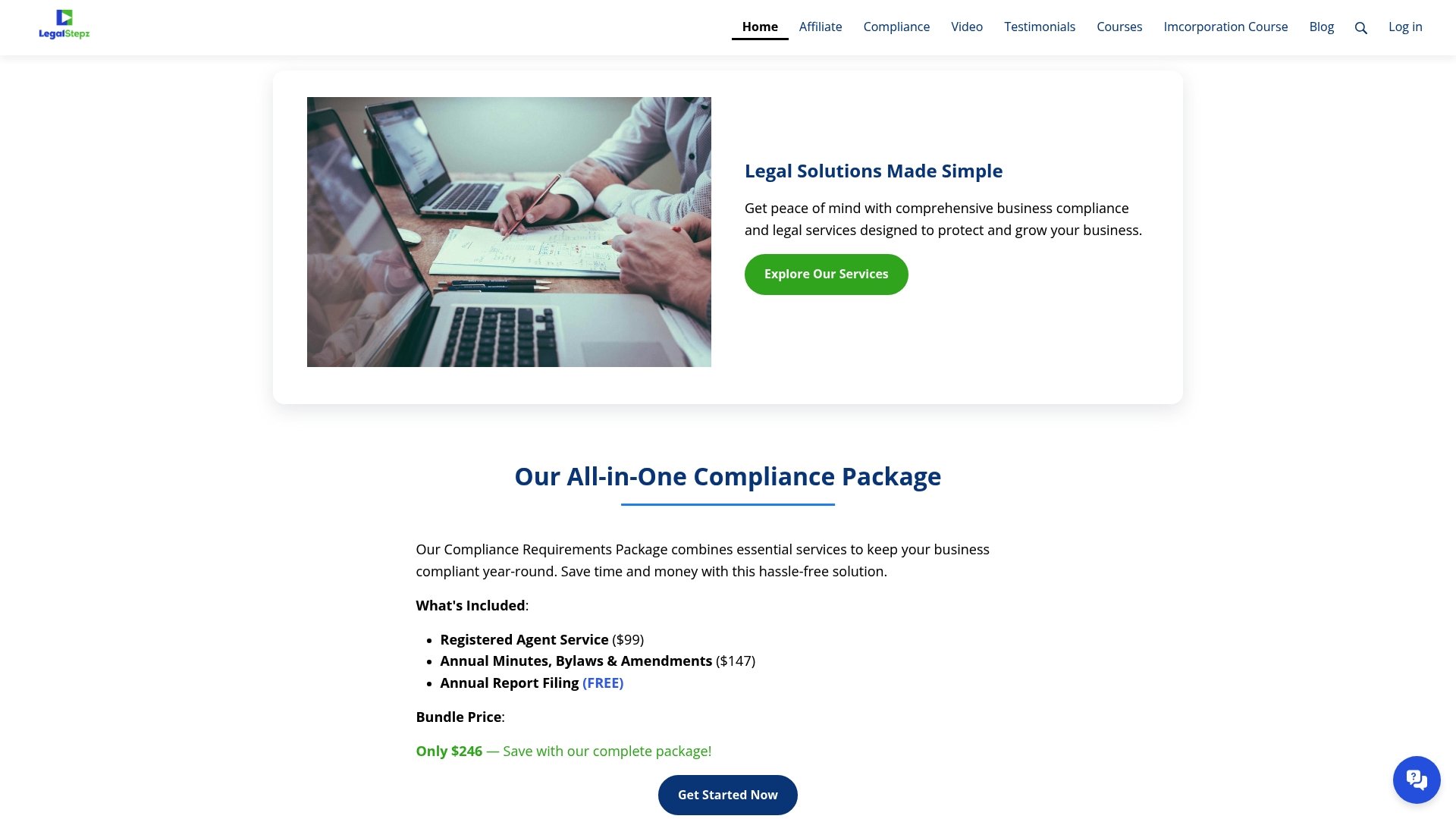
What the packages cover:
- Registered agent + Statement of Information filing: Ideal for California LLCs and corporations that need their annual state filing handled and a reliable registered agent on record
- Annual minutes + bylaws package: For corporations and LLCs preparing for investors or simply maintaining proper governance records
- Full annual compliance bundle: Covers registered agent service, Statement of Information, annual minutes, and document templates, the complete annual compliance checklist in one package
California startups preparing for a seed round or Series A will find the full bundle particularly useful: clean governance records and a current Statement of Information are among the first things investors and their attorneys check.
Get started with Legalstepz to review package options and confirm which filings your California entity needs this year.
Authoritative sources for filing and templates
Use these primary sources to confirm deadlines, fees, and requirements for your specific state and entity type. Requirements change, and the official portals are always more current than any guide.
- U.S. Small Business Administration: Federal compliance overview, including licensing, permits, and employer obligations
- IRS.gov: All federal tax forms, deposit schedules, and employer guidance; search by form number (Form 941, 940, 1120, Schedule C)
- Your state Secretary of State website: Annual report due dates, fees, registered agent requirements, and good-standing certificates; search "[your state] Secretary of State annual report"
- Department of Labor: Required workplace posters and federal employer obligations
- Legalstepz California Statement of Information guide: Step-by-step California filing resources, deadlines, and service options
- Legalstepz California corporation annual report guide: Detailed filing instructions and deadline calendar for California corporations
Always confirm your state-specific deadlines directly on your Secretary of State's portal before filing. State rules change, fees are updated, and online portals reflect those changes faster than any third-party checklist.
This article is general information, not legal or tax advice. Confirm current requirements with your state's Secretary of State, the IRS, and a qualified professional for your specific situation.