

The annual meeting requirement is a legal mandate that corporations hold at least one formal shareholder meeting each year to elect directors and vote on key business matters. California corporations face this obligation under state corporate law, and ignoring it carries real legal consequences. This article explains the core rules, the differences between corporations and LLCs, and the practical steps you need to stay compliant.
What is the annual meeting requirement under California law?
The annual meeting requirement is a statutory obligation for corporations to convene shareholders at regular intervals, typically once per year, to conduct formal governance business. Under California Corporations Code, this means electing the board of directors, presenting financial results, and allowing shareholders to vote on major decisions. Delaware corporate law sets a useful benchmark: corporations must hold meetings within 13 months of the prior meeting. California follows a similar framework, making the 13-month window a practical standard for most corporations operating in the state.
Annual meetings provide transparency through financial presentations, director elections, and shareholder approvals, fulfilling the fiduciary duties that officers and directors owe to shareholders. That last point matters more than most founders realize. The meeting is not just a box to check. It is the mechanism that keeps your corporate structure legally sound and your personal liability protection intact.

What are the specific legal requirements for holding an annual meeting?
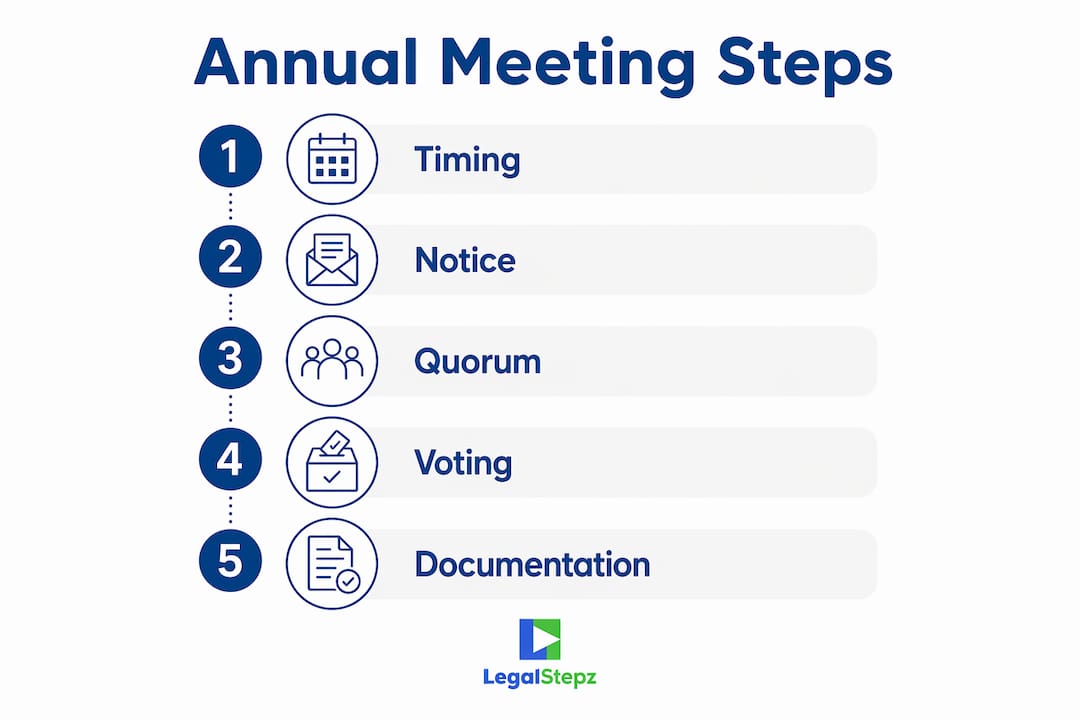
Annual meeting compliance rests on five procedural pillars: timing, notice, quorum, voting, and documentation. Each one has specific rules, and failing any one of them can void the actions taken at the meeting.
Timing and notice
Written notice must specify date, time, and place and must arrive no fewer than 10 days and no more than 60 days before the meeting. That window applies in both California and Delaware. The board must also fix a record date, typically no more than 60 days prior to the meeting, to determine which shareholders are eligible to vote. Missing the record date or sending notice outside the 10 to 60 day window gives shareholders grounds to challenge every vote taken.
Quorum and voting
A quorum generally requires a majority of voting shares present in person or by proxy for meeting actions to be valid. Some bylaws allow a lower threshold, such as one-third of shares, but the bylaws must explicitly state that. Proxy voting lets shareholders participate without attending in person, which is especially useful for small California corporations where shareholders may be spread across the state.
Pro Tip: Review your bylaws before every meeting to confirm the quorum threshold. If your bylaws are stricter than state law, courts will hold you to the bylaw standard, not the statutory minimum.
Documentation requirements
Corporations must prepare a stockholder list available for shareholder inspection at least 10 days before the meeting. Minutes must record every action taken, every vote count, and every resolution passed. Courts void actions taken at meetings if notice requirements are not met or quorum is lacking. Accurate minutes are your defense if a shareholder or creditor ever challenges a board decision.
Key items every annual meeting must address:
- Election or reelection of directors
- Approval of financial statements or auditor selection
- Any shareholder proposals submitted in advance
- Ratification of major actions taken since the last meeting
- Any amendments to bylaws requiring shareholder approval
How do annual meeting requirements differ for corporations vs. LLCs?
California corporations and LLCs operate under fundamentally different rules when it comes to annual meetings. Understanding that difference protects you from assuming your LLC has the same obligations as a corporation.
| Factor | Corporation | LLC |
|---|---|---|
| Legal source | California Corporations Code | Operating Agreement or Articles |
| Annual meeting required? | Yes, by statute | Only if Operating Agreement requires it |
| Failure consequences | Shareholder petition, veil piercing risk | Loss of liability protection if formalities ignored |
| Quorum rules | Set by statute and bylaws | Set by Operating Agreement |
| Minutes required? | Yes, mandatory | Recommended; required if Agreement says so |
| Can meeting be waived? | Only by written consent of all shareholders | Yes, if Operating Agreement permits |
LLCs often have annual meeting provisions written into their Operating Agreements, and failure to comply with those provisions can jeopardize liability protection. That is the critical point most LLC owners miss. The statutory mandate does not apply to LLCs the same way it does to corporations, but the Operating Agreement creates its own binding obligations.
In California, failure to observe annual meeting formalities can compromise legal protections for business owners and expose them to personal liability. For LLCs, the risk is not a court-ordered meeting. The risk is a creditor arguing that you ignored your own governance documents and therefore the LLC's liability shield should not apply to you. See the differences between incorporation and LLC for a deeper breakdown of how these entity types compare on governance obligations.
How to hold an annual meeting: practical steps for California owners
Following the annual meeting process correctly is not complicated, but it requires planning. Most compliance failures happen because business owners treat the meeting as an afterthought rather than a scheduled governance event.
-
Set the date early. Schedule your annual meeting at least 60 days in advance. This gives you time to fix the record date, prepare the stockholder list, and send proper notice within the required window.
-
Send written notice on time. Notice must go out no fewer than 10 days and no more than 60 days before the meeting. Include the date, time, location or virtual link, and a clear agenda. Electronic notice is valid in California if shareholders have consented to it.
-
Prepare the stockholder list. The list must be available for shareholder inspection at least 10 days before the meeting. Keep it current and accurate.
-
Confirm quorum before the meeting opens. Count shares represented in person and by proxy. Do not open the meeting to formal business until you have confirmed quorum is met.
-
Follow conduct guidelines. Clear conduct guidelines prevent meeting mismanagement and keep discussions productive. Distribute a written agenda and appoint a meeting chair who can keep the session on track.
-
Record accurate minutes. Document every vote, every resolution, and every significant discussion point. Minutes should be signed by the corporate secretary and stored with your other corporate records.
-
Consider written consents when appropriate. California law allows shareholders to act by written consent instead of holding a physical meeting in some circumstances. Check your bylaws and confirm all shareholders agree before using this option.
Pro Tip: Store your annual meeting minutes alongside your bylaws and articles of incorporation. If you ever face a legal challenge or due diligence review during a sale, having organized records from day one saves significant time and legal fees.
The annual requirements to maintain limited liability go beyond just holding a meeting. Filing your Statement of Information with the California Secretary of State is a parallel obligation that many owners overlook until they receive a penalty notice.
What are the legal risks of skipping annual meetings?
Skipping annual meetings is not a minor oversight. The legal and financial consequences are real and can compound over time.
"Missed annual meetings alone don't dissolve companies but create legal exposure potentially damaging to investors and business reputation." — legalclarity.org
The most serious risks include:
- Court-ordered meetings. Companies that do not hold annual meetings risk court orders forcing meetings at legal cost and damage to reputation. Any shareholder can petition a California court to compel a meeting.
- Piercing the corporate veil. Failure to hold meetings or follow formalities could allow creditors to pierce the corporate veil and hold owners personally liable. This means your personal assets become fair game for business debts.
- Voided corporate actions. Any vote or resolution passed without proper notice or quorum can be challenged and voided. That includes director elections, major contracts ratified by the board, and equity issuances.
- Governance reputation damage. Investors and lenders review corporate records during due diligence. Gaps in meeting minutes signal poor governance and can kill financing rounds or acquisition deals.
Failure to hold annual meetings is rarely the sole cause for piercing the corporate veil, but it is a key factor in a broader pattern of misuse. Courts look at the totality of governance behavior. Missing meetings repeatedly, combined with commingling personal and business funds, creates a strong case for personal liability.
Key takeaways
Annual meeting compliance protects your liability shield, validates corporate actions, and keeps shareholders informed. Skipping even one meeting creates legal exposure that compounds over time.
| Point | Details |
|---|---|
| Timing rule | Hold your annual meeting within 13 months of the prior meeting to stay compliant. |
| Notice window | Send written notice no fewer than 10 and no more than 60 days before the meeting date. |
| Quorum is mandatory | A majority of voting shares must be present or represented by proxy for actions to be valid. |
| LLCs face different rules | LLC meeting obligations come from the Operating Agreement, not state statute, but noncompliance still risks liability. |
| Missing meetings has costs | Courts can order meetings, void corporate actions, and creditors can use gaps to pierce your liability shield. |
Why annual meetings deserve more than a checkbox mentality
Most California entrepreneurs I work with treat the annual meeting as paperwork. They schedule it at the last minute, write thin minutes, and move on. That approach works until it does not.
The annual meeting is the one moment each year when your corporate structure proves it is real. Courts and creditors look at whether you actually ran your company as a separate legal entity. A well-documented meeting record is concrete evidence that you did. A missing or sloppy one is evidence that you did not.
The part that surprises most founders is how much the meeting agenda matters. Corporations that use their annual meeting to review financial performance, address shareholder concerns, and formally ratify major decisions build a governance record that protects them for years. Those that treat it as a formality create a paper trail of minimal effort that looks exactly like what it is.
Consistency in adhering to bylaws, even if stricter than state law, prevents litigation and voided meeting actions. That is not legal theory. That is what I have seen play out when companies face investor disputes or acquisition due diligence. The ones with clean records close deals. The others spend months and legal fees cleaning up gaps that should never have existed.
— Peter
How Legalstepz helps California entrepreneurs stay compliant
Annual meeting compliance is one piece of a larger governance picture that California corporations must maintain every year.

Legalstepz offers an incorporation course built specifically for California entrepreneurs who want to understand and manage their corporate formalities without relying entirely on outside counsel for every step. The course covers annual meeting procedures, bylaws, minutes drafting, and the Statement of Information filing that runs parallel to your meeting obligations. Legalstepz also provides registered agent services and annual minutes drafting so your records stay current and defensible. If you want your corporate structure to actually protect you, the right time to get organized is before a problem appears.
FAQ
What is the annual meeting requirement for California corporations?
California corporations must hold at least one shareholder meeting per year to elect directors and conduct formal governance business. Notice must be sent 10 to 60 days before the meeting, and a quorum of shareholders must be present or represented by proxy.
Do LLCs in California have to hold annual meetings?
California LLCs are not required by statute to hold annual meetings, but they must follow whatever their Operating Agreement requires. Ignoring those provisions can compromise the LLC's liability protection.
What happens if a corporation skips its annual meeting?
Any shareholder can petition a California court to order a meeting, and the corporation may face legal costs and reputational damage. Repeated noncompliance also strengthens creditor arguments for piercing the corporate veil.
What must be included in an annual meeting notice?
The notice must state the date, time, and place of the meeting and must be delivered no fewer than 10 and no more than 60 days before the meeting date.
Can shareholders act without holding a physical annual meeting?
Yes. California law allows shareholders to act by written consent in lieu of a meeting, provided the bylaws permit it and all required shareholders sign the consent document.