

Annual meeting minutes are the official written record of a corporation's key governance decisions, and California law treats them as mandatory proof that your business operates as a separate legal entity. Every California corporation, from a solo-founder S-Corp to a multi-shareholder C-Corp, must maintain these records under California Corporations Code § 1500. The annual minutes purpose explained simply: they protect you from personal liability, satisfy the IRS, and demonstrate that your corporation is real, governed, and compliant. Skip them, and you risk losing the legal protections that made you incorporate in the first place.
What are annual minutes and why are they required in California?
Annual minutes, formally called annual meeting minutes, are the documented record of decisions made at a corporation's yearly shareholder and board of directors meetings. They are not optional paperwork. California Corporations Code § 1500 mandates that every corporation maintain written minutes of shareholder and board proceedings to preserve the corporation's independent legal status. This requirement exists because courts use these records to determine whether a corporation is genuinely separate from its owners.
The purpose of annual minutes goes beyond satisfying a filing checklist. They serve as the primary evidence that your corporation holds formal governance meetings, elects officers, reviews finances, and makes decisions through proper channels rather than through informal personal decisions. Without them, a creditor or opposing attorney can argue that your corporation is simply an extension of you personally, a legal theory called "alter ego." If a court agrees, your personal assets become fair game for business debts.

Annual minutes differ from minutes of special or emergency meetings in one critical way. Annual board meeting minutes receive greater scrutiny than routine meeting minutes because they document elections, financial reviews, and major governance decisions. Auditors, lenders, and regulators all expect these records to be precise and thorough.
Here is what annual minutes typically cover that distinguishes them from other corporate records:
- Election or reaffirmation of corporate officers and directors
- Review and approval of the prior year's financial statements
- Ratification of major contracts or business decisions made during the year
- Confirmation of the corporation's registered agent and principal address
- Any resolutions affecting equity, compensation, or corporate structure
What key elements should be included in annual meeting minutes?
Legally valid minutes must include meeting logistics, attendance, quorum confirmation, motions, voting records, and formal approval. Each element serves a specific purpose. Meeting logistics establish that proper notice was given. Attendance and quorum records confirm the meeting had legal authority to act. Voting records prove that decisions were made by the right people in the right way.
A well-drafted set of annual minutes follows a consistent structure. Here is the sequence that satisfies both California requirements and best practices for meeting minutes:
- Meeting header: Full legal name of the corporation, type of meeting (annual shareholder or annual board), date, time, and location or virtual platform used.
- Notice confirmation: Statement that proper written notice was provided, noting that corporations must provide written notice 10 to 60 days before the meeting.
- Attendance and quorum: Names of all directors, officers, and shareholders present, with a clear statement that quorum was achieved.
- Approval of prior minutes: Motion to approve the minutes from the previous annual meeting, with vote recorded.
- Officer elections: Names of individuals elected or reaffirmed to each officer role, with vote counts.
- Financial review: Summary of the financial report presented and any resolutions approving it.
- Resolutions: Each formal resolution stated clearly, with the motion maker, seconder, and vote outcome recorded.
- Adjournment: Time the meeting ended and signature of the corporate secretary.
Pro Tip: Use a consent agenda for routine items like approving prior minutes or reaffirming standard officer roles. A consent agenda can save 20 to 30 minutes during preparation and keeps your annual meeting focused on substantive decisions.
One detail many California business owners miss: even if your corporation has one person holding every role, you still need separate documentation for the shareholder meeting and the board of directors meeting. Single-member corporations must hold and document both meetings annually to maintain legal protections. Writing one combined document that blurs the two roles is a compliance error that can undermine your corporate veil.
How do annual minutes protect the corporate veil and support IRS compliance?
The corporate veil is the legal boundary between your personal finances and your corporation's liabilities. Annual meeting documentation is the most direct way to prove that boundary is real. Failure to keep formal minutes is a primary trigger in California for alter ego claims, which can expose owners to personal liability by piercing that veil. A judge evaluating an alter ego claim will look specifically for evidence of formal governance. Minutes are that evidence.
For S-Corporations, the stakes are even higher because the IRS adds a layer of scrutiny beyond state law. Minutes are essential to demonstrate tax compliance for S-Corporations, specifically regarding officer compensation and distributions under Subchapter S rules. If your S-Corp pays you a below-market salary while distributing large profits, the IRS will look for documented board resolutions justifying that compensation structure. Without minutes, you have no defense.
Courts have consistently found that a corporation without formal meeting records looks, in practice, like a sole proprietorship. That perception is the foundation of every successful alter ego claim. If you want the liability shield, you have to act like a corporation, and acting like one means documenting that you govern like one.
The importance of meeting minutes extends to situations beyond the annual meeting itself. Major decisions made throughout the year, such as taking on significant debt, entering a major contract, or changing officer compensation, should each be documented in a special meeting or written consent resolution. Lack of minutes is a red flag that can lead to personal liability for business debts, and that risk applies to every undocumented decision, not just the annual ones.
Best practices for drafting, approving, and storing annual minutes in 2026
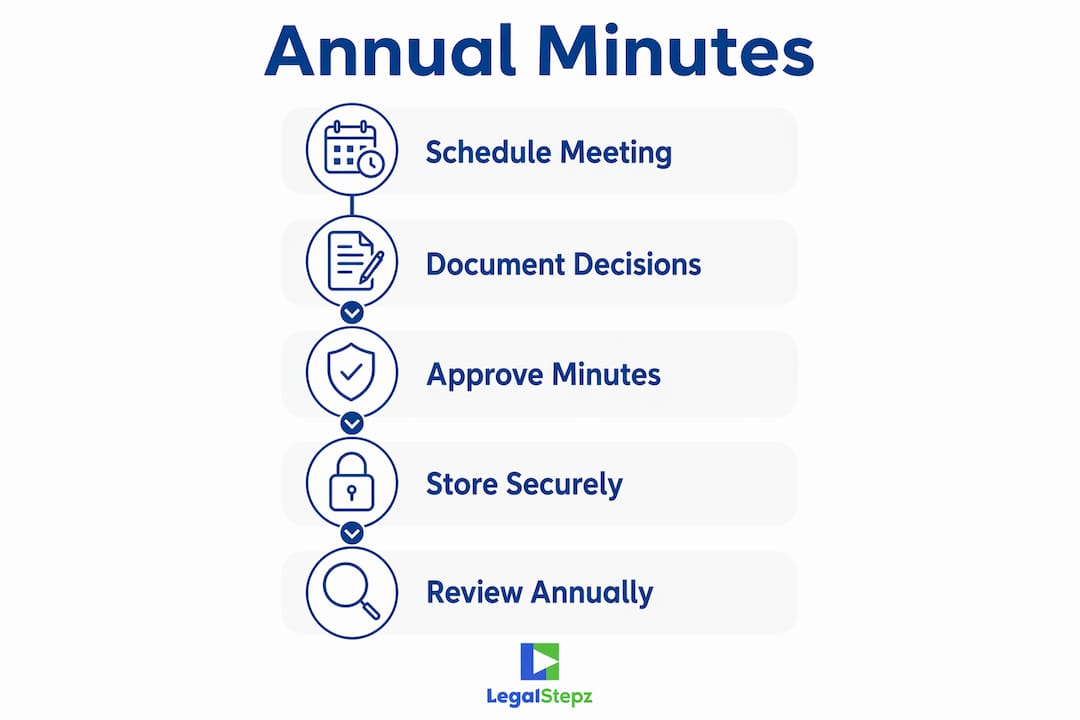
The standard for annual meeting documentation has evolved. Digital tools now make drafting faster, but the legal responsibility has not shifted. Technology and AI tools can accelerate the draft process for minutes, but final legal responsibility remains with the corporate secretary to ensure accuracy. Using an AI tool to generate a first draft is acceptable. Signing off on that draft without reviewing it for accuracy is not.
The table below compares common approaches to drafting and storing annual minutes:
| Approach | Strengths | Risks |
|---|---|---|
| Manual drafting by corporate secretary | Full control, high accuracy | Time-intensive, prone to delay |
| AI-assisted drafting with human review | Fast, consistent structure | Requires careful accuracy check before approval |
| Attorney-prepared minutes | Legally precise, defensible | Higher cost, less practical for routine years |
| Digital storage with version control | Organized, audit-ready | Requires consistent naming and backup protocols |
Corporate minutes should be drafted within 48 to 72 hours of the meeting to preserve accuracy. Waiting weeks after the meeting introduces errors and creates questions about whether the record reflects what actually happened. Once drafted, minutes should be circulated to all directors for review before formal approval at the next meeting.
Pro Tip: Store your annual minutes in a dedicated corporate records folder, either physical or digital, alongside your bylaws, articles of incorporation, and annual compliance filings. Auditors and lenders expect to see a complete, organized corporate records book, not scattered documents across email threads.
Avoid these common mistakes that California corporations make with their annual minutes requirements:
- Skipping quorum documentation, which invalidates the meeting's authority to act
- Combining shareholder and director meeting minutes into a single undifferentiated document
- Recording decisions without noting the specific vote count or unanimous consent
- Failing to have minutes formally approved at the subsequent meeting
- Storing minutes only in personal email rather than in a secured, backed-up corporate records system
Key takeaways
Annual meeting minutes are a legal requirement under California Corporations Code § 1500, and they serve as the primary evidence protecting your corporate veil, satisfying IRS scrutiny, and documenting governance decisions that define your corporation's legal standing.
| Point | Details |
|---|---|
| Legal mandate in California | California Corporations Code § 1500 requires written minutes of all shareholder and board proceedings. |
| Corporate veil protection | Minutes prove your corporation operates separately from you personally, blocking alter ego claims. |
| S-Corp IRS compliance | Documented resolutions on officer compensation and distributions are required under Subchapter S rules. |
| Required content | Every set of minutes must include logistics, quorum, motions, votes, and formal approval to be valid. |
| Drafting best practice | Draft within 48 to 72 hours of the meeting and store in an organized, dedicated corporate records system. |
Why California entrepreneurs underestimate annual minutes at their peril
I have reviewed corporate records for dozens of California small business owners over the years, and the pattern is almost always the same. The founder incorporated, felt the relief of having an LLC or S-Corp, and then quietly stopped treating the corporation like a separate entity. No annual meetings. No minutes. Sometimes no separate bank account. They assumed the paperwork was a formality.
It is not a formality. It is the mechanism by which the law recognizes your corporation as real. I have seen single-owner S-Corps lose their liability protection in disputes because they could not produce a single year of meeting records. The opposing attorney did not need to prove fraud. They just needed to show the corporation was never actually governed as one.
The entrepreneurs who get this right treat annual minutes the way they treat tax filings: non-negotiable, calendared in advance, and handled with care. They also understand that the annual meeting is not just a compliance checkbox. It is a structured moment to review the business, confirm leadership, and make formal decisions that will hold up under scrutiny. That discipline, practiced consistently, is what separates a corporation that protects you from one that only looks like it does.
If you are a solo founder, do not let the fact that you are the only person in the room make you casual about the process. Write the minutes. Record the votes. Sign the documents. Your future self, facing an audit or a lawsuit, will be grateful you did.
— Peter
Get your corporate compliance right with Legalstepz
California corporations that skip annual minutes are one lawsuit or IRS audit away from losing the protections they paid to create. Legalstepz offers structured resources to help you stay compliant without the confusion.

The Legalstepz Incorporation Course covers the full lifecycle of corporate governance, including how to draft annual minutes, structure your corporate records, and meet California's ongoing compliance requirements. For business owners operating as an LLC, the Limited Liability Company Course addresses record-keeping obligations specific to that structure. Both courses are built for California entrepreneurs who want to protect their liability shield without hiring a full-time attorney for every routine compliance task.
FAQ
What is the purpose of annual minutes for a corporation?
Annual minutes document the key governance decisions made at a corporation's yearly meetings, including officer elections, financial reviews, and major resolutions. They serve as legal proof that the corporation operates as a separate entity, which is required to maintain liability protection under California law.
Are annual minutes legally required in California?
Yes. California Corporations Code § 1500 requires every corporation to maintain written minutes of shareholder and board proceedings. Failure to do so is one of the primary triggers for alter ego claims that can pierce the corporate veil.
What happens if a California corporation skips annual minutes?
A corporation without annual meeting documentation risks having a court treat it as an extension of its owner rather than a separate legal entity. This exposes the owner to personal liability for corporate debts and can also invite IRS scrutiny, particularly for S-Corporations.
Do single-owner corporations need annual minutes?
Yes. Even single-member corporations must hold and document separate shareholder and director meetings annually. Holding all roles yourself does not eliminate the requirement. It makes consistent documentation more important, not less.
How soon after a meeting should minutes be drafted?
Minutes should be drafted within 48 to 72 hours of the meeting to preserve accuracy. They should then be circulated for review and formally approved at the next scheduled meeting to complete the record.