

The official form for California Articles of Incorporation is available free at the California Secretary of State's forms index and through BizFileOnline, the SOS online filing portal. BizFileOnline is the fastest path: you submit, pay the $100 filing fee, and the SOS processes your filing without a trip to Sacramento.
Before you open the form, run through these five steps:
- Check your corporate name using the SOS business entity search to confirm availability.
- Pick the right entity type and form (general stock, nonprofit, professional, benefit, or close corporation).
- Fill every required field — corporate name, purpose clause, authorized shares, agent for service of process, and incorporator signature.
- Choose your filing method — online via BizFileOnline, by mail, or in-person drop-off in Sacramento.
- Pay the filing fee ($100 base; $15 extra for in-person special handling).
The sections below walk through each step in detail, including exact form names, required wording, fees, timelines, and what to do the week after your filing is accepted.
Table of Contents
- What are articles of incorporation, and how do they differ from bylaws?
- What must California articles of incorporation include?
- Which SOS form do you use for your corporation type?
- How do you file articles of incorporation in California?
- What are the filing fees and how long does processing take?
- How do you check and reserve a corporate name in California?
- What do you need to do right after your articles are accepted?
- Why does the SOS reject articles of incorporation, and how do you fix it?
- Where do you download official forms and sample completed articles?
- How Legalstepz helps with California incorporation
- Key Takeaways
- The case for incorporating in California from the start
- Legalstepz: California incorporation and compliance, handled
- Useful sources and official references
What are articles of incorporation, and how do they differ from bylaws?
Articles of Incorporation are the document that legally creates your corporation under California law. The moment the Secretary of State accepts and files them, your corporation exists as a legal entity. Nothing else does that job.
Bylaws are different. They are an internal governance document that sets the rules for how your corporation operates: how directors are elected, how meetings are called, what officers do. Bylaws are not filed with the SOS; they are adopted by the board at the initial organizational meeting and kept in your corporate records book.
The Statement of Information is a third, separate document. California requires corporations to file it with the SOS within 90 days of incorporation and then every year after that. It updates the state on your officers, directors, and agent for service of process. Think of it as your annual check-in with the state, while the Articles are your birth certificate.
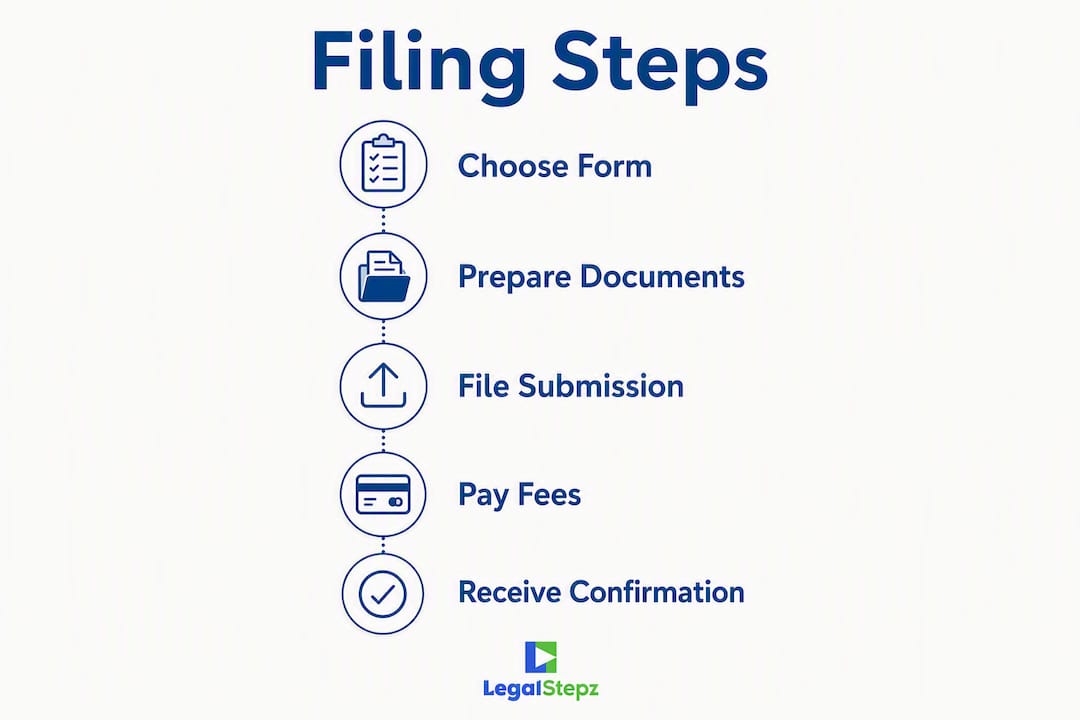
You need all three, but you file only the Articles to create the corporation. Bylaws and the Statement of Information come next.
What must California articles of incorporation include?
California Corporations Code §202 sets out the mandatory fields for a domestic general stock corporation. Miss any one of them and the SOS will reject your filing.
The required fields are:
- Corporate name — must include a required designator (Corporation, Corp., Incorporated, Inc., or Limited) and must be distinguishable from existing California entities.
- Purpose clause — for a general stock corporation, the prescribed statutory language is: "The purpose of this corporation is to engage in any lawful act or activity for which a corporation may be organized under the General Corporation Law of California other than the banking business, the trust company business or the practice of a profession permitted to be incorporated by the California Corporations Code." Use this exact wording. Do not paraphrase it.
- Authorized shares — state the total number of shares the corporation is authorized to issue. There is no minimum, but most small corporations authorize between 1,000 and 10,000,000 shares. One share is technically sufficient.
- Initial agent for service of process — the person or registered agent company designated to receive legal documents on behalf of the corporation. You must provide a California street address; P.O. Boxes are not acceptable for an individual agent.
- Incorporator signature — at least one incorporator must sign and date the document.
Optional but common additions include the names of initial directors, par value of shares, and any additional provisions limiting or expanding director liability.
Pro Tip: If you name an individual as your agent (rather than a registered agent company), that person must have a physical California street address listed on the form. The moment that person moves or becomes unavailable, you need to update the agent on file immediately. A missed service of process because your agent address is stale can have serious legal consequences. See why corporations update their agent of service for the full picture.

Which SOS form do you use for your corporation type?
The California Secretary of State publishes separate Articles of Incorporation forms for each corporation type. Filing the wrong one wastes your $100 fee and delays your formation.
General stock corporation
This is the default for most for-profit businesses. The form is commonly labeled Articles of Incorporation — General Stock (Form ARTS-GS). Download it from the SOS forms index or file directly through BizFileOnline.
Nonprofit corporation
California has three nonprofit subtypes: public benefit, mutual benefit, and religious. Each uses a different form variant. The purpose clause language also differs from the general stock version, so do not borrow wording across form types.
Professional corporation
Licensed professionals — doctors, attorneys, CPAs, dentists, architects, and others regulated by a California licensing board — must form a California professional corporation. Forming in Delaware or Wyoming does not satisfy California's professional practice rules. The professional corporation form (commonly ARTS-PC) requires additional language identifying the licensed profession. For a detailed breakdown, the California Professional Corporation guide covers the licensing board requirements and form-specific differences.
Benefit corporation
A benefit corporation is a for-profit entity that also pursues a general public benefit. It uses a distinct form with specific purpose language that must reference the public benefit purpose. The California Benefit Corporation guide explains what that purpose language must say and how it differs from a standard general stock filing.
Close corporation
A close corporation limits shareholders to 35 or fewer and operates under a shareholders' agreement rather than a traditional board structure. It uses its own form variant (ARTS-CL). Close corporations are relatively rare today; most small businesses with few shareholders simply use a general stock corporation with a shareholder agreement.
To confirm the correct form: go to the SOS forms index or the BizFileOnline forms area, filter by "Corporations," and match your entity type to the listed form. The form name and number appear on the download page.
How do you file articles of incorporation in California?
Three methods: online through BizFileOnline, by mail, or in-person drop-off in Sacramento. Online is faster and easier for most filers.
Online via BizFileOnline (recommended)
- Go to BizFileOnline and select "Domestic Corporation."
- Choose the correct corporation type and open the online form.
- Complete all required fields directly in the portal.
- Review the completed form for accuracy, especially the agent address and purpose clause.
- Pay the $100 filing fee by credit card.
- Submit. The SOS assigns a file date based on the date of receipt.
BizFileOnline processes filings faster than mail and gives you a confirmation number immediately. You can also request expedited processing through the portal for an additional fee.
By mail
- Download the correct form from the SOS forms index and complete it by hand or in a word processor using dark, legible type.
- Print the form, sign it, and make a copy for your records.
- Include a check or money order for $100 payable to the Secretary of State.
- Mail to: Secretary of State, Business Entities, P.O. Box 944260, Sacramento, CA 94244-2600.
- If requesting expedited processing, include the additional fee and a cover letter specifying the service level.
Mail processing takes longer than online filing. Standard mail turnaround varies; check the SOS current processing times page before you mail.
In-person drop-off (Sacramento)
- Bring the completed, signed form and payment to the SOS Sacramento office at 1500 11th Street, Sacramento, CA 95814.
- Pay the $100 filing fee plus a $15 special handling fee for in-person drop-off.
- Request a file-stamped copy if you need one for your records.
Note: some regional SOS offices accept drop-offs but cannot process mailed expedited fees. If you need expedited service, confirm the office's specific rules before you go.
Pro Tip: The SOS determines your corporation's official "file date" as the date the filing is received, not the date it is processed. If you mail a filing and it sits in a queue, your legal formation date is still the receipt date. For time-sensitive situations (end-of-year tax planning, for example), online filing gives you the most control over that date.
What are the filing fees and how long does processing take?
Filing fees
There is a base filing fee for Articles of Incorporation, and in-person drop-off at the Sacramento office incurs a special handling fee. Expedited processing carries additional fees on top of the base amount; the SOS publishes the current expedited fee schedule on its processing times page.
| Filing method | Base fee | Additional fee | Notes |
|---|---|---|---|
| Online (BizFileOnline) | $100 | Expedited fee (varies) | Fastest; credit card payment |
| $100 | Expedited fee (varies) | Check or money order | |
| In-person (Sacramento) | $100 | $15 special handling | Drop-off only at some offices |
California imposes a minimum annual franchise tax on corporations.
Beyond the SOS filing fee, California imposes an $800 minimum annual franchise tax on corporations. This applies to newly formed California corporations and to any out-of-state entity that is "doing business" in California. The tax is paid to the Franchise Tax Board, not the Secretary of State, and it is separate from your federal and state income tax filings.
If you form a corporation in Delaware or Wyoming but operate primarily in California, California will still treat you as doing business here and require both foreign registration and the $800 franchise tax. That means you pay fees in two states instead of one.
The first-year exemption that once applied to newly formed California corporations was eliminated; new corporations are generally liable for the franchise tax from their first year. Confirm the current rules directly with the California Franchise Tax Board before filing, since tax rules can change.
How do you check and reserve a corporate name in California?
Name problems are the most common reason the SOS rejects a filing. A quick search before you pay the fee takes five minutes and can save weeks of delay.
Use the SOS business entity search to check whether your proposed name is already in use. The SOS requires your corporate name to be "distinguishable" from existing California entities. Similar names that could cause confusion will be rejected.
Naming rules to know:
- Your name must include a required designator: Corporation, Corp., Incorporated, Inc., or Limited.
- Certain words are prohibited or restricted without special approval: "bank," "trust," "insurance," and similar regulated terms require additional documentation.
- Avoid names that are identical or nearly identical to existing entities, even if the business type differs.
Name availability and required designators are the two most common rejection triggers, so treat the name search as a non-negotiable first step.
If you want to lock in a name before you are ready to file, you can reserve it with the SOS for 60 days by filing a Name Reservation Request (Form NR) and paying a small reservation fee. For most filers who are ready to file immediately, a reservation is not necessary — just run the search and file.
What do you need to do right after your articles are accepted?
Filing the Articles creates the corporation. What you do in the next 90 days determines whether it stays in good standing.
- Statement of Information: California corporations must file a Statement of Information with the SOS within 90 days of incorporation and annually after that. The filing fee is $25. Missing this deadline puts your corporation at risk of suspension. Full requirements are covered in the California Statement of Information guide.
- Adopt bylaws: — The board of directors should adopt corporate bylaws at the initial organizational meeting. Bylaws are not filed with the SOS, but they are legally required and govern how your corporation operates.
- Apply for an EIN: An Employer Identification Number from the IRS is required to open a business bank account, hire employees, and file federal taxes. Apply free at IRS.gov — the online application takes about 10 minutes and issues the EIN immediately.
Pro Tip: The California Corporation Annual Report Requirements guide lays out the full ongoing compliance calendar, including Statement of Information deadlines and franchise tax due dates. Bookmark it before your first anniversary.
Why does the SOS reject articles of incorporation, and how do you fix it?
Most rejections are preventable. The SOS will return your filing with a rejection notice explaining the specific problem.
- Omitted mandatory fields: — Any required field left blank — authorized shares, purpose clause, incorporator signature — will cause rejection. Fix: use the SOS sample form as a checklist and verify every field before submitting.
- Unsigned or improperly signed document: — The incorporator must sign the document. A typed name without a signature, or a signature from someone other than the incorporator, is not acceptable. Fix: have the incorporator physically sign (or use the electronic signature process in BizFileOnline).
If you are unsure whether your draft will be accepted, the SOS offers a preclearance process for certain filings. You can also contact the SOS Business Entities filing support line for guidance before you submit. The SOS contact information and form-specific instructions are available on the SOS forms index page.
Where do you download official forms and sample completed articles?
The two places to get official California Articles of Incorporation forms are:
- SOS Forms, Samples and Fees page: Lists every form by entity type, with PDF downloads and links to sample completed forms. This is the authoritative source.
- BizFileOnline forms area: Provides the online versions of the same forms for direct electronic filing.
Common form names to look for:
| Form name | Corporation type |
|---|---|
| ARTS-GS (Articles of Incorporation — General Stock) | For-profit general stock corporation |
| ARTS-PC (Articles of Incorporation — Professional) | Licensed professional corporation |
| ARTS-CL (Articles of Incorporation — Close) | Close corporation |
| ARTS-NP (Articles of Incorporation — Nonprofit) | Nonprofit (public benefit, mutual benefit, religious) |
| ARTS-BC (Articles of Incorporation — Benefit) | Benefit corporation |
Download the sample completed form alongside the blank form. The sample shows you exactly how to format the purpose clause, how to list the agent address, and where the incorporator signs. The SOS requires dark, legible typed text; handwritten forms are generally not accepted for mail filings.
Per the SOS sample and instructions, the document must be reproducible (no dark backgrounds, no colored paper), and signatures must be original or comply with the electronic signature requirements for BizFileOnline submissions.
How Legalstepz helps with California incorporation
Legalstepz offers a practical set of services built specifically for California corporations and entrepreneurs who want to get formation right without hiring a full-service law firm.
What Legalstepz provides:
- Form preparation: Assistance preparing Articles of Incorporation using attorney-reviewed templates aligned with California Corporations Code requirements.
- Statement of Information filing: Legalstepz handles the initial and annual Statement of Information filings so you never miss a deadline.
- Registered agent services: Legalstepz acts as your registered agent for service of process, providing a reliable California address and forwarding legal documents promptly.
- Bylaws drafting: Customized corporate bylaws drafted to match your corporation's structure and officer roles.
- Incorporation course: A step-by-step online course covering California LLC and corporation formation, designed for entrepreneurs who want to understand the process and handle filings themselves.
For California entrepreneurs who want a handled filing with compliance built in from day one, Legalstepz is a direct alternative to piecing together the process yourself. Visit legalstepz.com to review service options and get started.
This article provides general information, not legal advice. Confirm current fees, processing times, and tax rules with the California Secretary of State and the Franchise Tax Board, or consult a qualified attorney for your specific situation.
Key Takeaways
Filing California Articles of Incorporation requires the correct SOS form, exact statutory wording, a valid California agent address, and a $100 filing fee — with BizFileOnline as the fastest submission method.
| Point | Details |
|---|---|
| Use the official SOS form | Download from the SOS forms index or file directly through BizFileOnline; match the form to your corporation type. |
| Five mandatory fields | Corporate name, purpose clause (exact statutory wording), authorized shares, agent address, and incorporator signature are all required. |
| Filing fee is $100 | Base fee is $100; in-person drop-off adds a $15 special handling fee; expedited fees vary. |
| $800 franchise tax applies | California's minimum annual franchise tax of $800 applies to new corporations from the first year, paid to the Franchise Tax Board. |
| Legalstepz handles the process | Legalstepz offers form preparation, registered agent services, Statement of Information filing, and bylaws drafting for California corporations. |
The case for incorporating in California from the start
Most of the advice pushing California founders toward Delaware is written for a very specific founder: one who is already in conversations with institutional venture capital and needs Delaware's Court of Chancery and its well-tested governance frameworks. That describes a small fraction of the people actually filing Articles of Incorporation in California.
For the majority — a local service business, a consulting firm, a small product company, a licensed professional — incorporating in California is administratively simpler and cheaper than forming out-of-state and then foreign qualifying in California. You avoid dual registration fees, dual annual reports, and the complexity of maintaining a registered agent in two states. The $800 franchise tax applies either way the moment you are doing business here, so forming in Delaware does not let you escape it.
The professional corporation situation is even clearer. Licensed professionals in California must form a California professional corporation regardless of what any Delaware formation guide says. There is no workaround.
The "start in California, redomesticate later" path is genuinely sensible for founders who might eventually seek institutional capital. Form a California corporation now, validate your business, and if the day comes when a Series A investor requires Delaware governance, redomesticate then. Redomestication typically costs several thousand dollars in legal fees, but you pay that cost only if and when it is actually necessary. Optimizing for investors who do not yet exist is a real cost with an uncertain payoff.
The $800 franchise tax is real and worth planning for. But it is a cost of doing business in California, not a reason to add compliance complexity before you have revenue.
Legalstepz: California incorporation and compliance, handled
Filing Articles of Incorporation yourself is doable. Staying compliant after filing — Statement of Information deadlines, registered agent updates, annual minutes, bylaws on file — is where most small California corporations quietly fall behind.
Legalstepz is built for California entrepreneurs who want formation done correctly from day one and compliance handled on an ongoing basis. The services include Articles of Incorporation preparation using attorney-reviewed templates, registered agent coverage, Statement of Information filings, and corporate bylaws drafting. There is also a step-by-step incorporation course for founders who prefer to own the process themselves.
No retainer, no law firm billing rates. Legalstepz offers transactional packages so you pay for what you need. Visit legalstepz.com to see current service options and get your California corporation started today.
Legalstepz provides document preparation and compliance services, not legal advice. Attorney-reviewed templates are used where indicated.
Useful sources and official references
Use these links to verify current fees, processing times, and form requirements directly with the primary sources before you file.
- California Secretary of State — Forms, Samples and Fees: The official source for all Articles of Incorporation forms, sample completed PDFs, and current filing fees. Start here.
- BizFileOnline — Business Forms: The SOS online filing portal for submitting Articles of Incorporation and other business entity documents electronically.
- BizFileOnline — Business Entity Search: Run your corporate name availability search here before preparing your filing.
- California SOS — Processing Times: Check current standard and expedited processing times before choosing your filing method.
- California Corporations Code §202: The statutory authority for required Articles of Incorporation contents, including the prescribed purpose clause.
- California Franchise Tax Board: Covers the $800 minimum franchise tax, first-year rules, and how to file. Confirm current rules here before your first tax year.
Fees and processing times change. Always confirm the current amounts on the SOS and Franchise Tax Board pages before you submit your filing. If you prefer a handled filing, contact Legalstepz for current service options.