

California law requires every corporation to authorize at least one share in its Articles of Incorporation, and there's no statutory ceiling on how many you can name. For most founders, the practical move is authorizing a comfortable buffer, often in the millions, so you don't refile every time you hire or raise money. If you already picked a number and need to change it, the amendment process further down covers exactly what that takes.
TL;DR:
- Most startups should authorize between one to ten million shares at formation to allow for future hiring and fundraising without frequent amendments.
- Authorized shares serve as a legal ceiling, with the number in your Articles of Incorporation, and can be increased through a formal amendment process involving board and shareholder approval.
- Creating more than one class of stock or modifying stock rights requires additional documentation and must comply with California law, especially for S corporations with restrictions on stock classes.
- Setting a low par value like $0.0001 per share is common and has little economic impact, as it mainly affects bookkeeping and filing fees rather than investor valuation.
- Padding your authorized share count by at least doubling your expected issuance over the next two years can prevent costly and time-consuming amendments during fundraising or hiring spikes.
Table of Contents
- Authorize Shares California Corporation: What the Law Actually Requires
- Authorized, Issued, and Outstanding Shares Aren't the Same Thing
- How Many Shares Should You Authorize at Formation?
- Increasing or Decreasing Authorized Shares in California
- S Corporations and the One-Class-of-Stock Rule
- Building a Cap Table That Won't Need Fixing in a Year
- A Founder's Honest Take on Picking a Number
- Getting Your Share Structure Filed Correctly the First Time
- Primary Sources and Further Reading
- Sources
- FAQ
Authorize Shares California Corporation: What the Law Actually Requires
The term "authorized shares" refers to the maximum number of shares a California corporation is legally permitted to issue. That number lives in your Articles of Incorporation, not in some separate filing, and it sets the ceiling for everything you do with equity later: founder grants, an option pool, a Series A term sheet. Nothing forces your hand toward a small number. California Corporations Code § 200 sets the floor at one authorized share and stops there. No cap exists in the statute.
That's a deliberate design choice. Delaware, by contrast, ties its franchise tax calculation partly to authorized share count, so Delaware companies sometimes keep the number artificially low to control tax bills. California doesn't run its franchise tax that way, which removes one of the main reasons founders elsewhere agonize over the number.
A few statutory basics worth knowing before you fill out the form:
- Your Articles of Incorporation must state the total number of shares the corporation is authorized to issue.
- If you're creating more than one class or series, the articles need to spell out the rights, preferences, and restrictions attached to each.
- California Corporations Code Chapter 4 governs how those classes get created and modified through officers' certificates and certificates of determination.
- Par value, the nominal per-share dollar amount you assign, is largely a legal formality in California rather than a meaningful economic figure.
Most startups set par value at something like $0.0001 per share. It has almost no bearing on what investors actually pay for stock. If you're drafting your Articles of Incorporation for the first time, the filing mechanics deserve their own step-by-step walkthrough, since the form asks for more than just a share count.
Authorized, Issued, and Outstanding Shares Aren't the Same Thing
Founders confuse these three terms constantly, and the mix-up causes real problems when it's time to grant equity or close a financing round. Here's how they actually relate to each other:
- Authorized shares are the legal ceiling. This is the number in your articles, and it doesn't change unless you formally amend that document.
- Issued shares are the subset of authorized shares that the corporation has actually distributed to someone. That someone might be a founder, an employee exercising an option, or an investor writing a check.
- Outstanding shares are issued shares still held by shareholders. Subtract any shares the company has bought back (treasury shares) from issued shares, and you get outstanding shares.
The gap between authorized and issued is what practitioners call "authorized but unissued" stock. That gap is not idle. It's your reserve for option grants, future hires, and financing rounds without triggering a new filing every time. Issued and outstanding shares can never exceed authorized shares, and that ceiling is where the real constraint sits.
Dilution happens only when new shares get issued or when options and warrants get exercised. Simply authorizing more shares doesn't dilute anyone. Authorized shares set a legal ceiling, not an ownership stake, which is the single most common point of confusion in early cap table conversations.
If you ever need to issue more shares than your articles currently authorize, there's no shortcut. You amend the articles, get the required board and shareholder approvals, and file the amendment with the Secretary of State before you can legally issue a single additional share.
How Many Shares Should You Authorize at Formation?
Most California startups authorize somewhere between 1,000,000 and 10,000,000 shares at incorporation, with 10,000,000 being a common landing spot for anyone expecting outside investment. Practitioners generally recommend authorizing more shares than you plan to issue right away, precisely so hiring and fundraising don't force repeated trips back to the Secretary of State.
Here's roughly how the logic breaks down by situation:
- A smaller number works fine for a simple, closely held company with a few founders and no near-term plan to raise institutional money or build an option pool.
- A moderate to larger number gives you room for founder stock, an employee option pool, and at least one priced financing round without amending your articles.
- Very large authorizations tend to appear mainly at companies anticipating multiple financing rounds or a stock split down the line, since a larger authorized pool makes per-share prices look cleaner on paper.
If your business is a family-run consulting firm with no plans to bring in investors or issue options, a smaller authorized count keeps your cap table simple and your annual paperwork lighter. There's no requirement to overshoot just because larger numbers are common.
Par value matters here too, though less than founders expect. A low par value like $0.0001 per share means issuing a million shares creates only $100 in aggregate par value, which is largely bookkeeping rather than a real cash obligation. California doesn't tie franchise tax to authorized share count the way Delaware does, so the number you pick has fee implications, but check current Secretary of State filing fees before you finalize your articles, since they can shift.
Pro Tip: Authorize at least double what you think you'll issue in the next 18 to 24 months. Amending your articles later means board approval, shareholder approval, and a new state filing, which costs both time and legal fees you can avoid by padding the number now.
Increasing or Decreasing Authorized Shares in California
Changing your authorized share count isn't a quick form update. It's a formal amendment to your Articles of Incorporation, and California law spells out exactly who needs to approve it and in what order.
- Board resolution first. Your board of directors has to approve the proposed amendment before it goes to shareholders. This typically happens at a board meeting or through written consent, and it should be documented in your corporate minutes.
- Shareholder approval. California Corporations Code § 903 requires approval from the outstanding shares of any class affected by the change, which protects minority shareholders from having their economic position diluted without a vote. The specific approval threshold depends on your bylaws and the classes involved, so confirming your quorum and voting rules before you schedule the vote saves a lot of back and forth.
- File the certificate of amendment. Once you have both approvals, you file a certificate of amendment with the California Secretary of State. This document states the new authorized share count and confirms the required votes were obtained.
- File an officers' certificate if you're creating or modifying a class or series. When the change involves new classes of stock rather than a simple numeric increase, California's Corporations Code requires additional documentation through an officers' certificate or certificate of determination.
Processing times with the Secretary of State vary depending on whether you use standard or expedited filing, and fees change periodically, so verify current numbers on the Secretary of State's website before you file. Build in a few weeks of lead time if you're amending shares ahead of a financing round. Waiting until the term sheet is signed to discover you're short on authorized shares is a bad way to spend a closing week.
S Corporations and the One-Class-of-Stock Rule
If your California corporation has elected S corporation status, you're locked into a real constraint that C corporations don't face. S corporations are limited to one class of stock for federal tax purposes, and violating that rule can blow up your S election entirely.
That doesn't mean every shareholder needs identical voting rights, though. Here's what's actually permissible:
- You can create voting and nonvoting shares within an S corporation as long as the economic rights (distribution and liquidation rights) stay identical across both.
- California's Corporations Code allows classes and series of stock generally, but S corporation tax rules override that flexibility the moment you try to give one class different economic terms than another.
- Creating or modifying a class still requires the certificate of determination or officers' certificate process described earlier.
If you're weighing a multiple-class structure for governance reasons, verify your S-corp eligibility with a tax professional before you file anything. It's easier to structure this correctly at formation than to unwind a broken election later.
Building a Cap Table That Won't Need Fixing in a Year
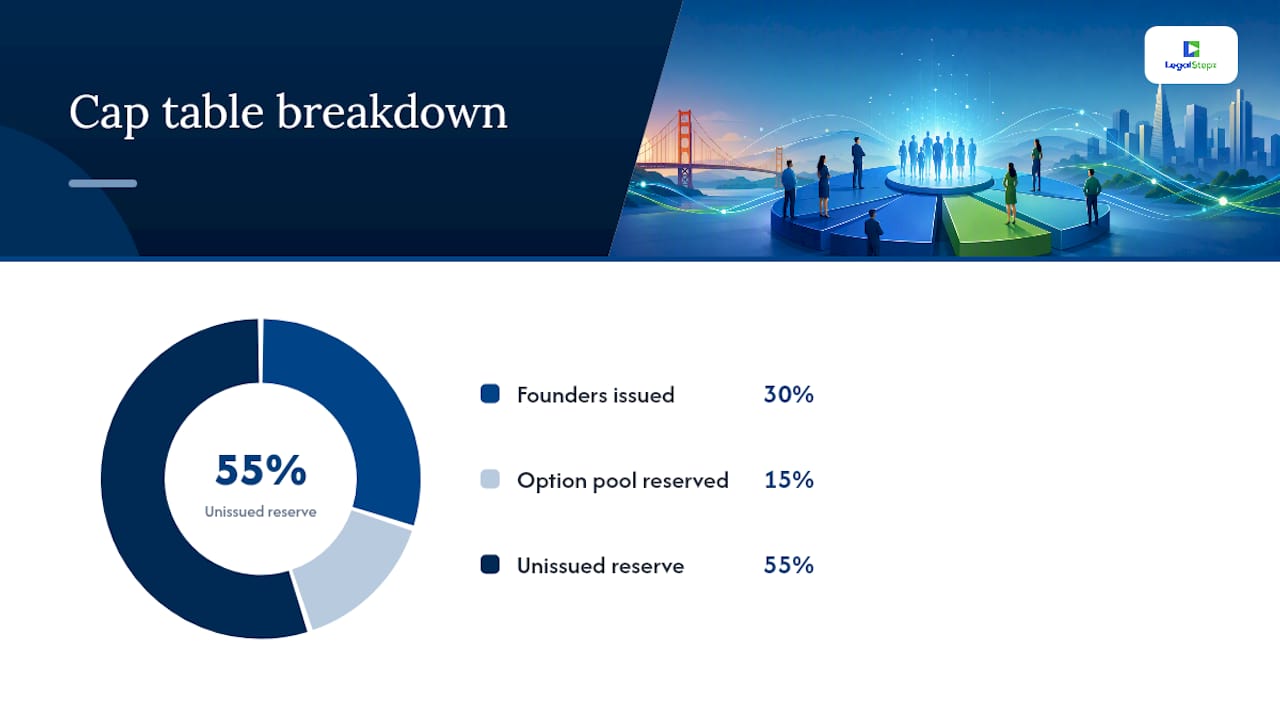
A workable cap table usually starts with founders holding a modest slice of issued shares, an option pool carved out and reserved but unissued, and a healthy stretch of authorized-but-unissued shares sitting in reserve for whatever comes next. Picture three founders splitting 3,000,000 issued shares, a 1,500,000-share option pool set aside for future hires, and 5,500,000 shares still sitting unissued out of a 10,000,000-share authorization. That structure leaves room to grant options and close a financing round without touching the articles again.
Cap table planning works best when it starts with issued shares and an option-pool plan, then backs into an authorized ceiling that comfortably covers both plus some cushion for convertible notes or SAFEs converting later. A practical three-step workflow looks like this:
- Estimate how many shares you'll need for hires and your option pool over the next two years.
- Forecast the dilution your first priced financing round will likely cause, since investors typically want 15 to 25 percent of the fully diluted cap table.
- Set your authorized number high enough to cover both, plus room for convertible instruments to exercise or convert without forcing an amendment.
If your convertible notes or SAFEs include conversion rights, California law expects your authorized share count to be sufficient to satisfy those conversions when they trigger. Running short at closing is an avoidable headache. Founders who want the filing itself handled correctly the first time, rather than learning the officers' certificate process mid-negotiation, often turn to a structured incorporation course that walks through the numbers before the paperwork goes in.
A Founder's Honest Take on Picking a Number
Most founders overthink the exact authorized share number and underthink what happens after they pick it. My honest recommendation: default to 10,000,000 authorized shares unless you have a specific reason not to, and revisit the number before every priced financing round rather than after you're already short.
The mistake I see most often isn't picking the wrong number at formation. It's forgetting to check the authorized count before a big hiring push or a new investor round, then discovering mid-negotiation that an amendment has to happen before the deal can close. That's a fixable problem if you catch it early and a genuinely annoying one if you catch it during closing week.
Pro Tip: Check your authorized share count against your projected option grants every time you plan to hire more than two or three people at once. It takes five minutes and saves you a scramble later.
None of this replaces actual legal advice for a complex structure, particularly if you're weighing multiple classes of stock or an S election. But for a straightforward formation, the math above will get you most of the way there.
— Peter
Getting Your Share Structure Filed Correctly the First Time
Amending authorized shares later means board resolutions, shareholder votes, and a certificate of amendment filed with the state, and any misstep in that sequence can stall a financing round at the worst possible moment. Some services handle the paperwork side of California corporate compliance: filing your Articles of Incorporation with the right share structure from day one, preparing certificate of amendment filings when needs change, drafting bylaws that match your governance approach, and acting as your registered agent so state notices don't get missed.

If you're still deciding on your initial authorized share count, or you already know you need to amend an existing filing, Legalstepz's formation and compliance services walk you through the officers' certificate and Secretary of State filing steps without you having to piece the process together from statute text. Start by reviewing your formation documents on the Legalstepz site and get the filing moving before it becomes a bottleneck in your next raise.
Primary Sources and Further Reading
- California Corporations Code § 200 — the statutory minimum for authorized shares.
- California Corporations Code § 903 — shareholder approval requirements for changing authorized shares by class.
- California Corporations Code Chapter 4 — procedures for share classes and officers' certificates.
- Cooley GO — authorized shares vs. issued and outstanding — practitioner explanation of common defaults.
- Corporate Finance Institute — authorized shares primer — a plain-English overview of how authorized shares work.
Sources
- Leginfo
- Authorized, issued and outstanding shares (Stripe Resources)
- Cooley GO — Authorized shares vs issued/outstanding
FAQ
How many shares should I authorize when incorporating in California?
Most California startups authorize somewhere between one million and ten million shares at incorporation, with ten million shares being a common landing spot for anyone expecting outside investment. Closely held businesses with no plans for an option pool or outside investment can reasonably authorize fewer.
What does "authorized shares" mean?
Authorized shares are the maximum number of shares a corporation's Articles of Incorporation permit it to issue. California requires at least one authorized share and sets no upper limit.
What's the difference between a C corporation and an S corporation in California?
A C corporation pays corporate-level income tax and can have multiple classes of stock, while an S corporation passes income through to shareholders' personal returns but is restricted to one class of stock for federal tax purposes. S corporations can still have voting and nonvoting shares as long as economic rights stay identical.
What's the difference between issued shares and authorized shares?
Authorized shares are the legal ceiling set in your articles, while issued shares are the portion of that ceiling actually distributed to founders, employees, or investors. Issued shares can never exceed the authorized count without first amending the Articles of Incorporation.
Can I increase my authorized shares after incorporating?
Yes. It requires a board resolution, shareholder approval under California Corporations Code § 903, and a certificate of amendment filed with the California Secretary of State. Services like Legalstepz can prepare and file that amendment for you.