

A business entity is any organizational structure formed to conduct business, recognized separately from its owner for legal and often tax purposes. It's a legally recognized organizational structure that determines how a business is taxed and the extent to which it provides liability protection to the people who own it.
That one choice, made at formation, ripples through everything else. Pick a sole proprietorship and your personal assets sit exposed to business debts. Pick an LLC or corporation and you build a legal wall between yourself and the company's liabilities, assuming you maintain it properly. Federal statute backs this up directly: statutory definitions commonly list business entities as corporations, associations, partnerships, LLCs, LLPs, or other legal entities.
Here's what this article covers:
- What each major entity type actually is and how it gets formed
- How liability protection and tax treatment differ across types
- The difference between forming an entity and choosing its tax classification
- A practical framework for picking the right structure and keeping it compliant
Key Takeaways
Choosing a business entity determines your personal liability exposure, your tax treatment, and your ongoing filing obligations, and none of that ends at formation.
| Point | Details |
|---|---|
| Definition matters legally | A business entity is a state-recognized structure that governs liability, taxes, and operations. |
| Formation and tax election differ | Your state creates the legal entity; the IRS separately decides how it's taxed. |
| Liability protection isn't permanent | Mixing personal and business funds or skipping filings can expose owners personally. |
| DBAs offer no protection | A DBA is a trade name only, not a separate legal entity. |
| Maintenance sustains protection | Annual reports, minutes, and a registered agent keep liability protection intact. |
Table of Contents
- The Main Types of Business Entities
- How State Formation and IRS Tax Classification Actually Work
- Weighing the Pros and Cons of Each Entity Type
- How to Choose the Right Business Structure
- Keeping Your Entity in Good Standing After Formation
- Where This Guidance Comes From
- Ready to Form or Maintain Your Entity the Right Way?
- What Most Guides Get Wrong About Entity Choice
- Sources
The Main Types of Business Entities
The most common business entity types recognized in the U.S. include the sole proprietorship, partnership, limited liability company (LLC), C corporation, and S corporation, and each one trades simplicity for protection differently.
- Sole proprietorship. No separate legal structure exists. You and the business are the same entity in the eyes of the law, and it forms automatically the moment you start operating, no filing required.
- Partnership. Two or more owners share profits, losses, and liability. General partnerships form without state paperwork, though a written agreement is smart; limited partnerships require a state filing.
- LLC (limited liability company). A state-filed entity that separates owner assets from business debts while allowing flexible tax treatment. Most states require articles of organization and, often, an operating agreement.
- C corporation. A fully separate legal entity, formed by filing articles of incorporation with the state. It pays its own corporate income tax.
- S corporation. Not a separate entity type at formation. It's a tax election a qualifying LLC or corporation makes with the IRS to pass income through to owners' personal returns.
Nonprofits and cooperatives are less common variants worth knowing about. A nonprofit files for tax exempt status after incorporating for a charitable or public purpose, and a cooperative is owned and controlled by its members, who typically share in profits based on use rather than investment.
How State Formation and IRS Tax Classification Actually Work
Forming a business entity and classifying it for taxes are two separate legal actions, handled by two different governments. You form an LLC or corporation with your state's filing office. Then, separately, you decide (or the IRS decides by default) how the IRS will tax it.
This distinction trips up a lot of new business owners:
- State formation creates the legal entity itself: the LLC, the corporation, the limited partnership. This is where liability protection originates.
- Federal tax classification determines how the IRS taxes that entity. An LLC can elect to be taxed as a sole proprietorship (disregarded entity), a partnership, or a corporation, independent of how it's structured at the state level. Learn more about what an LLC actually is before deciding which election fits your situation.
- Liability protection isn't automatic forever. Courts can "pierce the corporate veil," holding owners personally liable, usually when personal and business funds get mixed together or when the company ignores basic formalities like minutes and annual filings.
One more thing worth clearing up: filing a DBA (doing business as) does not create a legal entity. A DBA is just a registered trade name; it offers zero liability protection on its own.
Pro Tip: If you're operating under a DBA and think you're protected from personal liability, you're not. Only forming an LLC or corporation, and maintaining it correctly, creates that separation.
Weighing the Pros and Cons of Each Entity Type
Every structure trades something for something else. Here's the honest breakdown:
- Sole proprietorship. Best for solo freelancers testing an idea. Zero setup cost, zero liability protection, and all profit gets taxed once on your personal return. The SBA is blunt about this trade-off: easy to form, no protection at all.
- General partnership. Best for two founders splitting a small venture. Cheap and simple, but each partner can be held liable for the other's business decisions and debts.
- LLC. Best for small to mid-size businesses wanting liability protection without corporate complexity. Owners get pass-through taxation by default, moderate filing costs, and ongoing state compliance (annual reports, sometimes franchise tax).
- C corporation. Best for startups planning to raise venture capital or eventually go public. Full liability protection, but profits face double taxation, once at the corporate level, again when distributed as dividends. Formalities are heavier: a board, bylaws, annual meetings.
- S corporation. Best for profitable small businesses wanting to avoid double taxation while keeping a corporate structure. Pass-through taxation applies, but eligibility rules limit shareholder count and citizenship status.
Don't assume forming any of these automatically shields you forever. Liability protection depends on ongoing maintenance, not just the initial filing. Compare incorporation against forming an LLC before committing to one path.
How to Choose the Right Business Structure
Four questions drive most of this decision: how much liability exposure can you tolerate, what tax outcome do you want, how many owners are involved, and do you plan to raise outside investment?
The SBA frames the core trade-off simply: convenience versus protection. A sole proprietorship wins on convenience. An LLC or corporation wins on protection.
Run through this checklist before you file anything:
- Will you have business debts, contracts, or clients that could sue you personally if something goes wrong?
- Do you want profits taxed once on your personal return, or are you fine with corporate-level tax in exchange for reinvestment flexibility?
- Are you the sole owner, or will you need to formalize how decisions and profits get split among partners?
- Do you plan to bring on investors or eventually sell equity, which usually pushes toward a C corporation structure?
- Can you realistically keep up with annual filings, separate bank accounts, and recordkeeping, or do you need a service to handle that?
Red flags that mean it's time to call an attorney or CPA: multiple owners with unequal contributions, plans to raise capital from investors, or any business with meaningful liability exposure (physical products, client contracts, employees).
Pro Tip: If you're mixing personal and business funds even occasionally, stop. That single habit is the most common reason courts pierce the corporate veil and expose personal assets.
Keeping Your Entity in Good Standing After Formation
Forming an LLC or corporation is the easy part. Staying compliant is what actually preserves the liability protection you formed the entity for in the first place.
- File your state's annual report or Statement of Information on time, every year, without exception.
- Keep corporate minutes documenting major decisions, even for a small, closely held company.
- Maintain a registered agent so legal notices reach you reliably.
- Keep a separate business bank account; never pay personal expenses from company funds.
Skip these and you risk losing good standing with your state, or worse, giving a court grounds to pierce the veil and hold you personally liable. Legal Stepz's compliance checklist walks through the full annual task list.
Where This Guidance Comes From
Legal Stepz has spent years helping California entrepreneurs file Statements of Information, draft corporate minutes and bylaws, and stay compliant after formation, so this guidance reflects what actually trips up business owners, not just theory.
- What are the types of business ownership covers structure basics in more depth.
- The LLC Course walks through formation and maintenance step by step.
- For formation support beyond California, Bright Capital America offers company formation services.
Ready to Form or Maintain Your Entity the Right Way?
Understanding the definition is step one. Actually filing correctly and staying compliant year after year is where most entrepreneurs stumble, missing a Statement of Information deadline, skipping annual minutes, or never separating business and personal finances. Legal Stepz handles the paperwork side of entity maintenance: Statement of Information filings, registered agent service, and drafted corporate minutes and bylaws, so you're not guessing at compliance deadlines. If you're still deciding on a structure, the Legal Stepz LLC Course walks you through formation step by step. Start at Legalstepz to see which service fits where you are right now.
What Most Guides Get Wrong About Entity Choice
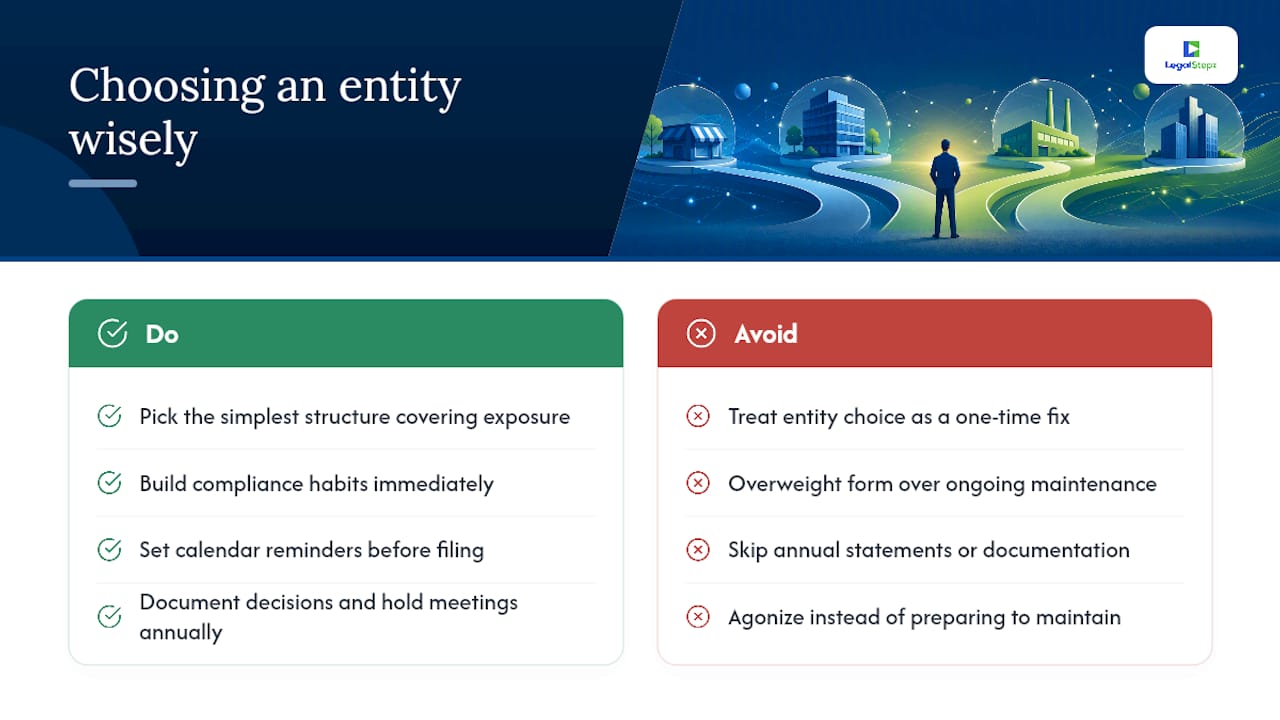
Most explainers treat entity selection as a one-time decision: pick the right box, file the paperwork, done. That's backwards. The filing is the easiest part. What actually determines whether your liability protection holds up in court is what you do in year two, year three, year five, not the form you submitted on day one.
I'd argue the conventional advice overweights "which entity is best" and underweights "can you actually keep up with what that entity requires." An LLC that skips its annual Statement of Information and never holds a documented decision is barely stronger than a sole proprietorship when a lawsuit hits. Meanwhile, plenty of freelancers spend more time agonizing over LLC versus S corp election than they ever will maintaining either one properly.
If you take one thing from this: pick the simplest structure that covers your actual liability exposure, then build the habit of compliance immediately. Set calendar reminders before you even finish the incorporation paperwork. That sequencing, discipline before complexity, is what separates protected owners from ones who find out too late that their "corporation" was one lawsuit away from being treated as a sole proprietorship anyway.
This article is general information, not a substitute for advice from a qualified lawyer. Consult a qualified legal professional about your own circumstances before acting on anything here.
Sources
- Business structures | Internal Revenue Service
- Choose a business structure | U.S. Small Business Administration
- What Is a Business Entity? - FindLaw
- Definition: business entity from 15 USC § 6764(1)