

For most California entrepreneurs, the fastest, lowest-risk path to a legally formed entity is working with a California-focused incorporation service that handles your formation filing, provides a registered agent, and sets up first-year compliance. Legalstepz does exactly that, specifically for California corporations and LLCs. Two California-specific realities make DIY risky without expert help: the state's Statement of Information requirement (a recurring compliance filing most founders miss) and the legal obligation to maintain a registered agent with a physical California address. Get those wrong and you lose good standing fast.
Your next 24–72 hours:
- Pick your entity type (LLC, C corp, or S corp) before touching any form.
- Check name availability on the California Secretary of State website and file your formation document.
- Appoint a registered agent with a California street address before your filing is submitted.
Table of Contents
- What do business incorporation services actually do in California?
- Why every California LLC and corporation must have a registered agent
- How do you stay in good standing with California after formation?
- What does it cost and how long does it take to form a California entity?
- Which entity should you choose: LLC, C corp, or S corp in California?
- What should you look for when hiring a California incorporation service?
- How Legalstepz helps California entrepreneurs stay compliant
- Key Takeaways
- What founders consistently get wrong about California formation
- Legalstepz: California formation and compliance, handled
- Official sources and further reading
What do business incorporation services actually do in California?
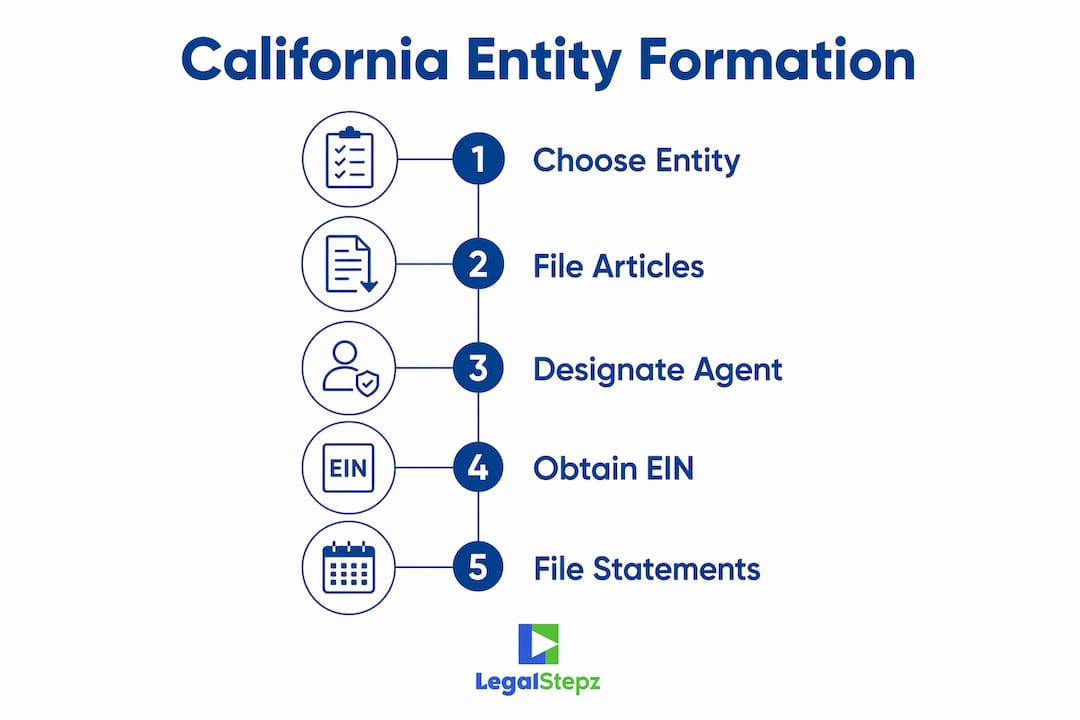
Registering with the Secretary of State is the core task, but the full process has more moving parts than most founders expect. Here is the ordered sequence:
- Check name availability on the California Secretary of State's business search portal. Reservation is optional and holds the name temporarily, subject to applicable fees and time limits.
- File your formation document. LLCs file Articles of Organization (Form LLC-1); corporations file Articles of Incorporation. Both go to the California Secretary of State. The standard filing fee for an LLC and corporation varies by entity and is set by the California Secretary of State.
- Designate a registered agent in the same filing. The agent must have a physical California street address.
- Get your EIN from the IRS. You can apply online at IRS.gov at no cost, and most businesses receive their EIN the same day.
- Register with the California Franchise Tax Board (FTB) if you will have employees or owe California income or franchise taxes. LLCs owe an $800 annual minimum franchise tax starting their first year.
- Draft initial minutes and bylaws (corporations) or an operating agreement (LLCs). These documents establish ownership structure and governance rules.
- File your first Statement of Information. Corporations must file within 90 days of formation; LLCs within 90 days of formation, then every two years.
- Open a dedicated business bank account to keep personal and business finances separate from day one.
Why every California LLC and corporation must have a registered agent
A registered agent is a mandatory requirement for LLCs and corporations in California. The agent accepts service of process, tax notices, and official state correspondence on your behalf during normal business hours. That last part matters more than people realize.
If a lawsuit is filed against your business and no one is available to accept service, the court can proceed without you knowing. Miss enough official notices and California can suspend your entity, stripping your liability shield. A P.O. box does not qualify. The agent must have a physical California street address and be present during business hours, every business day.
Pro Tip: If you use yourself as your own registered agent, you must be at that address during all business hours. Most founders are not, which is why a professional registered agent service is worth the annual fee. Legalstepz provides registered agent services specifically for California entities.
The other common mistake: forgetting to update the registered agent address when you move. California requires a formal update filing. Letting it lapse is one of the fastest ways to miss a critical legal notice.
How do you stay in good standing with California after formation?
Incorporation is not a one-time event. Maintaining good standing requires ongoing administrative discipline, and California has specific requirements that catch founders off guard:
- Statement of Information: Corporations file annually; LLCs file every two years. The Statement of Information filing requires a fee that applies to LLCs and corporations; missing the deadline incurs a penalty.
- Annual corporate minutes and bylaws: Corporations must hold at least one annual meeting and document it. Skipping this is one of the most common reasons courts pierce the corporate veil and expose owners to personal liability.
- Separate finances: Commingling personal and business funds is the other top trigger for veil-piercing. Keep a dedicated business account and credit card.
- Local business licenses and permits: Most California cities require a local business license independent of state registration. Check your city and county requirements.
- Payroll tax accounts: If you hire employees, register with the California Employment Development Department (EDD) before your first payroll.
Neglecting these tasks does not just create paperwork headaches. Courts have held owners personally liable for business debts when corporate records were neglected, effectively treating the entity as nonexistent.
What does it cost and how long does it take to form a California entity?
| Service Level | State Filing Fee | Registered Agent (Annual) | Timeline |
|---|---|---|---|
| DIY (standard) | — | — | 5 business days |
| DIY (expedited) | — + $350 expedite fee | — | 24 hours |
| Professional service | — (pass-through) | — | 3–7 business days |
For most small businesses, state registration fees run under $300, though California's expedited processing adds significantly to that. LLCs have a separate, recurring annual franchise tax that is not included in the registration fee table above. Always verify current fees and processing times directly on the California Secretary of State website, since these figures update periodically.
Which entity should you choose: LLC, C corp, or S corp in California?
Structure affects ownership rules, liability, taxes, and filing requirements, so this decision deserves real thought before you file anything.

| Entity | Liability Protection | California Tax | Best For |
|---|---|---|---|
| LLC | Yes | $800 min. franchise tax + gross receipts fee | Most small businesses, solo founders |
| C Corp | Yes | — | Startups seeking VC investment |
| S Corp | Yes | $800 annual minimum franchise tax | Profitable businesses reducing self-employment tax |
Three questions that point you to the right choice:
- Are you raising venture capital? If yes, form a C corp. VCs rarely invest in LLCs.
- Are you a solo founder or small team with no investor plans? An LLC gives you liability protection with less administrative overhead.
- Is your business generating significant profit and you want to reduce self-employment taxes? An LLC taxed as an S corp (or a formal S corp) can help, but the IRS and California both have eligibility rules. Changing entity type later can trigger significant tax consequences, so get this right the first time.
What should you look for when hiring a California incorporation service?
A legitimate service should cover every item on this list without you having to ask:
- Filing Articles of Organization or Articles of Incorporation with the California Secretary of State
- Providing a registered agent with a physical California address
- Filing your first Statement of Information
- Drafting initial minutes and bylaws (or operating agreement for LLCs)
- EIN application assistance
- Transparent, itemized pricing that separates state fees from service fees
Red flags to watch for: vague scope descriptions that lump state fees into a single "package price," no California-registered agent address listed, and no mention of post-formation compliance support. Some providers also offer optional services like registered office addresses and banking assistance, which can be useful but should never be required upsells.
Ask any provider: What is your turnaround time after I submit my information? Who signs the formation documents? How do you handle address or agent changes after filing?
How Legalstepz helps California entrepreneurs stay compliant
Legalstepz is built specifically for California corporations and entrepreneurs. The core services cover the full formation and compliance cycle:
- Articles of Organization / Articles of Incorporation filing with the California Secretary of State
- Registered agent services with a California address and business-hours availability
- Statement of Information filing so you never miss a California deadline
- Annual corporate minutes and bylaws drafting to keep your corporate records clean
- Post-formation compliance reminders tied to California-specific deadlines
For founders who want to handle formation themselves, Legalstepz also offers a step-by-step incorporation course covering LLC and corporation formation, compliance, and trademark registration. It is a practical option for self-directed founders who want to understand the process before paying for a service.
Pro Tip: Pairing the incorporation course with Legalstepz's registered agent and Statement of Information services gives you the knowledge to stay in control while offloading the tasks that have hard deadlines and real penalties.
Key Takeaways
Forming a California entity correctly from day one prevents the personal liability exposure that comes from missed filings and sloppy records.
| Point | Details |
|---|---|
| Choose entity before filing | Entity type drives tax treatment, investor eligibility, and California franchise tax obligations. |
| Registered agent is mandatory | Must have a physical California address and be available during business hours every business day. |
| Statement of Information has real penalties | Missing the deadline triggers a $250 late penalty; corporations file annually, LLCs every two years. |
| Good standing requires ongoing work | Annual minutes, separate finances, and local licenses all matter for preserving your liability shield. |
| Legalstepz covers the full cycle | Filings, registered agent, minutes/bylaws, and compliance reminders, all California-specific. |
What founders consistently get wrong about California formation
The mistake I see most often is treating formation as a finish line. A founder files their Articles, gets their EIN, and considers the job done. Then 90 days pass, the Statement of Information deadline hits, and nothing happens. California sends the notice to the registered agent address. If that address is wrong or the agent is not monitoring it, the notice disappears. The $250 penalty arrives later, and sometimes the entity is already suspended by then.
The second pattern: corporations that skip annual minutes because "we're just a two-person company." That reasoning does not hold up in court. A judge evaluating a liability claim does not care how small the company is. If the records do not exist, the corporate veil is thin.
Both mistakes have a one-sentence fix: put compliance deadlines on a calendar the day you form your entity, and use a service that sends you reminders. That alone prevents the majority of the problems I see California founders walk into.
Legalstepz: California formation and compliance, handled
Legalstepz gives California entrepreneurs a direct alternative to piecing together formation, registered agent, and compliance tasks from three different vendors. One package covers your California LLC formation, registered agent service, Statement of Information filing, and annual minutes, with reminders built in so nothing slips through. For founders who want to learn the process themselves, the incorporation course walks through every step. After formation, pairing Legalstepz's compliance services with business insurance gives your entity a complete risk foundation.

Start your California formation at legalstepz.com and choose the package that fits your entity type.
This article is general information, not legal or tax advice. Verify current California Secretary of State fees, filing deadlines, and franchise tax rules with the FTB or a qualified professional for your specific situation.
Official sources and further reading
- California Secretary of State — Business Entities: The authoritative source for current filing fees, forms (LLC-1, Articles of Incorporation), processing times, and name availability search.
- SBA: Choose a Business Structure: Plain-language guidance on LLC, C corp, and S corp trade-offs, including liability and tax implications.
- SBA: Register Your Business: Covers registered agent requirements, Secretary of State filings, and EIN registration steps.
- IRS: Apply for an EIN Online: Free, same-day EIN issuance for most business structures; the official application portal.
- California Franchise Tax Board: Source for California franchise tax rates, the $800 annual minimum, and LLC gross receipts fees.