

California law requires workers' compensation for any business with employees and commercial auto coverage for business-owned vehicles. Beyond that legal floor, most landlords and clients will functionally require general liability and commercial property or a business owner's policy before they'll sign a lease or a contract with you. Add cyber, EPLI, or E&O coverage once your revenue, staff, or client base grows enough that a single lawsuit or data breach could sink you.
TL;DR:
- Workers' compensation is mandatory for any California business with employees, regardless of size or whether employees are full-time or part-time.
- Commercial auto coverage is required if your business owns vehicles or relies on personal cars for business purposes, with personal auto policies often excluding claims for work-related driving.
- Landlords and clients usually demand general liability insurance, often requiring limits of $1 million per occurrence and inclusion of additional insured parties.
- Cyber insurance is nearly essential for businesses handling customer data, with stricter underwriting and real sublimits for ransomware and social engineering claims.
- Proper documentation of coverage and entity records is critical, as legal and insurance compliance are intertwined in protecting your assets and legal standing.
Table of Contents
- Business Insurance California Basics: The Legal Floor vs. Contract Reality
- Coverages Landlords and Clients Actually Demand
- Recommended Coverages That California Businesses Shouldn't Skip
- How to Choose the Right Broker-Agent and Policy
- What Drives Your Premium and How to Size Limits Sensibly
- California-Specific Risks That Change How You Buy
- Your Buying and Documentation Checklist
- Why Insurance and Entity Compliance Are the Same Conversation
- Where Legalstepz Fits After You've Got Coverage in Place
- Sources
- FAQ
Business Insurance California Basics: The Legal Floor vs. Contract Reality
Two separate categories drive every insurance decision a California business owner makes: what the state forces you to buy, and what everyone else forces you to buy. Confusing the two is the single most common mistake new business owners make, and it usually costs them either a fine or a lost contract.
Workers' compensation sits at the top of the mandatory list. Under Labor Code Section 3700, nearly every California employer with even one employee must carry workers' comp, and there's no minimum threshold based on hours or payroll size. This applies whether that employee is full-time, part-time, or a family member on the books. The California Department of Insurance's commercial guide confirms this and points employers toward the State Compensation Insurance Fund (State Fund) as one path to coverage, alongside private carriers and, for larger operations, self-insurance programs approved by the state. Small businesses without employees, including many single-owner LLCs and sole proprietors, are generally exempt, but the moment you put someone on payroll, the clock starts.
The penalties are not gentle. Operating without required workers' comp can trigger fines, a stop-work order that shuts down your operation on the spot, and in some cases criminal liability for the business owner. Insurers and legal analysts covering this space note that failure to carry required insurance can result in fines, stop-work orders, and loss of licenses. If you're still sorting out whether your specific setup requires coverage, Legalstepz's breakdown of workers' comp requirements walks through the three legal paths available and what triggers the $7,000-plus fines regulators can levy.
Commercial auto is the second statutory requirement, and it trips up more business owners than you'd expect. If your business owns a vehicle, even a single delivery van or a work truck, you need commercial auto coverage. The trap is subtler for businesses that rely on personal vehicles for business errands: a personal auto policy often excludes claims that happen while driving for business purposes, meaning a fender bender on a supply run could leave you personally exposed and your policy voided for that claim. Delivery drivers, contractors hauling equipment, and mobile service businesses (dog groomers, mobile mechanics, catering vans) all fall squarely into this exposure zone.
Profession-specific mandates stack on top of these two baseline requirements depending on your industry:
- Contractors licensed through the Contractors State License Board generally need bonding and, depending on classification, liability coverage to keep an active license.
- Healthcare providers, attorneys, and financial advisors often face malpractice or errors-and-omissions requirements tied to their licensing board rather than general insurance law.
- Businesses handling client funds or property (real estate brokers, escrow companies) frequently face fidelity bond or crime coverage mandates from their regulatory body.
Workers' comp and commercial auto are the only two coverages California law universally mandates for small businesses. Everything else is either profession-specific or contract-driven.
Verifying your specific obligations means checking with the Employment Development Department for payroll-related duties and the CDI's consumer guides for insurance-specific questions. Don't rely on what a competitor in your industry does. Licensing boards change requirements by profession, and what applies to a general contractor doesn't apply to a marketing consultant.
Coverages Landlords and Clients Actually Demand
Nobody at the state capitol is forcing you to buy general liability insurance. Your landlord, on the other hand, almost certainly is. General liability isn't a legal mandate in California, but it's become the de facto price of entry for commercial leases, client contracts, and vendor agreements. Insureon's data on California small business coverage shows that general liability is effectively required in practice because leases, client contracts, and lenders commonly demand it, even though no statute forces the purchase.
Commercial landlords typically request general liability limits of $1 million per occurrence and $2 million aggregate, and they'll usually want to be named as an "additional insured" on your policy. That designation means your insurer covers the landlord too if a customer slips on your storefront's wet floor and decides to sue the property owner along with you. Skipping this step, or buying a policy that technically meets the dollar amount but omits the additional insured endorsement, is one of the most common reasons a certificate of insurance gets rejected during lease negotiations.
A business owner's policy (BOP) bundles general liability with commercial property coverage into one package, usually at a lower combined cost than buying each separately. It's built for what insurers call "main street" businesses: retail shops, small offices, restaurants, and service businesses under a certain square footage and revenue threshold. The tradeoff is underwriting rigidity. BOPs come with strict eligibility limits on square footage, employee count, and revenue, and a business that's grown past those limits, or that carries unusual risk (heavy machinery, high-value inventory, hazardous materials) often gets declined and pushed toward separately underwritten commercial property and liability policies.
A few things to check before you assume a BOP fits your business:
- Confirm your square footage and annual revenue fall inside the carrier's published eligibility bands.
- Ask whether your specific business activity (food service, light manufacturing, personal care services) is excluded from the standard BOP form.
- Check whether business interruption coverage inside the BOP covers a realistic shutdown period, not just a token 30 days.
Property placement gets genuinely complicated in wildfire-exposed regions of California, which now covers a much larger footprint of the state than most owners realize. Standard commercial property policies in high-risk wildfire zones sometimes carry higher deductibles for wildfire-specific claims, and some carriers decline coverage in the highest-risk tiers entirely. Earthquake coverage is almost always a separate endorsement or standalone policy, never bundled automatically into a BOP or standard property policy, so if you're leasing space in an older building or a seismically active area, ask specifically about that gap.
Recommended Coverages That California Businesses Shouldn't Skip
Legal minimums and contract requirements cover the obvious risks. The coverages that actually save a California business from an existential threat tend to be the ones nobody makes you buy.
Cyber insurance has moved from optional to close to mandatory for any business handling customer data, and California's privacy law is the reason. The California Consumer Privacy Act and its expansion under the California Privacy Rights Act give consumers a private right of action for certain data breaches, meaning a breach doesn't just trigger a regulatory fine. It can trigger a lawsuit directly from affected customers. Combined with California's breach-notification requirements, which force you to tell affected individuals quickly after a breach, the financial exposure from a single incident can run well past what a small business keeps in reserve. Coverage specialists note that because of CCPA/CPRA and breach-notification rules, cyber insurance is essential in California, and carriers have responded by tightening underwriting standards significantly.
Pro Tip: Carriers increasingly require baseline security controls, multi-factor authentication, endpoint detection software, and tested data backups, before they'll even quote a cyber policy. Implementing these before you apply can materially lower your premium and widen your options.
Read the sublimits carefully before you buy. Many cyber policies advertise a headline aggregate limit that looks generous, but cyber coverages commonly include sublimits for ransomware and social engineering losses that cap the payout for the exact scenario most likely to hit a small business: an employee wiring money after a convincing fake invoice email. A policy with a $2 million aggregate limit and a $250,000 ransomware sublimit isn't the coverage the headline number implies.
Employment Practices Liability Insurance (EPLI) protects against claims of wrongful termination, discrimination, harassment, and wage-and-hour disputes. California's employment law environment is aggressive by national standards. The state's Fair Employment and Housing Act (FEHA) and the Private Attorneys General Act (PAGA) both give employees and, under PAGA, even non-injured employees acting on the state's behalf, expanded rights to sue over workplace violations. Any business with employees, even a handful, faces real exposure here, and standard general liability policies exclude employment-related claims entirely.
Other coverages worth budgeting for as your business scales:
- Errors and omissions (E&O), also called professional liability, for consultants, agencies, and service providers whose advice or work product could cause a client financial harm. Many client contracts now require proof of E&O before they'll sign.
- Directors and officers (D&O) insurance, once you bring on investors, a board, or outside executives who could be personally named in a lawsuit over a business decision.
- Umbrella insurance, which extends your liability limits above your general liability and auto policies once your business has enough revenue or foot traffic that a single large judgment could exceed standard limits.
- Crime insurance or fidelity bonds, for businesses handling client funds, cash, or valuable inventory where employee theft is a real, if uncomfortable, possibility.
None of these are legally required. All of them address a California-specific exposure that general liability simply doesn't touch.
How to Choose the Right Broker-Agent and Policy
Buying commercial insurance in California isn't like buying a policy off a comparison website for your car. Most small business coverage still moves through a licensed broker-agent, and the CDI recommends starting there rather than trying to self-navigate commercial lines. The reason is straightforward: commercial policies carry more customization, more exclusions, and more moving parts than personal insurance, and a good broker catches gaps a business owner wouldn't know to look for.
Here's a practical sequence for vetting an agent and comparing quotes:
- Verify the license. Search the agent or broker's name directly on the California Department of Insurance's license lookup. Confirm the license type matches what they're selling you (property and casualty, for commercial lines) and that it's active, not expired or under disciplinary action.
- Ask for the license number in writing. California regulations require agents to display their license and provide the license number on printed materials, so a legitimate broker will hand this over without hesitation.
- Request the sublimits, not just the headline limits. Ask specifically about ransomware sublimits, social engineering sublimits, and business interruption waiting periods on any cyber or property quote.
- Confirm additional insured endorsements if a landlord or client contract requires them, and get written confirmation the endorsement is included before you sign anything.
- Ask about deductibles and retentions separately. A low premium paired with a high deductible or self-insured retention can cost more out of pocket during an actual claim than a slightly higher premium with a lower retention.
- Get the coinsurance clause explained plainly. Property policies with coinsurance requirements can reduce your payout significantly if your building or contents are underinsured relative to their replacement value, even on a covered claim.
Pro Tip: Ask your broker directly whether your business qualifies for standard admitted-market coverage or whether you're being placed in the surplus lines market. Surplus lines carriers aren't backed by the state guaranty fund the way admitted carriers are, which matters if that carrier ever becomes insolvent.
A few underwriting red flags tend to push a business toward non-standard placement. High-risk industries (cannabis-adjacent businesses, certain construction trades, hospitality with liquor service), locations in the highest wildfire-risk tiers, and businesses with recent claims history all commonly get declined by standard carriers and referred to surplus lines or, for property specifically, the California FAIR Plan. Neither option is a failure on your part. They're simply a different, usually more expensive, path to the same coverage.
What Drives Your Premium and How to Size Limits Sensibly
Insurance pricing in California isn't arbitrary, even when it feels that way. Underwriters weigh a consistent set of factors, and understanding them helps you catch a quote that's out of line or find room to negotiate.
Premium drivers carriers weigh most heavily:
- Payroll size and total revenue, which drive workers' comp and general liability pricing directly.
- Business location, since ZIP code affects both crime-related exposure and, for property coverage, wildfire and earthquake risk zones.
- Claims history over the past three to five years, with a clean record earning meaningfully better rates.
- Industry classification codes, since a bakery and a roofing company carry very different risk profiles even at identical revenue levels.
Illustrative small-business pricing data from Insureon shows monthly premiums for common policies like general liability and workers' comp vary widely by policy type and business profile, which is exactly why a quote that seems cheap or expensive in isolation needs context from your specific payroll, location, and claims history before you can judge it fairly.
Sizing your limits doesn't have to be guesswork. Start with whatever your lease or largest client contract explicitly requires. If a landlord wants $1 million per occurrence, that's your floor, not your ceiling. From there, estimate a realistic worst-case scenario for your business: a customer injury lawsuit, a data breach affecting your full client list, a fire that destroys your inventory. If that worst-case number comfortably exceeds your general liability and property limits combined, an umbrella policy that sits on top of both is usually cheaper than raising each underlying limit separately.
A few cost-control tactics actually move the needle without leaving you underinsured:
- Bundling general liability and property into a BOP where you qualify, rather than buying each separately.
- Raising your deductible modestly on property and general liability if you have the cash reserves to absorb a smaller claim yourself.
- Implementing the security controls carriers reward on cyber quotes: multi-factor authentication, endpoint detection, and tested backups.
- Documenting safety training and loss-control measures, which some workers' comp carriers factor into experience modification ratings over time.
California-Specific Risks That Change How You Buy
Three things make insurance buying in California meaningfully different from most other states, and each one deserves its own line item in your planning.
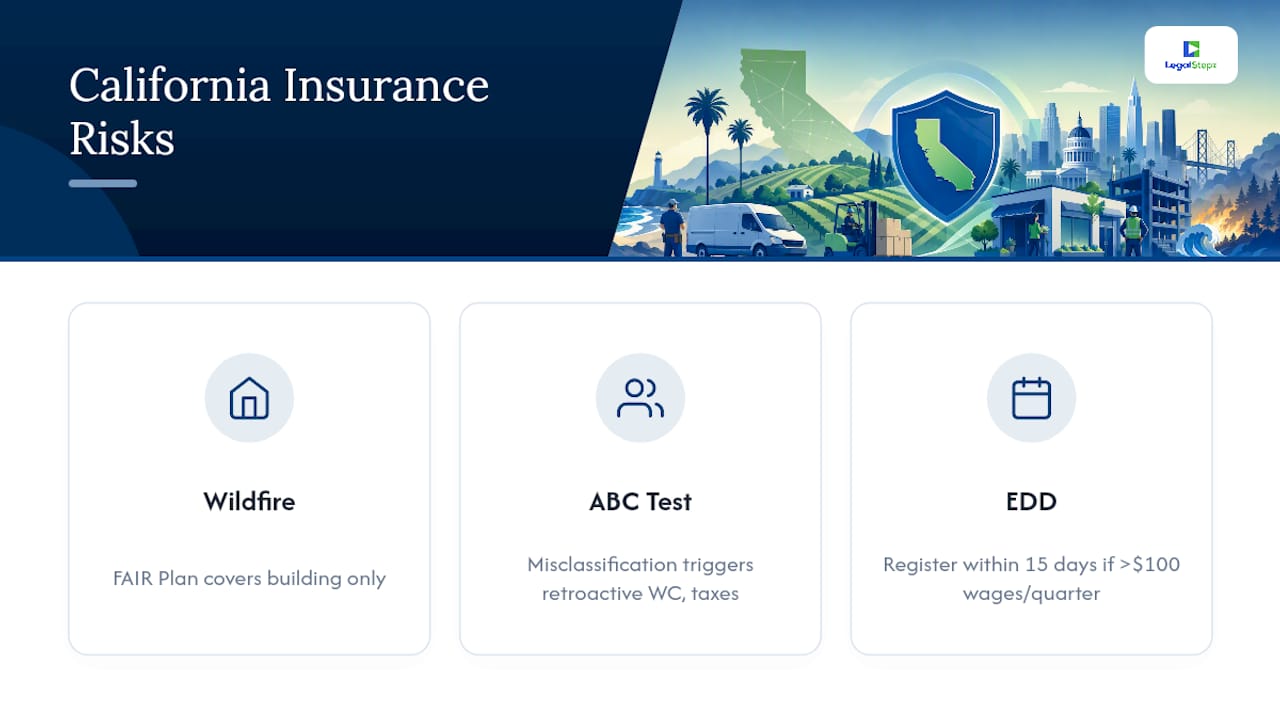
Wildfire exposure and the FAIR Plan. Large portions of California now sit in designated high wildfire-risk zones, and standard admitted carriers have pulled back coverage in the highest-risk areas over the past several years. The California FAIR Plan exists as a backstop for property owners who can't secure coverage in the admitted market, but it's a limited product. It typically covers the building itself against fire, not the full range of perils a standard commercial property policy covers. Most businesses placed with the FAIR Plan need a separate "difference in conditions" policy layered on top to cover the gaps, theft, liability, business interruption, and other perils the FAIR Plan doesn't touch.
The ABC test and contractor misclassification. California's ABC test, used to determine whether a worker is a true independent contractor or an employee, sets a high bar. If you treat someone as a 1099 contractor and the state later determines under the ABC test that they were functionally an employee, you can face retroactive workers' compensation liability, back payroll taxes, and penalties, on top of the exposure of having operated without coverage for that worker the entire time you misclassified them. Reviewing your contractor relationships against this test isn't a one-time exercise. It's worth revisiting any time your working relationship with a contractor changes in scope or exclusivity.
EDD registration and employer timing. Any business paying more than $100 in wages in a calendar quarter must register with the Employment Development Department within 15 days, a deadline that catches new employers off guard more often than it should. Registration triggers your obligations around State Disability Insurance (SDI) and Paid Family Leave (PFL) withholding, both of which run through payroll rather than a separate insurance purchase, but both of which are legally tied to the same employer status that triggers your workers' comp requirement. For a broader walkthrough of what this means for your filing and tax timeline, Legalstepz's guide to California small business tax obligations covers the sequencing in more detail.
Your Buying and Documentation Checklist
Getting from "I know what I need" to "I'm actually covered" takes a handful of concrete steps, and skipping the documentation half is where a lot of business owners get caught short during a claim or an audit.
- Gather your business details before requesting quotes: entity type, annual revenue, payroll figures, square footage, number of locations, and a rough claims history if you have prior coverage.
- Request quotes from at least two or three licensed brokers, and insist on seeing sublimits and exclusions side by side, not just the headline premium.
- Compare apples to apples: a cheaper quote with a lower liability limit or a higher wildfire deductible isn't actually cheaper once you account for your real exposure.
- Request your certificate of insurance (COI) once you bind coverage, and check that it lists the correct policy limits, effective dates, and any additional insured parties your lease or contract requires.
- Store your COI and full policy documents somewhere accessible, not just in an email inbox, so you can produce them quickly if a landlord, client, or auditor asks.
- Set a calendar reminder to review coverage annually, or any time your revenue, payroll, or square footage changes materially, since outdated limits are one of the most common gaps insurers find during a claim.
- Update your registered agent and business records whenever your coverage or entity details change, since consistent recordkeeping matters if you're ever asked to prove coverage during a dispute or a compliance check.
For the specific mechanics of what belongs in your ongoing business file alongside insurance documents, Legalstepz's record-keeping basics guide covers what to retain and for how long. And if legal exposure beyond insurance is on your mind, particularly around litigation risk, Serendib Law Firm's overview of business litigation in Southern California is worth a read for context on what these policies are ultimately protecting you against.
Why Insurance and Entity Compliance Are the Same Conversation
Most business owners treat insurance and entity paperwork as two separate chores handled by two separate people. That split doesn't hold up once you look at what actually happens during a claim or a lawsuit. An insurer investigating a claim, or an attorney arguing that your LLC's liability shield should apply, will both ask the same underlying question: did you actually run this business the way you say you did on paper?
That's why Legalstepz treats verifying coverage and keeping clean corporate records as one connected task, not two. A Statement of Information filed late, bylaws that don't match how the company actually operates, or a lapsed registered agent designation can all undercut the very protection your insurance policy is supposed to provide. Courts have pierced the corporate veil over exactly this kind of sloppiness, leaving an owner personally exposed despite having a general liability policy in force. Good recordkeeping and current insurance aren't separate boxes to check. They're the same defense, built from two directions.
That's the throughline across the compliance guides Legalstepz publishes, including the piece on protecting personal assets from your California business: the paperwork you keep is worth exactly as much as the coverage backing it up, and vice versa.
— Peter
Where Legalstepz Fits After You've Got Coverage in Place
Buying the right insurance is half the compliance picture. The other half is making sure your entity paperwork actually backs up that coverage when it counts, and that's where a lot of California business owners quietly fall behind. Legalstepz handles the recordkeeping side most owners put off: filing your Statement of Information on time, drafting annual corporate minutes and bylaws that match how your business actually runs, and standing in as your registered agent so nothing gets missed.
If you're forming your entity from scratch, Legalstepz's step-by-step courses walk you through LLC and corporation formation and trademark registration without needing to hire a lawyer for every step. Once you've secured your coverage, visit Legalstepz to see which compliance package fits your business, whether that's a Statement of Information filing, ongoing registered agent service, or a formation course that gets your entity structured correctly from day one. Getting your entity paperwork as current as your insurance policy takes one visit to start.
Sources
- Small Business Insurance in California
- Commercial Insurance Guide (California Department of Insurance)
- Cyber insurance for California businesses | Bollinsure
This article is general information, not a substitute for advice from a qualified financial advisor. Consult a qualified financial professional about your own circumstances before acting on anything here.
FAQ
What is the best small business insurance in California?
There's no single best policy. Most California small businesses build a foundation of general liability and a BOP, add workers' compensation once they hire staff, and layer in cyber or E&O coverage based on their specific industry exposure.
How much does a $1 million liability insurance policy cost?
Pricing varies widely by industry, location, payroll, and claims history, so there's no fixed rate that applies broadly. Insureon's California data shows monthly premiums differ significantly across policy types and business profiles, which is why getting a quote based on your specific numbers matters more than any generic figure.
What is the basic insurance coverage required in California?
Workers' compensation for businesses with employees and commercial auto insurance for business-owned vehicles are the two coverages California law actually mandates. General liability and property coverage aren't legally required but are functionally necessary for most leases and client contracts.
What is the average cost of business insurance for small businesses in California?
Average costs vary too much by industry and business size to state a single figure responsibly. Payroll, revenue, location, and claims history all move the number, which is why brokers price policies individually rather than off a flat rate card.
Do I need cyber insurance if I'm a small California business?
If you handle customer data of any kind, cyber insurance is close to essential given California's CCPA/CPRA private right of action and breach-notification requirements. Carriers increasingly require security controls like MFA and tested backups before offering competitive terms.
Does having insurance protect me if my LLC paperwork is out of date?
Insurance and entity compliance work together, not separately. Legalstepz's guides on protecting personal assets explain how outdated filings can undercut the liability protection your entity structure and insurance are both meant to provide.