

Business records are legally required documents that prove compliance, substantiate financial transactions, and protect your business in audits and legal proceedings. For California entrepreneurs, understanding why business records matter legally is not optional. The IRS, the California Franchise Tax Board, and state corporate statutes all impose specific retention and documentation obligations. Failing to meet them exposes you to penalties, personal liability, and a weakened position in any legal dispute. Proper record keeping, known formally as business documentation management, is the foundation of every defensible compliance posture.
Why business records matter legally: the core legal obligations
California entrepreneurs operate under a layered set of federal and state requirements that govern exactly what records to keep and for how long.
The IRS sets the baseline for federal tax records. Tax-supporting documents must be kept for at least 3 years under general rules, 6 years if income is underreported by more than 25%, and indefinitely if no tax return is filed. Employment tax records require a minimum 4-year retention period. These are floors, not ceilings, and California's own rules add another layer on top.

California corporations must maintain statutory books, including articles of incorporation, bylaws, shareholder records, and board meeting minutes. The California Corporations Code requires these to be available for inspection at any time. Employment records, including timecards, wage statements, and benefit documentation, carry their own retention obligations under California Labor Code. Missing any of these categories puts you out of compliance with state law, regardless of your federal standing.
The consequences of non-compliance are concrete and severe:
- Civil fraud penalties equal to 75% of any tax underpayment, plus accrued interest
- Criminal exposure of up to 5 years imprisonment for willful tax evasion
- Late filing penalties of 5% of unpaid taxes per month, capped at 25%, plus additional interest
- State regulatory fines for failure to maintain required corporate records
The Sarbanes-Oxley Act adds federal criminal liability for destroying or falsifying records in anticipation of a federal investigation. While Sarbanes-Oxley primarily targets public companies, its obstruction provisions apply broadly and have been used against private businesses in federal proceedings.
How do business records impact audits, legal disputes, and liability protection?
Records serve as the primary evidence in any tax or regulatory audit. When the IRS or California Franchise Tax Board selects your business for examination, your records are the only thing standing between you and an adverse finding.
When records are incomplete or missing, the government can shift the burden of proof to the taxpayer. That shift is significant. Instead of the agency proving you owe more tax, you must prove you do not. Without organized records, that is nearly impossible to do.
The evidentiary stakes are equally high in civil litigation. Courts apply the business records exception to hearsay, which allows contemporaneous business documents to be admitted as evidence. The critical requirement is that records be made during regular business operations. Records created after the fact, or specifically for litigation, face exclusion. A contract dispute, an employment claim, or a shareholder lawsuit all turn on whether your documentation was created in the ordinary course of business.
"Poor bookkeeping with missing or disorganized records is often cited as circumstantial evidence of intentional concealment, which undermines legal defenses for directors and officers."
Deficient records erode the business judgment rule, the legal doctrine that protects directors and officers from personal liability for good-faith business decisions. When records are absent or disorganized, courts and regulators treat that absence as evidence of concealment. Directors lose their shield. Personal assets become exposed.
Pro Tip: Document every significant board decision in writing at the time it is made. A contemporaneous memo or meeting minute is worth far more in court than a reconstructed account prepared months later.
The importance of business records extends beyond tax season. A well-documented business can defend itself in employment disputes, contract disagreements, and regulatory investigations without scrambling to reconstruct what happened.
Which records should California business owners keep, and for how long?
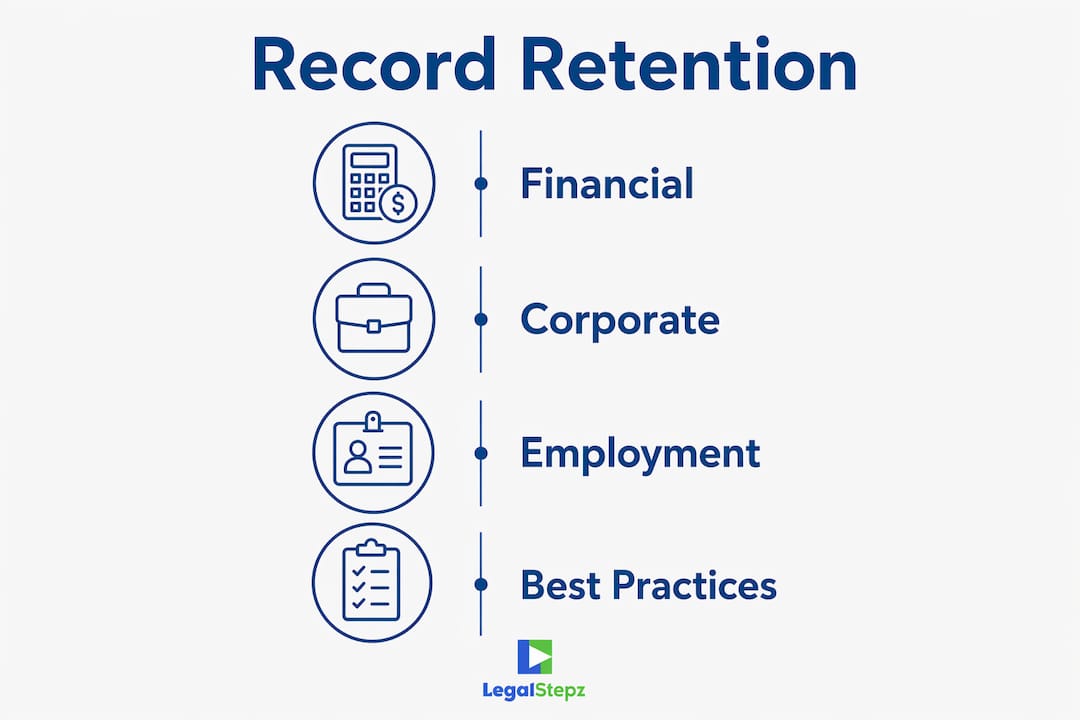
California business owners need to maintain records across four primary categories. Each carries different retention requirements based on federal and state law.
Financial and tax records
| Document Type | Minimum Retention Period | Rationale |
|---|---|---|
| Tax returns and supporting documents | 3 years (general) | IRS standard audit window |
| Returns with substantial underreporting | 6 years | Extended IRS audit window |
| Returns never filed | Indefinitely | No statute of limitations applies |
| Employment and payroll tax records | 4 years | IRS and California EDD requirement |
| Invoices, receipts, and ledgers | 7 years | Covers California FTB audit exposure |
| Corporate governance documents | Permanently | Required under California Corporations Code |
Corporate governance records
Meeting minutes, bylaws, shareholder agreements, and organizational resolutions must be kept permanently. These documents prove the legal structure of your business and the authority behind every major decision. California law requires corporations to make these available for shareholder inspection on demand. Legalstepz assists California corporations with annual minutes and statutory book maintenance to meet this obligation.
Employment and payroll records
Timecards, wage statements, employment contracts, and benefit records fall under California Labor Code and federal Fair Labor Standards Act requirements. California's statute of limitations for wage claims runs up to 4 years for written contracts. Keeping employment records for at least 4 years after termination covers most exposure.
Preserving records beyond minimum periods is safer than cutting retention to the legal floor. Variable audit timelines, ongoing litigation, and industry-specific regulations all create exposure that minimum periods do not cover. The cost of storing records is far lower than the cost of defending a claim without them.
What best practices help entrepreneurs maintain audit-ready records?
Effective record keeping requires a system, not just good intentions. California entrepreneurs who build structured processes protect themselves far better than those who rely on memory or informal filing.
Start with a written record retention policy. The policy should name specific document categories, assign retention periods, designate responsible employees, and set a destruction schedule for expired records. Compliance Management Systems that include board-level oversight and documented internal controls provide the strongest protection under the business judgment rule.
Digital records are legally admissible in California and federal proceedings when properly authenticated. Cloud-based storage with access controls, version history, and automatic backups reduces the risk of loss from fire, theft, or hardware failure. Physical records remain acceptable but require secure, organized storage with a clear indexing system.
Key practices that separate compliant businesses from vulnerable ones:
- Assign ownership. Name one person responsible for each record category. Diffuse responsibility means no responsibility.
- Conduct annual reviews. Regulations change. Your retention policy should be reviewed every year against current IRS, California FTB, and California Labor Code requirements.
- Train employees. Staff who handle financial transactions, contracts, or HR matters need to understand what to document and when.
- Avoid late documentation. Records created after the fact carry less legal weight and invite scrutiny. Document decisions and transactions at the time they occur.
- Back up digital records. A single storage location is a single point of failure. Use redundant backups in at least two locations.
Pro Tip: Set a calendar reminder each january to audit your record retention policy. Regulatory changes from the prior year often take effect in Q1, and an annual review keeps your system current without requiring constant monitoring.
Recordkeeping as a risk mitigation tool also provides operational value beyond compliance. Organized records give you a data foundation for tracking business performance, identifying trends, and making decisions grounded in documented history rather than guesswork.
Key Takeaways
Proper business documentation is the single most effective defense California entrepreneurs have against tax penalties, regulatory fines, and personal liability in legal disputes.
| Point | Details |
|---|---|
| Federal retention minimums | Keep tax records for 3–6 years minimum; employment records for 4 years; governance documents permanently. |
| Burden of proof shifts | Missing records force the taxpayer to prove innocence in IRS disputes, not the agency to prove guilt. |
| Contemporaneous records win | Courts favor records created during normal operations; documents made for litigation face exclusion. |
| Director liability exposure | Disorganized records erode the business judgment rule and expose directors to personal liability. |
| Written policy is non-negotiable | A documented retention policy with assigned ownership is the foundation of any compliant record keeping system. |
Records are your best legal asset, not just a compliance checkbox
After years of working with California business owners, the pattern I see most often is this: entrepreneurs treat record keeping as a burden until the moment they need those records to defend themselves. By then, it is too late to fix the gaps.
The businesses that come through audits and litigation cleanly are not the ones with the best lawyers. They are the ones with the best records. A well-maintained set of corporate records and annual minutes tells a coherent story about how the business operated, who made which decisions, and why. That story is your defense.
What I find most underappreciated is the intelligence value of good records. Organized documentation lets you see patterns in your own business: which contracts generate disputes, where payroll errors cluster, which quarters show irregular expenses. That visibility is worth money, not just legal protection.
My advice to any California entrepreneur: treat your records the way you treat your insurance policy. You maintain it consistently, not because you expect to use it, but because the cost of not having it when you need it is catastrophic.
— Peter
How Legalstepz supports California business compliance
California's record keeping requirements cover corporate governance, tax filings, employment records, and annual statutory obligations. Meeting all of them requires more than a filing cabinet.
Legalstepz helps California entrepreneurs file statements of information, draft annual minutes, establish bylaws, and maintain registered agent services. These are the exact documents California law requires corporations to keep current and available for inspection. Whether you are setting up a new entity or catching up on years of missed filings, Legalstepz provides the structure and expertise to get your records into compliance and keep them there. Visit legalstepz.com to get started with a compliant record keeping foundation built for California law.
FAQ
Why do business records matter legally?
Business records serve as primary evidence of compliance in tax audits, regulatory investigations, and civil litigation. Without them, the burden of proof shifts to the business owner, making it nearly impossible to defend against adverse findings.
How long must California businesses keep tax records?
The IRS requires a minimum of 3 years for general tax records, 6 years if income is underreported, and indefinitely if no return was filed. California's Franchise Tax Board audit exposure extends this window further, making 7 years a practical standard for financial documents.
What happens if business records are missing during an audit?
Missing records allow the IRS or California FTB to shift the burden of proof to the taxpayer. The business must then prove it does not owe additional tax, which is extremely difficult without documentation.
Are digital records legally acceptable in California?
Yes. Digital records are legally admissible in California and federal proceedings when properly authenticated. Cloud storage with access controls and version history meets the authentication standard courts apply.
What records must California corporations keep permanently?
California corporations must permanently maintain articles of incorporation, bylaws, board meeting minutes, shareholder records, and organizational resolutions. These documents are subject to shareholder inspection rights under the California Corporations Code.