

Corporate bylaws are the internal rulebook a corporation uses to govern its board of directors, officers, and shareholder processes. They are not filed with the state, they live in your corporate records, and every corporation should have a signed set adopted at the directors' organizational meeting. Your immediate next step: use a bylaws template to draft your provisions, then adopt them by board resolution at your organizational meeting and store the signed copy in your minute book. If you are forming a California corporation, Legalstepz can handle drafting, adoption minutes, and compliance filings so nothing falls through the cracks.
Key Takeaways
Corporate bylaws are the internal governance foundation every U.S. corporation needs, and adopting a signed, state-compliant set at the organizational meeting is the single most important step a founder can take to protect corporate separateness and investor readiness.
| Point | Details |
|---|---|
| Bylaws are internal, not filed | Keep signed bylaws in your minute book; they are not submitted to the state. |
| Articles of Incorporation prevail | Any bylaw that conflicts with the Articles or state statute is unenforceable. |
| Adopt at the organizational meeting | The board adopts bylaws by resolution at the first directors' meeting; record the vote in minutes. |
| California has specific requirements | California mandates three officer roles, minimum notice periods, and statutory shareholder inspection rights. |
| Legalstepz for California compliance | Legalstepz drafts bylaws, prepares adoption minutes, and files the Statement of Information for California corporations. |
Table of Contents
- What are the bylaws of a corporation?
- Why bylaws govern corporate conduct more than founders expect
- Key components every set of corporate bylaws should include
- Do bylaws need to be filed with the state?
- How to draft, adopt, and amend corporate bylaws
- California adoption checklist: a step-by-step playbook
- Common mistakes that make bylaws unenforceable or create disputes
- A practical template and adoption checklist you can use today
- When a template is not enough
- Legalstepz makes California bylaw compliance straightforward
- Sources
What are the bylaws of a corporation?
Corporate bylaws are the internal governance rules that tell a corporation how to run itself. They cover who sits on the board, how meetings are called, what counts as a quorum, how officers are appointed, and how decisions get made. According to Cornell Law's Legal Information Institute, bylaws are internal documents that most states expect corporations to maintain, but they are not routinely filed publicly the way Articles of Incorporation are.
That distinction matters more than most founders realize. Your Articles of Incorporation are a public filing with the state that creates the corporation and sets its fundamental parameters: name, registered agent, authorized shares, and incorporator. Bylaws, by contrast, are a private operating manual. And when the two conflict, the Articles win. Orrick confirms that bylaws cannot be inconsistent with either the Articles or the state's corporate statutes.
| Feature | Bylaws | Articles of Incorporation |
|---|---|---|
| Filed with the state? | No (internal document) | Yes (public filing) |
| Public record? | No | Yes |
| Primary purpose | Governs internal operations | Creates the corporation |
| Who adopts? | Board of directors | Incorporator(s) at formation |
| Typical contents | Meetings, voting, officers, board rules | Name, shares, registered agent |
Typical bylaw provisions include:
- Board composition, terms, and vacancies
- Officer roles, appointment, and removal
- Annual and special meeting procedures and notice requirements
- Voting thresholds and proxy rules
- Stock transfer restrictions
- Committee authority
- Indemnification of directors and officers
- Shareholder inspection rights
- Amendment procedures and fiscal year
Why bylaws govern corporate conduct more than founders expect
Well-written corporate bylaws do something a handshake agreement never can: they create a documented, enforceable framework that every director, officer, and shareholder can point to when a dispute arises. Clarity on who has authority to sign contracts, hire executives, or approve a financing round prevents the kind of governance ambiguity that turns co-founder disagreements into litigation.
The practical benefits extend beyond internal peace. Investors run diligence checklists, and bylaws are near the top. Banks require them before opening business accounts or extending credit. Acquirers request them in the first week of M&A due diligence. Stripe's explainer on company bylaws notes that properly adopted bylaws are a standard item lenders and investors request, and having clean, accessible records materially speeds transactions.
The risks of weak or missing bylaws are just as concrete. Wolters Kluwer warns that missing or outdated bylaws can create legal and transactional risks, and that courts may scrutinize corporate separateness when a corporation cannot produce its governance records. Veil-piercing arguments, where a court holds shareholders personally liable for corporate debts, often rely on exactly this kind of records failure.
Stakeholders who will ask to see your bylaws:
- Venture capital and angel investors (during term sheet diligence)
- Commercial banks and SBA lenders (account opening and loan underwriting)
- Attorneys representing the other side in any transaction
- Potential acquirers and their due-diligence teams
- State regulators in certain industries
Key components every set of corporate bylaws should include
A bylaw document is only as useful as its specificity. Vague provisions create the same governance vacuum as no provisions at all. Below is a practical breakdown of the core sections, with sample clause language you can adapt.
Board of directors
This section establishes how many directors the corporation has, how long they serve, how vacancies are filled, and what constitutes a quorum for board action. Orrick's guidance recommends stating the number or range of directors unless it is fixed in the Articles, and including written-consent provisions where state law permits.
Sample clause: "The Board of Directors shall consist of a specified number or range of directors as determined by the corporation. A majority of the authorized number of directors shall constitute a quorum for the transaction of business."
Officers
Name the required officer positions (President, Secretary, Treasurer at minimum), describe their duties, and specify who appoints and removes them. See Legalstepz's officer roles documentation guide for California-specific role requirements.
Sample clause: "The officers of the Corporation shall be a President, a Secretary, and a Chief Financial Officer. Officers shall be appointed by the Board of Directors and shall serve at the pleasure of the Board."
Meetings
Cover annual shareholder meetings, special meetings, notice requirements (how many days in advance, by what method), and whether virtual or telephonic attendance counts. California requires at least 10 days' advance notice for most shareholder meetings, and annual meeting requirements carry their own compliance obligations.
Sample clause: "An annual meeting of shareholders shall be held each year on a date and at a time designated by the Board of Directors. Written notice shall be given not less than ten (10) nor more than sixty (60) days before the meeting date."
Voting and proxies
State the default voting standard (majority of shares present, or majority of outstanding shares), whether cumulative voting applies, and how proxies are submitted and revoked.
Stock transfer rules
Specify any restrictions on transferring shares, right-of-first-refusal provisions, and the mechanics for recording transfers in the stock ledger.
Committees
Authorize the board to create an audit committee, compensation committee, or other standing committees, and define their scope and reporting obligations.
Indemnification
Commit the corporation to indemnify directors and officers against claims arising from their service, to the extent permitted by state law. This provision is a baseline expectation for anyone serving on a board.
Sample clause: "The Corporation shall indemnify its directors and officers to the fullest extent permitted by the California Corporations Code, as amended from time to time."
Records and inspection rights
Describe what corporate records must be maintained and the process by which shareholders may inspect them. California has specific statutory inspection rights; see Legalstepz's record inspection rights guide for the details.
Amendment procedure
State who can amend the bylaws (board alone, shareholders, or both) and what vote threshold is required. Draft this carefully: a supermajority requirement protects stability but can block necessary updates.
Fiscal year
One line, but it matters for tax filings and annual minutes. Confirm the fiscal year end and document it here. Legalstepz's fiscal year documentation guide explains how this interacts with California reporting cycles.
Pro Tip: Set quorum as a specific number or percentage based on your actual board size. "A majority of directors" works for a three-person board but creates ambiguity if the board later expands to nine. Lock in a concrete threshold now and amend it deliberately if the board size changes.
Do bylaws need to be filed with the state?
The short answer: no, not in most states. Bylaws are an internal document. You adopt them, sign them, and keep them in your minute book. The state never sees them unless litigation or a regulatory proceeding forces disclosure.
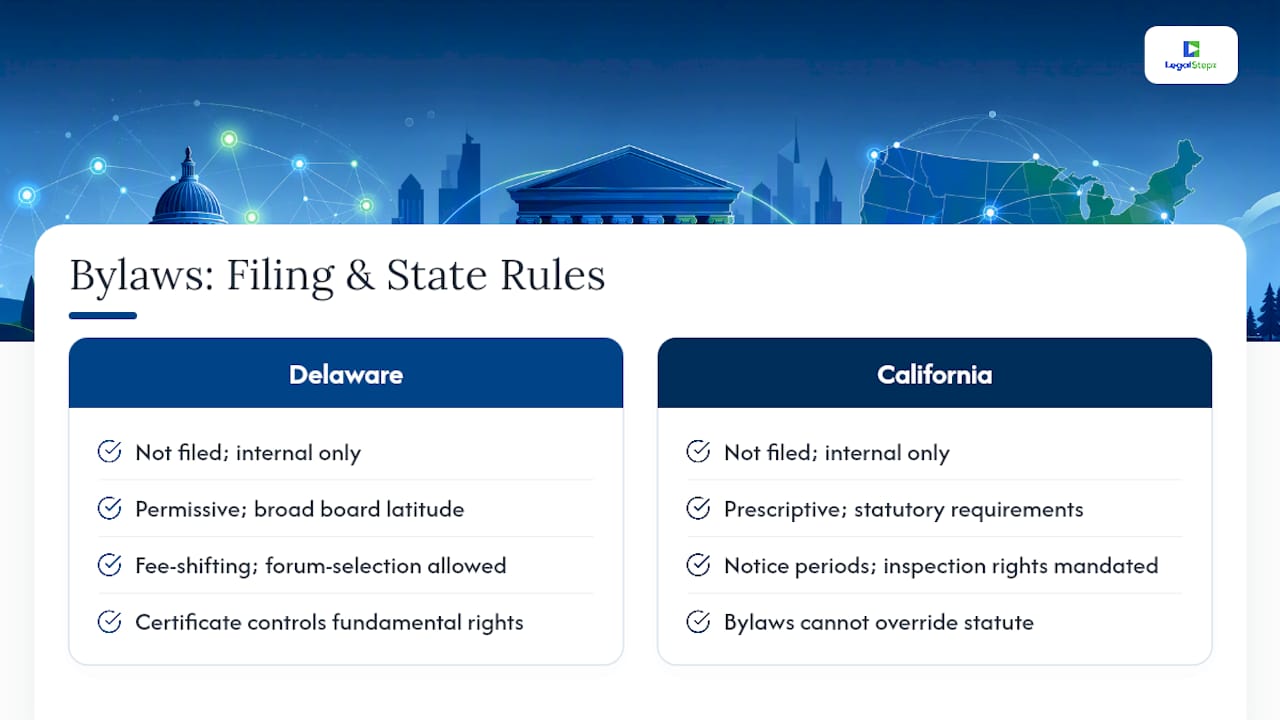
That said, state law still shapes what your bylaws must say and what they cannot override. Delaware's General Corporation Law is famously permissive, giving boards wide latitude to structure governance in the bylaws and allowing shareholders to adopt or amend bylaws directly. California's Corporations Code is more prescriptive: it mandates certain officer roles, sets minimum notice periods for meetings, and grants shareholders statutory inspection rights that bylaws cannot eliminate.
A few things to watch for by jurisdiction:
Delaware: Bylaws may include fee-shifting provisions and forum-selection clauses. The Certificate of Incorporation controls authorized shares and fundamental rights; bylaws handle the operational layer. Delaware law allows directors to adopt, amend, or repeal bylaws unless the Certificate reserves that power to shareholders.
California: The Corporations Code requires corporations to have a President (or Chair), a Secretary, and a Chief Financial Officer. California also mandates specific notice periods and imposes shareholder inspection rights by statute. Bylaws that attempt to waive those rights are unenforceable.
Regardless of state, bylaws cannot contradict the Articles of Incorporation or violate statutory requirements. When in doubt, check the state's corporate code directly or have counsel confirm the provision is permissible.
How to draft, adopt, and amend corporate bylaws
The process from blank document to signed, stored bylaws takes most corporations one to four weeks, depending on how quickly the founders align on governance decisions.
The practical sequence
- Draft the bylaws. Use a state-appropriate template as a starting point. Fill in the specific decisions your founders have made: board size, officer titles, meeting cadence, voting thresholds.
- Schedule the directors' organizational meeting. This is the first formal meeting of the board, typically held shortly after the Articles are filed.
- Adopt by board resolution. The board votes to adopt the bylaws. Record the vote in the meeting minutes.
- Sign and store. Directors sign the adoption resolution; the Secretary attests. File the signed bylaws and minutes in the corporate minute book.
- Distribute as needed. Provide copies to your bank, registered agent, and any investors who request them.
Stripe confirms that bylaws are typically created by the board at the organizational meeting and must be formally adopted and kept in corporate records.
Sample adoption resolution language
Cost options
| Approach | Typical cost shape | Best for |
|---|---|---|
| DIY template | Low (template cost only) | Simple single-class corporations with no outside investors |
| Online service with review | Moderate | Startups needing state-compliant documents without full attorney fees |
| Full attorney drafting | Higher | Multi-class stock, investor rounds, complex governance needs |
Records to keep after adoption
- Signed bylaws (original, with director signatures)
- Adoption resolution and meeting minutes
- Any subsequent amendment resolutions
- Stock ledger and share certificates (if issued)
Amending bylaws
Amendments follow the same logic as adoption: draft the change, adopt by the required vote (board, shareholders, or both per your amendment clause), record in minutes, and store the amended document. Wolters Kluwer recommends treating bylaws as a living document and scheduling regular reviews tied to annual corporate minutes so they stay current with leadership changes, new equity structures, and operational shifts.
California adoption checklist: a step-by-step playbook
California corporations face a more structured compliance environment than many other states, and the adoption process reflects that. Here is the sequence Legalstepz recommends for California founders.
Before the organizational meeting:
- Confirm the Articles of Incorporation are filed and accepted by the California Secretary of State
- Verify the registered agent is appointed and active
- Draft bylaws that comply with the California Corporations Code (officer roles, notice periods, inspection rights)
- Prepare the organizational meeting agenda and draft resolutions
At the organizational meeting:
- Adopt the bylaws by board resolution (use the sample language above)
- Appoint officers (President, Secretary, CFO at minimum)
- Authorize a bank account and designate signatories
- Issue initial shares and record in the stock ledger
- Prepare and sign meeting minutes
After the meeting:
- File the Statement of Information with the California Secretary of State within 90 days of incorporation (and annually thereafter). See Legalstepz's annual report requirements guide for current deadlines and fees.
- Retain signed bylaws and minutes in the corporate minute book
- Provide copies to your bank and any investors who request them
Sample California minutes entry:
Common California traps to avoid:
- Failing to include all three required officer roles (President, Secretary, CFO)
- Setting meeting notice periods shorter than the statutory minimum (10 days for most shareholder meetings)
- Omitting shareholder inspection rights, which California grants by statute and bylaws cannot waive
- Not filing the Statement of Information on time, which triggers a $250 penalty
Legalstepz handles bylaw drafting, adoption minutes preparation, and Statement of Information filing for California corporations. For step-by-step adoption guidance, see the California corporation bylaws adoption guide.
Common mistakes that make bylaws unenforceable or create disputes
Most bylaw problems are not exotic. They are the same handful of errors repeated across thousands of corporations.
Using a generic template without state customization. A Delaware template dropped into a California corporation will miss required officer roles, use the wrong notice periods, and omit statutory inspection rights. Fix: use a state-specific template or have a California-licensed attorney review before adoption.
Failing to formally adopt or sign the bylaws. Bylaws that were drafted but never voted on at an organizational meeting have no legal standing. Courts and lenders want to see a dated adoption resolution with director signatures. Fix: hold the organizational meeting, record the vote in minutes, and collect signatures before the document goes in the minute book.
Inconsistent language between bylaws and Articles. If the Articles authorize one class of common stock and the bylaws reference preferred stock rights, you have a conflict. The Articles prevail, but the inconsistency creates confusion and due-diligence friction. Fix: cross-check both documents before adoption.
Vague quorum and voting rules. "A majority of directors" sounds clear until you have a vacancy and a disputed meeting. Fix: state the quorum as a specific number or a percentage of the authorized (not seated) board.
Omitting amendment rules entirely. Without an amendment clause, state law defaults apply, which may require shareholder approval for changes the board could otherwise handle. Fix: include an explicit amendment provision that matches your governance intentions.
Not updating bylaws after major changes. A corporation that raises a Series A, adds a board seat, or changes its fiscal year without amending its bylaws is operating on outdated rules. Missing or outdated bylaws can create legal and transactional risks, and courts may use the gap against the corporation in veil-piercing arguments.
Red flags investors and banks watch for: missing director signatures on the adoption resolution, minutes that reference a meeting with no quorum, bylaws that predate the Articles filing date, and amendment resolutions with no shareholder vote where one was required.
A practical template and adoption checklist you can use today
A good bylaw template is not a fill-in-the-blank form. It is a structured document with placeholders for the decisions your founders must make, state-specific notes flagging where the law constrains your choices, and sample clause language you can adapt rather than write from scratch.
For a detailed review of the provisions and drafting choices available to California corporations, see Legalstepz's guide to bylaw provisions.
Sample clauses for high-impact sections
Board composition and quorum: "The Board of Directors shall consist of [number] directors. A quorum for the transaction of business shall require the presence of [majority / specific number] of the authorized directors."
Officer appointment: "The officers of the Corporation shall be elected by the Board of Directors at its annual organizational meeting and shall hold office until their successors are elected and qualified, or until earlier resignation or removal."
Meeting notice: "Notice of each meeting of shareholders shall be given in writing within an appropriate advance period before the date of the meeting, in compliance with applicable state laws."
Amendment procedure: "These Bylaws may be amended or repealed by the affirmative vote of a majority of the Board of Directors at any regular or special meeting, subject to any right of the shareholders to amend or repeal bylaws under applicable law."
Indemnification: "The Corporation shall indemnify its directors and officers to the fullest extent permitted by applicable law against expenses, judgments, fines, and amounts paid in settlement actually and reasonably incurred in connection with any proceeding arising from their service."
Adoption checklist
- Articles of Incorporation filed and confirmed
- Registered agent appointed
- Bylaws drafted and reviewed for state compliance
- Organizational meeting scheduled and noticed
- Adoption resolution prepared
- Board vote recorded in meeting minutes
- Bylaws signed by directors and attested by Secretary
- Signed bylaws and minutes filed in minute book
- Copies provided to bank, registered agent, and investors as needed
- Statement of Information filed (California corporations: within 90 days)
Storage and distribution
Keep the original signed bylaws in the corporate minute book alongside the adoption resolution and meeting minutes. Store a digital copy in a secure, access-controlled location. Provide copies to your bank when opening accounts, to investors during diligence, and to any co-founders or board members who request them. Annual minutes should reference the current bylaw version so the record stays coherent year over year.
CEB's guidance on corporate governance underscores that templates are useful starting points but should be reviewed and adapted to state law and company-specific facts before adoption, particularly for corporations with complex governance needs.
When a template is not enough
The standard template handles the standard corporation: one class of common stock, a small board, no outside investors, straightforward officer roles. That covers most early-stage companies, and a well-reviewed template adopted correctly is genuinely sufficient for them.
The cases where custom drafting earns its cost are narrower but consequential. A corporation raising a seed or Series A round will need preferred stock provisions, investor protective covenants, and possibly a staggered board, none of which a basic template addresses. A corporation with multiple founders who have different economic and voting rights needs those rights documented precisely in both the Articles and the bylaws, with no daylight between the two documents. Any corporation planning an acquisition or IPO within a few years should have governance documents that will survive institutional due diligence without a rewrite.
The risk with generic templates is not that they are wrong. It is that they are silent on the things that matter most in a complex situation. Silence in a bylaw is not neutral; it defaults to whatever the state statute says, which may not be what the founders intended. For corporations with investor rights, staggered boards, or preferred stock terms in play, the cost of a tailored review is small relative to the cost of a governance dispute at a critical moment.
Legalstepz makes California bylaw compliance straightforward
Drafting compliant bylaws, preparing adoption minutes, and staying current with California filing requirements is a lot to manage alongside actually building a business. Legalstepz handles the compliance layer so California founders can focus on the work that matters.

The Legalstepz compliance package covers bylaw drafting tailored to California corporations, preparation of organizational meeting minutes and adoption resolutions, Statement of Information filing, and registered agent services. For corporations that need ongoing compliance support, annual minutes preparation is also available. Every document is built for California's specific statutory requirements, not adapted from a generic national template.
If your corporation is at the formation stage or you have bylaws that have never been formally reviewed against current California law, visit Legalstepz to see the available packages and get your governance documents in order.
Sources
- bylaws | Wex | US Law | LII / Legal Information Institute
- What company bylaws are and how they work | Stripe
- Everything you need to know about company bylaws | Wolters Kluwer
- what are the bylaws of a corporation | Orrick
- Roles of corporate bylaws and business governance | CEB
This article is general information, not a substitute for advice from a qualified lawyer. Consult a qualified legal professional about your own circumstances before acting on anything here.