

California's annual report equivalent is the Statement of Information, a mandatory filing submitted to the California Secretary of State that updates your business address, management, and registered agent details. Most states call this an annual report. California calls it something different, files it on a different schedule, and pairs it with a completely separate tax obligation that trips up thousands of business owners every year. This California annual report explained guide covers every requirement you need to know: what to file, when to file it, what it costs, and what happens if you miss the deadline.
What is california's statement of information vs. an annual report?
The Statement of Information is California's functional equivalent of an annual report, but it works differently from what most business owners expect. California LLCs and corporations file this document every two years with the Secretary of State, not annually. That biennial schedule is unusual compared to most other states, and it catches many founders off guard when they move their business to California or form a new entity here.
The filing itself is straightforward. It captures your business address, the names and addresses of your officers or managers, and your registered agent's information. Critically, the Statement of Information does not include financial data. You are not submitting a balance sheet or income statement. This is purely an operational compliance document that keeps the state's records current.

Here is how California's filing compares to a typical annual report in other states:
| Feature | California Statement of Information | Typical Annual Report (Other States) |
|---|---|---|
| Filing frequency | Every two years | Every year |
| Financial data required | No | Sometimes |
| Filing authority | Secretary of State | Secretary of State |
| LLC fee | $20 | Varies ($50–$500) |
| Corporation fee | $25 | Varies |
| Initial filing deadline | Within 90 days of formation | Varies |
The fees are low by any standard. LLCs pay $20 per filing and corporations pay $25. The real cost of getting this wrong is not the fee. It is the $250 penalty and the risk of suspension that follows a missed deadline.
Pro Tip: File your Statement of Information online through BizFile, the Secretary of State's online filing portal. It accepts credit and debit cards, processes faster than mail, and reduces the chance of a clerical error that could delay your filing.
How often do you file and when are deadlines?
Filing frequency and timing depend on your entity type, but the core rule applies to both LLCs and corporations: file every two years. The specific window is tied to your formation month, which means every business has a unique filing calendar.
Here is how the schedule works in practice:
- Form your entity. The clock starts the day the Secretary of State approves your formation documents.
- File your initial Statement of Information within 90 days. This first filing is required regardless of where you fall in the biennial cycle.
- Identify your filing window. LLCs have a 6-month filing window based on their formation month, recurring every two years. If you formed in March, your window opens in September of your filing year and closes at the end of March.
- Submit before the window closes. You can file up to 6 months before the deadline, so there is no reason to wait until the last week.
- Pay the filing fee. $20 for LLCs, $25 for corporations. No exceptions.
The biennial filing cadence is genuinely unusual compared to other states' annual reports. Business owners who have operated in states like Delaware, Texas, or Florida are accustomed to a simple annual reminder. In California, the two-year gap can create a false sense of security. Two years feels like a long time until the window closes and you realize you missed it.
Late filings trigger a $250 penalty assessed by the Franchise Tax Board after a 60-day grace period. That grace period sounds generous, but the clock starts from your deadline, not from when you notice the problem. By the time most business owners realize they are late, the grace period is already shrinking.
Pro Tip: Set two calendar reminders: one at the start of your 6-month filing window and one 30 days before it closes. Label them clearly as "Statement of Information" so they do not get confused with your franchise tax due dates, which run on a completely different schedule.
What are the penalties for not filing in california?
Missing the Statement of Information deadline creates a chain reaction that can shut down your ability to operate legally in California. The consequences escalate in stages, and each stage is harder to reverse than the last.
The immediate consequence is a $250 late penalty assessed by the Franchise Tax Board after the 60-day grace period expires. That penalty is fixed. It does not scale with your revenue or how late you are.
Continued noncompliance leads to suspension or forfeiture by the Secretary of State. Suspension is not just a paperwork problem. Suspended entities lose the legal capacity to sue, defend claims, and enforce contracts. If a client owes you money and your entity is suspended, you cannot take them to court to collect. If a vendor breaches a contract, you cannot enforce it. Your business is legally paralyzed.
A suspended California LLC or corporation cannot sue, cannot defend itself in court, and cannot enforce any contract it has signed. Reinstatement requires clearing both Secretary of State and Franchise Tax Board obligations simultaneously.
Reviving a suspended entity requires clearing both the Secretary of State filing and any outstanding Franchise Tax Board obligations at the same time. That means paying the $250 penalty, filing the overdue Statement of Information, and resolving any unpaid franchise taxes before the state restores your good standing. The process takes time and often requires professional help.
The California Secretary of State and Franchise Tax Board operate independently for compliance tracking. A payment to one does not automatically update the other. This is the most common reason reinstatements get delayed: business owners pay one agency and assume the problem is solved.
For a deeper look at maintaining good standing as a California LLC, the annual requirements go beyond just the Statement of Information filing.
How does the $800 franchise tax differ from the statement of information?
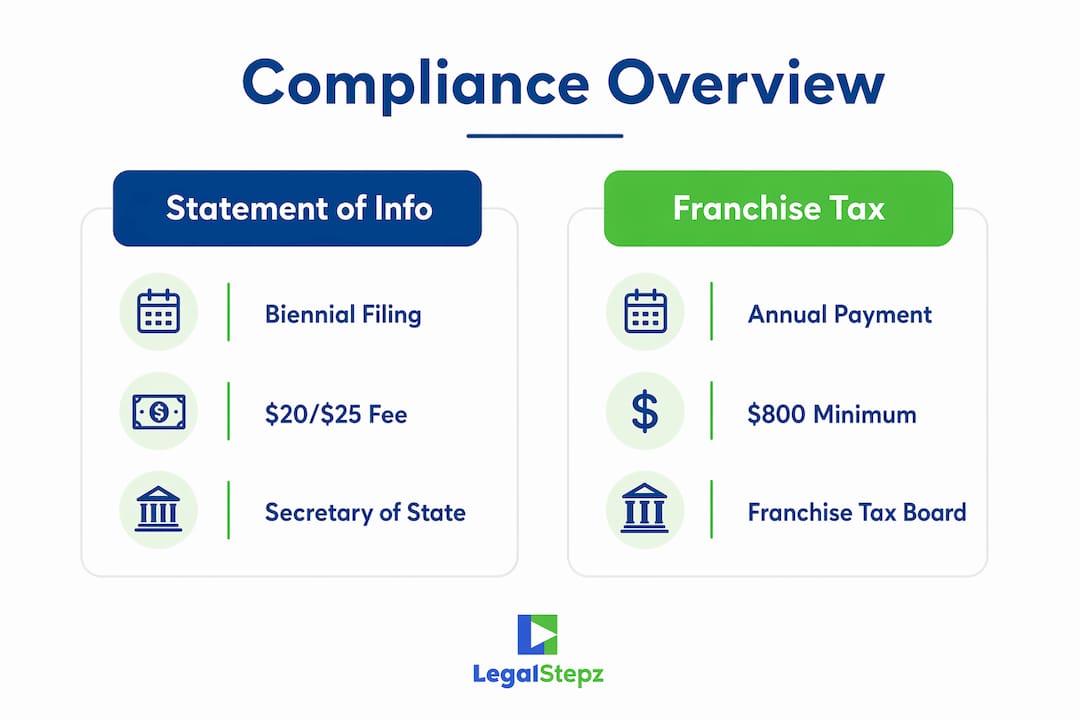
The $800 minimum franchise tax is the most misunderstood part of California business compliance. Business owners frequently believe that filing the Statement of Information satisfies all their annual obligations. It does not. The franchise tax is a completely separate requirement paid to a different agency on a different schedule.
Here is a side-by-side comparison of the two obligations:
| Obligation | Filing Authority | Frequency | Amount | Tied to Revenue? |
|---|---|---|---|---|
| Statement of Information | Secretary of State | Every two years | $20–$25 | No |
| Minimum Franchise Tax | Franchise Tax Board | Every year | $800 minimum | No (minimum is fixed) |
The $800 minimum franchise tax is owed every year regardless of revenue. A brand-new LLC that earned zero dollars in its first year still owes $800 to the Franchise Tax Board. The only exception is the first taxable year for newly formed LLCs, which received a first-year exemption under recent California law changes.
Missing the franchise tax payment carries more severe penalties than a late Statement of Information filing. The Franchise Tax Board charges interest on unpaid amounts, adds penalties, and can independently trigger suspension separate from the Secretary of State's process. A business can be suspended by both agencies simultaneously, compounding the reinstatement burden.
The practical implication is that you need two separate compliance calendars. Your Statement of Information calendar tracks your biennial filing window based on your formation month. Your franchise tax calendar tracks the annual April 15 due date for most entities. Mixing them up is the single most common compliance mistake California business owners make.
Pro Tip: Label your internal calendar entries with the specific agency name: "SOS Statement of Information" and "FTB Franchise Tax." The distinction matters when you are troubleshooting a compliance issue or working with a professional to resolve a suspension.
For a full breakdown of what the California franchise tax covers and how it is calculated, the details go well beyond the $800 minimum for higher-revenue entities.
Key takeaways
California business compliance requires two separate, parallel filing tracks that must both stay current to maintain good standing.
| Point | Details |
|---|---|
| Statement of Information is biennial | LLCs and corporations file every two years with the Secretary of State, not annually. |
| Fees are low but penalties are not | Filing costs $20–$25, but a missed deadline triggers a $250 penalty plus suspension risk. |
| No financial data required | The Statement of Information covers addresses and management only, not revenue or expenses. |
| Franchise tax is a separate obligation | The $800 minimum franchise tax goes to the Franchise Tax Board every year, independent of the SOS filing. |
| Suspension has real legal consequences | A suspended entity cannot sue, defend claims, or enforce contracts until both agencies are cleared. |
Why california's compliance system catches so many business owners off guard
I have worked with enough California business owners to know that the confusion here is not a sign of carelessness. The system is genuinely counterintuitive. Most states train you to think in annual cycles. California runs two parallel tracks on different schedules managed by two separate agencies that do not communicate with each other in real time.
The mistake I see most often is not the missed Statement of Information filing. It is the missed franchise tax. Founders file their Statement of Information on time, feel good about their compliance, and then get a notice from the Franchise Tax Board six months later because they forgot the $800 payment was due in April. They thought they were done. They were not.
The second most common mistake is waiting until the last week of the filing window. The 6-month window feels generous until something goes wrong: a registered agent address change, a manager who left the company, an officer whose information needs updating. Sorting those details under deadline pressure creates errors that slow down the filing.
My honest advice is to treat the Statement of Information and the franchise tax as two completely separate projects with separate owners, separate reminders, and separate checklists. Using BizFile for online filing removes most of the friction from the SOS side. The FTB side requires its own attention and, for most businesses, a tax professional who knows California's rules.
Stay proactive. The cost of compliance is $20 or $25 every two years plus $800 per year. The cost of non-compliance is $250 in penalties, potential suspension, and the legal paralysis that follows. The math is not complicated.
— Peter
How Legalstepz helps you stay compliant in california
California's split compliance system is manageable when you have the right support. Legalstepz is built specifically for California business owners who need to stay on top of their Statement of Information filings, registered agent requirements, and ongoing compliance tasks without getting buried in paperwork.

Whether you are forming a new LLC and need to understand your first 90-day filing obligation or you are an established corporation trying to untangle a compliance backlog, Legalstepz covers the full range of California business requirements. The platform handles Statement of Information filings, registered agent services, annual minutes, and bylaws. For business owners who want to understand the full incorporation process from day one, the Incorporation Course walks through every filing obligation in sequence. Visit Legalstepz to get started.
FAQ
What is california's version of an annual report?
California uses the Statement of Information instead of a traditional annual report. It is filed every two years with the Secretary of State and covers business address, officers, and registered agent details.
How much does it cost to file the statement of information?
LLCs pay a $20 filing fee and corporations pay $25. These fees are paid directly to the California Secretary of State at the time of filing.
What happens if i miss the statement of information deadline?
A $250 penalty is assessed by the Franchise Tax Board after a 60-day grace period. Continued noncompliance can lead to suspension or forfeiture, which strips the entity of its ability to sue or enforce contracts.
Is the $800 franchise tax the same as the statement of information filing?
No. The $800 minimum franchise tax is a separate annual payment made to the Franchise Tax Board. The Statement of Information is a biennial filing made to the Secretary of State. Missing either one creates independent compliance problems.
When is the first statement of information due for a new california business?
The initial Statement of Information must be filed within 90 days of formation, regardless of where the entity falls in the standard biennial cycle. After that, the two-year schedule based on your formation month applies.