

A California Benefit Corporation is a legally recognized for-profit corporation that must pursue both financial success and a documented positive impact on society and the environment. Governed by California Corporations Code Sections 14600 et seq., effective since january 1, 2012, this structure gives founders a legal framework to build mission-driven companies without sacrificing profit. Over 40 states have adopted similar laws as of mid-2026, signaling that the benefit corporation model has moved from niche experiment to mainstream legal option. For California entrepreneurs evaluating their legal structure, understanding the california benefit corporation explained in full detail is the clearest path to making the right choice.
How does a California Benefit Corporation differ from other business forms?
A California Benefit Corporation replaces the traditional fiduciary duty to maximize shareholder value with a broader mandate. Directors must consider stakeholder impacts beyond shareholders, including employees, communities, and the environment. That shift is not cosmetic. It is written into the corporate charter and enforceable under California law.
Traditional for-profit corporations operate under shareholder primacy. Every major decision is evaluated through the lens of financial return to investors. A Benefit Corporation legally expands that lens to include workers, suppliers, customers, and the public. Non-profits, by contrast, cannot distribute profits to owners at all. A Benefit Corporation sits between these two models, earning profit while carrying a documented social obligation.

The structure also differs from a Flexible Purpose Corporation, another California option. A Flexible Purpose Corporation allows companies to specify one or more special purposes in their charter, but it does not require a general public benefit. A Benefit Corporation must pursue a general public benefit as a default, with optional specific public benefits added on top.
B Corp certification is a separate concept entirely. It is a voluntary private certification issued by B Lab, a nonprofit organization. Benefit Corporation status is a legal designation granted by the state. Many states require legal Benefit Corporation status before a company can pursue B Corp certification, but the two are not interchangeable.
The table below summarizes the key structural differences:
| Feature | Benefit Corporation | Traditional C Corp | Non-Profit | B Corp Certification |
|---|---|---|---|---|
| Profit distribution | Allowed | Allowed | Not allowed | Allowed |
| Fiduciary duty | Stakeholders + shareholders | Shareholders only | Mission only | Shareholders (varies) |
| Public benefit required | Yes, legally mandated | No | Yes, by definition | No, voluntary standard |
| Annual benefit report | Required | Not required | Required (Form 990) | Required for renewal |
| Legal status | State law | State law | State law | Private certification |
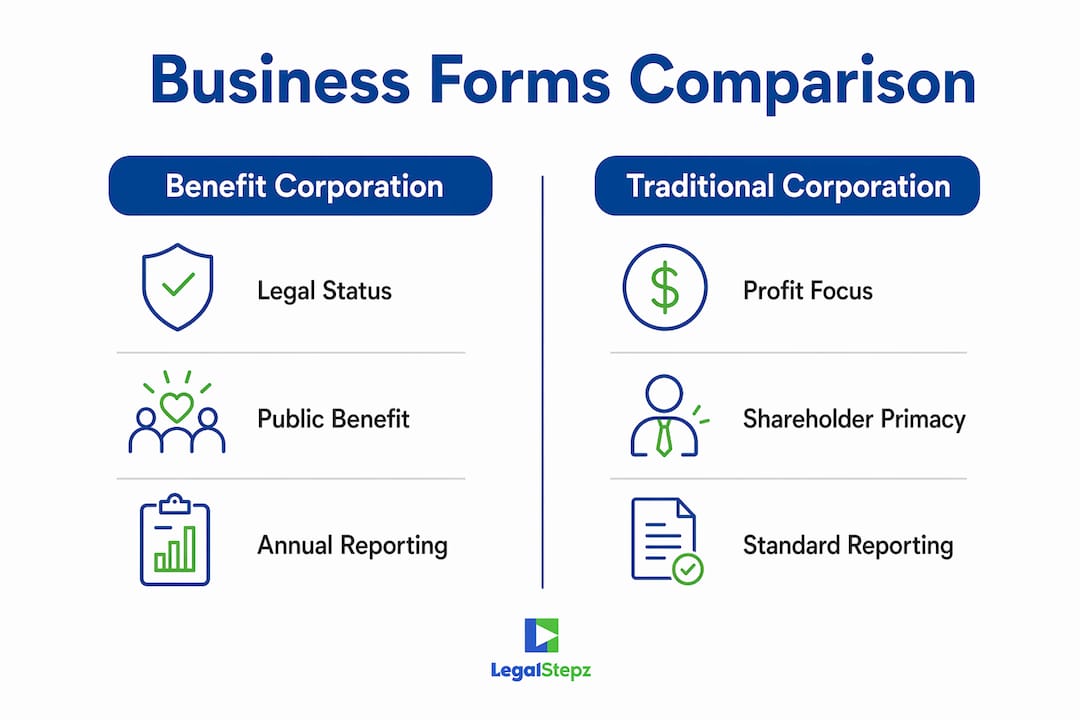
Entrepreneurs choosing between an LLC and a Benefit Corporation face a different set of tradeoffs. An LLC offers flexible management and pass-through taxation. A Benefit Corporation provides the corporate structure needed for equity investment and the legal protection to pursue social goals. For founders planning to raise venture capital while maintaining a mission, the Benefit Corporation is the stronger fit. Legalstepz covers the LLC vs. corporation decision in detail for founders weighing both paths.
What legal and operational requirements must a California Benefit Corporation meet?
California law sets clear, non-negotiable requirements for Benefit Corporations. Meeting them is not optional, and missing them carries real consequences.
-
State the general public benefit in the Articles of Incorporation. The charter must explicitly declare the company's commitment to creating a general public benefit. This language is binding and survives leadership changes, mergers, and ownership transfers.
-
Produce an annual benefit report. The report must include a narrative description of progress toward the public benefit goal, obstacles encountered, director assessments of performance, and officer information. This is not a marketing document. It is a legal accountability tool.
-
File the report with the California Secretary of State and publish it publicly. Annual benefit reports must be accessible to the public, typically posted on the company's website. Transparency is the mechanism that prevents the status from becoming a branding shortcut.
-
Use a third-party standard to assess social and environmental performance. California law requires companies to measure their impact against a recognized external standard. B Lab's B Impact Assessment is one widely used option, though others exist.
-
Appoint a benefit director or benefit officer if desired. These roles are optional under California law but common in practice. A benefit director holds specific responsibility for overseeing compliance with the public benefit mandate. Smaller companies often rely on a single benefit director or delegate oversight to the full board.
Pro Tip: Choose your third-party standard before you file. The standard shapes how you measure and report impact, and switching standards mid-stream creates reporting inconsistencies that can undermine credibility with investors and regulators.
Failure to file benefit reports can result in administrative dissolution or revocation of Benefit Corporation status. That outcome damages both reputation and financial relationships. Treat the annual report as a core compliance obligation, not an afterthought.
What are the practical benefits and challenges of forming a Benefit Corporation in California?
The advantages of Benefit Corporation status are concrete and legally grounded, not just marketing talking points.
- Director liability protection. Directors are legally protected when they prioritize social or environmental goals over short-term profits, provided those decisions align with the charter. This eliminates the risk of shareholder lawsuits for "failing to maximize profits," a real legal threat in traditional corporations.
- Mission durability. The public benefit commitment embedded in the Articles of Incorporation is not easily amended. It persists through leadership transitions and ownership changes, giving founders confidence that the company's values survive beyond their tenure.
- Brand credibility. Benefit Corporation status signals genuine legal commitment to stakeholders, not just a marketing claim. Customers, employees, and impact investors increasingly treat it as a meaningful differentiator.
- Access to impact capital. A growing segment of investors specifically targets Benefit Corporations. The legal structure provides the accountability framework those investors require.
The challenges are equally real and worth confronting directly.
Benefit Corporations receive no special tax treatment. They are taxed as traditional C Corporations at both federal and state levels. Entrepreneurs who expect a tax advantage based on entity status alone will be disappointed. The value of the structure is legal and reputational, not fiscal.
The administrative burden is significant. Annual benefit reports require time, data collection, and honest self-assessment. Companies that treat the reporting requirement as a checkbox exercise risk accusations of greenwashing. Strict transparency requirements are designed to hold companies accountable for their declared commitments, and public scrutiny of benefit reports is increasing.
The structure also demands genuine organizational commitment. Founders who adopt Benefit Corporation status primarily for marketing purposes, without embedding the mission into operations, face reputational and legal exposure. The legal form works best when the mission is real.
How do you form a California Benefit Corporation and stay compliant?
Formation follows a clear sequence. Each step has legal weight, so precision matters.
- Draft Articles of Incorporation that include the general public benefit language. California law requires explicit charter language. Generic articles used for standard C Corporations will not satisfy this requirement. Review the California domestic corporation framework to understand what baseline corporate formation requires before adding the benefit layer.
- File the Articles with the California Secretary of State. The filing fee and process mirror standard corporation formation. The difference is in the content of the document, not the filing mechanics.
- Select a third-party standard for impact measurement before operations begin. B Lab's B Impact Assessment is the most widely recognized option. Other credible standards exist in specific sectors, such as environmental or community development frameworks.
- Establish an annual reporting calendar. The benefit report is due annually. Build the data collection process into your operations from day one. Waiting until the deadline to gather impact data produces weak, unconvincing reports.
- Post the benefit report publicly. Most companies publish the report on their website. The annual report requirements for California corporations provide the compliance baseline, and Benefit Corporations layer additional reporting obligations on top.
Pro Tip: Treat your first benefit report as a baseline document, not a performance showcase. Honest reporting of early-stage impact, including gaps and obstacles, builds more credibility with sophisticated stakeholders than polished claims unsupported by data.
Ongoing compliance also means keeping your registered agent current, filing the Statement of Information with the California Secretary of State, and maintaining corporate minutes. These are standard corporate obligations that apply to Benefit Corporations alongside the benefit-specific requirements. Legalstepz handles registered agent services, annual minutes, and Statement of Information filings for California corporations.
Key Takeaways
A California Benefit Corporation is a for-profit legal entity that embeds a public benefit mandate into its charter, giving directors legal protection to prioritize social and environmental goals alongside profit.
| Point | Details |
|---|---|
| Legal foundation | Governed by California Corporations Code Sections 14600 et seq., effective since 2012. |
| Director protection | Directors can legally prioritize social goals over short-term profits without shareholder lawsuit risk. |
| No tax advantage | Benefit Corporations are taxed as C Corporations; no special state or federal tax treatment applies. |
| Annual reporting required | Companies must produce, file, and publicly post an annual benefit report using a third-party standard. |
| B Corp vs. Benefit Corp | B Corp certification is voluntary and private; Benefit Corporation is a state-granted legal status. |
Why I think most founders misread the value of Benefit Corporation status
Most founders I talk to focus on the marketing angle first. They want the credibility signal, the ability to say "we're a Benefit Corporation" in pitch decks and on their website. That instinct is not wrong, but it is incomplete.
The real value is legal protection for directors. Traditional corporate law creates genuine exposure for boards that choose environmental or community outcomes over short-term financial returns. Benefit Corporation status removes that exposure. For founders who plan to build long-term, mission-driven companies, that protection is worth more than any brand signal.
The founders who get the most from this structure are the ones who treat the annual benefit report as a management tool, not a compliance chore. The reporting process forces honest measurement of whether the mission is actually advancing. That discipline catches drift early, before it becomes a credibility problem.
My caution is this: do not file as a Benefit Corporation because it sounds good. File because your operations, your hiring decisions, your supplier relationships, and your capital allocation already reflect the mission. The legal structure should confirm what you are already doing, not define what you aspire to become someday.
— Peter
How Legalstepz can help you form and maintain your Benefit Corporation
Forming a California Benefit Corporation requires more than downloading a template. The Articles of Incorporation must include specific public benefit language, and your ongoing compliance obligations begin the moment you file.

Legalstepz offers an incorporation course built specifically to walk California entrepreneurs through the formation process step by step, from drafting compliant Articles of Incorporation to understanding your annual reporting obligations. Beyond formation, Legalstepz provides registered agent services, Statement of Information filings, and annual minutes drafting to keep your corporation in good standing year after year. If you are serious about building a mission-driven company on a legally sound foundation, Legalstepz gives you the tools to do it right from day one.
FAQ
What is a California Benefit Corporation?
A California Benefit Corporation is a for-profit legal entity governed by California Corporations Code Sections 14600 et seq. that must pursue both profit and a documented general public benefit, with directors legally required to consider stakeholder impacts beyond shareholders.
Is a Benefit Corporation the same as a B Corp?
No. B Corp certification is a voluntary private designation issued by B Lab, while Benefit Corporation is a legal status granted by the state of California. Many states require legal Benefit Corporation status before a company can pursue B Corp certification.
Does a Benefit Corporation get tax breaks in California?
A Benefit Corporation receives no special tax treatment at the state or federal level. It is taxed identically to a traditional C Corporation, so entrepreneurs should not expect tax advantages from the entity status alone.
What happens if a Benefit Corporation fails to file its annual benefit report?
Failure to file can result in administrative dissolution or revocation of Benefit Corporation status in California. That outcome damages both the company's reputation and its financial relationships with investors and partners.
Can a small startup form as a California Benefit Corporation?
Yes. California law imposes no minimum size requirement for Benefit Corporation formation. Smaller companies often appoint a single benefit director or delegate oversight to the full board to manage compliance obligations efficiently.