

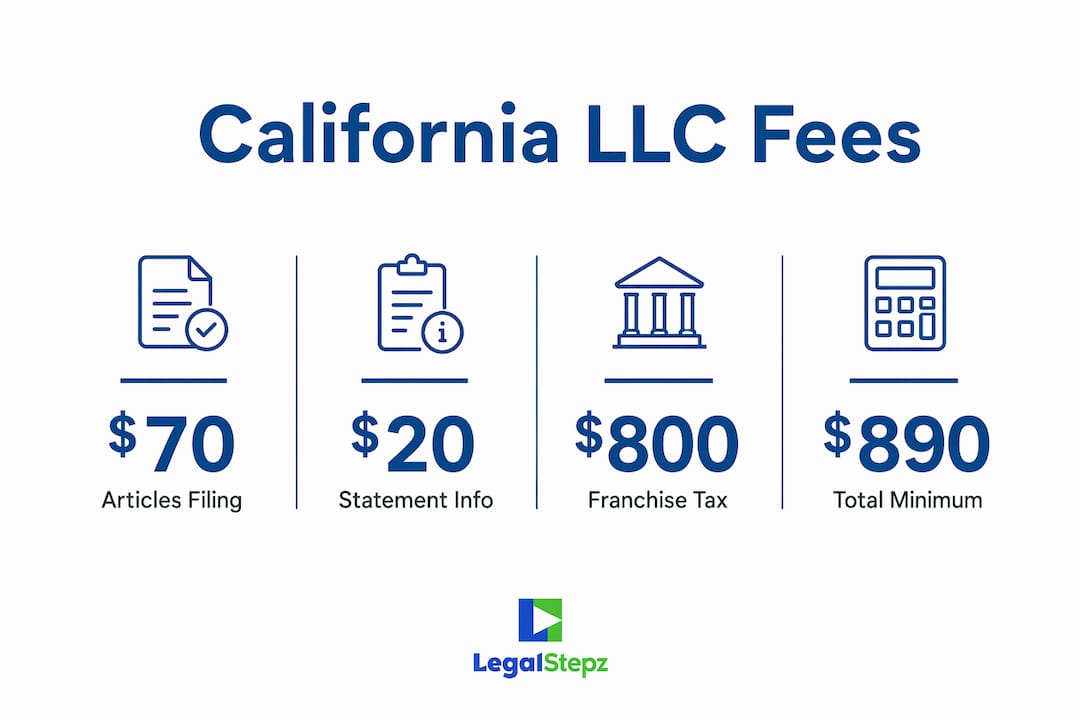
Forming a California LLC costs a minimum of $890 in the first year, covering the $70 Articles of Organization filing fee, the $20 initial Statement of Information, and the mandatory $800 annual franchise tax. This california business formation cost breakdown matters because most entrepreneurs budget only for the filing fee and get blindsided by the franchise tax bill weeks later. The Franchise Tax Board (FTB) and the California Secretary of State (SOS) each collect separate fees on different schedules, and missing either one triggers penalties. Understanding every line item before you file is the difference between a smooth launch and a cash-flow crisis in month three.
What are the mandatory government fees to form a California LLC?
The core state fees to form a California LLC in 2026 total $890 for the first year, split across two agencies and three separate payments. Each fee has its own deadline, its own agency, and its own penalty structure if you miss it.
Articles of Organization (LLC-1)
Filing the LLC-1 form with the California SOS costs $70 online. This is the document that legally creates your LLC. Processing times vary, but expedited SOS filing costs between $350 and $750 if you need faster turnaround. Most entrepreneurs filing online without expediting can expect standard processing within a few business days.

Initial Statement of Information (LLC-12)
Within 90 days of forming your LLC, you must file the LLC-12 form with the SOS for a $20 fee. This document lists your principal office address, registered agent, and managing members. After the initial filing, the Statement of Information recurs every two years at the same $20 cost. Missing the 90-day window results in a $250 late penalty, which is twelve times the filing fee itself.
The $800 minimum franchise tax
Every California LLC owes the FTB an $800 minimum annual franchise tax regardless of whether the business earns a single dollar. The payment is due by the 15th day of the 4th month of the LLC's tax year. For a calendar-year LLC, that means April 15. There is no grace period for new businesses and no first-year exemption for LLCs formed in 2026.
Here is a quick reference for the mandatory fees:
- Articles of Organization (LLC-1): $70, paid once at formation to the SOS
- Initial Statement of Information (LLC-12): $20, due within 90 days of formation
- Biennial Statement of Information: $20, due every two years thereafter
- Minimum annual franchise tax: $800, due by the 15th of the 4th month each tax year
- Annual LLC Return of Income (Form 568): No additional filing fee, but required for compliance
Filing Form 568 carries no extra cost, but missing this return puts your LLC out of good standing with the FTB, which can block you from renewing licenses or entering contracts.
How does the FTB's annual tax and gross receipts fee affect your budget?
The $800 minimum franchise tax is the largest single line item in the California business startup costs picture, and it compounds quickly for growing businesses. The FTB layers an additional income-based LLC fee on top of the minimum tax once your California income crosses $250,000.
The tiered LLC fee structure works as follows:
- $0 to $249,999 in California income: $800 minimum tax only
- $250,000 to $499,999: $800 minimum tax plus $900 LLC fee
- $500,000 to $999,999: $800 minimum tax plus $2,500 LLC fee
- $1,000,000 to $4,999,999: $800 minimum tax plus $6,000 LLC fee
- $5,000,000 and above: $800 minimum tax plus $11,790 LLC fee
The income-based LLC fee is due by the 15th day of the 6th month of the tax year, which is a separate deadline from the $800 minimum tax. That means a calendar-year LLC with strong revenue owes the $800 by April 15 and the income-based fee by June 15. Missing either deadline triggers interest and penalties.
Pro Tip: If you expect your LLC to cross $250,000 in California income in its first year, set aside the estimated LLC fee in a separate account from day one. The FTB expects an estimated payment, and underpaying creates a penalty even if you settle up at year-end.
Comparing California to other states puts this in perspective. Most states charge annual report fees between $50 and $300 with no minimum income tax. California's high ongoing cost structure is driven almost entirely by the recurring franchise tax and income-based fees, not the initial filing costs. The $70 Articles of Organization fee is actually among the lowest in the country. The real cost of operating in California is the $800 per year floor that never goes away.
What optional and local costs should entrepreneurs expect?
Beyond state fees, several additional costs of starting a business in California can add hundreds of dollars to your first-year budget. None of these are technically required by the SOS or FTB, but most businesses will encounter at least two or three of them.
- Registered agent services: If you do not have a physical California address or prefer privacy, a professional registered agent typically costs between $100 and $300 annually. The SOS requires every LLC to maintain a registered agent with a California street address.
- Operating agreement: California law requires LLCs to have an operating agreement, but you do not file it with the state. Drafting one yourself costs nothing. Hiring an attorney to draft it can run $500 to $1,500. Template-based services fall in between.
- Federal EIN: The IRS issues Employer Identification Numbers for free through its online portal. Some formation services charge $50 to $100 to obtain one on your behalf, which is unnecessary.
- Local business licenses: Cities and counties across California require their own business licenses and permits, with fees ranging from $50 to $500 or more annually. Los Angeles, San Francisco, and San Diego each have their own fee schedules based on industry and gross receipts.
- Expedited SOS filing: Standard processing is free beyond the base fee. Expedited processing costs $350 to $750 depending on turnaround time.
- DBA registration: If you operate under a name different from your LLC's legal name, you must file a fictitious business name statement with your county. Fees typically run $25 to $75.
Pro Tip: Check your city's business license portal before you file your LLC. Some cities require a license before you can legally accept your first payment, and the application process can take two to four weeks.
For a deeper look at registered agent options specific to California LLCs, the requirements and cost tradeoffs vary more than most entrepreneurs realize.
How to plan and budget for California LLC formation costs strategically
Smart budgeting for California LLC formation costs means accounting for both the one-time setup fees and the recurring annual obligations. The formation filing is a one-day event. The franchise tax is a permanent fixture.
-
Time your formation date carefully. Forming an LLC late in the calendar year can trigger two $800 franchise tax payments within just a few months. An LLC formed in November 2026 owes $800 for the 2026 tax year and another $800 due by April 15, 2027. Forming in January gives you the most runway before the first payment is due.
-
Build a first-year cost model before you file. Add up the $70 filing fee, $20 Statement of Information, $800 franchise tax, registered agent costs if needed, local business license fees, and any professional service fees. A realistic first-year budget for a California LLC with no revenue runs between $1,000 and $1,500 when you include local licenses and a registered agent.
-
Track the two separate FTB deadlines. The $800 minimum tax is due by the 15th of the 4th month. The income-based LLC fee is due by the 15th of the 6th month. Missing either one adds interest and penalties to your bill. Small businesses tracking key tax deadlines avoid these surprises with a simple calendar reminder set at formation.
-
Use DIY options where the savings are real. The FTB EIN application is free. The SOS online filing portal is straightforward. You can draft a basic operating agreement from a reputable template. Save professional service fees for your operating agreement and registered agent if you genuinely need them.
-
Plan for biennial compliance costs. The $20 Statement of Information recurs every two years. Add it to your business calendar now so it does not catch you off guard.
Pro Tip: If you are choosing between forming an LLC and a corporation in California, note that corporations face the same $800 minimum franchise tax. The business entity type you choose affects your tax treatment, not your exposure to the franchise tax floor.
Key takeaways
The total cost to form a California LLC in 2026 starts at $890 in mandatory state fees, with the $800 annual franchise tax representing the largest and most persistent expense every entrepreneur must plan for.
| Point | Details |
|---|---|
| First-year minimum cost | Budget at least $890 for state fees: $70 Articles of Organization, $20 Statement of Information, and $800 franchise tax. |
| No first-year exemption | The $800 franchise tax applies from year one with no exemption for LLCs formed in 2026. |
| Income-based fees kick in at $250K | Revenue above $250,000 triggers an additional LLC fee up to $11,790, due on a separate June deadline. |
| Formation timing matters | Forming late in the year can force two $800 payments within months. Form early in the calendar year. |
| Local costs add up | City and county business licenses add $50 to $500 or more annually and are legally required before operations begin. |
What I have learned about California formation costs after watching hundreds of startups
The single biggest mistake I see California entrepreneurs make is treating the $70 filing fee as the cost of forming an LLC. It is not. It is the cost of submitting a form. The actual cost of forming a California LLC is $890 in year one, and $800 every year after that, before you account for a single local license or professional service.
The first-year exemption misconception is particularly damaging. Before 2024, new LLCs could defer the $800 tax in their first year. That exemption no longer exists for LLCs formed in 2026. Entrepreneurs who read outdated guides or take advice from someone who formed their LLC in 2021 will budget incorrectly and face a surprise bill in their first quarter.
What I find most useful is separating formation costs into three buckets: one-time state fees, recurring state obligations, and local and optional costs. The first bucket is small and predictable. The second bucket is large and permanent. The third bucket varies by city, industry, and how much professional help you want. When you see the three buckets clearly, the budgeting becomes straightforward instead of stressful.
One more thing worth saying directly: California is expensive to operate in, but the formation process itself is not complicated. The SOS online portal works well. The FTB payment system is functional. The fees are high, but the process is transparent once you know where to look.
— Peter
How Legalstepz can help you manage formation and compliance
Starting a California LLC involves more paperwork than most entrepreneurs expect, and missing a deadline costs more than hiring help in the first place.

Legalstepz handles the filings and compliance tasks that trip up new business owners: Statement of Information filings, annual minutes, bylaws drafting, and registered agent services. If you want to understand the full formation process before you pay for anything, the Incorporation Course walks you through every step with clear explanations of fees, deadlines, and documents. For entrepreneurs ready to file now, Legalstepz offers formation support with transparent pricing so you know exactly what you are paying for and why.
FAQ
What is the minimum cost to form an LLC in California in 2026?
The minimum cost is $890, covering the $70 Articles of Organization fee, the $20 initial Statement of Information, and the $800 mandatory annual franchise tax. This amount is due in the first year regardless of whether the LLC earns any revenue.
Is there a first-year franchise tax exemption for new California LLCs?
No. The first-year exemption that previously applied to new LLCs was eliminated, and LLCs formed in 2026 owe the full $800 minimum franchise tax starting in their first tax year.
How often do California LLCs pay the $800 franchise tax?
The $800 minimum franchise tax is due every year, payable to the Franchise Tax Board by the 15th day of the 4th month of the LLC's tax year. For a calendar-year LLC, that deadline is April 15.
What local fees do California businesses need to budget for?
City and county business licenses typically cost between $50 and $500 or more annually, depending on your location and industry. These fees are separate from state fees and are required before you legally begin operations.
What is the cheapest way to start a business in California?
The cheapest approach is to file the Articles of Organization yourself through the SOS online portal for $70, file the initial Statement of Information for $20, obtain your federal EIN for free through the IRS, and draft your own operating agreement using a reputable template. You still owe the $800 franchise tax, which is unavoidable.