

California business record keeping basics are the essential practices of systematically creating, organizing, retaining, and protecting business documents to comply with state and federal laws. Every California entrepreneur needs to understand which records to keep, how long to keep them, and what tools make the job manageable. The California Franchise Tax Board (FTB), the Employment Development Department (EDD), and the California Department of Tax and Fee Administration (CDTFA) each have their own requirements. Miss any one of them and you risk denied deductions, audit penalties, or worse. This guide covers the required document types, specific retention timelines, and practical workflows to keep your business protected in 2026.
What types of records must California businesses keep?
California businesses must maintain records across six core categories. Each category serves a different compliance function, and gaps in any one of them can create serious problems during an audit or legal dispute.
- Income and expense records: Invoices, receipts, bank statements, and profit and loss statements. These form the backbone of your tax filings with the FTB and the IRS.
- Payroll and employment tax records: Wage records, W-2s, Form 940 and 941 filings, and EDD payroll tax documentation. Payroll records must be kept for a minimum of 4 years for IRS and EDD compliance, and 30 years if employees were exposed to hazardous materials.
- Sales and use tax records: Sales receipts, exemption certificates, and purchase records. The CDTFA requires these to prove taxable versus exempt transactions.
- Corporate governance documents: Meeting minutes, bylaws, stock ledgers, and operating agreements. Corporate governance records have no statutory expiration and must be kept permanently.
- Legal and insurance documents: Contracts, leases, permits, licenses, and insurance policies. These define your rights and obligations and are often needed years after a transaction closes.
- Tax filings and correspondence: Copies of all federal and California returns, plus any IRS or FTB correspondence.
The choice between digital and paper records matters less than consistency. California accepts digital records as long as they remain readable and accessible. Tools like QuickBooks Online, Xero, and Gusto handle income, expense, and payroll records automatically. They also generate the reports you need for FTB and EDD filings without manual assembly.
Pro Tip: Scan and upload every paper receipt the same day you receive it. A shoebox of faded receipts is not a record keeping system.

What are California's legal retention requirements for business records?
California's retention rules are stricter than federal rules in several areas. When state and federal requirements conflict, follow the longer retention period to reduce your audit exposure. That is the single most important rule in California record retention.
| Record Type | Federal Requirement | California Requirement |
|---|---|---|
| Income tax records | 3–7 years (IRS) | 8 years |
| Sales and use tax records | Varies | 4 years minimum (CDTFA) |
| Payroll records | 4 years (IRS/EDD) | 4 years minimum |
| Hazardous exposure payroll | N/A | 30 years |
| Corporate governance docs | No expiration | Permanent |
| OSHA accident records | 5 years | 5 years |
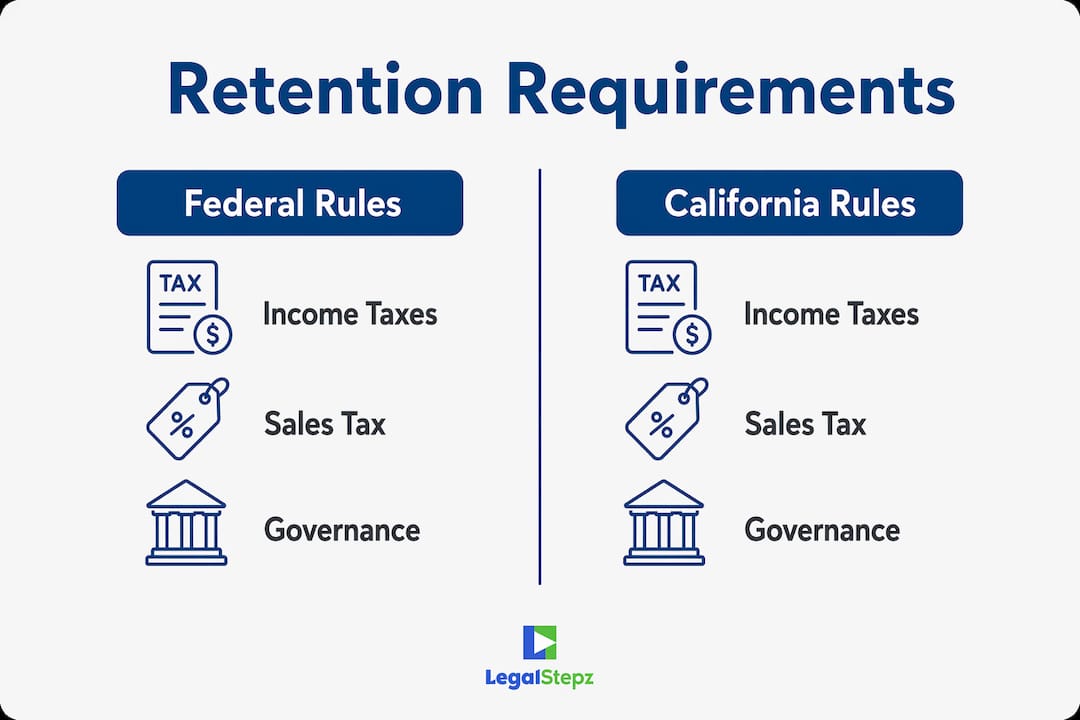
California mandates 8 years for income records, which exceeds the IRS's 7-year recommendation. That extra year matters because the FTB has a longer audit window than the IRS in cases involving substantial underreporting.
Sales and use tax records must be kept for at least 4 years to satisfy CDTFA requirements. If you cannot produce documentation proving a sale was exempt, the CDTFA can assess tax, interest, and penalties on that transaction.
Failure to maintain proper records can result in denied tax deductions, audit penalties, and legal consequences. The financial cost of non-compliance almost always exceeds the cost of a proper record keeping system.
One critical override: legal hold directives require you to retain all related documents indefinitely during litigation or government investigations. A scheduled destruction date means nothing once a legal hold is active. Destroying records under a legal hold is a separate legal offense.
Pro Tip: Set a calendar reminder each january to review your destruction schedule. Purge only what has cleared its retention window and has no active legal hold.
Which tools help California entrepreneurs manage records effectively?
The right software eliminates most of the manual work in record keeping. Here is how the leading tools compare for California small businesses:
| Tool | Best For | California-Specific Strength |
|---|---|---|
| QuickBooks Online | Income, expenses, reporting | FTB and IRS tax report generation |
| Xero | Small business accounting | Multi-user access, bank feeds |
| Gusto | Payroll and HR | Automated EDD filings |
| ADP | Mid-size payroll | Compliance updates for California labor law |
Beyond software, clear taxonomy and naming conventions in your record retention policy improve audit readiness and day-to-day efficiency. A folder structure like Year > Record Type > Entity takes ten minutes to set up and saves hours during tax season.
Cloud storage is the standard for digital records. Google Drive, Dropbox, and Microsoft OneDrive all provide offsite redundancy. Digital records are acceptable in California as long as they remain clear and readable. Back up your cloud storage to a second location, either a local drive or a second cloud service, to protect against data loss.
- Use consistent file naming:
2026_Q1_Payroll_EDDbeatsMarch payroll final FINAL. - Store scanned receipts in the same folder as the corresponding bank statement.
- Keep a separate folder for CDTFA sales tax filings, organized by quarter.
- Archive governance documents like bylaws and minutes in a permanent folder that never gets purged.
Record retention policies work best when they are customized to your business's scale and risk profile. A sole proprietor with no employees has different needs than an S-corp with 15 staff members. Build your system around your actual document volume, not a generic template.
What are the monthly, quarterly, and annual record keeping tasks?
California bookkeeping compliance is a continuous process, not a once-a-year scramble. Businesses that maintain monthly workflows avoid the errors and missed deadlines that trigger FTB, EDD, and CDTFA scrutiny.
Monthly tasks
- Categorize all income and expense transactions in QuickBooks Online or Xero.
- Reconcile every bank and credit card account against your statements.
- Review payroll records and confirm EDD deposits are current.
- Monitor sales tax collected versus owed for CDTFA reporting.
- File and store all new receipts, invoices, and contracts in the correct folders.
Monthly bookkeeping workflows include reconciling accounts, managing payroll, and preparing profit and loss statements, balance sheets, and cash flow reviews. These reports are not just for tax time. They tell you whether your business is actually profitable month to month.
Quarterly tasks
- Submit estimated tax payments to both the IRS and the FTB by the quarterly deadlines.
- File Form 941 (federal payroll tax) and the DE 9 (California EDD payroll tax return).
- Report and pay CDTFA sales tax for the quarter.
- Pay any 1099 contractor amounts and verify contractor records are complete.
Annual filings
California S-corps file Form 100S with the FTB. LLCs file Form 568. Federal S-corps file Form 1120S with the IRS. All California entities subject to the franchise tax owe a minimum $800 annual payment to the FTB. Missing this payment triggers penalties and interest that compound quickly.
Maintaining up-to-date books monthly eliminates year-end scrambling and reduces mistakes in California compliance. Businesses that wait until december to reconcile the full year consistently miss deductions and misclassify expenses.
Key takeaways
California business record keeping requires following state-specific retention periods, maintaining permanent governance records, and running monthly bookkeeping workflows to stay compliant with the FTB, EDD, and CDTFA.
| Point | Details |
|---|---|
| California beats federal rules | Keep income records for 8 years, not the IRS's 7-year recommendation. |
| Four core retention windows | Sales tax: 4 years; payroll: 4 years; income: 8 years; governance: permanent. |
| Legal holds override schedules | Never destroy records once a legal hold or audit notice is active. |
| Monthly workflows prevent penalties | Reconcile accounts, track payroll, and monitor sales tax every month without exception. |
| Right tools reduce manual work | QuickBooks Online, Xero, Gusto, and ADP automate the records California agencies require. |
Why I stopped treating record keeping as a compliance chore
Most small business owners treat record keeping as a tax-season obligation. That framing is the root cause of most compliance problems I see. When you only touch your records in april, you are not maintaining them. You are reconstructing them, and reconstruction is where errors happen.
The businesses that handle California audits well are not the ones with the best accountants. They are the ones with the most organized records. An FTB auditor asking for three years of sales records is not a crisis if your CDTFA folders are current. It becomes a crisis when you are digging through email attachments from 2022.
One thing most articles skip: the legal hold issue is more common than people expect. A contract dispute, a former employee's wage claim, or a regulatory inquiry can trigger a hold at any time. If you destroyed records on schedule without checking for active holds, you have a much bigger problem than a missing receipt.
My honest recommendation is to treat record keeping as a monthly financial review, not a filing task. Spend 90 minutes at the end of each month reconciling accounts, confirming payroll records, and archiving new documents. That 90 minutes prevents the 40-hour scramble that happens when the FTB sends a notice. If you are forming a California LLC or setting up governance documents for the first time, build the record keeping system before you need it, not after.
— Peter
How Legalstepz supports your California compliance needs
Staying compliant with California's record keeping and filing requirements takes more than good software. It takes the right legal foundation.
Legalstepz helps California business owners file statements of information, draft annual minutes, prepare bylaws, and maintain registered agent services, all the governance documents that must be kept permanently and filed on time. Whether you are just starting out or catching up on years of missed filings, Legalstepz provides the compliance support California businesses need. Avoid the penalties that come from missed deadlines or incomplete corporate records. Let Legalstepz handle the paperwork so you can focus on running your business.
FAQ
How long do California businesses need to keep tax records?
California requires businesses to retain income-related tax records for 8 years, which exceeds the IRS's 7-year recommendation. Always follow the longer period when state and federal rules differ.
What records must California businesses keep permanently?
Corporate governance documents including meeting minutes, bylaws, and stock ledgers must be kept permanently. These records define the legal existence of your business and are required for mergers, disputes, and regulatory inquiries.
What happens if a California business fails to keep proper records?
Failure to maintain proper records can result in denied tax deductions, audit penalties, and legal liability. The CDTFA can assess tax and penalties on any sale you cannot document as exempt.
Are digital records acceptable in California?
Yes. California accepts digital records as long as they remain clear and readable. Use cloud storage with offsite backup to protect against data loss and meet audit readiness standards.
What is a legal hold and how does it affect record destruction?
A legal hold is a directive to preserve all related records indefinitely during litigation or a government investigation. It overrides your normal retention schedule, and destroying records under an active hold is a separate legal offense.