

A California Certificate of Status is the official document that proves your business is legally registered, currently active, and in good standing with the state. The California Secretary of State issues it, and without one, you can hit a wall fast when applying for a loan, opening a business bank account, or expanding into another state.
Here is what the certificate actually confirms:
- Your business is registered with the California Secretary of State
- You are current on state filing requirements, including your Statement of Information
- Your entity is not suspended, forfeited, or dissolved
- You have met your franchise tax obligations with the Franchise Tax Board
- Your entity status is active, which signals compliance to banks, investors, and government agencies
Banks and investors treat this certificate as proof that your business manages its regulatory obligations seriously. It is used for securing credit, applying for permits, qualifying to do business in another state, and transferring ownership.
Who needs a California Certificate of Status and when?

Corporations, LLCs, and limited partnerships registered in California are all eligible to obtain one. Sole proprietors and general partnerships are not registered with the Secretary of State, so this document does not apply to them.
The situations that trigger the need for a certificate come up more often than most business owners expect:
- Applying for financing: Lenders and credit card issuers routinely request it before approving a business loan or line of credit.
- Expanding out of state: Foreign qualification in another state almost always requires a certificate from your home state, often called a certificate of good standing.
- Renewing licenses or permits: Some state and local agencies require proof of active status before renewing a professional license or business permit.
- Entering formal contracts: Vendors, suppliers, and potential buyers may request one before signing a significant agreement.
- Ownership transfers or investor due diligence: Anyone acquiring an interest in your business will want to verify its legal standing.
One thing worth knowing: the certificate is a snapshot in time. Many third parties require a certificate issued within 30–60 days to confirm current compliance, so an old one sitting in your files may get rejected. Always confirm the requestor's timeframe before you order.
Pro Tip: Order your certificate a few days before you actually need it, not the morning of a closing or application deadline. Processing is fast, but you want time to catch any issues with your entity's standing.
To be eligible, your business must be current on its Statement of Information filings and franchise tax payments. If either is overdue, the Secretary of State will show your entity as suspended rather than active, and no certificate will issue until you resolve it.

How to obtain your California Certificate of Status
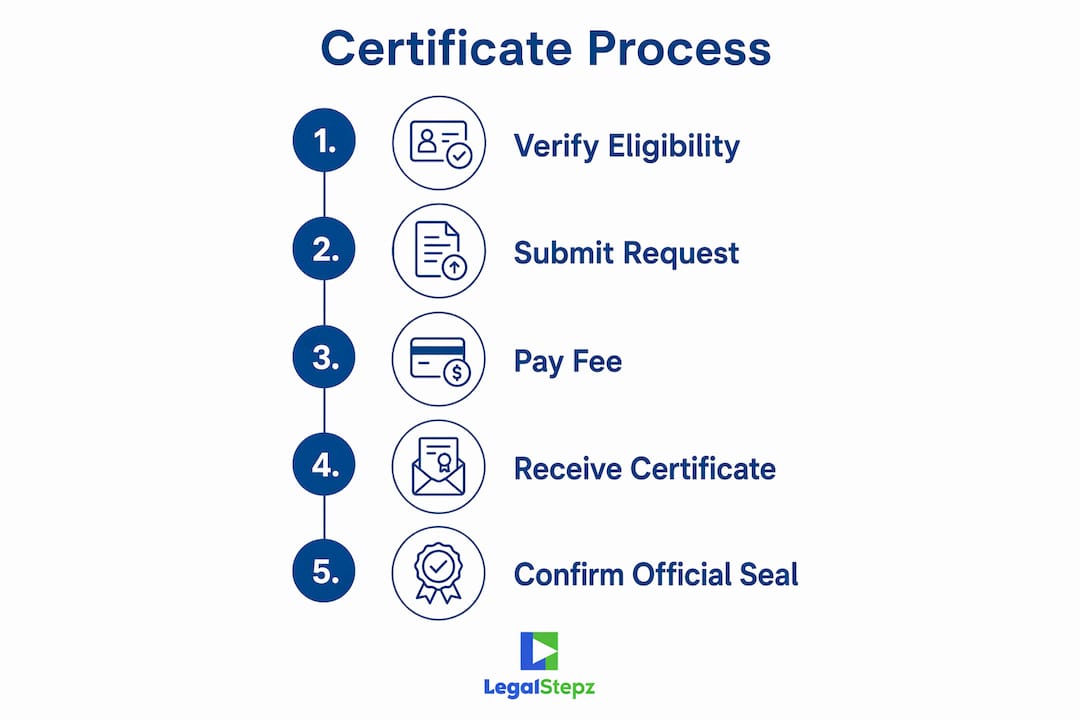
Two methods exist: online through the bizfileOnline portal, or by mail or in-person at the Sacramento office. Online is faster and cheaper for almost every situation.
Steps to order online
- Go to bizfileOnline.sos.ca.gov and log in or create an account.
- Search for your business using your exact legal name or your Secretary of State file number. Using the file number is more reliable since name variations can cause mismatches.
- Select your entity from the results and choose "Certificate of Status."
- Pay the $5 fee per certificate by credit card.
- Download the PDF immediately. It also stays in your "My Work Queue" for 90 days, so you can retrieve it again without reordering.
Steps to order by mail or in person
- Complete the Business Entities Records Order Form, available on the Secretary of State's website.
- Include your exact business legal name and SOS file number. Errors here cause delays or incorrect issuance.
- Mail or deliver the form to the Secretary of State's Sacramento office with payment.
- An additional $15 special handling fee applies for in-person requests.
| Request method | Cost | Processing time |
|---|---|---|
| Online (bizfileOnline) | $5 per certificate | Within minutes |
| $5 per certificate | 1–2 business days | |
| In-person (Sacramento) | $20 per certificate | Same day with handling fee |
After you receive the certificate, check that it carries the Secretary of State's official seal and signature. The document also includes a verification code you can use on the official SOS website to confirm its authenticity before sharing it with a third party.
Legal and operational obligations that affect your certificate eligibility
Your ability to get a clean Certificate of Status depends entirely on whether your business has kept up with two core obligations.
The first is the franchise tax. California LLCs and corporations must pay a minimum $800 annual franchise tax to the Franchise Tax Board. Fall behind on that, and the FTB can suspend your entity, which immediately blocks certificate issuance.
- Statements of Information: Corporations file annually; LLCs file every two years. Missing a filing triggers suspension from the Secretary of State's side, separate from any FTB action.
- Suspension consequences: A suspended entity cannot legally conduct business, enter contracts, or defend itself in court. The certificate will show "suspended" rather than "active" until all back filings and fees are resolved.
- No separate maintenance fee: There is no special fee to keep your certificate eligibility current. Staying current on your existing tax and filing duties is all that is required.
- Distinction from the FTB Entity Status Letter: The Franchise Tax Board issues a separate document called an Entity Status Letter, which focuses specifically on tax liabilities and good standing with the FTB. Some third parties ask for one or the other; confirm which document they actually need before you order, since they are not interchangeable.
A suspended entity that resolves its issues can be reinstated, but the process takes time and involves back payments, penalties, and additional filings. Staying current is far simpler than catching up.
How to spot and avoid Certificate of Status scams
The California Secretary of State has issued direct warnings about fraudulent solicitations targeting California businesses. Fake certificates are circulating through mailers, websites, and social media messaging apps including WhatsApp and WeChat, with some operators charging far above the official $5 fee.
"A Certificate of Status can only be issued by the California Secretary of State, who is the official custodian of business records for the State of California. These private entities have no affiliation with or authorization to act on behalf of the State of California or the California Secretary of State. They are illegally issuing fraudulent Certificates of Status for business entities registered with the California Secretary of State." — California Secretary of State, Fraudulent Certificates of Status Circulating
Third-party services often charge $100–$250 for the same process available for $5 directly from the state. That price gap alone should raise a flag. Here is how to protect yourself:
- Use only the official portal: Always order from bizfileOnline.sos.ca.gov or the Secretary of State's Sacramento office. The official domain ends in .sos.ca.gov.
- Ignore unsolicited mailers: If you receive a letter or email urging you to obtain or renew a Certificate of Status through a private company, treat it as a scam until proven otherwise.
- Verify the certificate: A legitimate certificate carries the Secretary of State's seal, an authorized signature, and a verification code. You can confirm authenticity on the official SOS website using that code.
- No private entity has authority: No business is required to go through a third party to obtain a certificate, and no private company can legally issue one.
- Check the source before paying: If you are unsure whether a website is legitimate, search for the Secretary of State's contact information independently and call to verify.
The fraud risk is real enough that the Secretary of State maintains a dedicated customer alerts page about it. A few minutes of verification can save you from paying for a worthless document.
Key Takeaways
A California Certificate of Status, issued by the Secretary of State for $5 online, is the fastest proof that your business is active, compliant, and ready for financing, licensing, or out-of-state expansion.
| Point | Details |
|---|---|
| Official issuer only | Only the California Secretary of State can legally issue a Certificate of Status. |
| Online cost is $5 | Order through bizfileOnline for $5; the PDF is ready within minutes and saved for 90 days. |
| Good standing is required | Your entity must be current on the $800 minimum franchise tax and Statement of Information filings. |
| Certificates expire quickly | Many third parties require a certificate issued within 30–60 days, so order close to when you need it. |
| Avoid third-party services | Private services charging $100–$250 for this document are unnecessary; always use the official state portal. |
Legalstepz can help you stay in good standing
Keeping your business eligible for a Certificate of Status means staying on top of your filings before they become a problem. Legalstepz helps California businesses file Statements of Information, draft annual minutes, set up bylaws, and maintain registered agent services, so your entity stays active and ready when you need it most.
Visit Legalstepz to get your compliance filings handled correctly the first time.