

Every California corporation must file an initial Statement of Information within 90 days of incorporating, then again annually during a six-month window tied to that original filing month, keep bylaws and meeting minutes at the principal executive office, maintain a valid agent for service of process, and file online through bizfileOnline, which now requires "User Access" credentials for anyone filing digitally as of August 1, 2026.
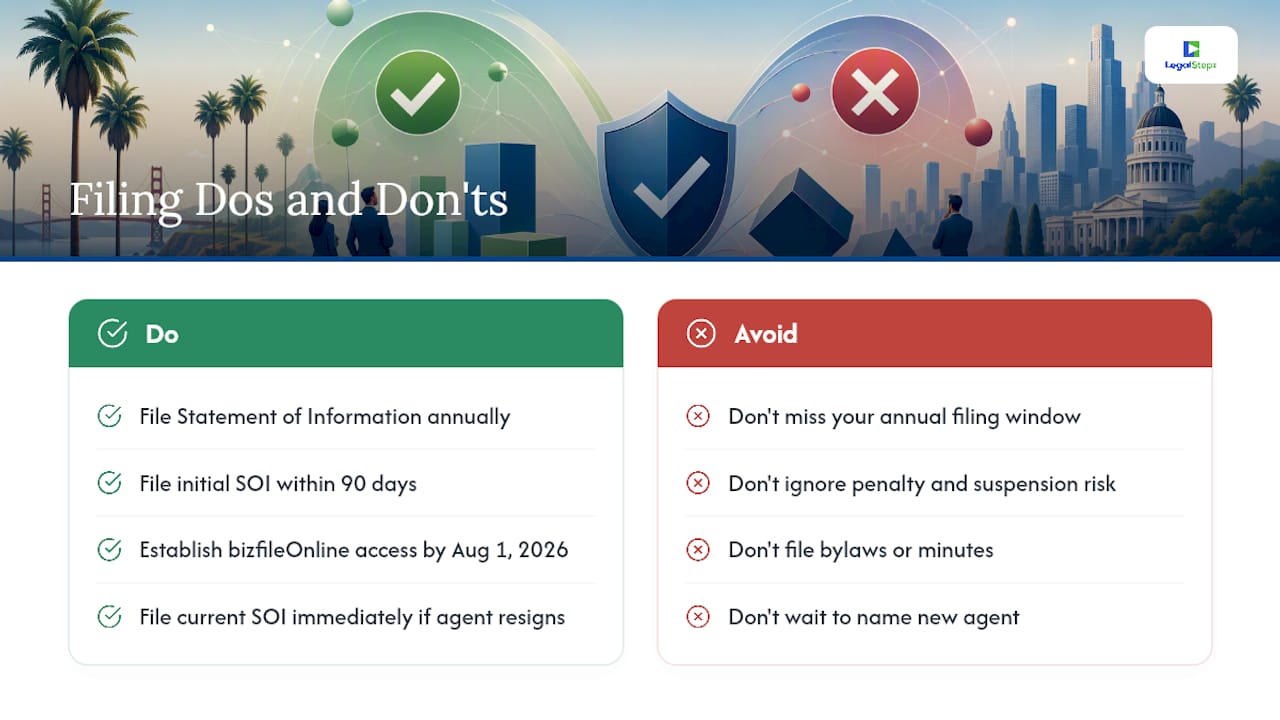
Here's the short version to pin above your desk:
- File your initial Statement of Information within 90 days of your Articles of Incorporation.
- Refile annually inside your six-month statutory window (more on that below).
- Store bylaws and minutes at your California principal executive office, not filed with the state.
- Confirm your registered agent is current; a lapsed agent risks suspension.
- Set up User Access on bizfileOnline before your next online filing.
Pro Tip: If your registered agent resigns or you get a notice from the Secretary of State, file a current Statement of Information immediately, don't wait for your next annual window. A gap in agent coverage is one of the fastest ways to trigger suspension.
Key Takeaways
California corporations stay in good standing by filing on time, keeping records at the principal office, and maintaining a valid agent for service of process.
| Point | Details |
|---|---|
| File within 90 days | Your initial Statement of Information is due within 90 days of your Articles of Incorporation. |
| Track your six-month window | Annual refilings fall inside a rolling window tied to your original filing month, not a fixed date. |
| Keep records on-site | Bylaws, minutes, and stock ledgers stay at your California principal executive office, never filed with the state. |
| Update agent changes immediately | A resigned or invalid agent requires a current Statement of Information right away, not at the next annual window. |
| Let LegalStepz manage the cycle | LegalStepz files Statements of Information, drafts minutes and bylaws, and tracks deadlines for California corporations. |
Table of Contents
- What Is the California Corporate Compliance Checklist for the Statement of Information?
- Why These Formalities Actually Protect Your Corporation
- Get Your California Filings Handled Without the Guesswork
- Frequently Asked Questions
- Sources
What Is the California Corporate Compliance Checklist for the Statement of Information?
Every California stock corporation, along with any qualified foreign corporation doing business in the state, must file a Statement of Information with the Secretary of State. The initial filing is due within 90 days of your Articles of Incorporation. After that, you're on an annual cycle, but the deadline isn't a fixed calendar date. It's a six-month window tied to the month you originally filed.
The form itself asks for specifics: your corporation's name and file number, the names and addresses of all directors, your CEO, secretary, and CFO, your principal executive office address, a separate mailing address if you use one, your agent for service of process and that agent's address, a brief description of your business activity, and a disclosure regarding any outstanding final judgments tied to Labor Code or wage order violations. Cal. Corp. Code §1502 spells out every one of these fields.
The filing fee is $25 as of 2026. Miss the window, and you're looking at a commonly cited $250 penalty, plus the risk of suspension or forfeiture of your corporate powers by the Franchise Tax Board or Secretary of State.pdf?hash=37649ABF78664582345BB04D63747820&rev=59626ad3b9b34589bf85fef7bc68b2f1). For more details on staying compliant with state payroll and tax regulations, see the California Payroll Compliance Guide.
Your six-month window depends on your original filing month:
| Original Filing Month | Filing Window Opens | Filing Window Closes |
|---|---|---|
| January | November 1 (prior year) | January |
| April | February 1 | April |
| July | May 1 | July |
| October | August 1 | October |
Outside that annual window, certain changes require an immediate update. Swap agents, move your principal office, or change officers, and you file a current Statement of Information right away rather than waiting. That new filing supersedes whatever you filed before. Track your specific window using the "Date Filed" listed on the Secretary of State's business search, since a missed reminder postcard is never a valid excuse for a late filing. For a full calendar view, LegalStepz breaks down filing deadlines by month.
Why These Formalities Actually Protect Your Corporation
I've watched founders treat the Statement of Information like paperwork busywork, something to knock out once and forget. That's backward. Courts look at exactly this kind of formality, bylaws on file, minutes documented, a real registered agent, when deciding whether to pierce the corporate veil and hold owners personally liable. LegalStepz built its filing and registered agent services around that reality, not around theory. We handle Statements of Information, draft annual minutes and bylaws, and track deadlines for California corporations that would rather run their business than chase a six-month window. This checklist is the same one we use with clients every day.
Get Your California Filings Handled Without the Guesswork
Filing your own Statement of Information is doable, but tracking a rolling six-month window, drafting compliant bylaws, and setting up a bizfileOnline User Access account correctly takes real time you'd rather spend on your business. LegalStepz handles the entire filing cycle for California corporations, not just the paperwork, but the calendar tracking that prevents a $250 penalty from ever landing on your desk.

Our service includes monitoring your specific filing window so nothing slips past you, handling the bizfileOnline submission with User Access already configured, filing certified Statements of Information with accurate director and officer data, and drafting annual minutes and bylaws using templates built for California corporate formalities. If you've changed your registered agent recently or aren't sure your bylaws would hold up under scrutiny, that's exactly when paid help saves you from a costly mistake. Visit LegalStepz to see current filing packages and get your Statement of Information filed correctly the first time.
Frequently Asked Questions
Do I need to file a Statement of Information every year? Yes. After your initial filing within 90 days of incorporation, you file annually during your six-month statutory window.
What happens if I miss my filing window? You risk a commonly cited $250 penalty, and continued noncompliance can lead to suspension of your corporate powers by the Secretary of State or Franchise Tax Board.
Are bylaws and meeting minutes filed with the state? No. They stay at your principal executive office in California as internal records, but they're critical evidence if your corporate structure is ever challenged in court.
What is the bizfileOnline User Access requirement? Starting August 1, 2026, the Secretary of State requires entities to establish User Access credentials on bizfileOnline before filing online, including the Statement of Information.
What do I do if my registered agent resigns? File a current Statement of Information immediately to name a new agent. Don't wait for your annual window, since an invalid agent can trigger suspension.
Sources
- Business Programs :: bizfileOnline :: California Secretary of State
- California Corporations Code §1502
Portal rules like User Access can change; always confirm current requirements directly with the Secretary of State before filing.