
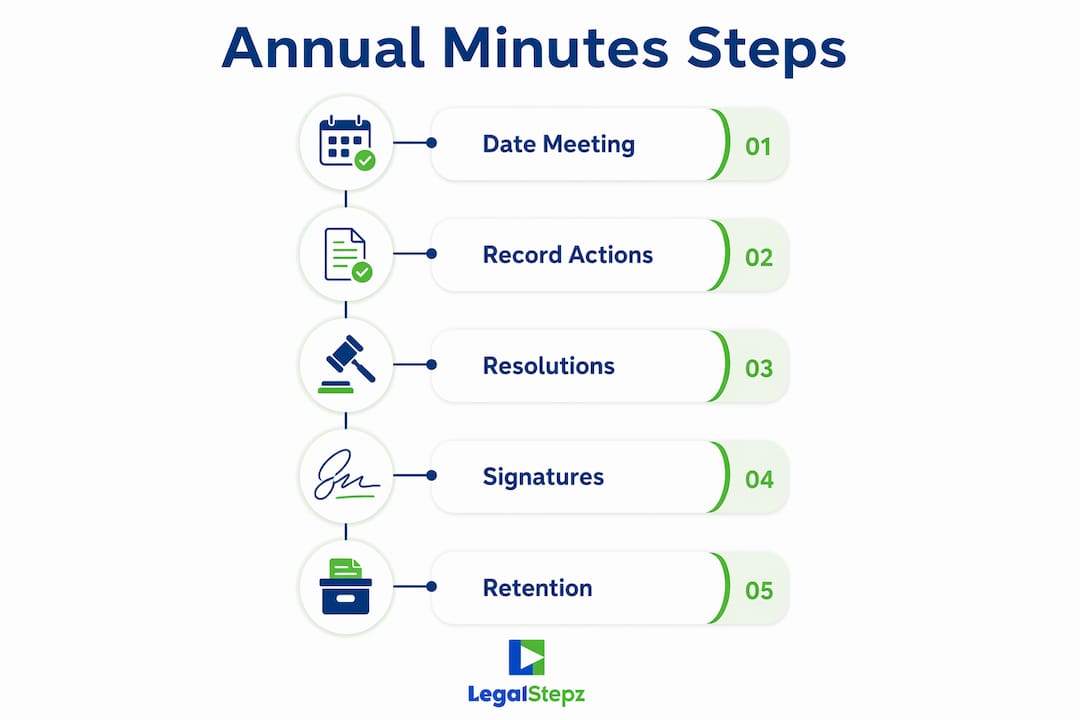
Every valid set of California corporation annual minutes must record the meeting date, time, and location; the names of attendees; each resolution passed; and the vote result, then be signed and stored in the corporate minute book. That is the short version. California Corporations Code §1500 requires every corporation to keep accurate minutes of shareholder, board, and committee proceedings — and missing or incomplete minutes are one of the fastest ways to lose the liability protection your corporation was formed to provide.
Here is a quick compliance checklist before you draft a single line:
- Date, time, and place of the meeting (or the date of the written consent)
- Names of attendees and their capacity (director, officer, shareholder)
- Quorum confirmation — enough members present to conduct business
- Agenda items covered during the meeting
- Motions and resolutions stated in full, with the mover's name
- Vote results — who voted yes, no, or abstained
- Sign-off by the chairperson and corporate secretary
- Approval notation — when the minutes were approved and by whom
- Storage location — minute book at the principal office or a secure digital repository
California Corporations Code §1500: "Each corporation shall keep adequate and correct books and records of account and shall keep minutes of the proceedings of its shareholders, board and committees of the board." Minutes must be kept in written form or in a form convertible to clearly legible paper, and that converted paper form is admissible in evidence to the same extent as an original.
A unanimous written consent (UWC) is a legally accepted alternative to a formal meeting, provided it is properly dated, signed by all required parties, and filed in the minute book.
Table of Contents
- Key takeaways for California corporate minutes
- What does California law actually require for annual minutes?
- What exactly goes into annual minutes, field by field
- Meeting minutes vs. unanimous written consent: which should you use?
- How to keep your minute book: storage, signatures, and retention
- How single-shareholder corporations should document annual actions
- Practical drafting rules that hold up under scrutiny
- Ready-to-use templates for California annual minutes
- Legalstepz handles your annual minutes so you can focus on running your business
- Key Takeaways
Key takeaways for California corporate minutes
California corporations must document annual actions in signed, dated minutes or a unanimous written consent and keep those records permanently in a corporate minute book under §1500.
| Point | Details |
|---|---|
| Statutory obligation | §1500 requires accurate minutes of all shareholder, board, and committee proceedings. |
| Required contents | Record date, time, place, attendees, resolutions, and vote results at minimum. |
| Retention practice | Keep signed originals in a minute book at the principal office; digital copies must be convertible to legible paper. |
| UWC alternative | A properly signed and dated unanimous written consent satisfies the minutes requirement for closely held corporations. |
| Legalstepz templates | Legalstepz provides attorney-drafted annual minutes templates and drafting services for California corporations. |
Action items:
- Draft minutes within 48 hours of any meeting
- Use a UWC when all shareholders or directors can sign without convening
- Store executed minutes in a dedicated minute book, physical or digital
- Review your corporate bylaws before each annual meeting to confirm notice and quorum requirements
What does California law actually require for annual minutes?
§1500 is the governing statute, and its language is broader than most small business owners realize. It covers minutes of shareholders, the full board, and any board committees — not just the annual shareholder meeting. Records must be kept at the corporation's principal office, or at the office of its transfer agent or registrar, and they must be in written form or a form that can be converted to clearly legible paper.
Why this matters beyond paperwork: Attorneys describe minutes as the corporation's "corporate memory" — the documentary proof that directors fulfilled their fiduciary duties and that the business operated as a genuine separate entity. Without that record, a creditor or plaintiff has a much easier path to piercing the corporate veil and reaching the owners personally.
The business judgment rule — the legal presumption that directors acted on an informed basis in the corporation's best interest — depends on evidence. Minutes are that evidence. A resolution that reads "After reviewing the proposed vendor contract and considering alternatives, the board unanimously approved the agreement" does more legal work than a blank page or a vague note.
Pro Tip: Keep the language neutral and action-focused. You do not need to transcribe every comment made in the room. A sentence confirming that the board "reviewed and considered" a matter before voting is enough to show fiduciary consideration without creating a transcript that could be used against you later.
What exactly goes into annual minutes, field by field
Start with the basics: every set of annual minutes needs a header block, an attendance section, a quorum statement, the body of resolutions, and a closing signature block. Here is what each field accomplishes and how to word it.
Required fields and why they matter:
- Meeting header — corporation name, meeting type (Annual Meeting of the Board of Directors), date, time, and location (or "held via video conference")
- Call to order — names the person who opened the meeting and the time it was called to order
- Attendees and capacity — lists each person present, their title, and whether they attended in person or remotely
- Quorum confirmation — states that a quorum was present and the meeting was duly constituted; without this, any resolution passed is potentially void
- Agenda items — lists each topic addressed, in order
- Motions and resolutions — the full text of each resolution, who moved it, who seconded it
- Vote results — the count or a statement that the motion carried unanimously
- Adjournment — time the meeting ended
- Signature block — signed by the chairperson and secretary, with the approval date
Sample resolution language you can adapt:
- "RESOLVED, that [Name] is hereby elected to serve as President of the Corporation for the ensuing year, effective immediately."
- "RESOLVED, that the financial statements of the Corporation for the fiscal year ended December 31, 20__, as presented to the board, are hereby approved and ratified."
- "RESOLVED, that the Corporation is authorized to enter into a services agreement with [Vendor Name] on the terms presented to the board, and the President is authorized to execute such agreement on behalf of the Corporation."
- "RESOLVED, that all acts and transactions of the officers of the Corporation since the last annual meeting are hereby ratified and approved."
Signature block example: The undersigned, being the duly elected Secretary of [Corporation Name], hereby certifies that the foregoing minutes are a true and correct record of the Annual Meeting of the Board of Directors held on [Date].
[Name], Secretary
[Name], Chairperson
For a concise single-shareholder corporation, one paragraph can cover the whole meeting: "On Date], [Name], as the sole director and officer of [Corporation Name], called the annual meeting to order, confirmed quorum, elected [Name] as President and Secretary for the ensuing year, approved the financial statements, and ratified all corporate acts since the prior annual meeting. The meeting was adjourned at [Time]." A longer form, used when the board reviewed contracts, considered conflicts of interest, or addressed sensitive matters, breaks each agenda item into its own numbered section with fuller resolution language. The [annual minutes purpose for each format is the same — the length just reflects the complexity of what was decided.

Meeting minutes vs. unanimous written consent: which should you use?
A unanimous written consent is a legally valid substitute for a formal meeting when every person required to vote signs the same document. Under California law, UWC carries the same evidentiary weight as formal minutes if it is properly executed and retained in the minute book.
Minutes vs. UWC at a glance:
- Minutes require a noticed meeting, quorum, and a real-time record of discussion and votes; they work best when the board is larger, decisions are contested, or you want a detailed record of deliberation.
- UWC skips the meeting entirely; every required signer must sign the same document, which makes it fast for routine annual actions in closely held corporations but impractical when even one director or shareholder is unavailable or unwilling.
- Audit trail: Both create a paper trail, but minutes document the deliberation process while a UWC documents only the outcome.
- Speed: A UWC can be circulated and signed in hours; a noticed meeting requires advance notice under your bylaws (often 10 days for board meetings).
Attach any referenced exhibits (financial statements, contracts) directly to the UWC before it is signed. Date the document the day the last required signature is obtained, not the day you started circulating it.
How to keep your minute book: storage, signatures, and retention
The minute book is not a formality — it is the physical or digital record that proves your corporation operated as a real, separate entity. Keep it at the corporation's principal office or in a secure digital repository where records can be converted to legible paper on demand.
What belongs in a complete minute book:
- Signed annual and special meeting minutes (or UWCs) for every year
- Notices of meetings and waivers of notice
- Bylaws and all amendments
- Articles of incorporation and any amendments
- Stock ledger and transfer records
- Shareholder agreements, if any
California does not require you to file minutes with the Secretary of State, but shareholders have inspection rights and minutes may be subpoenaed in litigation or requested during an IRS or state tax audit. Keep signed originals permanently. Financial statements and supporting documents attached to minutes should be retained for at least seven years, consistent with standard tax record-keeping practice.
Pro Tip: For digital storage, save minutes as PDF/A (the archival PDF standard), apply a timestamp, and restrict editing access to the corporate secretary. Store at least one encrypted backup off-site or in a cloud service with version history enabled. This satisfies the "convertible to clearly legible paper" standard under §1500 and gives you a defensible chain of custody.
How single-shareholder corporations should document annual actions
Single-shareholder corporations — including most S-Corps structured as one-person businesses — still must document annual corporate actions. The good news is that the process is genuinely simple. A short-form UWC or a one-page set of minutes, properly signed and dated, satisfies the requirement.
Model single-shareholder annual minutes (short form):
Annual Meeting of the Sole Director and Shareholder of [Corporation Name] Date: [Date] | Time: [Time] | Location: [Address or "held via telephone"]
[Name], being the sole director and sole shareholder of the Corporation, called the meeting to order and confirmed that a quorum was present.
RESOLVED, that [Name] is elected to serve as President, Secretary, and Treasurer for the ensuing year.
RESOLVED, that the financial statements for the fiscal year ended [Date] are approved.
RESOLVED, that all acts of the officers since the last annual meeting are ratified.
There being no further business, the meeting was adjourned.
[Name], Sole Director and Secretary
For S-Corps, the stakes are slightly higher. The IRS can scrutinize S-Corp elections and officer compensation, and well-maintained minutes that document salary decisions, distributions, and shareholder loans help demonstrate that the corporation is operating as a genuine business entity. A single missed year of minutes will not automatically terminate S-Corp status, but a pattern of missing records weakens the argument that corporate formalities were observed.
Practical drafting rules that hold up under scrutiny
Draft minutes within 48 hours of the meeting. Waiting longer increases the risk of "memory creep" — the gradual drift between what actually happened and what gets recorded — and makes the document harder to defend in an audit or litigation.
Drafting do's and don'ts:
- Do record every resolution in full, including the exact wording of the motion.
- Do note the vote count or state "unanimously approved."
- Do log any disclosed conflicts of interest and confirm the conflicted director abstained.
- Do confirm quorum at the start of the minutes.
- Don't transcribe debate verbatim — record the action and the outcome, not the argument.
- Don't use subjective adjectives ("the board enthusiastically approved") — neutral language is more defensible.
- Don't leave minutes unsigned or undated.
- Don't back-date minutes to a date before all signatures were obtained.
Common mistakes and how to fix them:
- Late or missing minutes: Use a ratification resolution at the next meeting to formally approve the prior period's actions. A retroactive UWC can also document decisions made without a formal meeting, provided all required parties sign.
- Missing sign-off: Circulate the draft to the chairperson and secretary immediately after the meeting; set a 72-hour deadline for corrections and signatures.
- No quorum documentation: Add a standing agenda item at the top of every meeting to confirm and record quorum before any vote is taken.
Pro Tip: After drafting, circulate the minutes to all attendees with a short cover note asking for corrections within five business days. Open the next meeting with an approval motion: "The minutes of the [Date] meeting, as circulated, are approved." That approval notation in the subsequent minutes creates a clean chain of record.
Ready-to-use templates for California annual minutes
Two templates cover most situations: a short form for routine annual actions and a long form for meetings where the board reviewed contracts, approved financials, or addressed officer changes.
Short-form template (fill-in checklist):
- Corporation name: ___________________________
- Meeting type: Annual Meeting of the Board of Directors
- Date: _______________ | Time: _______________ | Location: _______________
- Directors present: ___________________________
- Quorum confirmed: Yes / No
- Resolution 1 (officer elections): ___________________________
- Resolution 2 (financial approval): ___________________________
- Resolution 3 (ratification of acts): ___________________________
- Meeting adjourned at: _______________
- Secretary signature: _______________ | Date: _______________
- Chairperson signature: _______________ | Date: _______________
Long-form template structure:
- Header block (corporation name, meeting type, date, time, place)
- Attendance and quorum (list each attendee, confirm quorum)
- Approval of prior minutes (motion, vote)
- Officer elections (full resolution text, vote result)
- Financial statement review and approval (attach statements as Exhibit A)
- Ratification of corporate acts (full resolution text)
- Other business (describe each item, resolution, vote)
- Adjournment (time, mover)
- Certification paragraph and signature block
Fill-in instruction: Replace every bracketed placeholder with the specific name, date, or figure before the document is signed. Never leave a bracket in an executed set of minutes — a court or auditor reading "[Name]" in a signed document will question whether the record was ever completed.
Store the executed copy in the minute book immediately after signing. Attach any referenced exhibits before filing. For California business record keeping that spans multiple years, label each set of minutes with the fiscal year and meeting date on the tab or folder name so retrieval is fast when you need it.
Legalstepz provides attorney-drafted templates for both formats, along with a drafting and review service for corporations that want a compliance professional to prepare or check their minutes before filing them in the minute book.
Legalstepz handles your annual minutes so you can focus on running your business
Drafting compliant annual minutes takes time you probably do not have — and a single gap in your minute book can expose you to personal liability or derail an audit. Legalstepz offers a faster path: attorney-drafted California annual minutes templates, a complete drafting service, and a minute-book review that checks your existing records against §1500 requirements. You get a finished, ready-to-sign document without spending hours researching California corporate formalities or worrying whether your language will hold up.
Legalstepz also handles the related compliance tasks that go hand-in-hand with annual minutes: statement of information filing, bylaws drafting, and registered agent services. Whether you need a one-time template or ongoing corporate compliance support, the service is built for California small business owners and corporate secretaries who want clean records without the legal fees of a full-service law firm. Visit Legalstepz to get your annual minutes drafted or download a template today.
Key Takeaways
Legally valid California annual minutes must record meeting details, resolutions, and vote results, be signed by the chairperson and secretary, and be retained permanently in a corporate minute book under California Corporations Code §1500.
| Point | Details |
|---|---|
| Statutory requirement | California Corporations Code §1500 mandates accurate minutes of all shareholder, board, and committee proceedings. |
| Core contents | Every set of minutes must include date, time, place, attendees, quorum confirmation, resolutions, vote results, and signatures. |
| UWC alternative | A unanimous written consent, properly signed and dated, satisfies the minutes requirement for closely held and single-shareholder corporations. |
| Retention and storage | Keep signed originals permanently in a minute book at the principal office; digital copies must be convertible to clearly legible paper. |
| Legalstepz | Legalstepz provides attorney-drafted California annual minutes templates and a full drafting service for small business owners and corporate secretaries. |
This article is general information, not legal advice. Confirm current requirements with the California Secretary of State or a qualified California attorney for your specific situation.