

California corporations are required to file a Statement of Information with the California Secretary of State every year to maintain good standing and legal authority to operate. This document is the official equivalent of what most states call an annual report. Missing the deadline triggers a $250 penalty from the Franchise Tax Board and can result in suspension of your corporation's right to do business. Whether you run a domestic C-corp, an S-corp, or a foreign corporation registered in California, the same filing rules apply. This guide covers every california corporation annual report requirement you need to know, from deadlines and fees to step-by-step filing instructions.
1. What are California corporation annual report requirements?
The Statement of Information is the formal name for California's annual report for corporations. Every domestic and foreign corporation registered with the California Secretary of State must file it. The filing keeps the state's public records current and confirms your corporation is actively managed and contactable.
California uses an anniversary-based schedule rather than a calendar-year deadline. That means your due date is tied to the month your corporation was formed or registered, not january 1 or december 31. This detail trips up many first-time filers who assume a uniform statewide deadline exists.

The California annual report filing obligation applies to both for-profit C-corps and S-corps. The tax election you make with the IRS does not change your California Secretary of State filing duties. California S-corp annual compliance steps are identical to those for a C-corp at the state level.
2. When are California corporation filing deadlines?
The initial Statement of Information is due within 90 days of forming or registering your corporation with the California Secretary of State. After that, you file annually by the last day of your anniversary month every year.
Key deadline facts for corporations:
- Initial filing: Due within 90 days of incorporation or registration
- Annual filing: Due by the last day of the same month your corporation was formed or registered
- Early filing window: You may file up to six months early before your due date
- LLCs and nonprofits: File biennially, not annually, on a different schedule
The six-month early window is one of the most underused tools in California compliance. Filing early lets you sync the task with other annual business administration work, like renewing business licenses or reviewing your corporate minutes.
Pro Tip: Set a calendar reminder for three months before your anniversary month. That gives you time to gather officer and director information without rushing.
Knowing your exact formation date is critical. Pull your original Articles of Incorporation from the California Secretary of State's records if you are unsure. The date on that document sets every future deadline.
3. What information must be included in the filing?
The Statement of Information for corporations uses Form SI-550. The form requires specific details about your corporation's current structure and operations. Missing any required field will cause the filing to be rejected.
Required information includes:
- Legal name and entity number assigned by the California Secretary of State
- Principal business address in California (a P.O. box is not accepted as the principal address)
- Mailing address if different from the principal address
- Name and address of your registered agent for service of process
- Names and addresses of the CEO, CFO, and Secretary (all three officer roles are required)
- Names and addresses of all directors
- A brief description of the business activity your corporation conducts
The registered agent requirement is non-negotiable. Your registered agent must have a physical California street address and be available during normal business hours to receive legal documents on your corporation's behalf.
If nothing has changed since your last filing, you can submit Form SI-550NC, the no-change version. The $25 fee still applies, but the form is shorter and faster to complete.
Pro Tip: Review your corporate minute book before filing. The officer and director names you submit must match your most recent annual minutes to avoid internal record conflicts.
4. What are the fees and penalties for late filing?
The filing fee for a California corporation is $25, payable through the online filing portal at the time of submission. This fee applies to both the standard SI-550 and the no-change SI-550NC form.
Late filing carries serious consequences:
- $250 penalty assessed by the Franchise Tax Board for missing the deadline
- Suspension of corporate rights if non-compliance continues, which stops your ability to legally conduct business in California
- Inability to enter contracts, defend lawsuits, or access courts while suspended
- Reinstatement process required to restore good standing, which involves filing all overdue statements and paying all outstanding penalties
The $250 penalty is ten times the cost of the original $25 filing fee. That math alone makes timely filing the obvious choice. Suspension creates even larger problems. A suspended corporation cannot enforce contracts or maintain business licenses, which can unravel deals and damage client relationships.
Reinstating a suspended corporation requires filing the overdue Statement of Information, paying the $250 penalty, and resolving any outstanding Franchise Tax Board obligations. The process can take weeks and costs far more in time and legal fees than the original filing would have.
5. How to file the California corporation annual report online
The California Secretary of State recommends filing through bizfileOnline, the official state portal. Online filing processes immediately and generates a confirmation receipt, which you should save for your corporate records.
Follow these steps to complete your filing:
- Go to bizfileOnline.sos.ca.gov and create or log into your account
- Search for your corporation using your entity name or Secretary of State entity number
- Select the Statement of Information filing from your entity's filing options
- Choose the correct form: SI-550 for a standard filing or SI-550NC if no information has changed
- Enter all required information including officer names, addresses, and registered agent details
- Review every field before submitting, paying close attention to officer addresses and the business description
- Pay the $25 filing fee using a credit or debit card
- Download and save your confirmation immediately after submission
Mail-in filing is still available but takes significantly longer to process and does not provide immediate confirmation. For most California business owners, online filing through bizfileOnline is the faster and more reliable option.
Pro Tip: File your Statement of Information up to six months early to avoid deadline pressure. Early filing counts as your annual filing and resets your next due date to the same anniversary month the following year.
Aligning your internal corporate records with the information you submit is critical. Discrepancies between your minute book and your public filing can create complications during audits, financing rounds, or business sales.
6. How does California compare to other states and entity types?
California's filing structure differs from most other states in two important ways. First, California uses anniversary-month scheduling instead of a uniform calendar-year deadline. Second, California LLCs and nonprofits file biennially, while corporations file annually. That distinction matters if you operate multiple entity types in California.
| Entity type | Filing frequency | Form | Fee |
|---|---|---|---|
| California corporation (C-corp or S-corp) | Annual | SI-550 or SI-550NC | $25 |
| California LLC | Biennial | LLC-12 | $20 |
| California nonprofit corporation | Biennial | SI-100 | $20 |
| Foreign corporation registered in California | Annual | SI-550 | $25 |
Most other U.S. states tie annual report deadlines to a fixed calendar date, often january 1 or the anniversary of the fiscal year. California's anniversary-month system means every corporation has a unique deadline. That is more personalized but also more prone to being forgotten without a dedicated compliance calendar.
Foreign corporations registered to do business in California follow the same annual schedule as domestic corporations. If your company was incorporated in Delaware or Nevada but operates in California, you still owe a Statement of Information every year to the California Secretary of State.
For California nonprofit annual filing obligations, the biennial schedule and lower $20 fee reflect the different regulatory treatment nonprofits receive under California law.
Key takeaways
California corporations must file a Statement of Information annually with the California Secretary of State to avoid a $250 penalty and potential suspension of business rights.
| Point | Details |
|---|---|
| Annual filing obligation | Corporations file Form SI-550 every year by the last day of their anniversary month. |
| $25 filing fee | Pay online through bizfileOnline at the time of submission to receive immediate confirmation. |
| $250 late penalty | The Franchise Tax Board assesses this penalty for missing the deadline, ten times the filing fee. |
| No-change option available | Submit Form SI-550NC if no officer, director, or address information has changed since last filing. |
| LLCs and nonprofits differ | California LLCs and nonprofits file biennially on Form LLC-12 or SI-100, not annually. |
Why I treat the Statement of Information as a first-tier compliance task
Most business owners treat the Statement of Information as a low-stakes administrative chore. I think that framing is a mistake. The filing is the state's primary mechanism for confirming your corporation is real, active, and properly managed. When you miss it, you are not just paying a $250 fine. You are signaling to the state that your corporation may be dormant or abandoned.
I have seen corporations lose the ability to close financing rounds because a suspended status showed up in due diligence. The buyer or investor pulls a Secretary of State record, sees the suspension, and the deal stalls. Reinstating the corporation takes time your deal timeline does not have. Consistent corporate records and timely public filings prevent exactly that scenario.
The six-month early filing window is the single most practical tool available to California business owners. File in the seventh month before your anniversary month, and you eliminate deadline risk entirely. Pair that with a review of your annual corporate minutes and you have a complete annual compliance check done in one sitting.
My advice: build a compliance calendar on day one of your corporation's existence. Put the anniversary month in bold. Set reminders at six months, three months, and one month out. The $25 filing fee is one of the cheapest insurance policies your corporation can buy.
— Peter
Legalstepz can handle your California compliance filings
California's annual filing rules are straightforward once you know them. Staying on top of them year after year is where most business owners struggle.
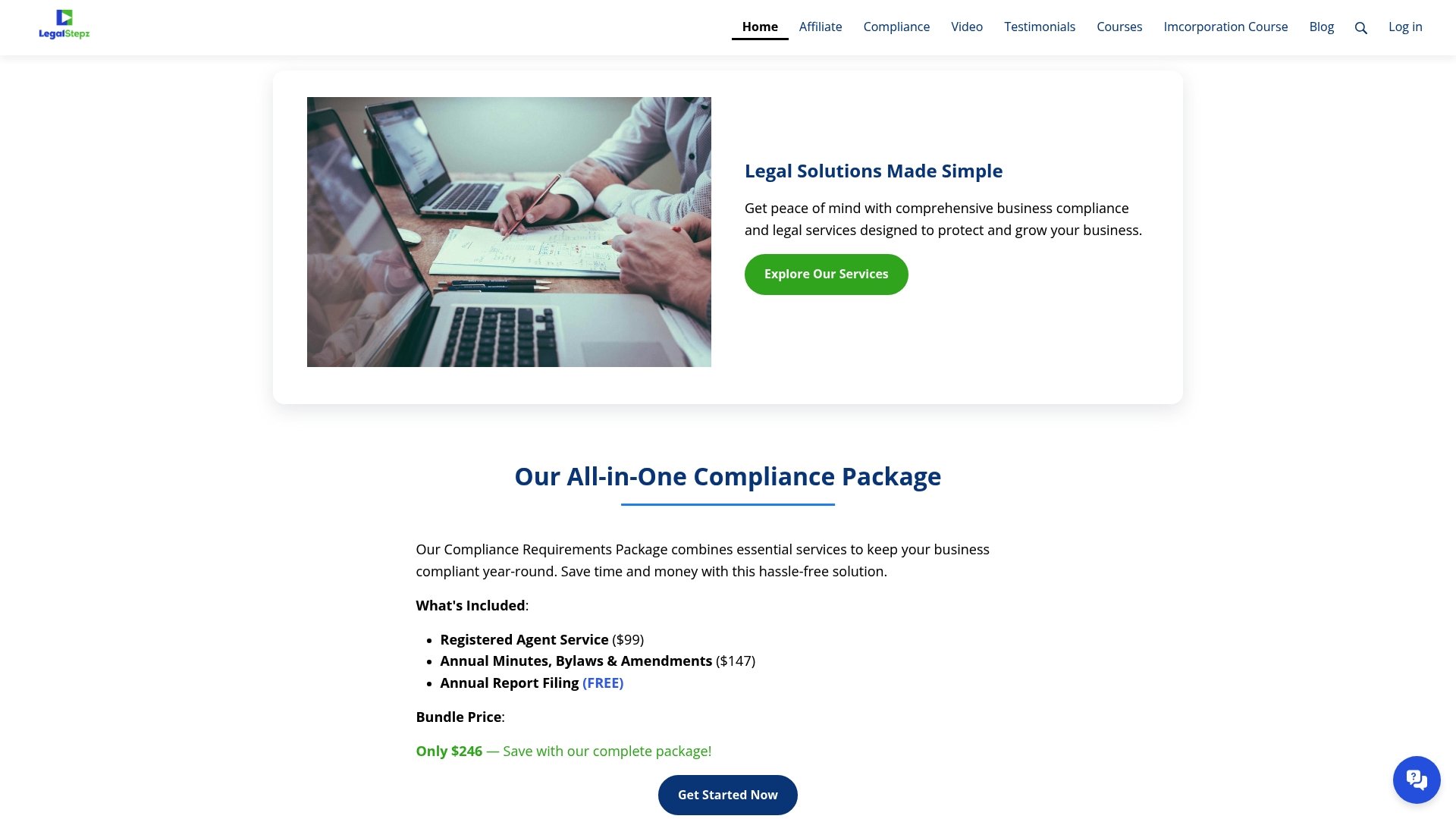
Legalstepz offers direct support for California corporations, including filing your Statement of Information, drafting annual corporate minutes, and providing registered agent services to keep your corporation in good standing. If you want to build a deeper understanding of California corporate compliance from the ground up, the Legalstepz Incorporation Course covers annual filing requirements, corporate recordkeeping, and the full lifecycle of a California corporation. It is built specifically for California business owners who want to handle compliance with confidence rather than guesswork.
FAQ
What is the California corporation annual report called?
California calls it the Statement of Information, not an annual report. Corporations file Form SI-550 annually with the California Secretary of State.
How much does it cost to file a California Statement of Information?
The filing fee is $25 for corporations, paid online through the bizfileOnline portal. A $250 penalty applies if you miss the deadline.
When is the California Statement of Information due?
The initial filing is due within 90 days of incorporation. After that, corporations file annually by the last day of their anniversary month.
Can I file the Statement of Information early?
Yes. California allows corporations to file up to six months before the due date. Filing early counts as your annual filing and does not change your anniversary month deadline.
What happens if I do not file the Statement of Information?
The Franchise Tax Board assesses a $250 penalty, and continued non-compliance results in suspension of your corporation's right to conduct business in California.