

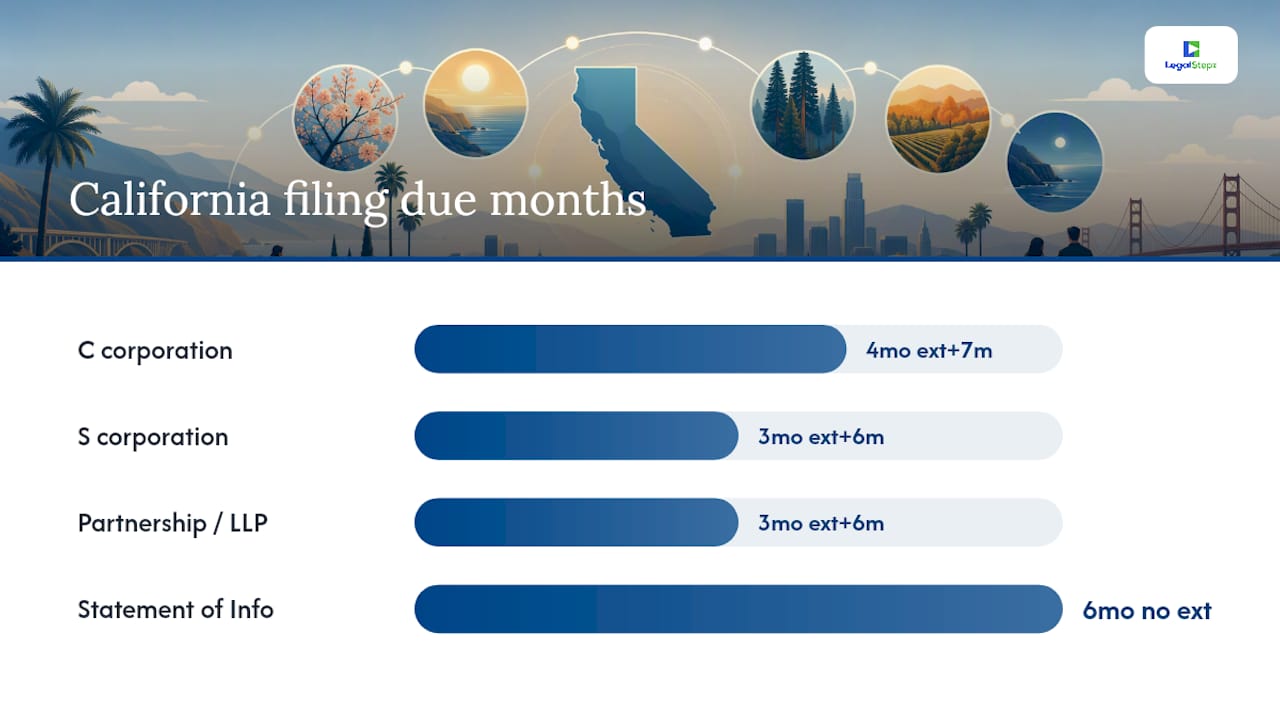
California's corporate filing deadlines follow a specific schedule that differs from federal rules in ways that catch officers off guard every year. The core dates: C corporations file Form 100 by the 15th day of the fourth month after their tax year closes (April 15 for calendar-year filers), while S corporations and partnerships file Form 100S by the 15th day of the third month (March 15). California grants automatic extensions — seven months for C corps, six months for S corps — but those extensions cover only the filing deadline, not the payment. Tax owed is due on the original date, period.
Beyond the income tax return, your California corporation filing deadlines list includes four other calendars running simultaneously: the franchise minimum tax and LLC annual fee schedule, quarterly estimated tax payments, sales and use tax returns through the California Department of Tax and Fee Administration (CDTFA), payroll deposits through the Employment Development Department (EDD) and IRS, and the Secretary of State's Statement of Information window tied to your incorporation anniversary. Verify every date against the FTB due dates page, the CDTFA, the California Secretary of State, and the EDD before finalizing your calendar.
| Filing Type | Entity | Original Due Date | Extension Available |
|---|---|---|---|
| Form 100 (income/franchise) | C corporation | 15th day, 4th month after year-end | 7 months (file only) |
| Form 100S | S corporation | 15th day, 3rd month after year-end | 6 months (file only) |
| Partnership return | Partnership / LLP | 15th day, 3rd month after year-end | 6 months (file only) |
| Statement of Information | All corporations | 6-month window ending in anniversary month | None |
| Sales & use tax | All registered sellers | Varies by CDTFA-assigned frequency | None standard |
| Payroll deposits | All employers | Varies by deposit schedule | None |
Key takeaways
California corporations face four simultaneous compliance calendars — FTB, CDTFA, EDD, and SoS — and extensions never extend the payment due date, only the filing deadline.
| Point | Details |
|---|---|
| C corp original due date | Form 100 is due the 15th day of the 4th month after year-end; April 15 for calendar-year filers. |
| Extension rule | Automatic 7-month extension for C corps and 6 months for S corps covers filing only — tax is still due on the original date. |
| Statement of Information | Due in a 6-month window ending in your incorporation anniversary month; missing it triggers a $250 penalty and possible suspension. |
| CDTFA filing frequency | CDTFA assigns monthly, quarterly, or annual frequency — verify your current assignment each January in your CDTFA account. |
| Legalstepz compliance services | Legalstepz files Statements of Information, provides registered agent service, and prepares annual minutes to keep California corporations in good standing. |
Table of Contents
- 1. What are the filing deadlines by entity type in California?
- 2. When and how do California corporations make estimated tax payments?
- 3. What are the CDTFA sales and use tax filing deadlines?
- 4. What payroll and employment tax deadlines apply to California corporations?
- 5. When is your Statement of Information due with the California Secretary of State?
- 6. How do extensions and penalties work, and what counts as "timely"?
- 7. What filings are required when you dissolve a California corporation?
- 8. What are the most common California filing mistakes, and how do you avoid them?
- A practical perspective on California compliance
- Legalstepz keeps your California compliance on track
- Sources
1. What are the filing deadlines by entity type in California?
FTB Publication 1060 sets the due-date formulas that govern every California business return. Here is how each entity type maps to the calendar.
C corporations on a calendar year owe Form 100 by April 15, with an extended filing deadline of November 15. The Taxes notes initial-year exceptions that can shift the first-year due date, so new corporations should confirm their specific start date before assuming April 15 applies.
S corporations on a calendar year owe Form 100S by March 15, with an extended filing deadline of September 15. The payment due on March 15 cannot be pushed to September, regardless of whether you file an extension.
Partnerships and LLPs share the same March 15 original deadline for calendar-year filers. Fiscal-year filers calculate their date from the close of their own tax year, not the calendar year. If your fiscal year ends June 30, your partnership return is due September 15.
LLCs carry an additional obligation: the annual LLC fee, which scales with gross receipts and is due by the original return due date. The minimum franchise tax of $800 applies to most LLCs and corporations regardless of income or activity level. See the California franchise tax overview for the current fee schedule and payment mechanics.
Foreign corporations registered in California follow the same Form 100 schedule as domestic C corporations. Their registration and qualification filings with the Secretary of State are separate from the tax calendar and must be current before the tax return is filed.
For a deeper look at how fiscal-year choices affect your documentation requirements, the California corporation fiscal year documentation guide covers the tradeoffs in detail.
Pro Tip: If your fiscal year currently ends in a month that puts your original due date close to a major holiday or your busiest operating season, consider whether a fiscal-year change could shift that crunch. A June 30 year-end, for example, moves a C corporation's original return deadline to October 15 — well clear of April tax season.
2. When and how do California corporations make estimated tax payments?
Estimated tax payments prevent a large underpayment penalty at year-end. California corporations generally must pay estimated taxes in four installments during the taxable year. For calendar-year C corporations, those installments are due on April 15, June 15, September 15, and December 15 of the current tax year.
The minimum franchise tax affects the first installment. A corporation's first estimated payment must be at least the minimum franchise tax amount ($800 for most entities), even if projected income is zero. Subsequent installments are based on the corporation's expected annual tax liability.
Here is the action sequence for a calendar-year C corporation:
- Confirm your entity's minimum franchise tax obligation before the first installment date (April 15).
- Calculate projected annual income and divide the estimated tax liability across the four installment dates.
- Submit the first installment by April 15 using FTB Form 100-ES or pay electronically through the FTB's Web Pay system.
- Submit the second installment by June 15, adjusting if income projections have changed.
- Submit the third installment by September 15, again adjusting for year-to-date actuals.
- Submit the fourth installment by December 15 to close out the estimated payment cycle.
- File Form 100 by April 15 of the following year (or by November 15 if using the automatic extension), reconciling actual tax against estimated payments made.
- Pay any remaining balance by the original April 15 due date, even if you file on extension.
The FTB's due dates for businesses page includes links to estimated payment worksheets and vouchers. If your corporation's income is uneven across quarters, the annualized income installment method can reduce penalty exposure by matching each payment to actual income earned through that period rather than a flat 25% of annual liability.
3. What are the CDTFA sales and use tax filing deadlines?
The CDTFA assigns each registered seller a filing frequency based on reported or anticipated sales volume. That frequency determines your due dates for the year. You must file on or before the due date even when you have no sales to report for the period.
| Reporting Basis | Period End Date | Return Due Date |
|---|---|---|
| Monthly | Last day of each month | Last day of the following month |
| Quarterly (calendar) | March 31, June 30, Sept 30, Dec 31 | Last day of the month following period end |
| Quarterly with prepayment | Same quarterly periods | Prepayment due 24th of the second month of each quarter; return due last day of month following quarter end |
| Annual | December 31 | January 31 of the following year |
The quarterly-prepayment schedule catches many businesses off guard. If CDTFA assigns you this frequency, you owe a prepayment by the 24th of February, May, August, and November, with the full quarterly return reconciling those prepayments at the end of each quarter.
For businesses that close or discontinue operations mid-year, the final sales tax return is due by the last day of the month following the close of the final reporting period. A business that stops operations on August 10 and files quarterly would owe its final return by September 30. The CDTFA filing dates page includes the complete tables for all frequencies and the final-return mapping for discontinued businesses.
If your sales volume changes significantly, contact CDTFA to request a frequency reassignment. Filing on the wrong frequency creates both underpayment and administrative penalties.
4. What payroll and employment tax deadlines apply to California corporations?
Payroll compliance runs on its own calendar, separate from income tax returns. California employers interact with both the EDD for state payroll taxes and the IRS for federal obligations.
State payroll deposits (EDD):
- Next-day depositors: Employers whose accumulated state payroll tax liability reaches $500 or more must deposit by the next business day.
- Semi-weekly depositors: Employers with larger payrolls follow a semi-weekly schedule tied to payroll dates.
- Quarterly depositors: Smaller employers with lower liability may deposit quarterly, but EDD reassigns frequency as payroll grows.
- DE 9 (Quarterly Contribution Return): Due the last day of the month following each quarter end (April 30, July 31, October 31, January 31).
- DE 9C (Quarterly Wage and Withholding Report): Filed on the same schedule as DE 9.
Federal payroll deposits (IRS):
- Monthly depositors: Federal payroll taxes deposited by the 15th of the following month.
- Semi-weekly depositors: Payrolls paid Wednesday through Friday require deposits by the following Wednesday; payrolls paid Saturday through Tuesday require deposits by the following Friday.
- Form 941 (Employer's Quarterly Federal Tax Return): Due April 30, July 31, October 31, and January 31.
- W-2 distribution to employees: January 31.
- 1099-NEC distribution to recipients: January 31.
- W-2 / 1099 filing with SSA / IRS: January 31 for electronic filers.
Timing matters on EFT payments. Initiating an electronic funds transfer on the due date is not the same as a timely deposit if the transaction does not settle by the cutoff. The IRS and EDD both treat the settlement date, not the initiation date, as the deposit date. Build in at least one business day when scheduling electronic payroll tax payments.
The California payroll compliance guide from Glendale Payroll covers state-specific deposit rules in detail, and the payroll tax deposit schedule explainer breaks down how frequency assignments work for new and growing employers.
5. When is your Statement of Information due with the California Secretary of State?
The Statement of Information deadline does not follow the tax calendar. It is tied to your corporation's incorporation anniversary, and the California Secretary of State's filing tips page defines the window as the six-month period ending in the anniversary month.
| Month of Incorporation | Filing Window |
|---|---|
| January | August through January |
| February | September through February |
| March | October through March |
| April | November through April |
| May | December through May |
| June | January through June |
| July | February through July |
| August | March through August |
| September | April through September |
| October | May through October |
| November | June through November |
| December | July through December |
A corporation incorporated in March has a filing window running from October through March. Miss that window and you face a $250 penalty, and the Secretary of State can suspend your corporate powers. Suspension means you cannot legally defend a lawsuit, enter contracts, or access California courts until you are reinstated.
Under California Corporations Code Section 1502, every corporation must file a Statement of Information annually during the applicable filing period. The statute explicitly states that failure to receive a notice from the Secretary of State does not excuse the obligation to file.
Do not rely on a mailed reminder. The SoS sends them as a courtesy, not a legal obligation. Set a calendar reminder for the first month of your filing window, not the last. For a practical walkthrough of the filing process, the California Statement of Information guide covers what to include and how to submit. The annual report requirements guide also maps the Statement of Information into the broader annual compliance picture.
6. How do extensions and penalties work, and what counts as "timely"?
Extensions in California are automatic for corporations in good standing. C corporations get seven months; S corporations get six months. Neither requires a separate extension request — the extension kicks in automatically as long as you have paid at least the minimum tax due by the original deadline.
Late payment: Interest accrues from the original due date on any unpaid balance. The FTB also charges a late payment penalty of 5% of the unpaid tax, plus 0.5% for each additional month the tax remains unpaid, up to a maximum of 25%.
Late filing: A separate penalty applies when the return itself is filed late without a valid extension. Filing on extension eliminates the late-filing penalty as long as the tax was paid by the original due date.
If you cannot pay the full amount by the original due date, pay as much as possible and contact the FTB about an installment agreement. Partial payment reduces the penalty base. Do not skip payment entirely because you plan to file on extension — that is the single most expensive mistake on the California corporate compliance timeline.
Disaster relief can change all of these dates. When the IRS grants federal disaster relief, California agencies often align state deadlines to match. The IRS wildfire relief announcement is an example of how federal postponements can shift state obligations. Always check the FTB's emergency tax postponement page during any declared disaster.
Pro Tip: When you make a payment close to a deadline, print or screenshot the confirmation number and timestamp immediately. If a dispute arises about timeliness, that record is your evidence. Agency portals sometimes experience outages on high-traffic deadline days, so initiate payments at least 48 hours early when possible.
7. What filings are required when you dissolve a California corporation?
Closing a corporation does not end your filing obligations. It triggers a specific sequence of final returns across every agency that has jurisdiction over your business.
- FTB final return: File a final Form 100 or 100S for the short tax year ending on the date of dissolution. Mark the return as "final." The franchise minimum tax is still owed for the final year unless the corporation qualifies for an exemption.
- CDTFA final sales tax return: Due by the last day of the month following the close of the final reporting period. If you close on October 15 and file quarterly, your final return is due November 30. Cancel your seller's permit through your CDTFA account after filing.
- EDD final payroll returns: File a final DE 9 and DE 9C for the last quarter in which you paid wages. Deposit all remaining payroll tax liabilities before the final return due date.
- IRS final Form 941: Due the last day of the month following the final quarter in which wages were paid. Check the "final return" box on the form.
- W-2s and 1099s: Issue to employees and contractors by January 31 of the year following the final payroll, even if the corporation dissolved mid-year.
- Secretary of State dissolution: File a Certificate of Dissolution (Form DISS STK) with the SoS. The corporation must be in good standing with the FTB before the SoS will accept the dissolution filing.
- FTB tax clearance: In some cases, the FTB issues a tax clearance certificate confirming no outstanding liabilities before the SoS processes the dissolution. Confirm current requirements on the FTB website.
Maintain good standing with both the FTB and the SoS through the entire dissolution process. A suspended corporation cannot file dissolution documents, which creates a loop that delays closure and accumulates additional penalties.
8. What are the most common California filing mistakes, and how do you avoid them?
California's rules diverge from federal patterns in ways that create predictable, expensive mistakes. The most common ones are not obscure edge cases — they happen to experienced officers every year.
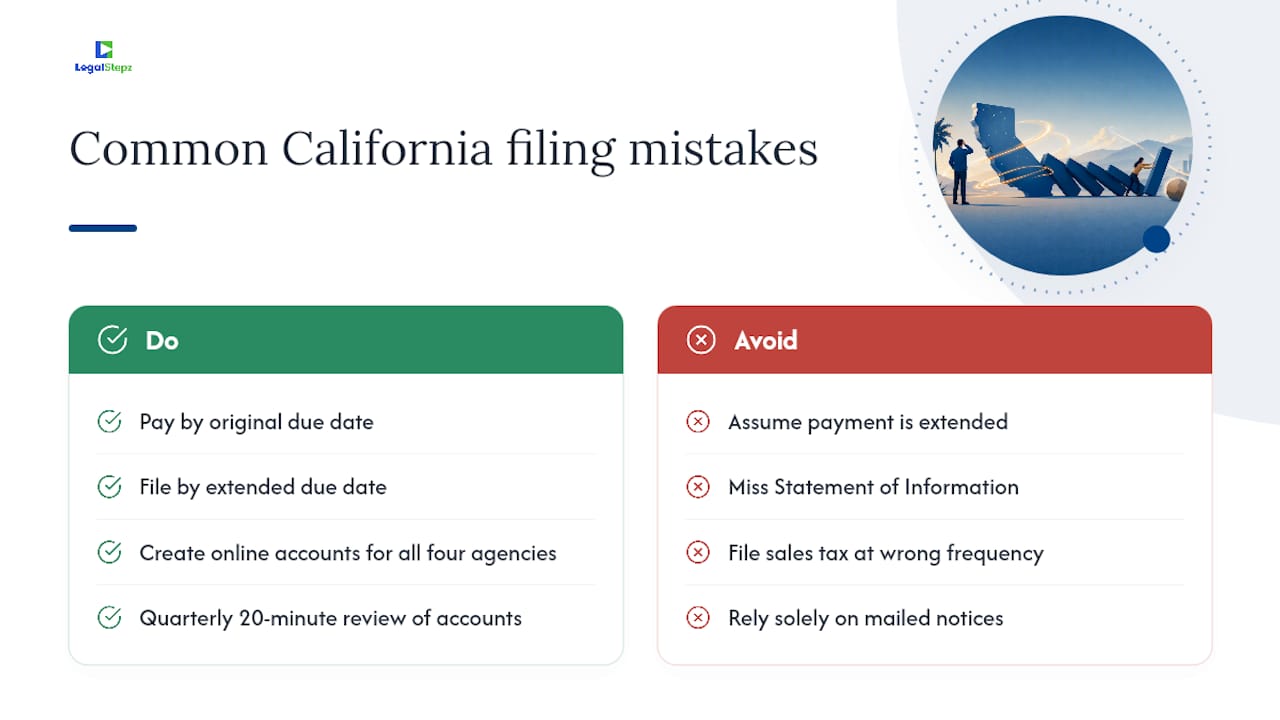
The most dangerous assumption in California corporate compliance is that federal compliance is sufficient. California has its own minimum franchise tax, its own extension mechanics, and a Secretary of State maintenance calendar that runs on a completely different timeline from any federal obligation.
Confusing filing extensions with payment extensions is the most costly mistake on the list. An officer files on extension, assumes the payment is also extended, and receives an FTB penalty notice months later. The rule is absolute: pay by the original due date, file by the extended date.
Missing the Statement of Information window because the mailed reminder never arrived. The SoS filing tips page and California Corporations Code Section 1502 both make clear that the obligation exists regardless of whether any notice was received. Track your anniversary month independently.
Filing sales tax returns on the wrong frequency after CDTFA reassigns your account. If your sales volume crosses a threshold, CDTFA may shift you from quarterly to monthly filing without a loud notification. Log into your CDTFA account at the start of each year to confirm your current filing frequency.
Relying solely on mailed agency notices for any deadline. The FTB, CDTFA, EDD, and SoS all send courtesy notices, but none of them carry legal responsibility for your compliance. Build your own calendar.
Pro Tip: Set up online accounts with all four agencies — FTB, CDTFA, EDD, and SoS — at the start of each year. Each portal shows your current filing frequency, outstanding balances, and upcoming due dates in one place. A 20-minute quarterly review of all four accounts catches reassignments and balance discrepancies before they become penalties.
For a broader look at why California imposes these layered requirements and what the consequences of missing them are, the annual filings rationale guide explains the policy framework clearly.
A practical perspective on California compliance
Most corporate officers treat compliance as a once-a-year event. That framing is what causes the problems. California runs four separate compliance calendars simultaneously — FTB, CDTFA, EDD, and SoS — and each one has its own logic, its own penalties, and its own agency portal. None of them talk to each other.
The officers who stay out of trouble are not necessarily the ones with the best accountants. They are the ones who built a 12-month compliance calendar in January and review it quarterly. They know their Statement of Information window by heart. They set estimated payment reminders before the quarter starts, not the week it ends. They check their CDTFA account in January to confirm their filing frequency before assuming it is the same as last year.
The $800 minimum franchise tax surprises new corporations every year because it is owed even when the business has no revenue. The Statement of Information penalty surprises officers who incorporated in an odd month and never mapped their anniversary window. These are not obscure rules. They are the standard California corporate compliance timeline, and they are all publicly documented on agency websites.
The practical fix is simple: treat compliance as a calendar problem, not a tax problem. Every deadline in this article has a corresponding agency page where you can verify the current date. Bookmark them. Check them once a quarter.
Legalstepz keeps your California compliance on track
Staying current with California's layered filing requirements takes more than a good accountant. It takes someone watching the calendar year-round. Legalstepz handles the filings that trip up California corporations most often: Statement of Information submissions, registered agent services so you never miss a legal notice, and annual corporate minutes and bylaws preparation that keeps your records audit-ready.
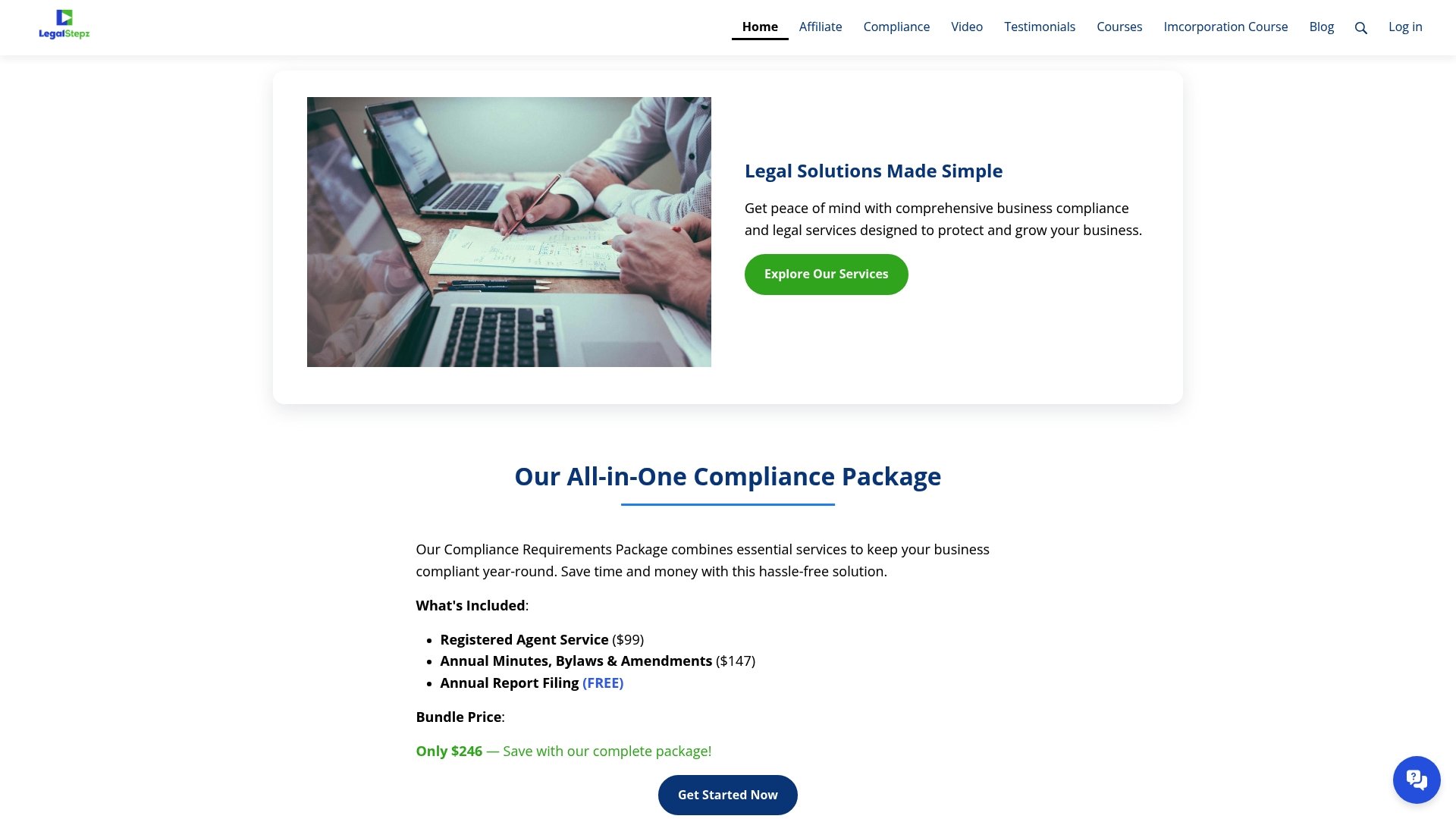
The Statement of Information alone carries a $250 penalty for a missed window, plus the risk of suspension that blocks you from defending lawsuits or signing contracts. Legalstepz files it for you on time every year, without you having to track the anniversary window yourself. For corporations that want full-year coverage, the compliance packages bundle registered agent service, SoI filing, and annual minutes into a single annual cost. Visit Legalstepz to see the current packages and get your corporation's compliance calendar covered today.
Sources
Verify every deadline directly with the issuing agency before finalizing your compliance calendar. Emergency relief orders and legislative changes can shift dates without broad public notice.
- Ftb
- Sales & use tax returns filing dates | CDTFA
- Statements of Information Filing Tips :: California Secretary of State
- California Code, CORP 1502
- C Corporations | Taxes
- IRS: California wildfire victims qualify for tax relief
This article provides general information about California filing deadlines and is not a substitute for professional legal or tax advice. Confirm current rules with the relevant agency or a qualified professional before making compliance decisions.