

California corporation fiscal year documentation is the process of maintaining accurate financial records and meeting specific tax filing deadlines tied to a non-December tax year end. Every California corporation must file with the California Franchise Tax Board (FTB) and the IRS, using forms such as Form 100 and Form 1120, and pay the $800 minimum franchise tax regardless of income. Choosing a fiscal year instead of a calendar year shifts every filing deadline, which means missing a single date can trigger penalties, audits, or forced default to calendar-year status. This guide covers the exact deadlines, required documents, and record-keeping practices California corporations need to stay compliant in 2026.
What is California corporation fiscal year documentation?
California corporation fiscal year documentation refers to the complete set of financial records, tax forms, and compliance filings a corporation must prepare when its tax year ends on a date other than december 31. The IRS defines a fiscal year as any 12-month period ending on the last day of any month except december. A calendar year, by contrast, always ends on december 31.
Most California C corporations can freely choose a fiscal year end. S corporations and partnerships face more restrictions and generally must use the calendar year unless they make a Section 444 election or obtain IRS approval through Form 1128. Choosing the wrong structure without proper approval causes the corporation to default to calendar-year status, which creates retroactive filing complications.

A valid business purpose must support the fiscal year choice. Picking a june 30 or september 30 year end simply to avoid a busy tax season does not qualify. Seasonal businesses, retailers whose peak revenue falls outside december, or companies that align with a parent corporation's reporting cycle all have legitimate justifications.
The California FTB conforms closely to federal income calculations but enforces its franchise tax independently. That independence means a corporation can owe California taxes even in a year with zero federal taxable income.
Pro Tip: Document your business reason for the fiscal year choice in your corporate minutes at formation. If the IRS ever questions the election, that contemporaneous record is your strongest defense.
What are the differences between fiscal and calendar years for California corporations?
The core difference is timing. A calendar-year corporation closes its books on december 31 every year. A fiscal-year corporation closes on the last day of a chosen month, such as june 30 or september 30. That single choice shifts every downstream deadline.
How fiscal year selection affects filing deadlines
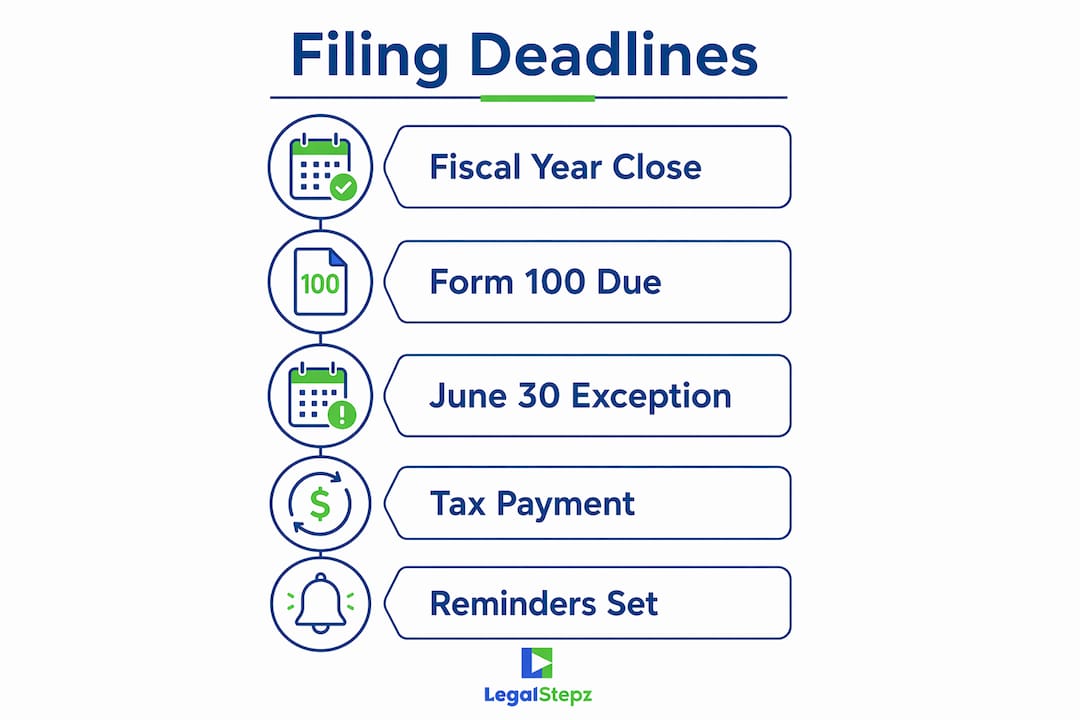
California C corporations must file Form 100 by the 15th day of the 4th month after the fiscal year closes. A corporation with a september 30 year end, for example, faces a january 15 filing deadline. A calendar-year corporation using december 31 faces an april 15 deadline. The shift sounds simple, but it catches many owners off guard when they assume the standard april date still applies.
The June 30 exception
C corporations with a june 30 fiscal year end face a unique rule. Their filing deadline moves to the 15th day of the 3rd month after year end, which is september 15. That is a full month earlier than the standard fourth-month rule. This exception exists because of a federal conformity rule, and California follows it. Missing september 15 when you assumed october 15 was the deadline is one of the most common and costly errors California fiscal-year filers make.
| Tax year end | Standard deadline | Exception applies? |
|---|---|---|
| December 31 | April 15 | No |
| September 30 | January 15 | No |
| June 30 | September 15 | Yes, 3rd month rule |
| March 31 | July 15 | No |
Pro Tip: Set a calendar reminder 90 days before your fiscal year closes. That window gives you enough time to gather documents, reconcile accounts, and avoid a last-minute scramble.
What are the key filing deadlines and required documents for California corporations?
Compliance requires knowing both what to file and when to file it. The documents and deadlines below apply to California C corporations with a fiscal year.
Core filing deadlines
- Form 100 (California Corporation Franchise or Income Tax Return): Due the 15th day of the 4th month after fiscal year end, except for june 30 year ends (3rd month, september 15).
- IRS Form 1120: Due the 15th day of the 4th month after fiscal year end for C corporations.
- Quarterly estimated tax payments: Due on the 15th day of the 4th, 6th, 9th, and 12th months of the current tax year.
- $800 minimum franchise tax: Due by the 15th day of the 4th month after the fiscal year closes. First-year corporations are exempt for 12 months after formation.
- Extension request via Form 7004: Must be filed by the original due date. It grants a 6-month extension to file the return but does not extend the time to pay taxes owed.
Required documents for filing
Gathering the right documents before the deadline prevents errors and reduces audit risk. Every California corporation should prepare the following before filing:
- Trial balance and general ledger for the fiscal year
- Bank statements and bank reconciliations for all accounts
- Accounts receivable and accounts payable aging schedules
- Fixed asset schedules and depreciation tables
- Federal Form 1120 or 1120-S (used as the basis for California Form 100)
- Schedule R (California apportionment and allocation of income)
- Any 1099s, W-2s, or 1098s issued or received during the year
The IRS cross-references tax returns with third-party information such as 1099s and W-2s. A mismatch between what a corporation reports and what third parties report is a direct audit trigger.
Pro Tip: Reconcile your bank accounts monthly, not just at year end. Monthly reconciliations make the annual close far faster and reduce the chance of missing a transaction that could flag an audit.
How to properly document and maintain fiscal year records for California corporations
Proper record keeping is the foundation of clean fiscal year filings. California corporations must maintain records that match the chosen tax year, not the calendar year. Mixing records across different year-end periods creates reconciliation errors that are difficult to unwind during an audit.
The annual report requirements for California corporations also tie into fiscal year documentation. The Statement of Information, filed with the California Secretary of State, is due every year for corporations and must reflect current officer and director information. While it does not follow the fiscal year calendar directly, keeping it current is part of the broader compliance picture.
Records every California corporation must keep
- Trial balances prepared at fiscal year end
- Monthly bank statements and reconciliations
- Accounts receivable and payable aging reports
- Fixed asset schedules with acquisition dates, costs, and depreciation methods
- Payroll records, including W-2s and 941 filings
- Corporate minutes and resolutions authorizing major financial decisions
- Prior-year tax returns for at least 7 years
California conforms to federal income calculations but applies its franchise tax independently. That means a corporation must document California-source income separately when it operates in multiple states. Schedule R handles this apportionment, but it requires detailed records of where revenue was earned and where expenses were incurred.
Dormant corporations face a trap that many owners do not see coming. An inactive corporation that stops filing still owes the $800 minimum franchise tax and must file Form 100 every year until it formally dissolves with the California Secretary of State. Penalties and interest accumulate silently while the owner assumes the obligation ended when business activity stopped.
Pro Tip: If your corporation has been inactive for more than one year, calculate the total tax and penalty exposure before deciding whether to dissolve. In many cases, the cost of formal dissolution is far less than the accumulated back taxes.
What common mistakes should California corporations avoid with fiscal year filings?
Most compliance failures come from a small set of recurring errors. Knowing them in advance is the most direct way to avoid them.
- Applying calendar-year deadlines to a fiscal year. A corporation with a september 30 year end that files by april 15 is filing five months late. Every fiscal-year corporation must calculate its own deadline from its specific year-end date.
- Missing the june 30 exception. C corporations with a june 30 year end must file by september 15, not october 15. This one-month difference is the most frequently missed deadline among fiscal-year filers.
- Assuming dormancy eliminates filing obligations. Inactive corporations still owe the $800 minimum franchise tax and must file annually until formally dissolved with the Secretary of State.
- Skipping quarterly estimated tax payments. Missing estimated payments triggers underpayment penalties even if the annual return is filed on time.
- Filing without required schedules. Form 100 requires supporting schedules such as Schedule R for apportionment. Submitting the return without them causes processing delays and potential penalties.
- Failing to attach federal Form 1120. California Form 100 uses the federal return as its starting point. Missing the federal attachment creates an incomplete state filing.
- Not requesting an extension before the deadline. Form 7004 must be filed by the original due date. Filing it late means the extension is invalid and the return is already delinquent.
Switching to or maintaining a fiscal year requires IRS approval via Form 1128 or a Section 444 election for certain entity types. Improper establishment can result in default calendar-year status, which creates retroactive filing complications and potential penalties for the years the wrong year-end was used.
Correcting a missed deadline starts with filing the return as soon as possible and paying any tax owed. The FTB charges a 5% late filing penalty plus 0.5% per month the return remains unfiled, up to 25%. Acting quickly limits the total penalty exposure.
Key Takeaways
California corporation fiscal year documentation requires knowing your exact year-end date, filing the correct forms by the right deadlines, and maintaining detailed financial records every year without exception.
| Point | Details |
|---|---|
| Fiscal year shifts all deadlines | Your filing due date is calculated from your specific year-end, not april 15. |
| June 30 year-end is a special case | C corporations with a june 30 year end must file by september 15, one month earlier than the standard rule. |
| $800 minimum tax applies always | Every California corporation owes $800 annually, even with zero income, until formally dissolved. |
| Dormant corporations still file | Inactive corporations must file Form 100 and pay franchise tax until dissolution is complete. |
| Records must match the fiscal year | Trial balances, bank reconciliations, and depreciation schedules must align with your chosen year-end. |
Why fiscal year planning deserves more attention than most owners give it
Most California entrepreneurs treat the fiscal year choice as a one-time administrative checkbox at formation. I have seen that assumption cause real damage. A retailer who chose a june 30 year end to align with their inventory cycle missed the september 15 deadline three years in a row because their accountant was still thinking in april terms. The penalties were avoidable. The fix was a single calendar reminder and a clear written policy in the corporate records.
The deeper issue is coordination. Your accountant, your attorney, and your bookkeeper all need to work from the same fiscal year calendar. When one of them defaults to calendar-year assumptions, errors compound. I recommend building a one-page compliance calendar specific to your fiscal year and sharing it with every advisor at the start of each year. It takes 20 minutes to create and prevents months of cleanup.
The dormancy trap is the other issue I see constantly. Owners who stop operating assume their tax obligations stop too. They do not. The California FTB will continue assessing the $800 minimum franchise tax and late penalties until you file a final return and complete the formal dissolution process with the Secretary of State. If you have an inactive corporation sitting on the shelf, address it now. The longer you wait, the larger the bill.
— Peter
How Legalstepz helps California corporations stay compliant
Getting your fiscal year documentation right from day one is far easier than correcting years of missed filings. Legalstepz offers a step-by-step incorporation course built specifically for California entrepreneurs, covering how to select and document your fiscal year correctly, meet FTB and IRS filing deadlines, and maintain the records that keep your corporation in good standing.
The course walks you through Form 100 requirements, the $800 minimum franchise tax rules, and the documentation practices that prevent audits. Legalstepz also provides registered agent services, annual minutes drafting, and Statement of Information filing so your compliance calendar stays on track year after year. If you are forming a new corporation or cleaning up an existing one, the California annual report guide is a practical starting point.
FAQ
What is the filing deadline for a California C corporation with a fiscal year?
California C corporations must file Form 100 by the 15th day of the 4th month after their fiscal year closes. The exception is corporations with a june 30 year end, which must file by september 15.
Does the $800 minimum franchise tax apply to fiscal-year corporations?
Yes. Every California corporation owes the $800 minimum franchise tax regardless of income or fiscal year end date. First-year corporations are exempt for the first 12 months after formation.
What happens if a dormant California corporation stops filing?
A dormant corporation still owes the $800 minimum franchise tax and must file Form 100 every year until it formally dissolves with the California Secretary of State. Penalties and interest accumulate on unfiled returns.
What forms does a California fiscal-year corporation need to file?
A California C corporation must file California Form 100 and IRS Form 1120. Multi-state corporations must also attach Schedule R for apportionment. S corporations use Form 1120-S at the federal level and the corresponding California form.
Can a California corporation change its fiscal year?
Yes, but changing a fiscal year requires IRS approval through Form 1128 or a Section 444 election for certain entity types. Filing without proper approval can result in the IRS defaulting the corporation back to calendar-year status.