
What officer roles does California law require your corporation to have?
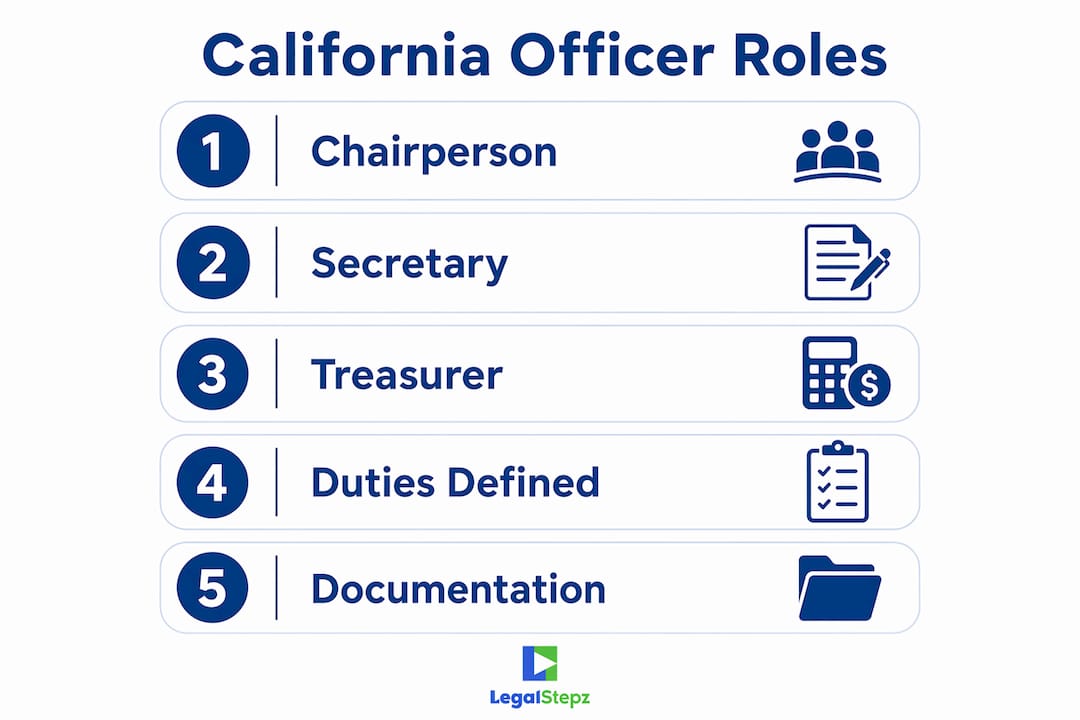
California Corporations Code Section 312 sets the floor clearly: every California corporation must have three specific officers. No exceptions, no workarounds.
- Chairperson or president. The statute allows the title to be "chair of the board," "chairperson of the board," or simply "chairperson." A corporation may have both a chairperson and a president, or just one person filling that combined role.
- Secretary. Responsible for maintaining official corporate records and meeting minutes.
- Chief financial officer (CFO). Sometimes called the treasurer; handles financial oversight and signs financial instruments.
One person can legally hold all three roles simultaneously unless your articles of incorporation or bylaws say otherwise. That means a solo founder can be president, secretary, and CFO all at once. Most California corporations do not restrict this in their bylaws, which can create ambiguity about authority during audits or disputes, so it is worth addressing explicitly in your governing documents.
Beyond the mandatory three, the board may appoint additional officers with whatever titles fit the business, provided each has defined duties and the authority necessary to sign instruments or share certificates. A title alone is not enough. The duties must be spelled out in the bylaws or a board resolution.
Table of Contents
- What does each mandatory officer actually do?
- Which documents actually prove your officer roles are legitimate?
- How do you appoint, resign, and define officer authority in California?
- What are the legal responsibilities and compliance risks for California officers?
- Key Takeaways
What does each mandatory officer actually do?
The duties tied to each role are not arbitrary. They reflect how California law expects the corporation to function day to day.
- President or chairperson of the board. Under Section 312(a), the president (or chairperson when there is no president) serves as the general manager and chief executive officer of the corporation. That means overall management authority, unless the articles or bylaws carve out exceptions. This officer typically signs contracts, executes major agreements, and represents the corporation externally.
- Secretary. The secretary's job is fundamentally about records. Meeting minutes, notices of board and shareholder meetings, corporate resolutions, and the corporate minute book all fall under this role. When a third party needs proof that a board action was properly authorized, the secretary's records are the evidence.
- CFO. Financial oversight is the core function: managing accounts, signing checks and financial instruments, and maintaining the corporation's financial records. The CFO also typically certifies financial statements and works directly with auditors or tax advisors.
Bylaws or board resolutions can expand or narrow these duties. A board might, for example, require dual signatures on checks above a certain amount, or restrict the president's authority to bind the corporation on contracts exceeding a specific dollar threshold. Those refinements belong in writing, not in informal practice.
Pro Tip: Even when one person holds all three officer roles, draft separate duty descriptions in your bylaws for each title. It protects you during audits and makes the corporate structure legible to banks, investors, and courts.

Which documents actually prove your officer roles are legitimate?
California corporate officer responsibilities are only as solid as the paper trail behind them. Here are the key documents every corporation needs:
- Corporate bylaws. These are your primary internal governance document. Bylaws establish.pdf?hash=37649ABF78664582345BB04D63747820&rev=59626ad3b9b34589bf85fef7bc68b2f1) officer titles, duties, signing authority, and the process for appointing or removing officers. They are not filed with the state, but they carry enormous legal weight. A bank opening a corporate account will ask for them. So will a court.
- Board meeting minutes. Every officer appointment should appear in the minutes of a board meeting. The resolution appointing an officer, the date it was adopted, and the names of directors who voted are all part of the record. Minutes are the contemporaneous evidence that an action actually happened.
- Statement of information. Filed with the California Secretary of State, this document discloses officer names and addresses.pdf?hash=37649ABF78664582345BB04D63747820&rev=59626ad3b9b34589bf85fef7bc68b2f1) and is required to maintain active corporate status. California corporations must file this annually, and it carries a filing fee. Letting it lapse puts the corporation's good standing at risk. For a full breakdown of annual filing obligations, the California corporation annual report requirements guide covers the specifics.
- Corporate minute book. Think of this as the master file for everything above. Bylaws, meeting minutes, officer appointment records, and resignation letters all live here. It is what you hand over during due diligence, an audit, or a legal dispute.
- Board resolutions. When the board grants an officer specific signing authority or defines a new officer's powers, that grant needs its own written resolution. A verbal understanding does not bind the corporation legally.
Documents for officer roles are not a formality. They are the mechanism by which officer authority becomes legally real. For guidance on how registered agent responsibilities intersect with officer documentation, that is another layer worth understanding.
How do you appoint, resign, and define officer authority in California?
The process is straightforward, but the details matter.
- Appointment. Officers are chosen by the board of directors and serve at the board's pleasure, per Section 312(b). That means the board can remove an officer at any time unless a written employment contract says otherwise. The appointment should be documented in board meeting minutes with a clear resolution.
- Resignation. Any officer may resign by delivering written notice to the corporation. Verbal resignations create problems. The written notice should be dated, addressed to the corporation or its board, and filed in the corporate minute book immediately.
- Authority. An officer's legal capacity to bind the corporation through contracts, bank accounts, or other instruments must be grounded in the bylaws or a specific board resolution. Without that documentation, a third party has no reliable basis for trusting that the officer had authority to act. When officer signing authority needs to be formally witnessed or notarized, professional notary services can handle that step cleanly.
- Changes in officer status. Any time an officer is appointed, resigns, or is removed, update the corporate minute book promptly. Then check whether the change triggers an obligation to update the statement of information with the Secretary of State. For practical guidance on recording these changes, the California corporation fiscal year documentation guide is a useful reference.
What are the legal responsibilities and compliance risks for California officers?
California law is explicit about requiring officers but quieter about their fiduciary duties. Unlike directors, officers do not have their fiduciary obligations spelled out in the Corporations Code. That statutory gap does not mean officers are off the hook.
- Act with care and loyalty. Despite the ambiguity, officers generally should meet the same standard of care and loyalty expected of directors. Acting in the corporation's best interest, avoiding conflicts of interest, and making decisions with reasonable diligence all reduce personal legal exposure.
- Signing authority carries real legal weight. Because officers bind the corporation through the instruments they sign, an officer who exceeds documented authority can create personal liability or expose the corporation to disputes it cannot easily defend.
- Documentation failures have consequences. Failure to properly appoint officers or maintain records can create serious problems during audits, legal disputes, and financing transactions. Gaps in the minute book are often the first thing an opposing attorney or auditor looks for.
- Stay current with the Secretary of State. Officer information in the statement of information must reflect reality. If an officer changes and the filing is not updated, the corporation risks penalties and questions about its good standing.
Section 312 of the California Corporations Code mandates exactly three officer roles for every corporation: chairperson or president, secretary, and CFO. These are not optional, and the authority each officer holds is only as enforceable as the documentation behind it.
Key Takeaways
California corporations must have three mandatory officer roles under Section 312, and every appointment, resignation, and grant of authority must be documented in writing to be legally enforceable.

| Point | Details |
|---|---|
| Three mandatory officers | Every California corporation must have a chairperson or president, a secretary, and a CFO under Section 312. |
| One person, multiple roles | A single individual may hold all three officer roles unless the bylaws or articles restrict it. |
| Bylaws define authority | Corporate bylaws establish officer titles, duties, and signing powers and are the primary governance document. |
| Statement of information | Officer names and addresses must be filed annually with the California Secretary of State to maintain good standing. |
| Documentation prevents disputes | Board minutes, written resignations, and board resolutions are the legal evidence that officer actions were authorized. |
Need help filing your statement of information, drafting annual minutes, or updating your bylaws to reflect current officer roles? Legalstepz handles the documentation so your corporation stays compliant without the paperwork headache.