

California corporation record inspection rights give shareholders, directors, and LLC members the legal authority to access essential corporate records for oversight and transparency. These rights are codified primarily in California Corporations Code Sections 1600, 1601, 1602, and 1603. Understanding who holds these rights, what records are accessible, and how to exercise them properly protects your ownership interest and keeps your corporation accountable. Whether you are a majority shareholder or a minority LLC member, California law gives you meaningful tools to demand access.
What California corporation record inspection rights cover
California law grants access to a broad range of corporate documents. The specific records available depend on your role in the corporation.
Shareholders can inspect the following under Section 1601:
- Accounting books and records, including general ledgers and financial statements
- Minutes of board and shareholder meetings, covering decisions made at every formal session
- Shareholder lists, including names, addresses, and share counts
- Federal, state, and local tax returns for recent fiscal years, supporting thorough financial review
- Corporate governing documents, such as bylaws and articles of incorporation
Directors have access to all of the above, plus internal reports and operational records. LLC members have rights to inspect company books and records regardless of ownership percentage under Section 17704.10. That parity matters because it protects minority members who might otherwise be shut out of financial oversight.
Inspection rights extend to federal, state, and local tax returns for several fiscal years. This scope gives shareholders a complete picture of the corporation's financial health, not just a snapshot.

Who has the right to inspect records under California law?
The right to inspect corporate records is not identical for every stakeholder. California law draws clear distinctions based on your role and ownership stake.
Shareholder rights and the proper purpose standard
Shareholders must show a proper purpose related to their ownership interest when requesting inspection under Section 1601. Vague or curiosity-based requests are likely to be rejected. Courts require that the stated purpose be reasonably connected to your role as a shareholder. Common qualifying purposes include investigating financial mismanagement, evaluating a potential sale of shares, or communicating with other shareholders about a governance concern.
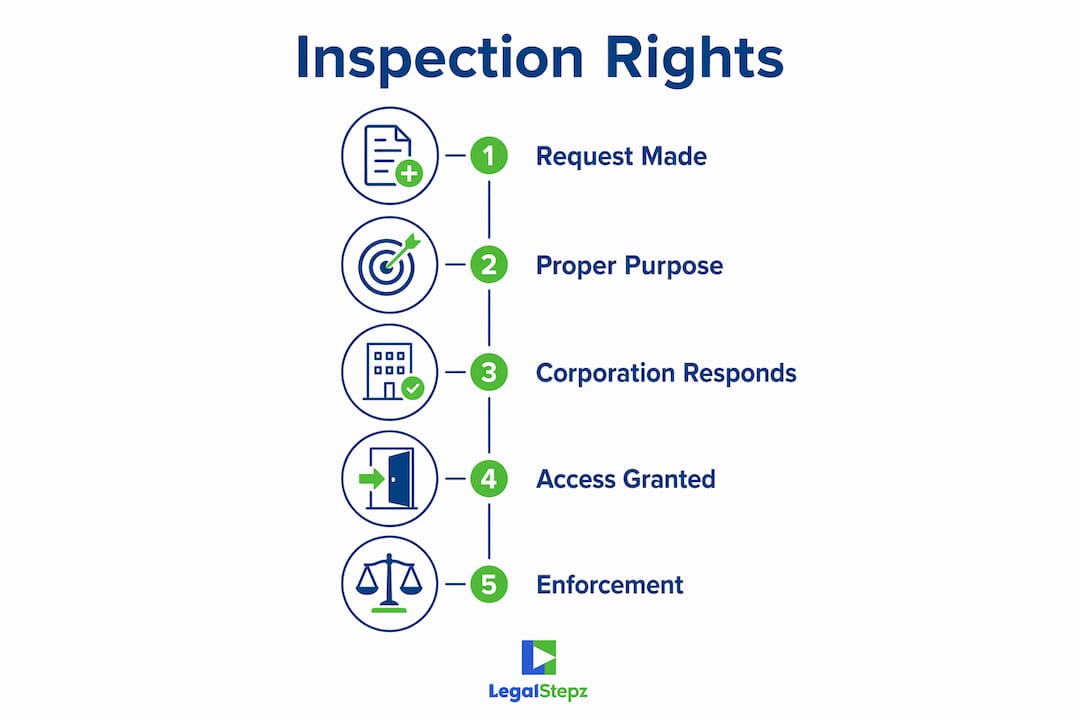
Shareholders with 5% or more ownership hold stronger rights. The 5% ownership threshold triggers additional absolute rights to inspect shareholder lists and certain financial information. Below that threshold, the proper purpose standard applies more strictly.
Director rights under Section 1602
Directors occupy a different legal position. Directors have an absolute right under Section 1602 to inspect all corporate books, records, and documents at any reasonable time without showing a purpose. No advance notice is legally required. This unconditional access reflects the director's fiduciary duty to oversee the corporation's affairs.
LLC member rights under Section 17704.10
LLC members in California can inspect company books and records regardless of their ownership percentage. This is a meaningful distinction from corporate shareholder rights, where ownership size can limit access. Minority LLC members have the same inspection access as majority members, which reinforces transparency across all ownership levels.
Pro Tip: If you are a shareholder below the 5% threshold, frame your inspection demand around a specific governance concern, such as a disputed board decision or an unexplained financial transaction. Vague requests fail; precise ones succeed.
How to make a valid inspection request in California
A properly drafted inspection demand is the difference between getting access and getting ignored. Follow these steps to submit a request that holds up legally.
-
Draft a written demand. California law requires written requests for shareholder inspection under Section 1601. State your name, your role (shareholder, director, or LLC member), and the specific records you want to inspect. Generic requests for "all records" are weaker than targeted requests for specific documents.
-
State a clear and proper purpose. Written inspection requests must include a specific statement of purpose, identification of the records sought, and delivery to the designated corporate officer. Your stated purpose must connect directly to your ownership interest. "I am requesting inspection of the accounting books to evaluate the accuracy of the 2024 financial statements" is far stronger than "I want to review the company's finances."
-
Identify the records with specificity. Name the exact documents or categories you want. Minutes from a specific board meeting, the shareholder list as of a certain date, or tax returns for a defined fiscal year all qualify. Broad, sweeping requests invite pushback.
-
Deliver the demand to the right person. Send your written demand to an authorized corporate representative, such as the CEO, CFO, or registered agent. Delivery methods include certified mail, email with read receipt, or in-person delivery with a signed acknowledgment.
-
Set a reasonable inspection timeframe. Request a specific date and location for the inspection. California law requires corporations to respond within a reasonable time. Inspections typically occur at the corporation's principal executive office during normal business hours.
-
Bring advisors to the inspection. You have the right to review records with your attorney or accountant present. This is especially useful when reviewing complex financial statements or tax returns.
Pro Tip: Send your written demand by certified mail and keep the return receipt. If the corporation later claims it never received your request, you have documented proof of delivery. This single step prevents the most common delay tactic.
Common mistakes to avoid include failing to state a purpose, sending demands to the wrong person, and requesting records in categories so broad that the corporation can argue the request is unreasonable. Review your demand carefully before sending. Legalstepz can help you draft a precise, legally sound inspection demand that meets California's requirements.
For context on related California corporate compliance obligations, understanding annual reporting requirements helps you see how record keeping and inspection rights fit into the broader compliance picture.
What to do if your inspection request is denied
A corporation that refuses or ignores a valid inspection demand faces serious legal consequences under California law.
- File a lawsuit under Section 1603. California courts have the power to compel inspection when a corporation unlawfully refuses. The process moves quickly because courts treat inspection rights as fundamental to corporate governance.
- Request appointment of an independent accountant. Courts can force inspection and appoint independent accountants for audits at the corporation's expense. This remedy is particularly powerful when you suspect financial misconduct.
- Claim attorney's fees. Under Sections 1603 and 1604, courts award attorney's fees to prevailing shareholders who had to litigate for access. This shifts the financial burden of enforcement onto the corporation that refused.
- Document every denial. Keep copies of your written demand, all correspondence, and any verbal refusals. This evidence supports your court filing and strengthens your position.
- Understand the corporation's risk. A corporation that stonewalls a valid inspection demand faces court costs, attorney's fees, and reputational damage. Most corporations comply once they understand the legal exposure.
"Court rulings emphasize swift enforcement of inspection rights and award attorney's fees to discourage corporate stonewalling under Sections 1603 and 1604. Legal penalties reinforce inspection rights and incentivize corporate cooperation."
The enforcement mechanism is strong by design. California's legislature built these remedies to make refusal more costly than compliance.
Best practices for California corporations to maintain compliance
Corporate officers and owners who maintain accurate records avoid the conflicts that lead to inspection disputes. These practices protect both the corporation and its stakeholders.
- Centralize your minute book. Minutes and corporate records must be maintained at the principal executive office under Section 1500. A disorganized or incomplete minute book creates immediate legal liability if an inspection is requested.
- Conduct routine document reviews. Schedule quarterly reviews of your corporate records to catch gaps before they become legal problems. Update minutes, resolutions, and financial records promptly after each board or shareholder meeting.
- Communicate inspection rights proactively. Shareholders and directors who understand their rights are less likely to escalate disputes. Proactive transparency builds trust and reduces the risk of adversarial inspection demands.
- Keep governing documents current. Bylaws and articles of incorporation should reflect the corporation's actual operating structure. Outdated documents create confusion and invite challenges.
- Use a reliable record keeping system. Whether digital or physical, your system must allow you to locate any document quickly. Courts do not accept "we couldn't find it" as a defense.
For a detailed look at record keeping requirements under California law, the fundamentals of organizing and maintaining corporate documents are worth reviewing alongside your inspection rights obligations.
Key Takeaways
California corporation record inspection rights are enforceable by law, and corporations that refuse valid demands face court-ordered access, independent audits, and attorney's fee awards under Sections 1603 and 1604.
| Point | Details |
|---|---|
| Directors hold absolute rights | Section 1602 gives directors unconditional access to all corporate records at any reasonable time. |
| Shareholders must state a purpose | Inspection demands must identify specific records and a purpose tied to ownership interest. |
| 5% ownership unlocks stronger rights | Shareholders at or above 5% gain additional access to shareholder lists and financial records. |
| LLC members have equal access | Section 17704.10 grants all LLC members inspection rights regardless of ownership percentage. |
| Refusal triggers legal penalties | Courts can compel access, appoint auditors, and award attorney's fees to prevailing shareholders. |
Why I think most business owners underestimate these rights
Most California business owners treat inspection rights as a last resort, something you invoke only when a dispute has already turned hostile. That framing is a mistake. Inspection rights are a governance tool, not just a litigation weapon. Directors especially should use Section 1602 access routinely, not just when something feels wrong.
The most common failure I see is vague demands. A shareholder sends a letter asking for "all financial records" and then wonders why the corporation pushes back. Precision is everything. A demand that names specific documents, states a clear purpose, and is delivered to the right person is almost impossible to refuse lawfully.
Corporate officers also underestimate the risk of a disorganized minute book. If your records are not centralized and current at the principal executive office, you are one inspection demand away from a legal crisis. The annual meeting requirements that generate minutes are not optional formalities. They are the foundation of your compliance posture.
My practical advice: treat inspection rights as a transparency habit, not an emergency measure. Directors should review records regularly. Shareholders should understand their threshold rights. And every corporation should maintain its minute book as if an inspection demand could arrive tomorrow, because legally, it can.
— Peter
How Legalstepz supports California corporations with record compliance
California corporations face real legal exposure when records are incomplete or inspection demands are mishandled. Legalstepz helps California business owners and corporate officers stay ahead of these obligations.
Legalstepz drafts annual minutes, prepares bylaws, and files statements of information so your corporate records stay current and legally sound. When an inspection demand arrives, having organized, complete records is your best defense. Legalstepz also provides registered agent services, giving your corporation a reliable point of contact for legal notices and demands. Visit Legalstepz to see how the platform supports your California corporate compliance needs from formation through ongoing governance.
FAQ
What records can a California shareholder inspect?
Under Section 1601, shareholders can inspect accounting books, meeting minutes, shareholder lists, and recent tax returns by submitting a written demand that states a proper purpose.
Do directors need to give advance notice before inspecting records?
No. Directors have an absolute right under Section 1602 to inspect all corporate records at any reasonable time without advance notice or a stated purpose.
What happens if a California corporation refuses an inspection request?
A shareholder can file suit under Section 1603 to compel access. Courts can appoint independent accountants and award attorney's fees to the prevailing shareholder under Section 1604.
Do LLC members have the same inspection rights as corporate shareholders?
LLC members in California have broad inspection rights under Section 17704.10 regardless of ownership percentage, which in some cases gives them stronger access than minority corporate shareholders.
What makes an inspection demand legally valid in California?
A valid demand must be written, identify the specific records sought, state a proper purpose tied to your ownership interest, and be delivered to an authorized corporate representative.