

A California domestic corporation is a legally separate business entity formed under California state law that shields its owners from personal liability for business debts and lawsuits. The formal legal term is a domestic stock corporation, and it is governed by the California Corporations Code, Section 200. Three key institutions shape every California corporation: the California Secretary of State handles formation filings, the Franchise Tax Board collects annual taxes, and the IRS governs federal tax elections. Understanding how these three interact is the foundation of getting your corporation right from day one.
What is a california domestic corporation?
A California domestic corporation is any corporation incorporated in California, as opposed to a foreign corporation, which is formed in another state but registered to do business here. The word "domestic" simply means the entity was born under California law. That distinction matters because domestic corporations follow California Corporations Code rules for governance, taxation, and compliance, while foreign corporations must separately qualify to operate in the state.
The most important feature of this structure is the corporate veil. Your corporation is a separate legal person. It can own property, sign contracts, and be sued. If the business fails or faces a lawsuit, creditors generally cannot reach your personal bank accounts, home, or car. That protection is the primary reason entrepreneurs choose this structure over a sole proprietorship or general partnership.

California also recognizes other business entity types, including LLCs, limited partnerships, and professional corporations. Each has different rules and tax treatment. A domestic stock corporation is the right choice when you plan to raise outside investment, issue stock to employees, or eventually pursue a public offering.
How to form a california domestic corporation
Formation follows a clear sequence. Missing a step or filing out of order creates gaps in your legal protection and can delay your ability to open a bank account or sign contracts.
- Choose a corporate name. The name must be distinguishable from existing California entities. Search the California Secretary of State's business name database before committing.
- File Articles of Incorporation. Submit Form ARTS-GS to the California Secretary of State. The filing fee is $100, and processing takes roughly 5 business days online.
- Appoint a registered agent. Every California corporation must designate a registered agent with a physical California address to receive legal documents. A professional registered agent keeps your home address off public records and ensures you never miss a legal notice.
- Adopt corporate bylaws. Bylaws are your internal rulebook. They define how directors are elected, how meetings are called, and how decisions are made. California law does not require you to file bylaws with the state, but you must have them.
- Hold an organizational meeting. Directors meet to formally adopt bylaws, elect officers, and authorize the issuance of stock.
- Issue stock certificates. Each founder or investor receives stock certificates documenting their ownership percentage.
- File your Statement of Information. Corporations must file a Statement of Information with the Secretary of State within 90 days of incorporation and every two years after that.
- Obtain an EIN and open a business bank account. Apply for a federal Employer Identification Number through the IRS website at no cost. Use it to open a dedicated corporate bank account.
Pro Tip: The $800 annual minimum franchise tax is waived for the first tax year for newly incorporated entities as of mid-2026. Plan for this payment starting in year two, because it is due regardless of whether your corporation earns any revenue.
The initial filing fee of $100 is deceptively low. Ongoing costs include the $800 franchise tax, registered agent fees, and professional fees for legal and accounting compliance. Many first-time founders are caught off guard by the recurring expense. Budget for it before you incorporate.
C-corp vs. s-corp: which structure fits your business?
Every California domestic corporation starts as a C-Corporation by default. You can elect S-Corporation status with the IRS after formation. The choice has major tax consequences.
| Feature | C-Corporation | S-Corporation |
|---|---|---|
| Federal tax rate | 21% corporate rate | Pass-through to owners |
| Double taxation | Yes, on dividends | No |
| Shareholder limit | Unlimited | 100 maximum |
| Shareholder eligibility | Anyone, including foreign investors | U.S. citizens and residents only |
| Best for | Startups seeking venture capital | Small, closely held businesses |
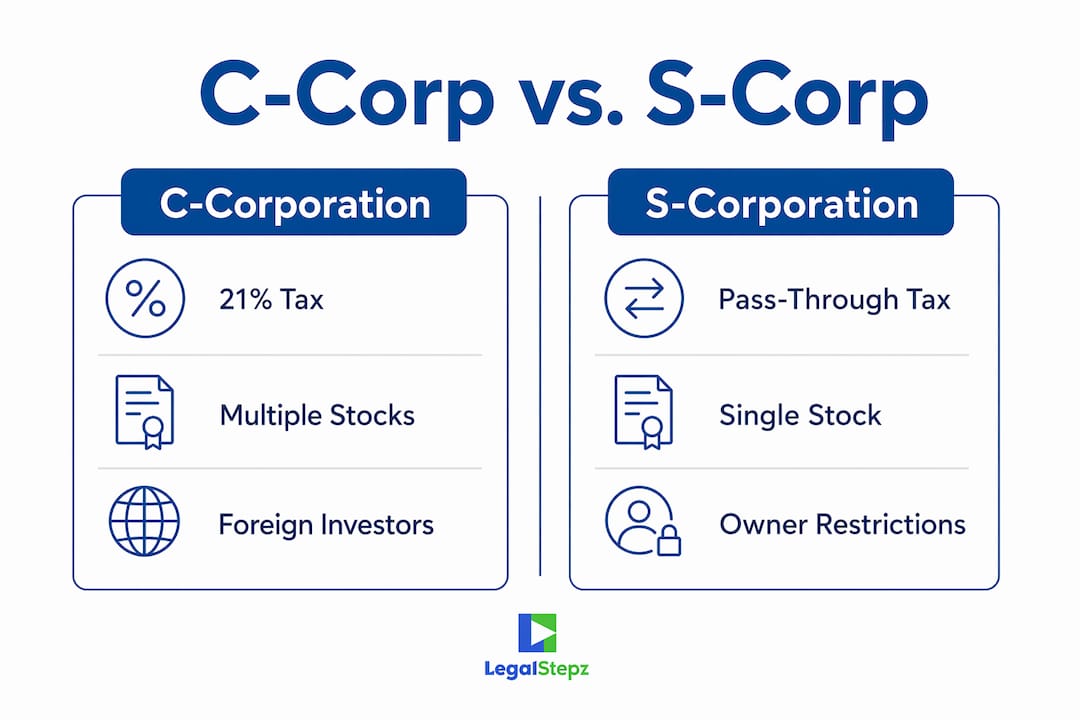
C-Corporations pay taxes at the 21% federal corporate rate, and shareholders pay personal income tax again when dividends are distributed. That is the double taxation problem. S-Corporations avoid it by passing profits and losses directly to shareholders' personal tax returns. That makes S-Corp status attractive for small businesses where owners take most of the profit as personal income.
The tradeoff is flexibility. C-Corps can issue multiple classes of stock and accept foreign investors, which is why nearly every venture-backed startup in Silicon Valley uses a C-Corp structure. S-Corps are limited to 100 shareholders, all of whom must be domestic individuals or certain trusts.
Pro Tip: If you plan to raise money from venture capital firms or angel investors, form a C-Corp from the start. Converting from an S-Corp to a C-Corp later triggers tax consequences and creates administrative headaches.
California also imposes its own 1.5% franchise tax on S-Corp net income, on top of the $800 minimum. Factor that into your tax projections before making the election. For a deeper look at how these choices play out for startups, the California startup legal structure guide covers the tradeoffs in detail.
What are the ongoing compliance requirements?
Forming a corporation is the easy part. Keeping it in good standing requires consistent attention to several annual and biennial obligations.
- Statement of Information: Due within 90 days of incorporation, then every two years on a rolling schedule. The filing fee is $25. Missing this deadline triggers a $250 penalty and can lead to suspension of your corporate powers.
- Annual minimum franchise tax: The Franchise Tax Board requires a minimum $800 payment each year starting in year two. Suspension for nonpayment means your corporation cannot legally conduct business, enter contracts, or defend itself in court.
- Annual corporate minutes: Hold and document your annual meeting of shareholders and directors. Minutes do not need to be filed with the state, but they must exist in your corporate records book.
- Federal BOI reporting: The Corporate Transparency Act requires corporations to report Beneficial Ownership Information to FinCEN. Failure to file carries penalties of $500 per day. That adds up fast. The Legalstepz guide on the Corporate Transparency Act explains who must file and when.
- Federal and state tax returns: C-Corps file Form 1120 federally and Form 100 with the Franchise Tax Board. S-Corps file Form 1120-S and California Form 100S.
Suspension is the most serious consequence of noncompliance. A suspended corporation loses the right to use the courts, which means you cannot sue to collect a debt or defend against a lawsuit while suspended. Reinstating a suspended corporation requires paying all back taxes, penalties, and filing all missing documents, which can cost thousands of dollars.
How to protect your limited liability and avoid common pitfalls
Limited liability is not automatic or permanent. Courts can strip that protection through a legal doctrine called piercing the corporate veil. When a court pierces the veil, shareholders become personally liable for corporate debts. Neglecting corporate formalities is the most common reason this happens.
Here is what you must maintain to keep the veil intact:
- Separate bank accounts: Never mix personal and business funds. Pay yourself a salary or take distributions, but do not use the corporate account for personal groceries or rent.
- Corporate records book: Keep a complete binder or digital file containing your bylaws, meeting minutes, stock certificates, and resolutions. A complete corporate records book is your first line of defense in any legal dispute.
- Documented meetings: Hold annual meetings and document decisions in written minutes. Even a one-person corporation must go through this process.
- Shareholder agreement: Bylaws govern the corporation, but a separate shareholder agreement governs the relationships between owners. Default California statutory rules can favor majority shareholders, leaving minority owners with little recourse. A shareholder agreement specifies what happens when an owner wants to sell shares, dies, or becomes incapacitated.
Pro Tip: Treat your corporation like a separate person from day one. Open a corporate credit card, use a separate email domain, and sign every contract with your title, such as "Jane Smith, President." These habits build the paper trail that protects you if you are ever sued.
The annual requirements for maintaining limited liability are not optional formalities. They are the price of the liability protection you incorporated to get.
Key takeaways
A California domestic corporation protects owners from personal liability only when formation is done correctly and ongoing compliance obligations are met without exception.
| Point | Details |
|---|---|
| Formation costs more than $100 | Budget for the $800 annual franchise tax and professional fees starting in year two. |
| C-Corp vs. S-Corp choice is permanent | Choose based on your investor and tax strategy before filing, not after. |
| Compliance prevents suspension | File your Statement of Information and pay franchise taxes on time to keep corporate powers active. |
| Corporate formalities protect you | Maintain bylaws, minutes, and separate accounts to prevent courts from piercing the corporate veil. |
| Shareholder agreements fill critical gaps | Bylaws alone do not protect minority owners; a separate shareholder agreement is necessary. |
What i have learned after years of watching corporations fail their owners
Most founders treat incorporation as a one-time event. They file the Articles, get the EIN, and move on. That mindset is exactly how they end up personally liable for a business debt three years later.
The single biggest mistake I see is skipping the shareholder agreement. Bylaws tell you how the corporation runs. A shareholder agreement tells you what happens when things go wrong between co-founders. Without one, California's default rules apply, and those rules were not written with your specific situation in mind. I have watched 50/50 partnerships collapse because neither owner could force a buyout or dissolve the company cleanly.
The second thing most people underestimate is the true ongoing cost of maintaining a California corporation. The $100 filing fee is the entry ticket. The real cost is the $800 annual franchise tax, registered agent fees, accounting fees for tax returns, and legal fees for annual minutes and compliance reviews. A realistic first-year budget beyond formation is $2,000 to $4,000 for a small corporation with a good professional team.
Professional registered agents are worth every dollar. Your registered agent's address appears on public state records. Using your home address means anyone can find where you live. A professional service also ensures you never miss a lawsuit notice because you were traveling or changed addresses.
Start your compliance calendar the day you incorporate. Set reminders for your Statement of Information deadline, your franchise tax payment, and your annual meeting. Proactive compliance costs almost nothing. Fixing a suspended corporation costs a lot.
— Peter
How Legalstepz helps you form and maintain your corporation

Forming a California domestic corporation correctly from the start saves you from expensive corrections later. Legalstepz offers a step-by-step incorporation course that walks you through every filing, from Articles of Incorporation to your first Statement of Information. The course covers bylaws, stock issuance, and the BOI reporting requirements under the Corporate Transparency Act. Legalstepz also provides registered agent services, annual minutes drafting, and Statement of Information filing so your corporation stays in good standing year after year. Visit Legalstepz to explore the full range of formation and compliance tools built specifically for California entrepreneurs.
FAQ
What does "domestic corporation" mean in california?
A domestic corporation in California is any corporation formed under California state law, as opposed to a foreign corporation formed in another state. It is governed by the California Corporations Code and must comply with state filing and tax requirements.
How much does it cost to form a california corporation in 2026?
Filing Articles of Incorporation costs $100 with the California Secretary of State. Starting in year two, corporations owe a minimum $800 annual franchise tax to the Franchise Tax Board, plus ongoing legal and accounting fees.
What is the difference between a c-corp and an s-corp in california?
A C-Corp pays taxes at the 21% federal corporate rate and faces double taxation on dividends. An S-Corp is a pass-through entity where profits flow to shareholders' personal returns, avoiding double taxation, but it is limited to 100 domestic shareholders.
What happens if i miss my statement of information filing?
Missing the Statement of Information deadline triggers a $250 penalty and can result in suspension of your corporate powers by the California Secretary of State. A suspended corporation cannot legally conduct business or defend itself in court.
Do i need a shareholder agreement if i already have bylaws?
Yes. Bylaws govern how the corporation operates, but a shareholder agreement governs the rights and obligations between individual owners. Without one, California's default statutory rules apply, which often disadvantage minority shareholders in disputes over share transfers or buyouts.