

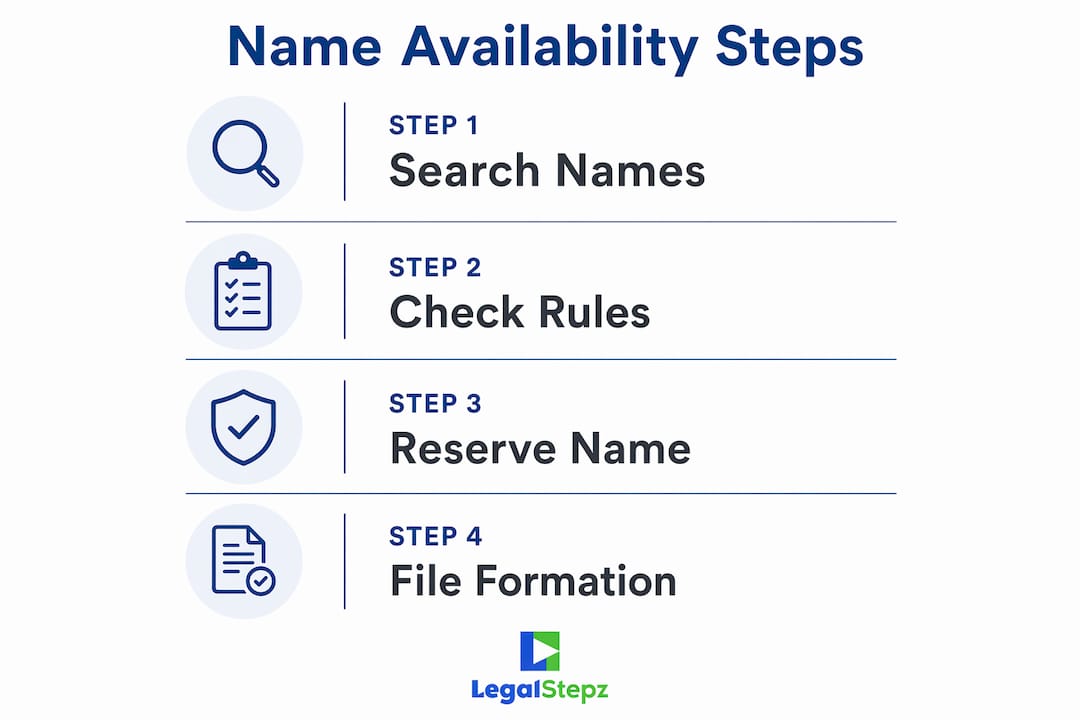
California entity name availability is determined by whether your proposed business name is distinguishable from existing registered entities and compliant with state law, verified through the California Secretary of State's official bizfile Online portal. Getting this right before you file saves you from rejected applications, wasted fees, and the headache of rebranding before you've even opened your doors. The bizfile Online database holds over 17 million business records, making it the most comprehensive starting point for any California business name registration. Skipping this step is one of the most common and costly mistakes new entrepreneurs make.
How to check California entity name availability
The California Secretary of State's bizfile Online portal is the official, free tool for checking whether your desired name is taken. You search by entity name or entity number, and the results show existing businesses, their status, registered agents, and filing dates. That information tells you whether a name is actively in use, suspended, or dissolved.

One critical technique most entrepreneurs overlook: drop legal suffixes like "LLC" or "Inc." before searching. Searching "Apex Solutions LLC" instead of "Apex Solutions" will return fewer results and mask real conflicts. The portal treats the base name as the unit of comparison, so searching the root gives you the clearest picture.
Here is the step-by-step process:
- Go to bizfile.sos.ca.gov and select "Business Search."
- Choose "Entity Name" as your search type.
- Enter your base name without any legal designator.
- Review all results, including inactive and dissolved entities.
- Note any names that look visually similar to yours.
- Cross-reference the entity status to confirm whether similar names are still active.
Pro Tip: Search partial name strings, not just the exact phrase. Searching "Apex" instead of "Apex Solutions" will surface every variation that could conflict with your name.
The portal covers corporations, LLCs, and limited partnerships. However, the Secretary of State search excludes limited liability partnerships and general partnerships. That gap matters if you operate in a field where those structures are common, such as law or accounting.
What are the legal rules for California business entity names?
California law defines "distinguishable" using a visual recognition standard. The Secretary of State compares names based on how they look, not how they sound. Punctuation, capitalization, and spacing differences do not make two names distinguishable. That means "A.P.E.X. Incorporated" and "Apex Corporation" are considered indistinguishable under California law. This is a stricter standard than most entrepreneurs expect.
The practical implication is significant. You cannot simply add a period, change a capital letter, or swap "and" for "&" to get around an existing name. The Secretary of State will reject your filing if the base name is not clearly different from an existing registered entity.
Certain words are restricted or prohibited entirely:
- "Bank," "trust," "insurance," and "credit union" require approval from the relevant state regulatory agency before the Secretary of State will accept the name.
- Governmental terms like "FBI," "Treasury," or "State Department" are prohibited because they imply a government affiliation.
- Words suggesting a licensed profession (such as "attorney" or "engineer") may require proof of licensure or board approval.
- Misleading terms that suggest a purpose the entity does not actually serve are grounds for rejection.
Every California corporation and LLC must also include a legal designator in its official name. A corporation must use "Corporation," "Corp.," "Incorporated," or "Inc." An LLC must use "Limited Liability Company," "LLC," or "L.L.C." These designators are required for compliance but are ignored when the Secretary of State runs the distinguishability analysis.
"Choosing a compliant and available entity name involves more than checking the Secretary of State database. Avoiding misleading or restricted words is critical to compliance, and many filings are rejected not because the name is taken, but because it contains a prohibited term the applicant never flagged."
Understanding these rules before you fall in love with a name saves you from a rejection that delays your entire formation timeline.
How does name reservation work in California?
Name reservation gives you a window to secure a name before you complete your formation filing. The California Secretary of State holds the name exclusively for 60 days after you submit a reservation request. No one else can register that exact name during that period.
The process requires a fee and must be submitted by mail or in person. Online reservations are not currently available through the Secretary of State's office. You also cannot renew a reservation consecutively, so you cannot simply keep re-reserving the same name indefinitely. If you need more time, you must complete your formation filing before the 60 days expire.
Many entrepreneurs also file a Fictitious Business Name, commonly called a DBA ("doing business as"), at the county level. A DBA lets you operate under a name that differs from your legal entity name. The table below shows the key differences between the two approaches.
| Feature | Entity name registration | Fictitious Business Name (DBA) |
|---|---|---|
| Filed with | California Secretary of State | County clerk's office |
| Scope | Statewide | County level only |
| Exclusive rights | Yes, within the state database | No exclusive rights granted |
| Trademark protection | No | No |
| Required designator | Yes (LLC, Inc., etc.) | No |
| Duration | Ongoing (with renewals) | Typically 5 years |
A DBA is a public notice document, not a trademark registration. Multiple businesses can legally operate under the same DBA name within a county. That means your DBA provides zero protection against someone else using the same name nearby or online.
Pro Tip: File your California LLC formation before your 60-day reservation expires. Missing that window means starting the reservation process over, and the name may no longer be available.
Why should you check trademarks and domain names too?
State registration and federal trademark rights are completely separate systems. Registering your entity name with the California Secretary of State does not stop a federal trademark holder from demanding you change your name. Federal trademark searches via the USPTO database are a necessary step alongside any state name check.
The USPTO's Trademark Electronic Search System (TESS) lets you search registered and pending trademarks by name, class, and owner. A pending trademark application carries the same risk as a registered one. If someone filed before you, they may have priority even if their registration is not yet complete.
Beyond trademarks, check these additional layers before committing to a name:
- Domain availability: Search for your exact name as a .com domain. A name with no available domain creates a branding problem from day one.
- Social media handles: Check Instagram, LinkedIn, X (formerly Twitter), and Facebook for handle availability. Inconsistent handles across platforms weaken your brand identity.
- Google search results: A quick search reveals whether the name is already associated with another business in public perception, even if it is not legally registered.
- State trademark database: California maintains its own trademark registry, separate from the Secretary of State's entity database. A name can be clear in the entity database but conflicted in the state trademark system.
Pro Tip: Run your federal trademark search before you invest in logo design, website development, or marketing materials. Rebranding after launch costs far more than a trademark search costs upfront.
Legal experts recommend layered protection: state name registration, county DBA filings, and federal trademark registration together provide the most complete brand security. No single step alone is sufficient.
Common mistakes when choosing a California entity name
Most naming errors are avoidable. Knowing what trips up other entrepreneurs puts you ahead before you file.
- Searching with suffixes. Including "LLC" or "Inc." in your search query narrows results and hides real conflicts. Always search the base name only.
- Assuming a DBA protects your name. DBA filings are public notice documents, not trademark registrations. They do not prevent anyone else from using the same name.
- Picking overly generic names. Names like "California Business Solutions LLC" are nearly impossible to distinguish from dozens of similar entities and offer no brand identity.
- Choosing location-based names. Names tied to a city or region limit your business as you grow and may conflict with existing local entities.
- Ignoring restricted words. Words like "bank," "trust," or "insurance" require regulatory approval. Filing without that approval results in automatic rejection.
- Skipping the USPTO search. State availability does not equal federal trademark clearance. These are two separate checks that both need to happen.
For a deeper look at naming pitfalls specific to California businesses, the patterns are consistent: entrepreneurs move too fast and skip the layers that matter most.
Key Takeaways
California entity name availability requires a distinguishable name under state law, verified through bizfile Online, supplemented by USPTO trademark and domain checks for complete brand protection.
| Point | Details |
|---|---|
| Search without suffixes | Drop "LLC" or "Inc." from searches to get accurate, complete results on bizfile Online. |
| Distinguishability is visual | Punctuation and capitalization changes do not make a name legally distinct under California law. |
| Reservations last 60 days | Name reservations hold your name exclusively for 60 days and cannot be renewed consecutively. |
| DBAs do not protect your name | Fictitious Business Name filings are public notice only; multiple businesses can share the same DBA. |
| Layer your protection | Combine state registration, county DBA filing, and federal USPTO trademark registration for full coverage. |
What I've learned about naming a California business the right way
Most entrepreneurs treat the Secretary of State name search as a checkbox. They run one search, see no exact match, and assume they're clear. That assumption causes more problems than almost any other early-stage mistake I've seen.
The visual distinguishability standard catches people off guard every time. You can spend weeks building a brand around a name, only to have the Secretary of State reject it because an existing entity looks too similar on paper. "Apex Digital" and "Apex Digitals" are not different enough. Neither are "BlueSky" and "Blue Sky." The standard is stricter than common sense suggests, and the rejection comes after you've already paid your filing fee.
The DBA misconception is equally damaging. Many business owners I've spoken with genuinely believe that filing a fictitious business name at the county level locks in their brand. It does not. It tells the public you're operating under that name. That's it. Someone can file the exact same DBA in the next county over, and neither of you has any legal claim over the other.
My honest recommendation: treat name selection as a three-layer process. Check the Secretary of State database first, then run a USPTO trademark search, then check domain and social media availability. Do all three before you commit to anything. If your name involves a restricted word like "bank" or "trust," get legal counsel before you file. The Secretary of State will not tell you why your filing was rejected in a way that saves you time. A qualified attorney will.
For complex naming situations or restricted terms, consulting a California business attorney before filing is worth every dollar. The cost of a one-hour consultation is a fraction of what a rejected filing or a trademark dispute will cost you later.
— Peter
Legalstepz makes California business filings straightforward
Checking name availability is just the first step in forming a California business entity. The filings, compliance requirements, and legal designators that follow can pile up quickly for a first-time founder.
Legalstepz helps California entrepreneurs handle the full formation process, from registering your business name to filing statements of information, drafting bylaws, and maintaining registered agent services. The platform is built for founders who want their compliance handled correctly without needing to become legal experts themselves. If you're ready to move from name search to formation, Legalstepz gives you a clear path forward.
FAQ
What does "distinguishable" mean for a California business name?
California law defines "distinguishable" as visually distinct from all existing registered entity names. Differences in punctuation, capitalization, or spacing do not make a name distinguishable.
How long does a California name reservation last?
A name reservation holds your chosen name exclusively for 60 days. Consecutive renewals are not permitted, so you must complete your formation filing within that window.
Does a DBA protect my business name in California?
A DBA does not grant exclusive rights to a name. Multiple businesses can operate under the same fictitious business name within a county, so a DBA provides no trademark-level protection.
Can I check California business name availability online for free?
Yes. The California Secretary of State's bizfile Online portal is free to use and contains over 17 million business entity records. Search by base name without legal suffixes for the most accurate results.
Does registering my entity name in California protect it nationwide?
No. State registration only prevents another entity from registering the same name with the California Secretary of State. Federal trademark registration through the USPTO is required for nationwide brand protection.