

California fictitious business name filing is the process of legally registering a business alias with the county clerk's office where the business operates. Known formally as a Fictitious Business Name (FBN) statement and informally as a DBA ("doing business as"), this registration is required any time a sole proprietor, partnership, LLC, or corporation operates under a name different from its legal name. Banks require valid FBN proof to open accounts under a fictitious name, which means skipping this step blocks your ability to accept payments or sign contracts as your brand. California law, specifically Business and Professions Code Sections 17910 and 17920, governs the entire process.
What are the requirements for California fictitious business name filing?
Filing a fictitious business name in California starts with meeting a specific set of prerequisites. Getting these right before you touch a form saves you from rejection and refiling fees.
Who must file
Any individual, general partnership, LLC, or corporation that conducts business under a name that does not include the owner's legal surname must file an FBN statement. An LLC named "Rivera Consulting LLC" operating as "Rivera Consulting" does not need to file. That same LLC operating as "Pacific Growth Advisors" does need to file. The rule is straightforward: if your brand name differs from your registered legal name, you file.
Name availability and exclusivity
Run a business name search at your county clerk's office before filing. Each county maintains its own index. A name that is available in Sacramento County may already be registered in Los Angeles County. Filing an FBN does not grant exclusive rights to the name. Two businesses can legally operate under identical fictitious names in different counties. If name protection matters to you, a state trademark registration through the California Secretary of State is a separate step worth considering.

Address and entity details
California requires a physical street address for the principal place of business on every FBN statement. P.O. Boxes are not accepted. This address becomes public record, used for legal process purposes. You will also need the full legal name and address of every owner, the type of business entity, and the state of formation if you are an LLC or corporation.
Fees
County-specific rules affect the cost of filing. Filing fees typically range from around $26 to $75 for the first fictitious name, with additional fees for each extra name listed on the same statement. Check your specific county clerk's website for the current fee schedule before you go.
Pro Tip: Search the county clerk's FBN index online before visiting in person. Many California counties, including Los Angeles and San Diego, publish searchable databases. Confirming name availability in advance prevents a wasted trip.
How to complete the step-by-step filing process
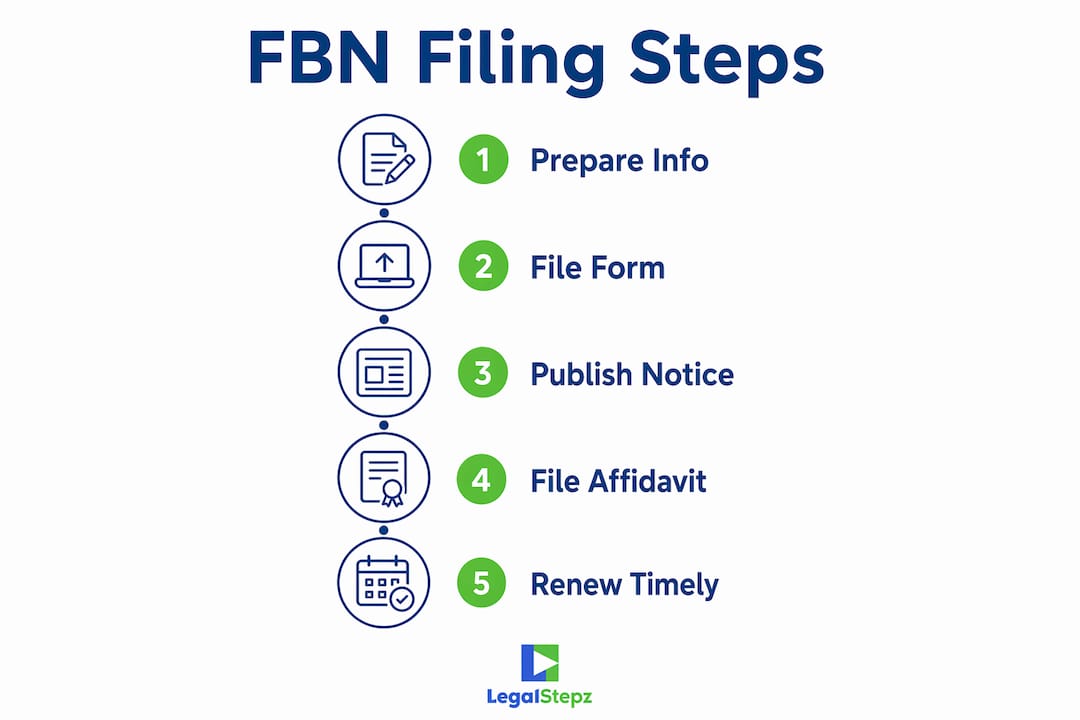
The California DBA filing process follows a clear sequence. Missing any step, or completing steps out of order, can invalidate your registration.
-
Obtain the correct form. Download the FBN statement form directly from your county clerk's website. Los Angeles County, San Diego County, and Sacramento County each publish their own version. Do not use a generic form from a third-party site without confirming it matches your county's current requirements.
-
Complete the form accurately. List the exact fictitious business name as you intend to use it, your physical street address, and the full legal name of every owner or registered entity. Errors on this form are the most common reason for rejection. Double-check spelling, punctuation, and entity type before signing.
-
Sign with a wet-ink signature. Most counties require an original, wet-ink signature on the FBN statement. Some counties do not accept digital or electronic signatures. If you are filing by mail, confirm your county's signature policy before sending.
-
Submit the form and pay the fee. File in person at the county clerk's office, or by mail if your county allows it. A limited number of counties offer online submission. Each county has its own submission rules, so verify the accepted methods before you file.
-
File within 40 days of starting business. California law requires filing within 40 days of commencing business for profit. Filing late does not automatically void your registration, but it does expose you to legal risk if a dispute arises during the gap period.
-
Keep your stamped receipt. The county clerk stamps and returns a copy of your filed statement. Store this document. Banks, landlords, and vendors will ask for it.
Pro Tip: If you are filing for an LLC or corporation, the officer or manager signing the form must match the entity's current registered records. A mismatch between the signer's title and the entity's filed documents is a common rejection trigger.
What are the newspaper publication requirements after filing?
Publication is the step most California entrepreneurs underestimate. Filing the FBN statement with the county clerk is not the finish line. The law requires you to publish the statement in a local newspaper before your registration is legally complete.
The publication rules are specific:
- The FBN statement must be published once a week for four consecutive weeks.
- Publication must begin within 30–45 days of the filing date.
- The newspaper must be court-approved and have general circulation in the county where the business is located. A newspaper that is approved in Orange County is not automatically valid for a business in Riverside County.
- Publication costs typically range from $30 to $150 depending on the newspaper and county. Smaller community papers often charge less than major metro dailies.
- After the final publication, the newspaper provides an affidavit of publication.
- That affidavit must be filed with the county clerk within 30 days after the last publication date. Failing to file the affidavit invalidates the registration.
Pro Tip: Call your county clerk's office and ask for a list of approved newspapers before contacting any publication. Some newspapers advertise FBN publication services but are not court-approved for your specific county. Using the wrong paper means starting the four-week publication cycle over.
The affidavit step catches many business owners off guard. The newspaper handles publication, but filing the affidavit with the county clerk is your responsibility. Set a calendar reminder for the day after your final publication date so you do not miss the 30-day window.
How to maintain and renew your fictitious business name registration
An FBN registration does not last forever. Staying compliant means tracking your renewal date and updating your filing whenever key facts change.
-
Know your expiration date. An FBN registration is valid for five years from the date of filing, as specified under California Business and Professions Code Section 17920. Mark the expiration date in your records the day you receive your stamped receipt.
-
File an amendment when facts change. If you move your business to a new address, add or remove an owner, or change the legal structure of your entity, you must file an amended FBN statement. Operating under an outdated filing creates legal exposure, particularly in contract disputes.
-
File an abandonment statement when you stop using the name. If you rebrand or close the business, file a fictitious business name abandonment statement with the county clerk. This removes your name from the public index and formally ends your registration.
-
Renew before expiration. Renewal follows the same process as the original filing. You complete a new FBN statement, pay the filing fee, and publish again in an approved newspaper. Renewal does not carry over the original publication. You must complete the full four-week publication cycle again.
-
Keep copies of all documents. Store your original filed statement, the newspaper's affidavit of publication, and any amendments or renewals in one place. Good business record keeping prevents gaps in your compliance history and protects you if a dispute arises years later.
Non-renewal does not trigger a fine, but it does mean you lose the legal right to operate under that name. Another business can register the same fictitious name in your county the day after your registration expires.
Key takeaways
Completing a California fictitious business name filing requires meeting address, publication, and affidavit deadlines in the correct sequence to achieve valid legal registration.
| Point | Details |
|---|---|
| File within 40 days | Submit your FBN statement to the county clerk within 40 days of starting business. |
| Use a physical street address | P.O. Boxes are rejected; your business address becomes public record. |
| Publish in an approved newspaper | Run the notice once a week for four consecutive weeks in a court-approved local paper. |
| File the affidavit on time | Submit the affidavit of publication to the county clerk within 30 days of the final publication. |
| Renew every five years | FBN registrations expire after five years and require a full new filing and publication cycle. |
What I've learned from watching entrepreneurs rush this process
Most filing mistakes I see come from one source: treating the FBN process as a single step instead of a three-part sequence. Entrepreneurs file the statement, feel done, and then miss the publication window entirely. Weeks later, they discover their registration is legally incomplete.
The address issue is the other consistent problem. Using a P.O. Box on the FBN form is the fastest way to get your statement rejected. I have seen business owners use a mailbox service address thinking it qualifies as a street address. It does not. The county clerk's office checks this. If your business operates from a home address and you want privacy, forming an LLC before filing an FBN is a better path. The LLC's registered agent address can serve as the public-facing address, keeping your home off the public record. Legalstepz covers this in detail in the guide on forming a California LLC.
The newspaper selection step deserves more attention than it gets. Not every paper that offers FBN publication services is court-approved for your county. I have seen registrations challenged because the business owner used a paper that was approved in an adjacent county. Always get the approved list from the county clerk directly, not from the newspaper's sales team.
One more thing: the affidavit of publication is your responsibility, not the newspaper's. The paper will give you the affidavit after the final run. You must walk it back to the county clerk within 30 days. That step is what closes the loop legally. Miss it, and your entire filing is void.
— Peter
Legalstepz can help you get this right
Filing a fictitious business name in California involves more moving parts than most entrepreneurs expect. The county-specific rules, publication requirements, and affidavit deadlines create real risk for anyone working through the process alone.
Legalstepz built its Incorporation Course specifically for California entrepreneurs who want to handle business formation correctly the first time. The course walks you through entity selection, FBN filing, and ongoing compliance obligations in plain language. It pairs well with Legalstepz's registered agent services and statement of information filing support, so you have one place to manage your California business compliance from formation through renewal.
FAQ
What is a fictitious business name in California?
A fictitious business name, also called a DBA, is any name a business uses that differs from the owner's legal name or the entity's registered name. California requires registration of this name with the county clerk where the business operates.
How long does a California FBN registration last?
An FBN registration is valid for five years under California Business and Professions Code Section 17920. After five years, you must refile and complete a new publication cycle to maintain the registration.
Do I need to publish my FBN statement in a newspaper?
Yes. California law requires you to publish the FBN statement once a week for four consecutive weeks in a court-approved newspaper with general circulation in your county. You must then file the affidavit of publication with the county clerk within 30 days of the final publication.
Can two businesses use the same fictitious name in California?
Yes. Filing an FBN does not grant exclusive rights to the name. Identical fictitious names can legally coexist within and across California counties. A state trademark registration is the only way to secure exclusive rights to a business name in California.
What happens if I miss the 40-day filing deadline?
Missing the 40-day window does not automatically cancel your ability to file, but it does create legal exposure. You should file as soon as possible. Operating under an unregistered fictitious name can affect your ability to enforce contracts and open business bank accounts.