

Yes, a California LLC can elect S-corporation tax status. You file Form 2553 with the Internal Revenue Service to make the federal election, and the California Franchise Tax Board automatically recognizes it for state tax purposes. Three things change immediately: you now file Form 100S with the FTB, you owe at least $800 in annual franchise tax (plus 1.5% of net income under California's S-corp rate), and you must put yourself on payroll with a reasonable salary.
Before you call your CPA, pull these together:
- Your trailing 12-month net income and owner draws
- A rough estimate of payroll and bookkeeping costs
- Copies of your current LLC formation documents and EIN confirmation
Key Takeaways
| Point | Details |
|---|---|
| Federal election via Form 2553 | File with the IRS by March 15 (calendar year) or within 75 days of the desired effective date. |
| California taxes S-corp income at 1.5% | The FTB charges 1.5% of net income on Form 100S, with an $800 minimum franchise tax floor. |
| Reasonable salary is required | Pay yourself a market-rate salary; underpaying is an IRS audit trigger with back-tax risk. |
| Break-even depends on full compliance costs | Factor in payroll service fees, higher CPA costs, and California's entity-level tax before electing. |
| Legalstepz for California compliance | Legalstepz files your Statement of Information, provides registered agent services, and drafts annual minutes. |
Table of Contents
- How a California LLC elects S-corp tax status, step by step
- California-specific taxes and fees after electing S-corp status
- Federal tax and payroll implications of S-corp status
- Pros, cons, and red flags for S-corp election in California
- Operational requirements to keep liability protection after S election
- Quick decision checklist to bring to your CPA
- What working with California small businesses actually teaches you
- Legalstepz handles the California filings so you can focus on the business
- Sources
How a California LLC elects S-corp tax status, step by step
The federal election comes first. California follows automatically once the IRS accepts it.
Step 1: Confirm federal eligibility
S-corp eligibility rules require your LLC to have no more than 100 shareholders, only one class of membership interest, and all members must be U.S. citizens or permanent residents. Partnerships, corporations, and most trusts cannot be shareholders. A standard single-member or small multi-member California LLC typically qualifies without structural changes.
Step 2: Decide whether you need Form 8832 first
Most LLCs skip this step. A single-member LLC is already a disregarded entity by default; a multi-member LLC is already a partnership. Neither classification is "corporation," so the IRS needs Form 8832 only when you want to change the LLC's base federal classification to corporation before the S election. If you are filing Form 2553 directly and your LLC has never made a prior classification election, you can attach Form 2553 to Form 8832 and file them together, effective the same date. Filing order matters: the corporate classification must be effective on or before the S-corp election date.
Step 3: File Form 2553
Form 2553 must be signed by all LLC members. The election is effective for a tax year if you file:
- By March 15 of that year (for a calendar-year LLC), or
- Within 75 days of the date you want the election to take effect
Miss the deadline? Revenue Procedure 2013-30 provides a late-election relief path when the failure was due to reasonable cause. It is technical, and a CPA should evaluate whether you qualify before you file anything.
Step 4: California follow-up filings
The FTB does not require a separate state S-corp election form. Once the IRS accepts your Form 2553, your LLC files Form 100S with the FTB for each tax year the S election is in effect. You also keep your California Secretary of State obligations intact: file a Statement of Information every two years (due within 90 days of formation, then biennially), maintain a registered agent with a California street address, and keep your articles of organization current.
Pro Tip: Keep a copy of your IRS acceptance letter for Form 2553 in a permanent compliance folder. The FTB may request proof of the federal election during an audit or correspondence review. A certified mail receipt or IRS e-file confirmation is your best evidence of the filing date.
California-specific taxes and fees after electing S-corp status
This is where California's math diverges sharply from other states, and it catches owners off guard.
The $800 minimum franchise tax
Every LLC organized or doing business in California owes the $800 annual minimum franchise tax, regardless of income or profit. Electing S-corp status does not eliminate this obligation. California treats the $800 as a floor, not a credit against other taxes. You pay it even in a year when the business loses money. See the California franchise tax breakdown for how this applies across entity types.
California S-corp income tax: 1.5% of net income
On top of the $800 minimum, California taxes S-corporation net income at 1.5%. That rate applies to the entity's California-source net income, reported on Form 100S.
California's 1.5% S-corp tax rate applies at the entity level, separate from what individual members pay on their personal returns. This is a California-specific cost that does not exist in most other states.
LLC gross-receipts fee
California also charges LLCs an annual gross-receipts fee based on total income from all sources. The FTB publishes current fee tiers on its LLC page. Electing S-corp status does not eliminate this fee for LLCs. Confirm the current tiers directly with the FTB, since thresholds are subject to legislative adjustment.
| California obligation | Who owes it | Minimum amount | Filing form |
|---|---|---|---|
| Annual franchise tax | All LLCs and S corps | $800 | Form 100S |
| S-corp net income tax | LLCs taxed as S corps | 1.5% of net income | Form 100S |
| LLC gross-receipts fee | LLCs (including those with S election) | Varies by gross receipts | FTB Schedule |
| Statement of Information | All California LLCs | $20 filing fee | SOS Form LLC-12 |
Secretary of State obligations
The S election is a tax status change, not a structural one. Your LLC remains an LLC with the California Secretary of State. That means the Statement of Information, registered agent, and articles of organization requirements stay exactly as they were before the election.
Federal tax and payroll implications of S-corp status
The tax savings from an S election come from one mechanism: splitting owner compensation into salary and distributions. Salary is subject to payroll taxes (Social Security and Medicare). Distributions are not. The IRS taxes both as ordinary income on your personal return, but only the salary portion runs through FICA.
How the savings work
A sole owner of a California LLC taxed as a sole proprietorship pays self-employment tax on all net profit. After an S election, the owner pays payroll taxes only on the reasonable salary portion.
The reasonable salary requirement
The IRS requires owner-employees of S corporations to pay themselves a salary that reflects what the market would pay for the same work. There is no bright-line percentage. The IRS S-corp guidance makes clear that underpaying salary to maximize distributions is an audit trigger. If the IRS reclassifies distributions as wages, you owe back payroll taxes, interest, and penalties. Document how you determined your salary: pull comparable job postings, note your hours and role, and keep that analysis in your compliance file.
Payroll obligations you take on
Once you elect S-corp status, you must:
- Register for federal and California employer accounts (EIN already done; add CA EDD registration)
- Run payroll at least quarterly and make timely federal tax deposits
- File Form 941 quarterly with the IRS
- Issue yourself a W-2 by January 31 each year
- File California payroll returns with the Employment Development Department
Most owners outsource payroll to a service provider. The cost typically runs a few hundred dollars per month for a single-employee setup, which factors directly into your break-even calculation.
Pro Tip: Set your reasonable salary before the first payroll run of the year, document the comparable-wage analysis in writing, and store it with your annual corporate minutes. Changing the salary mid-year without documentation looks reactive to auditors.
Illustrative break-even example
This is a simplified example for illustration only, not tax advice. Your actual numbers will differ.
Assume a California LLC owner with $150,000 in net profit, a $70,000 reasonable salary, and $80,000 in distributions:
- Self-employment tax avoided on $80,000 in distributions: roughly $11,300 (at the combined 15.3% rate, before the Social Security wage base cap)
- Estimated annual payroll service cost: $2,400
- Estimated additional CPA cost for S-corp return: $1,500
- Net estimated savings: roughly $7,400
At $80,000 in net profit with a $50,000 salary, the math tightens considerably. The savings on $30,000 in distributions may not cover the added compliance costs. That is why most advisors suggest the election rarely pays below roughly $50,000–$80,000 in annual net profit, though your specific numbers are what matter.
Pros, cons, and red flags for S-corp election in California
Pros
- Payroll tax savings on the distribution portion of owner compensation, once net income is high enough to justify the election
- Pass-through taxation at the federal level: no corporate-level federal income tax, income flows to members' personal returns
- Cleaner compensation structure that separates salary from profit distributions, which can simplify financial planning
- Liability protection remains intact; the LLC's legal structure does not change
Cons and recurring costs
- California's 1.5% entity-level tax on net income, on top of the $800 minimum, adds a cost that does not exist in most other states
- Payroll administration is mandatory and adds monthly cost even in slow revenue years
- CPA fees increase because Form 100S and payroll filings are more complex than a Schedule C or partnership return
- Loss of simple distributions: you cannot just move money from the business account to your personal account without running payroll first
- Administrative burden of corporate formalities, annual minutes, and recordkeeping
Red flags where S election usually fails to pay
- Net profit below $50,000 annually: the compliance costs often exceed the payroll tax savings
- Part-time or side businesses where the owner's reasonable salary would consume most of the profit
- Owners who are unwilling to maintain separate accounts, run payroll, and document decisions
- Businesses with significant losses in early years, where there is no profit to shelter
When to consider alternatives
Staying taxed as a disregarded entity or partnership is simpler and cheaper at lower income levels. If your goal is a corporate structure rather than tax savings, converting to a C corporation or a California close corporation may serve you better than an S election. The LLC vs. corporation comparison covers the structural trade-offs in more detail.
Operational requirements to keep liability protection after S election
Electing S-corp status is a tax decision, not a legal restructuring. Your LLC keeps its liability shield, but you have to maintain it actively. Courts have pierced the LLC veil when owners treated the business account as a personal piggy bank or failed to keep basic records, regardless of tax status.
What to maintain
- Separate bank accounts: one business checking account, never commingled with personal funds
- Annual minutes: document major decisions, salary determinations, and any changes to ownership or operating agreement
- Member/shareholder records: keep a current list of all members, their ownership percentages, and any transfers
- Registered agent: maintain a California-registered agent with a physical street address at all times
- Statement of Information: file every two years with the California Secretary of State (Form LLC-12, $20 fee)
IRS Publication 583 outlines the recordkeeping standards the IRS expects from business owners, including separate books and documentation of business decisions.
Payroll recordkeeping
Keep copies of all Form 941 filings, payroll registers, W-2s, and the written analysis supporting your reasonable salary determination. If the IRS questions your salary, that documentation is your first line of defense.
Quarterly and annual compliance checklist
Each quarter:
- Make federal payroll tax deposits on time
- File Form 941 with the IRS
- File California payroll returns with the EDD
- Review year-to-date profit against salary to confirm the reasonable-salary determination still holds
Each year:
- File Form 100S with the FTB by the 15th day of the third month after your tax year ends
- File the federal S-corp return (Form 1120-S) by March 15 for calendar-year filers
- Issue W-2s to all owner-employees by January 31
- File the Statement of Information with the California Secretary of State if due
- Hold and document annual member meeting or written consent in lieu of meeting
Quick decision checklist to bring to your CPA
Walk into your CPA meeting with these numbers and questions ready. The more specific you are, the faster they can run the actual analysis.
Numbers to prepare
- Trailing 12-month net income (after business expenses, before owner draws)
- Total owner draws or distributions taken in the past year
- Projected net income for the next 12 months
- Current bookkeeping cost per month
- Any existing payroll costs if you already have employees
Questions to ask your CPA
- What reasonable salary range do you recommend for my role and industry?
- What will the S-corp return (Form 1120-S and Form 100S) cost annually?
- What payroll service do you recommend, and what is the monthly cost for a single-employee setup?
- Does the election make sense given California's 1.5% entity-level tax?
- What is the earliest effective date we can target, and do we need Form 8832?
- What happens if I want to revoke the election later?
Threshold guidance
S election tends to make financial sense when net profit is high enough that the payroll tax savings on distributions clearly exceed the combined cost of payroll services, increased CPA fees, and California's entity-level tax. At lower income levels, the math often does not work. This is an owner-specific calculation, not a universal rule. The California business formation cost breakdown can help you estimate the compliance side of that equation before you sit down with your CPA.
Revoking the S election
If the election no longer makes sense, you can revoke it. The effective date rules for revocation mirror those for the original election. California follows the federal revocation automatically. Plan the timing carefully: mid-year revocations create short tax years and additional filing complexity.
What working with California small businesses actually teaches you
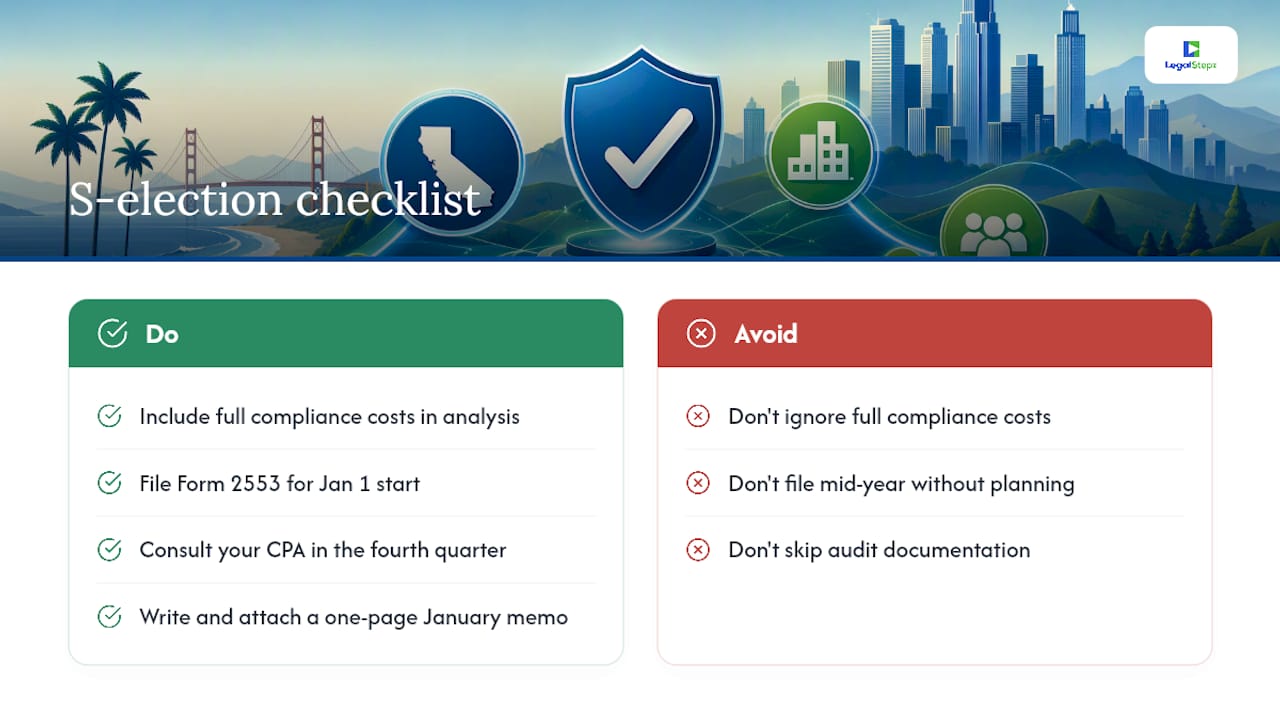
Most owners who regret the S election made the same mistake: they calculated the payroll tax savings but forgot to add the full cost of compliance. When you add them together, the net savings at $80,000 in profit can shrink to a few thousand dollars. That is still worth doing, but it is not the windfall some owners expect.
The timing of the election matters more than most guides admit. Filing Form 2553 to be effective January 1 of a new year is cleaner than a mid-year election. It aligns with your accounting period, simplifies the first payroll setup, and avoids a short-year return. If you are reading this in the fourth quarter, talk to your CPA now about a January 1 effective date for next year.
One documentation shortcut that pays off in audits: write a one-page memo each January explaining how you set your reasonable salary. Note the comparable job postings you reviewed, the hours you work, and the role you perform. Attach it to your annual minutes. That memo costs you 30 minutes and can save thousands in penalties if the IRS ever questions your compensation split.
Legalstepz handles the California filings so you can focus on the business
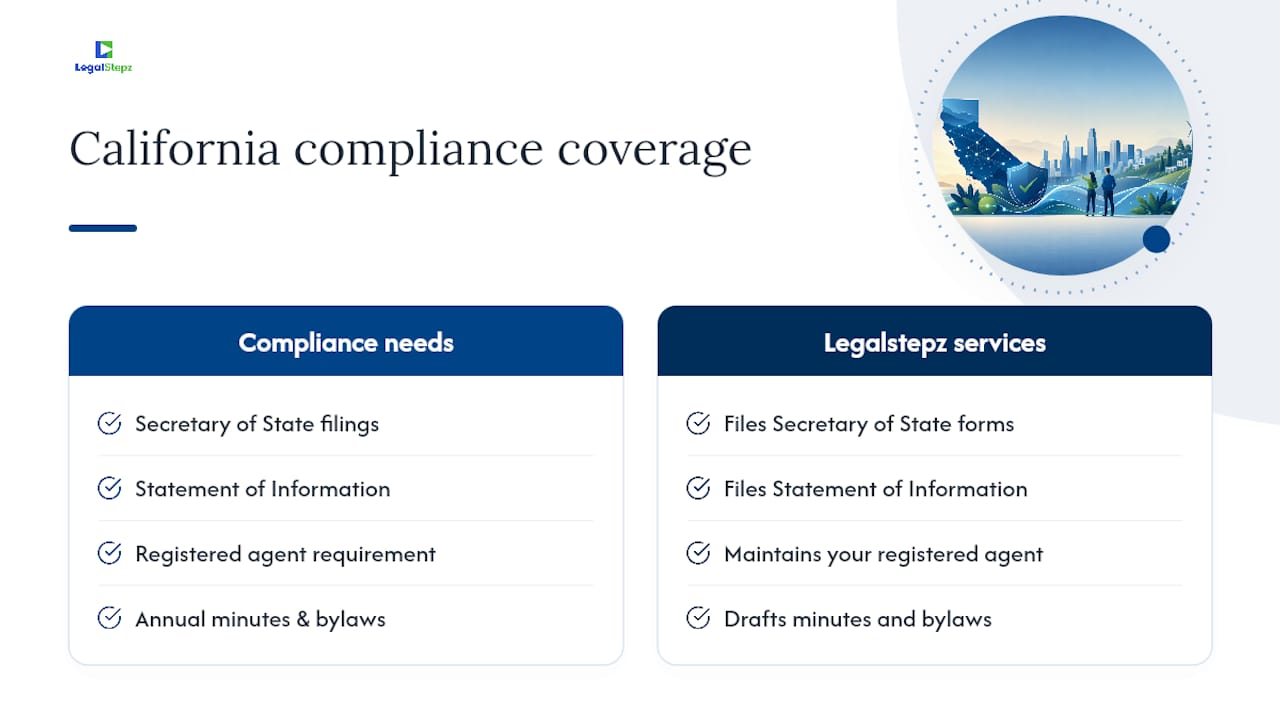
Staying compliant after an S election means keeping up with California Secretary of State filings, registered agent requirements, annual minutes, and the Statement of Information, on top of everything the IRS expects. Missing any one of them can jeopardize your liability protection or trigger penalties.

Legalstepz handles the California compliance side directly: filing your Statement of Information, maintaining your registered agent, drafting annual minutes and bylaws, and providing step-by-step formation courses for owners who want to understand exactly what they are signing. You get the documentation your CPA needs to complete the tax filings, without spending hours tracking down forms or decoding SOS instructions. If you are still in the formation stage, the California LLC formation guide walks you through the full process before you layer in the S election. Visit Legalstepz to review compliance packages and get started today.
Sources
These are the primary government sources you and your CPA will need. Bookmark them before you file anything.
This article provides general information about California LLC and S-corporation tax elections. It is not legal or tax advice. Consult a licensed CPA or tax attorney to evaluate your specific situation and confirm current rules with the IRS and California FTB before filing.
This article is general information, not a substitute for advice from a qualified financial advisor. Consult a qualified financial professional about your own circumstances before acting on anything here.