

California nonprofit annual filing requires submitting Form RRF-1 to the Attorney General's Registry of Charities and Fundraisers and either Form 199 or Form 199N to the Franchise Tax Board (FTB) every year. These are two separate obligations with separate agencies, separate fees, and separate consequences if you miss them. Most calendar-year filers face a shared deadline of may 15. Failing to file either one can cost your organization its right to solicit donations, its eligibility for grants, and ultimately its good standing in California. This guide covers every layer of that compliance picture, from fee schedules to audit thresholds to the 2026 shift to mandatory online submissions.
What is california nonprofit annual filing and what forms are required?
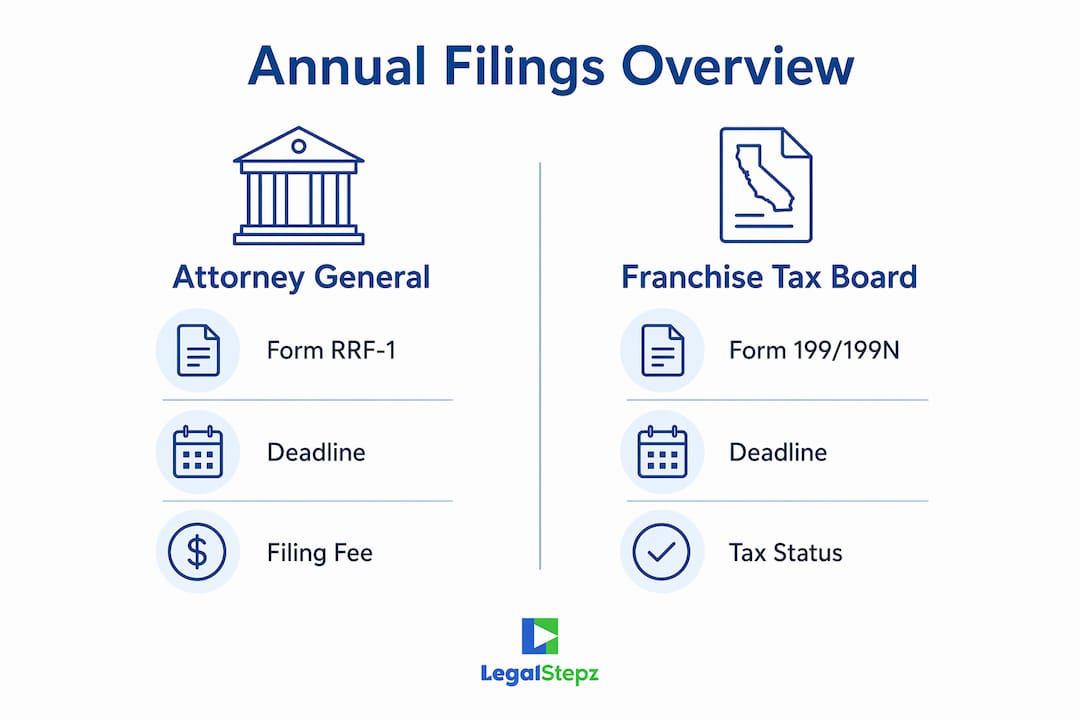
California nonprofit annual filing is the formal process of renewing your organization's registration and confirming its tax-exempt status with two state agencies each year. The Attorney General oversees charitable registration through Form RRF-1 (Registration Renewal Fee Report). The Franchise Tax Board governs tax-exempt status through Form 199 (Exempt Organization Annual Information Return) or Form 199N, the e-Postcard version for smaller organizations.
These two filings are not interchangeable. Satisfying one does not satisfy the other, and both filings are required for full state compliance. Many administrators learn this the hard way after filing only with the FTB and assuming they are done for the year.

The standard deadline for both filings is 4 months and 15 days after your fiscal year end. For calendar-year organizations, that falls on may 15. Extensions are available but must be requested proactively, and they do not automatically carry over from your federal IRS Form 990 extension.
Understanding the annual requirements for California entities before your first filing cycle is the clearest way to avoid surprises.
What is form rrf-1 and how does it renew your registration?
Form RRF-1 is the annual renewal filing submitted to the California Attorney General's Registry of Charities and Fundraisers. It confirms your organization is still operating, still charitable in purpose, and still entitled to solicit donations in California. The RRF-1 deadline is 4 months and 15 days after fiscal year end, which means may 15 for calendar-year filers.
Fee schedule based on gross revenue
The filing fee scales with your organization's gross annual revenue:
| Gross Annual Revenue | RRF-1 Filing Fee |
|---|---|
| Under $25,000 | $0 |
| $25,000 to $100,000 | $25 |
| $100,000 to $250,000 | $50 |
| $250,000 to $1 million | $75 |
| $1 million to $10 million | $150 |
| $10 million to $50 million | $225 |
| Over $50 million | $1,200 |
The fee structure starts at $0 for the smallest organizations and reaches $1,200 for those with over $50 million in gross revenue. This sliding scale means your fee can change from year to year if your revenue crosses a threshold.
Required attachments
Every RRF-1 submission must include a copy of your federal Form 990, Form 990-EZ, or Form 990-PF, whichever applies. Organizations with $2 million or more in gross revenue must also attach an audited financial statement prepared under generally accepted auditing standards (GAAS). This requirement comes directly from California's Nonprofit Integrity Act.
One nuance worth knowing: the audit threshold applies to unrestricted gross revenue. Government grants that are accounted for separately may be excluded from that calculation. If your organization hovers near the $2 million mark, consult a CPA before assuming you are below the threshold.
Consequences of missing the deadline
Missing the RRF-1 filing triggers a $25 late fee immediately. Continued non-filing leads to suspension by the Attorney General, which strips your organization of the right to solicit donations in California. Suspension also disqualifies you from grants administered by California agencies and can affect federal grants that flow through the state.
Pro Tip: Set a calendar reminder for february 1 if you are a calendar-year filer. That gives you three months to gather your Form 990, calculate your fee, and schedule an audit if needed before the may 15 deadline.
How does the franchise tax board's annual filing work?
The FTB filing is a separate annual obligation that maintains your organization's state tax-exempt status. California requires nonprofits to file Form 199 or Form 199N each year, regardless of whether they also file with the Attorney General.
The threshold that determines which form you file is $50,000 in gross receipts:
- Form 199N (e-Postcard): For organizations with gross receipts of $50,000 or less. This is a simple online form requiring basic identifying information and a confirmation that you are still operating.
- Form 199 (full return): Required for organizations with gross receipts above $50,000. This form mirrors many of the questions on the federal Form 990 and requires more detailed financial reporting.
The FTB deadline generally aligns with the RRF-1 deadline at 4 months and 15 days after fiscal year end, which is may 15 for calendar-year filers. The alignment is convenient but can create a false sense of security. Filing both on the same day is fine. Assuming one covers the other is not.
Failure to file with the FTB can result in the revocation of your state tax-exempt status. That means your organization could become subject to California franchise tax, which is a significant financial burden for any nonprofit operating on a tight budget. Understanding California franchise tax obligations helps administrators recognize exactly what is at stake.
Pro Tip: If your gross receipts fluctuate near the $50,000 threshold, file Form 199 rather than Form 199N. Filing the more detailed form when you did not have to costs nothing. Filing the simpler form when you were required to file the full return creates a compliance problem.
How do the two filing tracks compare and intersect?
The two filing tracks run in parallel and must both be completed every year. The table below shows the key differences at a glance.
| Filing | Agency | Deadline | Fee | Key Attachment |
|---|---|---|---|---|
| Form RRF-1 | Attorney General | May 15 (calendar year) | $0 to $1,200 | Federal Form 990 or variant |
| Form 199 | Franchise Tax Board | May 15 (calendar year) | None | None required separately |
| Form 199N | Franchise Tax Board | May 15 (calendar year) | None | None |
The most common compliance pitfall is treating these as redundant. They serve different regulatory purposes. The Attorney General cares about charitable solicitation rights and donor protection. The FTB cares about tax-exempt status and state revenue. Neither agency accepts the other's filing as a substitute.
Federal IRS Form 990 extensions do not automatically extend your California deadlines. You must request extensions separately with each California agency if you need more time. Missing that distinction is a frequent source of late fees and suspension notices.
The Attorney General's Registry is also moving to mandatory online filing in 2026. Paper filings and paper checks will no longer be accepted. Organizations that have relied on mailing in their RRF-1 packets need to update their internal workflows now, not in december.
Pro Tip: If you use an accounting firm to prepare your Form 990, ask them to flag the California filing deadlines explicitly in their engagement letter. Many firms default to federal timelines and leave state deadlines to the client.
How should nonprofit administrators manage annual filings efficiently?
Staying on top of California nonprofit compliance is a process, not a single task. The administrators who handle it best treat it as a year-round workflow rather than a spring scramble.
Here is a practical sequence that works for most calendar-year organizations:
- October through november: Forecast your gross revenue for the year. Determine whether you will cross the $2 million audit threshold or the $50,000 FTB threshold. If an audit is likely, engage your CPA now. Audit scheduling fills up fast in the first quarter.
- January: Confirm your fiscal year-end financials are being closed out. Begin assembling your internal RRF-1 filing packet with your finance team. This packet should include your draft Form 990, your fee calculation, and any audit report.
- February through march: Complete and sign your federal Form 990. This document is a required attachment to your RRF-1, so your California filing cannot move forward without it.
- April: Submit both your RRF-1 and your FTB filing. Do not wait until may 14. Processing delays, portal issues, and missing signatures are all easier to fix with two weeks of buffer.
- May 15: Deadline. Confirm receipt from both agencies.
For the 2026 transition to online filing, organizations need to create accounts on the Attorney General's online portal before the deadline season begins. Testing the system with a staff member in advance prevents last-minute technical failures.
AI-assisted legal document tools, such as those offered through platforms like AI Legal Beagle, can help administrators review complex filing documents and spot errors before submission. This is especially useful for organizations preparing their first audited financial statement attachment.
Pro Tip: Keep a dedicated compliance folder updated throughout the year with board meeting minutes, financial statements, and any correspondence from the Attorney General or FTB. When filing season arrives, you will have everything in one place instead of hunting through email chains.
Key takeaways
California nonprofits must complete two separate annual filings with two separate state agencies to maintain full compliance and protect their right to solicit donations.
| Point | Details |
|---|---|
| Two filings required | Submit Form RRF-1 to the Attorney General and Form 199 or 199N to the FTB every year. |
| Shared deadline | Both filings are due may 15 for calendar-year organizations, 4 months and 15 days after fiscal year end. |
| Audit threshold | Organizations with $2 million or more in gross revenue must attach an audited financial statement to Form RRF-1. |
| Missed deadlines cost more than fees | Late filing triggers a $25 fee and can suspend your right to solicit donations and receive grants. |
| 2026 online mandate | The Attorney General is requiring mandatory online filing in 2026, replacing all paper submissions. |
What i have learned after watching nonprofits navigate this process
The single most damaging misconception I see is the belief that filing with one agency covers the other. Nonprofit teams are stretched thin, and when someone says "we filed our taxes," they often mean the FTB return. The RRF-1 with the Attorney General gets forgotten entirely until a suspension notice arrives.
The audit requirement is the second major blind spot. Organizations that grow quickly sometimes cross the $2 million threshold in a year when they have not budgeted for an audit. A GAAS-compliant audit from a qualified CPA firm takes time and money. Discovering you need one in april, with a may 15 deadline, is a genuinely difficult situation. Revenue forecasting in the fall is not optional for organizations in that revenue range.
The 2026 online filing mandate is actually good news, even if it requires workflow changes. Paper filings get lost. Checks get misapplied. Online submissions create a timestamped record that protects your organization if a dispute ever arises about whether you filed on time. The organizations that resist this transition are the ones most likely to have compliance problems in the years ahead.
My strongest recommendation is to treat compliance as a board-level responsibility, not just a staff task. When board members understand that a missed RRF-1 can freeze fundraising and disqualify the organization from grants, they tend to prioritize the resources needed to get it done right.
— Peter
How Legalstepz helps california nonprofits stay compliant
Keeping up with California's dual filing requirements takes more than a calendar reminder. Legalstepz offers practical tools and guidance built specifically for nonprofits navigating state compliance obligations.

Whether you are working through your first annual filing cycle or preparing your organization for the 2026 online filing transition, Legalstepz provides the structure you need. The Incorporation Course walks you through California nonprofit legal requirements from formation through ongoing compliance, including annual filings, registered agent obligations, and recordkeeping best practices. For administrators who want a single resource that covers the full compliance picture, Legalstepz is the place to start.
FAQ
What forms does a california nonprofit file annually?
California nonprofits file Form RRF-1 with the Attorney General's Registry of Charities and Fundraisers and either Form 199 or Form 199N with the Franchise Tax Board each year. Both filings are required and serve different regulatory purposes.
When is the california nonprofit annual filing deadline?
The deadline for both Form RRF-1 and the FTB annual filing is 4 months and 15 days after fiscal year end. For calendar-year organizations, that is may 15.
Does filing form 199 with the FTB satisfy the rrf-1 requirement?
No. The FTB and Attorney General filings are completely independent. Filing with one agency does not satisfy the obligation to the other.
What happens if a california nonprofit misses the rrf-1 deadline?
Missing the RRF-1 deadline triggers a $25 late fee and can lead to suspension of your organization's right to solicit donations in California, along with loss of grant eligibility.
Which california nonprofits need an audited financial statement?
Organizations with $2 million or more in gross revenue must attach an audited financial statement prepared under GAAS to their Form RRF-1, as required by California's Nonprofit Integrity Act.