

A California professional corporation is a corporation formed exclusively for licensed professionals to legally deliver regulated services under California law. Unlike a general corporation, it operates under strict ownership and governance rules that prevent unlicensed individuals from controlling professional practice. If you are a physician, attorney, dentist, or accountant in California, this entity structure is not optional. It is the legally required path to practicing through a corporate structure.
What is a California professional corporation?
The California professional corporation, commonly called a PC, is governed by the Moscone-Knox Professional Corporation Act (Cal. Corp. Code §§ 13400 through 13410). This statute creates a distinct corporate entity designed specifically for licensed professionals to practice their profession. The Act applies to dozens of licensed professions, including medicine, law, dentistry, optometry, psychology, and architecture.
The core purpose of a PC is to allow licensed professionals to enjoy corporate benefits, such as limited liability and tax planning options, while keeping control of professional services firmly in licensed hands. This is the critical distinction from a general corporation. A general corporation can be owned by anyone. A professional corporation cannot.
Many California entrepreneurs confuse PCs with general corporations or limited liability companies. That confusion carries real legal risk. The Moscone-Knox Act exists precisely because California determined that unlicensed ownership of professional practices creates public harm. Understanding this framework is the first step toward building a compliant, protected practice.

How does the Moscone-Knox Act restrict ownership and control?
The Moscone-Knox Act sets ownership rules that have no equivalent in general corporate law. Ownership is restricted so that at least 51% of shares must be held by licensed persons in the corporation's primary profession. Up to 49% may be held by allied licensed professionals in related fields. No unlicensed person may own shares under any circumstances.
Here is what that means in practice:
- A medical PC must have at least 51% of shares held by licensed physicians.
- Nurse practitioners or other allied health professionals may hold up to 49% of shares.
- A hospital administrator with no clinical license cannot own a single share.
- Lay investors, private equity funds, and non-licensed family members are categorically excluded from ownership.
The Act also governs what happens when a shareholder loses their license. Under Cal. Corp. Code § 13401.5 and § 13403, a disqualified shareholder must transfer their shares within a statutory deadline. Failure to complete that transfer on time exposes the corporation to disciplinary action and potential dissolution. The Corporate Practice of Medicine doctrine reinforces these rules in healthcare by prohibiting corporations from employing physicians to practice medicine unless the corporation itself is a properly formed PC.
Pro Tip: Draft a shareholder agreement before issuing a single share. Include mandatory buy-sell provisions triggered by license loss, death, or disqualification. This is not a formality. It is the mechanism that keeps your corporation compliant when a disqualification event occurs.
The 51/49 ownership rule creates stricter fundraising and ownership limitations than regular corporations face. This matters enormously for growth planning. You cannot simply bring in outside investors the way a tech startup can.
How do you form a California professional corporation?
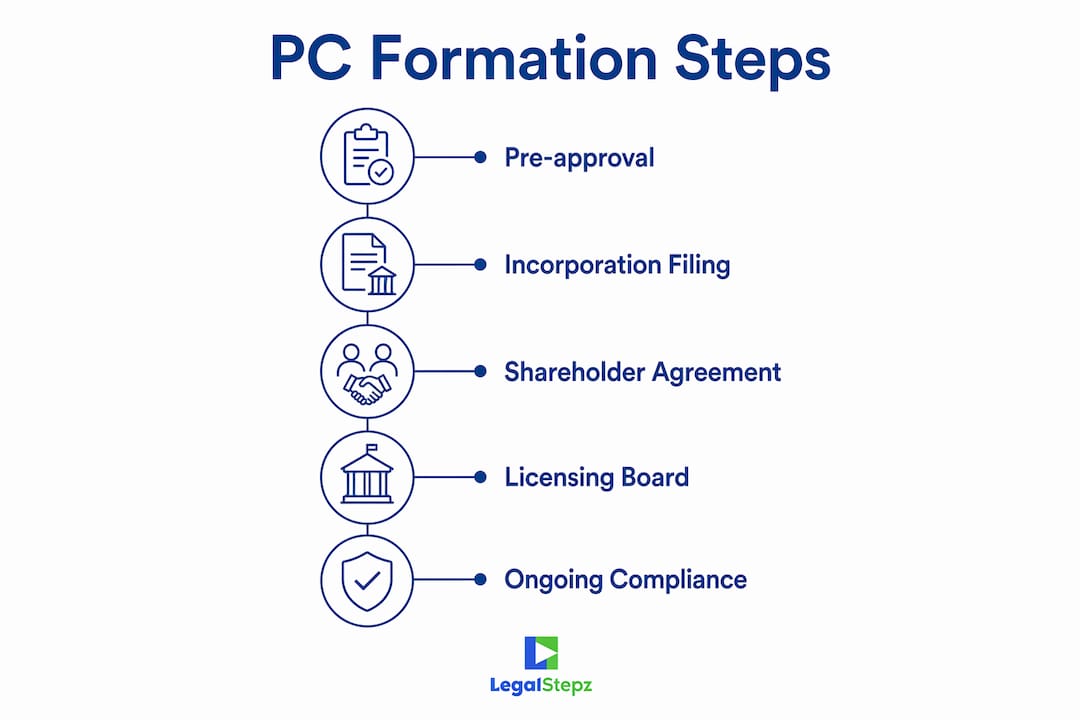
Forming a California professional corporation requires completing two parallel tracks simultaneously: corporate filings with the California Secretary of State and registration with the relevant professional licensing board. Missing either track creates a defective entity.
Follow these steps in order:
- File Articles of Incorporation. The Articles must state a specific professional purpose, such as "the practice of medicine." The corporate name must include a professional designation like "Medical Corporation" or "A Professional Corporation." Generic names are not permitted.
- Adopt bylaws. Bylaws must address ownership transfer restrictions, quorum rules, and officer qualifications consistent with the Moscone-Knox Act. Legalstepz provides bylaw drafting services tailored to California PCs.
- Hold an organizational meeting. Elect directors and officers, all of whom must hold the required license. Approve bylaws and authorize share issuance.
- Issue shares only to qualified persons. Document every share issuance with a stock ledger and written agreements. Never issue shares to an unlicensed person.
- Obtain an Employer Identification Number (EIN) from the IRS. This is required before opening a business bank account or hiring employees.
- File a Statement of Information with the California Secretary of State within 90 days of incorporation. This filing must be renewed every two years. Legalstepz handles Statement of Information filings directly, reducing the risk of missed deadlines.
- Register with your licensing board. Most licensing boards in California require a separate application to authorize the PC to practice. The Medical Board of California, the State Bar of California, and the Dental Board of California each have their own registration process.
Pro Tip: Do not wait until after incorporation to contact your licensing board. Some boards require pre-approval of your corporate name before the Secretary of State will accept your Articles. Confirm the sequence with your board before filing anything.
If you want a guided walkthrough of every filing step, Legalstepz offers an incorporation course built specifically for California professionals navigating this process.
How does a PC compare to an LLC or general corporation?
California law makes this comparison straightforward. California LLCs generally cannot render professional services. Cal. Corp. Code § 17701.04 bars LLCs from providing licensed professional services unless expressly authorized by statute, which is rare. For physicians, attorneys, dentists, and most other licensed professionals, the LLC is simply not a legal option for practicing their profession.
The table below shows how the three main entity types compare for California licensed professionals.
| Feature | Professional Corporation | General Corporation | LLC |
|---|---|---|---|
| Permitted for licensed practice | Yes | No | Generally no |
| Ownership restrictions | Licensed persons only | No restrictions | No restrictions |
| Liability protection | Partial (not own malpractice) | Full for business debts | Full for business debts |
| Tax election options | S-corp or C-corp | S-corp or C-corp | Pass-through default |
| Governance formalities | High (Moscone-Knox rules) | Moderate | Low |
| Licensing board registration | Required | Not applicable | Not applicable |
A professional corporation protects shareholders from liabilities related to business debts and other shareholders' malpractice. It does not shield a professional from personal liability for their own malpractice. This distinction matters. A physician whose partner commits malpractice is protected. A physician who commits malpractice personally is not. No corporate structure eliminates that personal exposure.
For professionals who want to understand how the LLC compares as a general business structure, the Legalstepz guide on California business entities covers the full range of options in detail.
What are the ongoing compliance requirements for a California PC?
Maintaining a California professional corporation is not a one-time task. Ongoing compliance requires active licensure of all shareholders, directors, and officers, annual meetings, required filings, and prompt handling of disqualification events. Think of compliance as running on two tracks simultaneously: corporate formalities and licensing board requirements.
Key compliance obligations include:
- Annual meetings and corporate minutes. California law requires annual shareholder and director meetings. Minutes must be drafted, approved, and retained. Legalstepz drafts annual minutes as a core service for California PCs.
- Biennial Statement of Information. Filed with the California Secretary of State every two years. Late filing triggers penalties and can result in suspension of the corporation.
- Active licensure monitoring. Every shareholder, director, and officer must maintain an active, unrestricted license. A lapse in any one person's license triggers mandatory share transfer obligations under the Moscone-Knox Act.
- Shareholder disqualification handling. When a shareholder dies, retires, or loses their license, the corporation must complete the share transfer within the statutory deadline. Shareholder agreements with buy-sell provisions are the mechanism that makes this possible without a crisis.
- Licensing board renewals. Most boards require periodic renewal of the PC's authorization to practice, separate from individual license renewals.
Pro Tip: Set calendar reminders 90 days before every filing deadline, license renewal, and annual meeting. Noncompliance does not just create fines. It can pierce the corporate veil, exposing every shareholder to personal liability for corporate debts.
Failure to comply can result in disciplinary actions from licensing boards, loss of corporate protections, and personal liability for shareholders. The california corporation penalty avoidance guide principle is simple: document everything, file on time, and monitor licenses continuously.
How are California professional corporations taxed?
Professional corporations can elect to be taxed as S-corporations or C-corporations. Most California PCs choose S-corp status to avoid double taxation, but the choice carries trade-offs that require careful analysis.
Key tax considerations for California PCs:
- C-corporation taxation subjects the corporation to federal corporate income tax and then taxes shareholders again on dividends. This double taxation is the primary reason most PCs elect S-corp status.
- S-corporation taxation passes income through to shareholders, who report it on personal returns. California still imposes a 1.5% franchise tax on net income for S-corps, with a minimum annual franchise tax of $800.
- Reasonable compensation rules apply under S-corp status. The IRS requires shareholder-employees to receive a reasonable salary before taking distributions. Underpaying salary to avoid payroll taxes is a common audit trigger.
- Retirement planning is a significant benefit of the PC structure. Physicians and attorneys using PCs can contribute to defined benefit plans or 401(k) plans at levels unavailable to sole proprietors.
- Tax debt situations can arise when payroll obligations or franchise taxes go unmanaged. California-based tax professionals, including those at Omni Tax Help, specialize in resolving state tax liabilities for business owners.
Tax planning for a California PC is not a DIY exercise. The interaction between California franchise tax, federal S-corp rules, and reasonable compensation requirements creates enough complexity that a qualified CPA with professional corporation experience is a necessary investment, not an optional one.
Key takeaways
A California professional corporation is the only legally compliant corporate structure for most licensed professionals in California, governed by the Moscone-Knox Act with strict ownership, compliance, and tax rules that distinguish it from every other entity type.
| Point | Details |
|---|---|
| Moscone-Knox Act governs all PCs | Cal. Corp. Code §§ 13400 to 13410 sets ownership, governance, and share-transfer rules for every California PC. |
| 51% licensed ownership is mandatory | At least 51% of shares must be held by licensed professionals in the primary profession; no unlicensed ownership is permitted. |
| Formation runs on two tracks | Corporate filings with the Secretary of State and licensing board registration must both be completed to create a valid PC. |
| Compliance is continuous | Annual minutes, biennial Statements of Information, and active license monitoring are required to maintain good standing and liability protection. |
| S-corp election is common but complex | Most PCs elect S-corp status to avoid double taxation, but California's 1.5% franchise tax and reasonable compensation rules still apply. |
Why compliance is harder than formation for most California PCs
Formation gets all the attention. In my experience working with California professionals, the Articles of Incorporation get filed, the EIN gets obtained, and everyone moves on assuming the hard part is done. It is not. The hard part starts the day after incorporation.
The most dangerous compliance gap I see is the absence of a shareholder agreement with real teeth. Professionals form their PC, issue shares informally, and never document what happens when a partner loses their license or dies. Then the event happens, the statutory deadline runs, and the corporation is suddenly out of compliance with the Moscone-Knox Act. That is not a paperwork problem. That is a licensing board problem, and licensing board problems can end careers.
The 2026 implementation of SB 351 adds another layer of complexity. SB 351 restricts private equity and hedge fund interference in physician professional corporations to protect clinical judgment and ownership compliance. This directly affects Management Services Organization and PC structures that have become common in healthcare. If your PC has any relationship with an MSO, your shareholder agreements and governance documents need review now, not after a regulatory inquiry.
My honest recommendation: treat your PC's compliance calendar with the same discipline you apply to patient care or client representation. The professionals who get into trouble are almost never the ones who formed their PC incorrectly. They are the ones who stopped paying attention after formation.
— Peter
Start your California PC the right way with Legalstepz
Forming and maintaining a California professional corporation requires precision at every step, from filing Articles of Incorporation to drafting compliant bylaws and keeping annual minutes current.

Legalstepz provides the filing support, document drafting, and registered agent services California professionals need to stay compliant without the legal overhead. Whether you are starting from scratch or catching up on missed filings, the Legalstepz incorporation course walks you through every formation step with California-specific guidance. For ongoing compliance support, visit Legalstepz to explore Statement of Information filing, annual minutes drafting, and registered agent services built for California PCs.
FAQ
What professions require a California professional corporation?
California requires licensed professionals including physicians, attorneys, dentists, optometrists, psychologists, architects, and accountants to form a professional corporation to practice through a corporate entity. The Moscone-Knox Act lists all covered professions under Cal. Corp. Code §§ 13400 to 13410.
Can a California LLC be used instead of a professional corporation?
No. Cal. Corp. Code § 17701.04 prohibits California LLCs from rendering professional services in most licensed fields. Licensed professionals in medicine, law, and dentistry must use a professional corporation, not an LLC.
What happens if a shareholder loses their license?
Under the Moscone-Knox Act, a disqualified shareholder must transfer their shares within the statutory deadline. Failure to complete the transfer exposes the corporation to disciplinary action and potential loss of its authorization to practice.
Does a California professional corporation protect against malpractice claims?
A PC protects shareholders from liability for other shareholders' malpractice and for general business debts. It does not protect a professional from personal liability for their own malpractice. That exposure remains regardless of corporate structure.
What is the minimum annual tax for a California professional corporation?
California imposes a minimum annual franchise tax of $800 on professional corporations, plus a 1.5% franchise tax on net income for those electing S-corp status. C-corp elections are subject to the standard California corporate tax rate instead.