

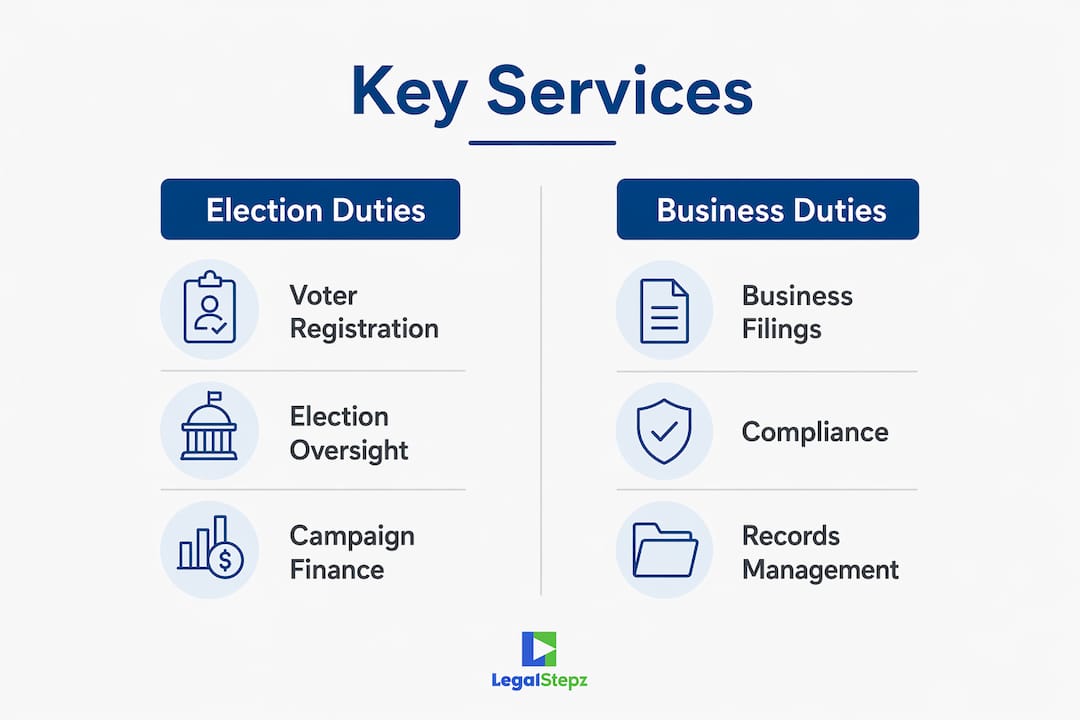
The California Secretary of State is the state's chief elections officer and primary business registrar, managing functions that affect every voter and business owner in California. The office oversees statewide elections, processes business entity filings, maintains campaign finance disclosures, and manages the state archives. With nearly 500 employees and a voter registration database covering more than 23 million Californians, this office touches daily life in ways most residents never fully realize. Understanding the California Secretary of State explained in full means knowing both its democratic role and its direct impact on your business compliance.
What are the main election responsibilities of the California Secretary of State?
The California Secretary of State serves as the state's chief elections officer, a role that carries significant legal and operational weight. The office certifies election results, tests and approves voting equipment, and publishes the official voter guide distributed to all registered voters before each election cycle.
The voter registration database managed by the office covers more than 23 million Californians. Maintaining that database requires constant updates, cross-referencing with other state agencies, and security protocols to prevent unauthorized changes.

California's election processes have grown more complex in recent years. The office now administers universal mail-in voting and has managed high-profile recall elections, both of which demand additional layers of verification and public communication. These events have raised the office's visibility considerably.
Key election duties include:
- Certifying candidates for state and federal offices
- Testing and approving all voting systems used across 58 counties
- Publishing the official California Voter Guide before each election
- Overseeing campaign finance reporting and lobbyist disclosures
- Maintaining the statewide voter registration system
Pro Tip: Register to vote or update your registration directly through the Secretary of State's website at sos.ca.gov. Changes made at least 15 days before an election take effect for that cycle.
How does the California Secretary of State support business owners?
The Secretary of State's office is the official registrar for all business entities formed or operating in California. Corporations, LLCs, partnerships, and nonprofits all file their formation documents here. Without this registration, a business cannot legally operate in the state.
What does it cost to file with the Secretary of State?
California LLC filings require a $70 Articles of Organization fee at formation, followed by a $20 Statement of Information fee due within 90 days of formation and then biennially. The Franchise Tax Board separately charges an $800 annual franchise tax, which is not collected by the Secretary of State but is triggered by the registration. Understanding the full cost breakdown before you file prevents surprises.
Foreign entities, meaning businesses formed outside California that operate here, must register with the office as well. Failing to do so carries a $2,000 annual penalty for unregistered foreign LLCs. That penalty compounds quickly and does not disappear simply by registering late.
How to file your business documents
The office offers several filing methods and processing speeds:
- Standard processing takes 5–15 business days and carries no additional fee beyond the base filing cost.
- 24-hour expedited processing costs $350 on top of the standard filing fee.
- 4-hour expedited processing costs $500 above the base fee.
- Same-day processing costs $750 above the base fee.
These expedited processing tiers exist because business owners often need proof of registration quickly, whether for a bank account, a contract, or a lease agreement.
The bizfileOnline portal is the office's primary digital filing system. Manual paper filings are still accepted but take longer and carry a higher risk of rejection due to errors. The portal validates information in real time, which reduces the chance of a rejected application.
| Filing method | Processing time | Best for |
|---|---|---|
| Standard online | 5–15 business days | Non-urgent formations |
| 24-hour expedited | 1 business day | Moderate urgency |
| 4-hour expedited | Same day, afternoon | High urgency |
| Same-day | Same day, morning | Critical deadlines |
Pro Tip: When you form a California LLC, use the bizfileOnline portal rather than mailing paper forms. Rejected paper filings lose their place in the queue and restart the processing clock.
Privacy and your business address
Every address listed on a California business filing becomes part of the public record. Using a home address as your registered business address means anyone can find it through a simple online search. Many business owners use registered agents to list a professional address instead, keeping personal information off public databases.
What other services does the Secretary of State provide?
The office's responsibilities extend well beyond elections and business filings. The Secretary of State also manages the California State Archives, commissions notaries public, and oversees lobbyist registrations and campaign finance disclosures. These functions support government transparency and public access to official records.
Key additional services include:
- State Archives: The office preserves historical government records, legislative documents, and official state papers. Researchers, journalists, and attorneys regularly access these archives.
- Notary public commissioning: The office processes applications, administers oaths, and maintains the official roster of commissioned notaries across California.
- Lobbyist registration: Any individual or firm paid to influence California legislation must register with the office and file periodic disclosure reports.
- Campaign finance oversight: The office maintains public records of contributions and expenditures for state candidates and ballot measures.
- Official state documents: The office authenticates documents for international use through apostilles, a service frequently needed by businesses operating across borders.
These services make the Secretary of State a central hub for government transparency. Lobbyist and campaign finance records are publicly searchable, which gives residents direct access to information about who funds political activity in the state.
What compliance challenges do businesses face with the Secretary of State?
Compliance failures with the Secretary of State carry real financial consequences. Missing a Statement of Information filing triggers a $250 penalty. That penalty is just the starting point. Continued noncompliance can result in the Secretary of State suspending the business entity, which blocks the company from entering contracts, suing in court, or defending itself in litigation.
Failing to register at all creates even larger problems. Unregistered businesses that are later discovered can face penalties reaching 30–50% of their total tax liabilities, plus interest. The Franchise Tax Board actively cross-references 1099 filings and federal income reports to identify businesses operating without proper state registration. Noncompliance is rarely invisible for long.
Common compliance pitfalls include:
- Missing the 90-day window to file the initial Statement of Information after formation
- Failing to update the Statement of Information when officers or addresses change
- Operating a foreign entity in California without registering it with the office
- Leaving a dormant business entity active without formally dissolving it, which continues to accrue annual fees and franchise taxes
- Filing paper forms with errors that cause rejection and delay
Dissolving a business properly matters as much as forming it correctly. An entity left open on the books continues to owe the $800 annual franchise tax even if it has no revenue. The Secretary of State's office processes Certificate of Dissolution filings, which formally close the entity and stop the fee clock.
Pro Tip: Set a calendar reminder for your Statement of Information due date every two years. The Secretary of State does not always send reminders, and a missed filing triggers an automatic $250 penalty.
Key Takeaways
The California Secretary of State's office is the single most consequential state agency for both voters and business owners, managing elections, business registrations, and government transparency from one central authority.
| Point | Details |
|---|---|
| Chief elections officer | The office manages voter registration for 23 million+ Californians and certifies all statewide election results. |
| Business registration hub | All California LLCs, corporations, and foreign entities must register here before operating legally. |
| Fees and penalties | A $70 formation fee and $20 Statement fee apply to LLCs; late filings trigger a $250 penalty and foreign LLCs face $2,000 annually. |
| Expedited filing options | Same-day processing is available for $750 above the base fee when deadlines are critical. |
| Broader public services | The office also manages state archives, notary commissions, lobbyist registrations, and campaign finance records. |
Why the Secretary of State role matters more than most people realize
Most California residents think of the Secretary of State only during election season, if they think of the office at all. That's a costly blind spot, especially for business owners.
I've seen business owners delay registration for months, assuming the state won't notice. The Franchise Tax Board's cross-referencing system makes that assumption dangerous. The FTB finds unregistered businesses through 1099 data and federal filings, and the resulting penalties can exceed what the owner would have paid in years of proper compliance.
The election side of the office has also become far more complex. Universal mail-in voting and recall elections require operational precision at a scale most people don't appreciate. The office coordinates with 58 county election offices, manages equipment certification, and publishes voter guides, all simultaneously during peak election periods.
What strikes me most is how the office's transparency functions go unnoticed. The lobbyist and campaign finance databases are publicly searchable and genuinely useful. Journalists, researchers, and engaged citizens can trace political money in California with more detail than most states allow.
For business owners, the practical lesson is simple. Register on time, file your Statement of Information on schedule, and dissolve entities you no longer use. The penalties for avoiding California LLC compliance are not proportional to the offense. A $250 late fee can cascade into suspension, loss of court access, and compounding tax penalties. The Secretary of State's office gives you every tool to stay compliant. Use them.
— Peter
How Legalstepz helps California businesses stay compliant
California's filing requirements are specific, time-sensitive, and unforgiving when missed. Legalstepz provides direct support for business owners who need to get it right the first time.
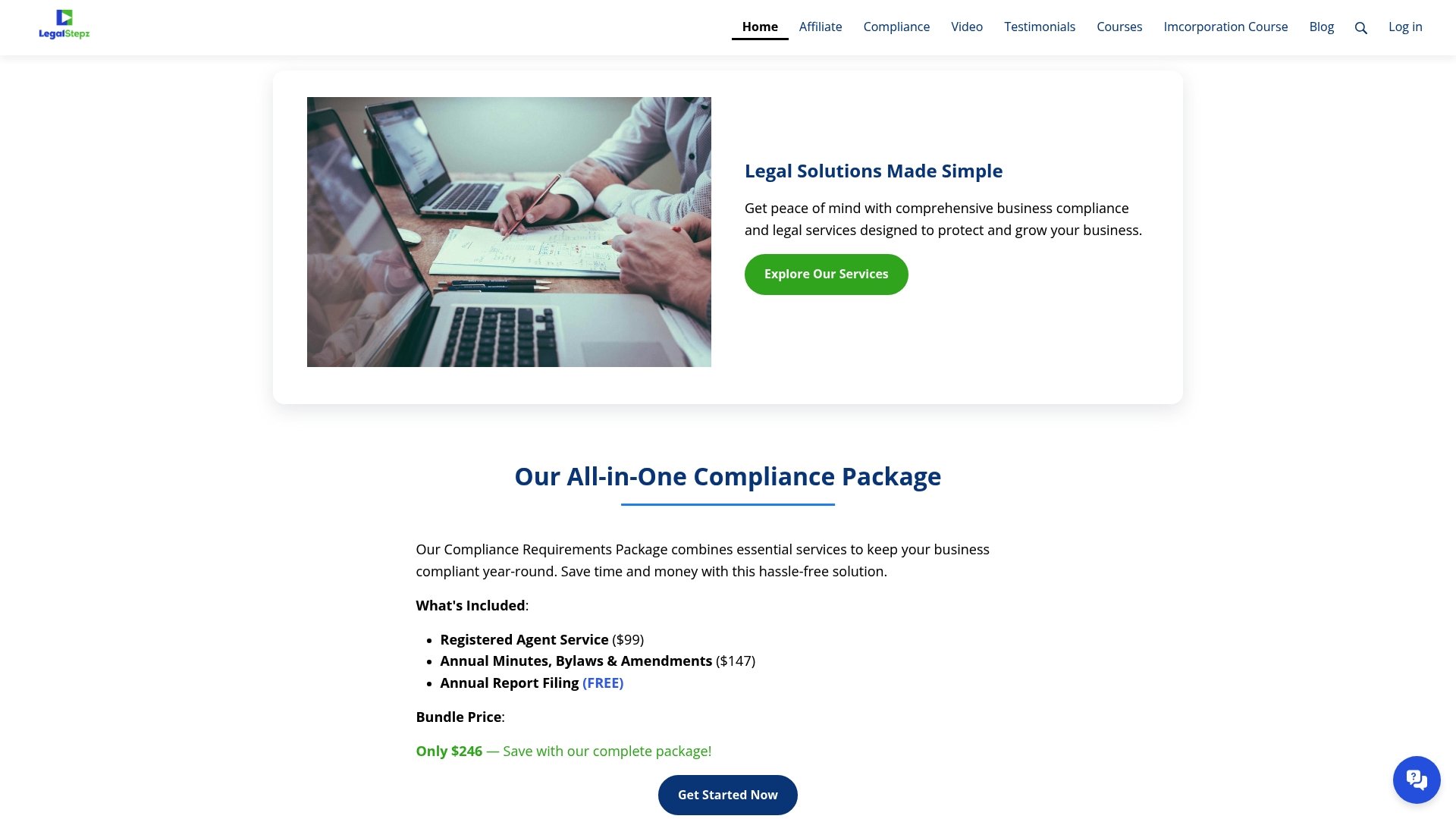
Legalstepz handles Statement of Information filings, annual minutes, bylaws drafting, and registered agent services for California businesses. Using a registered agent through Legalstepz keeps your personal address off the public record while meeting the state's legal requirements. Whether you are forming a new LLC or catching up on overdue filings, Legalstepz gives you a clear path to good standing with the Secretary of State's office without the guesswork of navigating state portals alone.
FAQ
What does the California Secretary of State do?
The California Secretary of State serves as the state's chief elections officer and business registrar, overseeing statewide elections, business entity filings, campaign finance disclosures, state archives, and notary public commissions.
How much does it cost to file an LLC with the California Secretary of State?
Filing a California LLC requires a $70 Articles of Organization fee, a $20 Statement of Information fee due within 90 days of formation, and an $800 annual franchise tax collected separately by the Franchise Tax Board.
What happens if I miss my Statement of Information filing?
Missing a Statement of Information filing triggers an automatic $250 penalty. Continued noncompliance can lead to entity suspension, which blocks the business from entering contracts or accessing California courts.
Can I file business documents online with the California Secretary of State?
The bizfileOnline portal accepts most business filings online. Online filing is faster and reduces errors compared to paper submissions, with expedited options available for same-day processing at an additional $750 fee.
How do I protect my home address when registering a California business?
Using a registered agent service lists a professional address on your public filings instead of your home address. This keeps personal information out of the Secretary of State's publicly searchable business records.