

Yes, California allows a corporation to convert directly into an LLC under Corporations Code Chapter 11.5. The core filing is a Certificate of Conversion submitted through the Secretary of State's bizfileOnline system, using conversion forms sometimes referenced as CONV-1A or llcconv. Before you file anything, get shareholder approval locked down and run the numbers with a CPA, because conversion can trigger a taxable liquidation and lock you into the $800 annual LLC minimum franchise tax going forward.
TL;DR:
- Shareholder approval and a clear plan of conversion are required before filing, and a tax model must be run to assess potential liquidation triggers.
- Filing the Certificate of Conversion must be done in a specific order, with approvals first, followed by tax modeling, then submission through the Secretary of State's online portal.
- Conversion can result in a taxable event, and the LLC will owe an $800 minimum annual franchise tax plus possible additional fees based on gross receipts.
- Post-conversion, updating contracts, liabilities, and employee benefit plans is essential to preserve liability protection and avoid legal gaps.
- Complex cases involving real estate, intellectual property, or outside investors should involve legal and tax professionals before proceeding.
Table of Contents
- What California law requires before you convert a corporation to an llc
- Steps to convert corporation to llc california: forms, fees, and filing order
- What tax consequences follow a corporation-to-LLC conversion
- What compliance tasks come after the conversion filing
- When should you stop and call a lawyer or CPA?
- How conversion affects your existing contracts and liabilities
- How employee status and benefits change after conversion
- What management and governance look like after conversion
- What happens to stock options and shareholder agreements
- Legal Stepz's take on making this process manageable
- Start your California LLC conversion filing with Legal Stepz
- Where to verify these forms and rules yourself
- Sources
What California law requires before you convert a corporation to an llc
California's conversion statute lives in Corporations Code Sections 1150 through 1160, with Section 1151 specifically authorizing a domestic corporation to convert into a domestic LLC without dissolving and reforming as a new entity. That distinction matters practically: the LLC inherits the corporation's contracts, licenses, and legal history rather than starting from zero, though you'll still need to update the paperwork behind the scenes.
The statute doesn't let a board just decide to convert on its own. It requires formal corporate action first, and skipping this step is the single most common reason conversions get challenged later.
Before filing anything with the state, you need to secure:
- Board approval through a formal resolution recommending the conversion to shareholders.
- Shareholder approval, typically requiring a majority vote or written consent, depending on what your bylaws specify.
- Documentation of dissenting shareholders, since California law gives dissenters certain rights that must be addressed, not ignored.
- A plan of conversion outlining how corporate shares convert into LLC membership interests.
If your bylaws set a higher threshold than a simple majority, that higher bar controls. The Secretary of State's conversion information page lists the exact statutory language and current form versions, and it's worth checking directly since form numbers and requirements do get updated periodically.
One nuance worth flagging: shareholders who vote against the conversion don't automatically get blocked from proceeding. California's approach favors majority rule with dissenter protections, not unanimous consent, which is different from how some other states handle entity conversions.
Steps to convert corporation to llc california: forms, fees, and filing order
Getting the sequence right matters more than most guides admit. File tax paperwork before corporate approvals, or approvals before you've modeled the tax hit, and you'll be redoing work.
Here's the order that actually works:
- Secure corporate approvals first. Get the board resolution and shareholder vote or written consent documented and dated before you touch any state forms.
- Run a tax model before filing anything. This is the step people skip and regret. A CPA can tell you whether the conversion triggers a taxable liquidation event that costs more than the filing fees ever will.
- Prepare the Certificate of Conversion. This is the core document; the SOS provides the current form template for LLC conversions, sometimes labeled CONV-1A depending on entity type.
- File through bizfileOnline. The Secretary of State's online portal is the fastest submission method and where most conversions get processed today.
- Pay the filing fee. Current SOS guidance lists a $150 filing fee for the conversion document itself.
- File the LLC Statement of Information once your conversion is approved and processed, since this is a separate requirement from the conversion filing itself.
- Complete final corporate tax returns marking the corporation's last tax year, coordinated with your CPA's timeline.
Expedited filing options exist through the SOS for an additional fee if you're on a deadline, though standard processing works fine for most conversions that aren't tied to a closing date or investor deadline.
Pro Tip: File your Certificate of Conversion before you notify vendors, banks, or landlords about the entity change. Some banks won't update account ownership until they see the state-stamped conversion document in hand, so jumping the gun just means a second round of paperwork.
What tax consequences follow a corporation-to-LLC conversion
The filing fee is the cheap part. The tax consequences are where conversions get expensive if nobody modeled them first.
Converting a corporation to an LLC can be treated as a taxable liquidation for federal tax purposes, according to tax guidance from UpCounsel. That means the corporation may recognize gain on its assets as if it sold them, and shareholders may separately recognize gain on the deemed distribution they receive in exchange for their stock. This isn't a paperwork formality. It's a real tax event that can generate liability at both the corporate and shareholder level in the same transaction.
The $800 question: Every California LLC owes a minimum annual franchise tax of $800, regardless of profit. On top of that, LLCs with gross receipts above certain thresholds owe a graduated additional fee that scales with revenue, per Franchise Tax Board guidance. A corporation converting to LLC status inherits this fee structure permanently.
Before you file the conversion, work through these steps with a tax professional:
- Run a full tax model comparing corporate liquidation treatment against staying incorporated.
- Prepare final corporate tax returns covering the short tax year ending at conversion.
- Determine whether you need a new EIN for the LLC or can retain the existing one.
- Plan for Form 568 filings and estimated LLC fee payments going forward.
- Confirm whether your gross receipts trend puts you near the $250,000 graduated fee threshold.
Businesses with straightforward balance sheets and no major appreciated assets often find the tax hit manageable. Businesses holding real estate, intellectual property, or other appreciated assets inside the corporation face a much bigger number, and that's exactly the scenario where skipping the CPA consultation gets expensive.
What compliance tasks come after the conversion filing
Getting the Certificate of Conversion approved isn't the finish line. It's the start of a checklist that, if ignored, can quietly undermine the liability protection you converted to get.
Your priorities immediately after approval:
- Draft a written Operating Agreement. California doesn't require you to file this with the state, but the RUAA and standard practice both treat it as essential for defining member rights and management.
- File your LLC Statement of Information within the required window after conversion, then again on the biennial schedule that follows. Legal Stepz covers the specific timing rules if you need the exact deadlines.
- Update every bank account, contract, and vendor agreement to reflect the LLC's legal name and EIN, since banks in particular will freeze activity on accounts still listed under the old corporate name.
- Notify licensing boards and permit issuers. Professional licenses, seller's permits, and local business licenses typically need updating to reflect the new entity type.
- Confirm your registered agent designation carries over correctly or gets refiled under the LLC's name.
None of this is optional if you want the LLC's liability shield to hold up. An LLC that still operates under old corporate paperwork gives a plaintiff's attorney an easy argument that the entities weren't properly separated.
When should you stop and call a lawyer or CPA?
Some conversions are simple. A single owner with no debt, no pending disputes, and modest assets can often move through this process cleanly. Others aren't simple at all, and pretending otherwise costs more than the professional fees would have.
Call in help before filing if any of these apply:
- Your corporation holds appreciated real estate, patents, or other assets where the taxable liquidation treatment could generate a meaningful gain.
- One or more shareholders oppose the conversion or haven't signed off yet.
- You have pending litigation, unresolved contracts, or active liens against the corporation.
- You operate payroll in multiple states or have complex employer tax obligations tied to the corporate EIN.
- Your business generates revenue near or above the $250,000 gross receipts threshold that triggers the graduated LLC fee.
Timing matters too. Converting mid fiscal year without planning ahead can split your tax year awkwardly and complicate your final corporate return.
Pro Tip: Before you file the conversion, pull together a complete archive of corporate minutes, resolutions, and final filings. If the IRS or Franchise Tax Board ever questions the transition, a clean paper trail showing exactly when and how you approved the conversion is worth far more than trying to reconstruct it later.
How conversion affects your existing contracts and liabilities
California's conversion statute is designed so the LLC steps into the corporation's shoes rather than starting fresh, which means existing contracts generally remain valid and enforceable after conversion. The entity's legal identity continues; it just changes form. That's the theory, and it holds up in most cases.
Practice is messier. Many contracts, especially loan agreements, commercial leases, and vendor agreements, contain change-of-entity clauses or assignment restrictions that get triggered by a conversion even when the underlying business hasn't changed at all. Before filing, pull your major contracts and check for language requiring counterparty notice or consent when the entity type changes.

Liabilities carry over the same way assets do. If the corporation had outstanding debts, pending claims, or contingent liabilities, the LLC inherits them. Conversion isn't a way to shed obligations. Creditors who had recourse against the corporation retain that same recourse against the LLC after the change, and this is by design under the conversion statute rather than an oversight.
Insurance policies deserve particular attention here. General liability and professional liability carriers often need notice of an entity change, and a policy written for "ABC Corporation" may not clearly cover claims against "ABC LLC" without an endorsement. Contact your insurance broker before the conversion closes, not after a claim arrives.
How employee status and benefits change after conversion
Employees generally keep their jobs, pay, and daily responsibilities through a corporation-to-LLC conversion since the entity continuing to operate is the same business under new legal form. Employment agreements, offer letters, and employee handbooks referencing the corporation by name should get updated, but the underlying employment relationship doesn't need to be re-created from scratch.
Payroll is where the real work happens. If you obtain a new EIN for the LLC, which your CPA will help determine based on how the conversion is structured, payroll providers need advance notice to avoid gaps in tax deposits or W-2 reporting at year end. Getting this wrong mid year creates a genuinely annoying reconciliation problem come tax season.
Benefit plans need a closer look than most owners expect. Group health insurance, 401(k) plans, and other benefit arrangements are often written with the corporate entity named as plan sponsor. Depending on the plan documents, a conversion may require a formal plan amendment or even a new plan adoption to keep coverage uninterrupted. This is squarely a question for your benefits broker or ERISA counsel, not something to assume works itself out.
Stock-based compensation for employees runs into the issues covered in the next section on outstanding equity, since LLCs don't issue stock the way corporations do.
What management and governance look like after conversion
Corporations run on a fixed structure: shareholders elect a board, the board appoints officers, and formal meeting minutes document nearly everything. LLCs trade that rigidity for flexibility, and that's often the whole point of converting.
An LLC can be member-managed, where the owners run daily operations directly, or manager-managed, where designated managers (who may or may not be members) handle operations while members retain oversight on major decisions. Nothing in California law forces you into either model. You choose it in the Operating Agreement, and this single document does the governance work that bylaws, board resolutions, and shareholder agreements used to split across multiple filings.
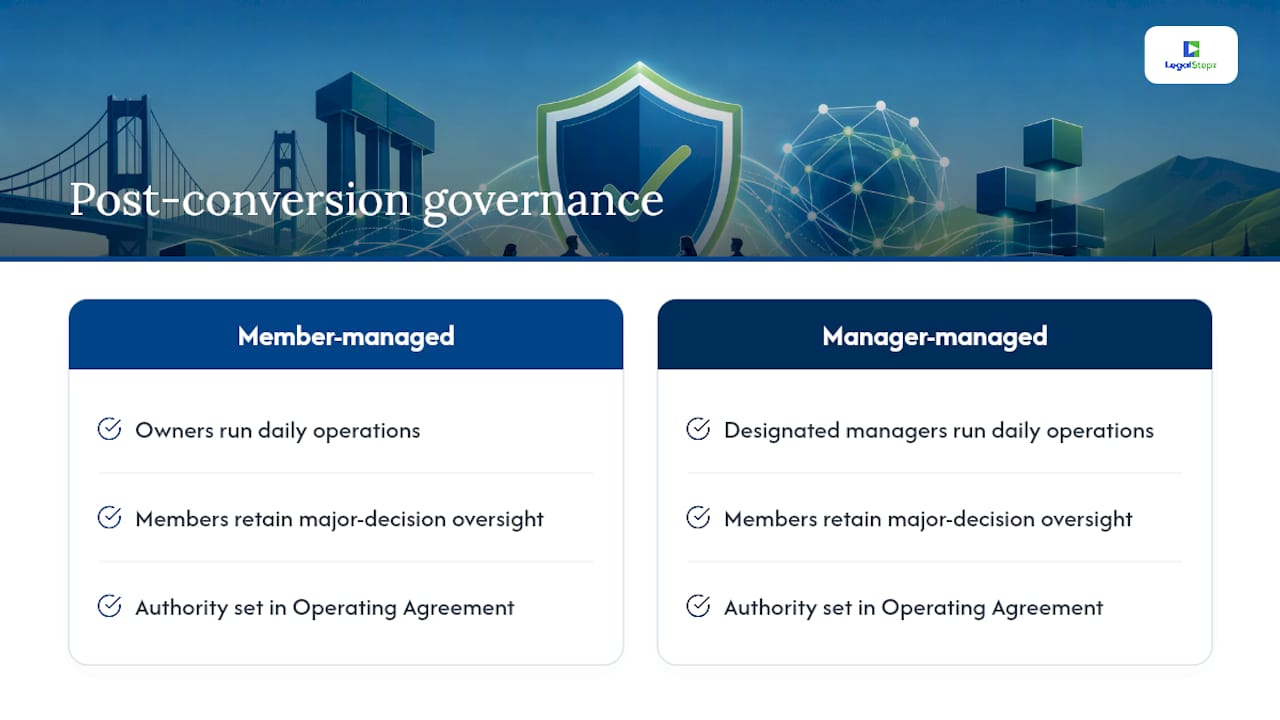
The practical upside is fewer formalities. LLCs aren't required to hold annual shareholder meetings or maintain the same minute book discipline corporations do. The practical risk is exactly the same coin flipped over: without formal requirements forcing documentation, some LLC owners get sloppy about recording major decisions, and that sloppiness becomes a real problem if a dispute or liability question surfaces later.
Voting rights inside an LLC also don't have to mirror stock ownership the way corporate voting does. Members can allocate voting power, profit sharing, and management authority independently of capital contribution, as long as the Operating Agreement spells it out clearly. That flexibility is valuable for businesses with unequal contributions of capital versus labor, but it only works if the agreement is drafted carefully.
What happens to stock options and shareholder agreements
Stock options present one of the thornier practical problems in a corporation-to-LLC conversion, mostly because LLCs don't have stock at all. Membership interests replace shares, and options designed to purchase stock at a strike price don't translate cleanly into an entity that issues percentage interests instead.
Companies with outstanding options, whether under a formal equity incentive plan or informal agreements, generally need to resolve those grants before or as part of the conversion. That can mean accelerating vesting, converting options into equivalent membership interest rights, or cashing out option holders entirely. Each path carries different tax consequences for the option holders and the company, which is another reason the tax modeling step earlier in this process isn't optional.
Existing shareholder agreements, buy-sell agreements, and voting agreements written for corporate stock don't automatically carry over in a form that makes sense for LLC membership interests. These documents typically reference share transfers, rights of first refusal on stock, and drag-along or tag-along provisions tied to corporate share structure. After conversion, they need to be rewritten as membership interest provisions inside or alongside the new Operating Agreement.
The insight from UpCounsel worth remembering here: investors and venture capital funds overwhelmingly prefer investing in corporations, not LLCs, largely because of how equity compensation and preferred stock structures work. If your company has outside investors holding preferred stock or convertible notes, conversion can complicate or even block future funding rounds. That's a business decision worth weighing well before the legal paperwork starts.
Legal Stepz's take on making this process manageable
Some service providers handle the filing side of this: preparing and submitting Certificates of Conversion with the Secretary of State, filing the LLC Statement of Information once conversion clears, providing registered agent service, and supplying Operating Agreement templates so you're not drafting governance language from scratch.
What we don't do is tax advice. The liquidation risk and franchise tax questions covered above need a CPA who can model your specific numbers, not a filing service. Pair the two: let a tax professional confirm the conversion makes financial sense, then bring us your board resolutions and shareholder consents to handle the state-level paperwork correctly the first time.
— Peter
Start your California LLC conversion filing with Legal Stepz
Legal Stepz is built for exactly this handoff moment: once your shareholders have approved the conversion and your CPA has signed off on the tax picture, you need someone to handle the state paperwork correctly and quickly, without billing agency hourly rates for what should be a straightforward filing.
Trying to interpret SOS form instructions on your own, or hiring a law firm to bill hours for document prep, are both real options. Some providers offer fixed-scope filing packages that cover the Certificate of Conversion, the follow-up Statement of Information, and registered agent service, so you're not tracking three separate deadlines across three separate vendors.
Before you start, gather your signed board resolution, your shareholder consent or vote record, and confirmation from your CPA on the tax treatment. Then pick an Operating Agreement template that matches your management structure, member managed or manager managed, and head to Legal Stepz to schedule your conversion filing and get your registered agent service set up in the same visit.
Where to verify these forms and rules yourself
Check the SOS conversion forms and CONV-1A guidance, FTB's LLC tax and fee pages, and Corporations Code Chapter 11.5 directly before filing.
This article is general information, not a substitute for advice from a qualified lawyer. Consult a qualified legal professional about your own circumstances before acting on anything here.
Sources
- Conversion Information - California Secretary of State
- Ftb
- California Revised Uniform Limited Liability Company Act (RUAA) — California Legislature
- How to convert an S corp to an LLC - UpCounsel