

California allows a straightforward statutory conversion from LLC to corporation, no dissolution or asset transfer required. The two things to do right now: pull your operating agreement to check its voting threshold for major changes, and start drafting a Plan of Conversion that meets the requirements in Cal. Corp. Code §17710.03. Everything else follows from those two moves.
TL;DR:
- Most LLCs can convert to a corporation in California without dissolving or transferring assets, maintaining contracts, bank accounts, and tax history.
- Approval thresholds depend on whether the LLC is member-managed or manager-managed, with some operating agreements requiring higher approval levels than the statutory minimum.
- The standard filing fee for the conversion is $150, with expedited processing available and processing times ranging from days to weeks based on the method chosen.
- Converting automatically changes your federal tax classification to a corporation, and most entities retain their EIN unless structured as a merger rather than a direct conversion.
- Post-filing steps include adopting bylaws, issuing stock, filing the Statement of Information within 90 days, and updating bank and contract details to reflect the new corporate status.
Table of Contents
- How Do You Convert an LLC to a Corporation in California?
- Who Has to Approve the Conversion, and What Can Go Wrong?
- What Forms Does California Require, and What's the Filing Fee?
- Will Converting Change Your EIN or Tax Status?
- What Do You Need to Do Right After Filing?
- When Do You Need to File a DFPI Notice of Transaction?
- What's the Realistic Timeline and Budget for Conversion?
- How Legalstepz Supports a California LLC Conversion
- What California LLC Owners Get Wrong About Conversion
- Get Help Filing Your California LLC-to-Corporation Conversion
- Sources
How Do You Convert an LLC to a Corporation in California?
The California LLC conversion process runs through a single statutory mechanism, and it's less painful than most owners expect. You're not forming a new entity and shutting down the old one. You're changing the legal wrapper on the same business, which means contracts, bank relationships, and your tax history generally carry forward. Here's the order of operations.
-
Draft the Plan of Conversion. This document has to state the terms of conversion, exactly how membership interests convert into shares of stock, and the proposed governing documents for the new corporation. Section 17710.03 spells out these contents, and skipping one of them is the most common reason a filing gets kicked back or challenged later by a member who feels blindsided.
-
Hold the member/manager vote. Circulate the plan and hold a vote consistent with your operating agreement, or the statutory default if your agreement is silent. Document the vote with written resolutions and keep signed minutes. This isn't a formality to rush through, because it's the record that proves everyone agreed to the conversion terms if a dispute ever surfaces.
-
Prepare the Articles of Incorporation with the Statement of Conversion attached. California requires these combined into one filing package. The Statement of Conversion confirms the entity's prior existence as an LLC and the approval obtained under §17710.03.
-
Sign and file with the Secretary of State. BizFileOnline is the fastest route, though mail filing remains an option. Pay the filing fee at submission.
-
Get your confirmation. The SOS returns a stamped, filed copy or certificate confirming the conversion date, the date your corporation legally exists.
-
Move into corporate formalities immediately. Adopt bylaws, hold your initial board meeting, issue stock to the former LLC members according to the plan's conversion ratio, and file your initial Statement of Information within 90 days of the conversion's effective date.
Nolo's practical guidance on the California conversion process frames this correctly: the statutory route is the streamlined path precisely because it avoids the old workaround of forming a new corporation and merging the LLC into it, a process that used to take twice as long and cost more in legal fees.
Who Has to Approve the Conversion, and What Can Go Wrong?
Member and manager approval isn't a rubber stamp. It's a statutory requirement with real teeth, and getting it wrong is the single most common reason conversions get unwound or challenged.
- Default vote thresholds under §17710.03 depend on whether your LLC is member-managed or manager-managed. Manager-managed LLCs typically need approval from both the managers and a specified percentage of membership interests, while member-managed LLCs vote directly.
- Check your operating agreement first. Many agreements raise the bar above the statutory default, requiring unanimous consent or a supermajority for a fundamental change like this. If yours does, the higher threshold controls, not the statute.
- Signature requirements on the Statement of Conversion depend on your management structure. Managers sign for manager-managed LLCs; authorized members sign otherwise. Get this wrong and the SOS can reject the filing outright.
- Dissenters' rights can come into play if a member votes no and the LLC lacks unanimous consent language. Understand what buyout or appraisal rights that member may have before you file.
- Keep the plan available. The statute requires the Plan of Conversion to be retained at the corporation's principal office and made available to members on request. This isn't optional paperwork. It's the record that protects the company if a former member later disputes the terms.
What Forms Does California Require, and What's the Filing Fee?
The California Secretary of State requires one combined filing: Articles of Incorporation that include the Statement of Conversion. You'll find the conversion forms and instructions on the SOS business programs site, and BizFileOnline lets you complete the whole thing electronically.
- Signatures: an authorized manager (manager-managed LLC) or authorized member (member-managed LLC) signs the Articles/Statement of Conversion. California generally does not require notarization for this filing.
- Attachments to include: the completed combined form, any required cover sheet, and payment for the filing fee.
- Filing methods: BizFileOnline for the fastest turnaround, mail for those who prefer paper, and in-person drop-off at the Sacramento office for same-day options.
The current SOS filing fee for this conversion is $150. That figure comes straight from the Secretary of State's conversion information page, and it's worth double-checking the fee schedule before you file since state fees do shift over time.
Standard processing can take several weeks depending on the SOS's current workload. Expedited processing is available for an added fee and typically cuts that down to a handful of business days. BizFileOnline shows real-time filing status, so you're not stuck guessing whether your submission is sitting in a queue.
Will Converting Change Your EIN or Tax Status?
A statutory conversion resolves under California law, but the IRS has its own rules about what happens to your federal tax classification, and this is where owners most often get tripped up.
- Federal classification changes automatically. Once your entity becomes a state-law corporation, it's treated as a corporation for federal tax purposes. IRS guidance on LLCs filing as corporations confirms Form 8832 generally isn't required for this kind of state-law conversion, since the entity classification changes by operation of law rather than by election.
- EIN retention is usually straightforward. In most conversions, the entity keeps its existing EIN. A new EIN is typically required only in narrower circumstances, such as when the conversion is structured through a merger into a newly formed corporation rather than a direct statutory conversion.
- S-corp elections have a hard deadline. If you want S-corp treatment starting with your first corporate tax year, Form 2553 has to be filed within two months and fifteen days of the conversion's effective date. Miss that window and you're stuck with C-corp treatment until the following tax year, which can mean an unplanned year of double taxation exposure. Our guide on electing S-corp status in California walks through the mechanics.
- Mid-year conversions split your tax year. Converting partway through the year usually means filing a final partnership return for the LLC period and a short-year corporate return afterward. Talk to your accountant early about picking an effective date, ideally at year-end, that avoids this split entirely.
Pro Tip: Set your conversion's effective date for January 1 whenever the vote timeline allows it. You'll sidestep the short-year return entirely and give your S-corp election, if you're making one, a clean start on day one of the new corporate tax year.
What Do You Need to Do Right After Filing?
Getting your stamped Articles back from the SOS isn't the finish line. It's the starting gun for a short list of corporate formalities that, if skipped, leave your new corporation exposed.
- Adopt bylaws and hold your first board meeting. This is where you formally elect officers, ratify the stock issuance, and set the corporate calendar going forward.
- Issue stock and build your shareholder register. Former LLC members receive shares according to the conversion ratio set out in the Plan of Conversion. Document this carefully.
- File your initial Statement of Information (Form SI-500) within 90 days of the conversion's effective date. Miss this deadline and you'll face penalties plus a suspended good-standing status that complicates everything from bank loans to contract renewals.
- Update your bank accounts, licenses, permits, and vendor contracts to reflect the new corporate name and entity type. Most banks require a copy of the filed Articles before they'll retitle an account.
When Do You Need to File a DFPI Notice of Transaction?
Issuing shares to former LLC members can trigger California securities law, even when the transaction feels purely internal.
- Section 25103(h) of the California Corporations Code allows a Notice of Transaction exemption for certain stock issuances tied to a reorganization or conversion, but the filer has to affirmatively qualify for and document that exemption.
- Small conversions where shares go only to the pre-existing LLC members, in the same proportions they already held, often fit within a standard exemption. Issuances involving new outside investors are far less likely to qualify automatically.
- DFPI filing fees can apply when a Notice of Transaction is actually required, so factor that into your budget if your conversion involves anything beyond a clean, proportional share issuance to existing members.
- If any outside investors are receiving shares as part of the conversion, talk to securities counsel before assuming an exemption applies. The cost of getting this wrong runs well past a filing fee.
What's the Realistic Timeline and Budget for Conversion?
Most straightforward conversions typically take about a month or two from the first vote to a fully compliant corporation, though the exact pace depends on how fast your members can meet and how the SOS is running that month.
- Weeks 1 to 3: Review the operating agreement, draft the Plan of Conversion, and hold the member/manager vote.
- Filing window: BizFileOnline submissions often process within days; mail filings and standard processing can stretch to several weeks. Expedited service shortens this to a handful of business days for an added fee.
- Days after filing: Adopt bylaws, hold the board meeting, and issue stock.
- Within 90 days: File the initial Statement of Information, no exceptions on this one.
Budget line items: the $150 SOS filing fee covers the core conversion filing. A DFPI Notice of Transaction, when required, can run several hundred dollars, with some filings reaching around $600 depending on the transaction size. Add legal or accounting fees for drafting the plan and reviewing tax timing, plus any ongoing registered agent fees if you're using one.
How Legalstepz Supports a California LLC Conversion
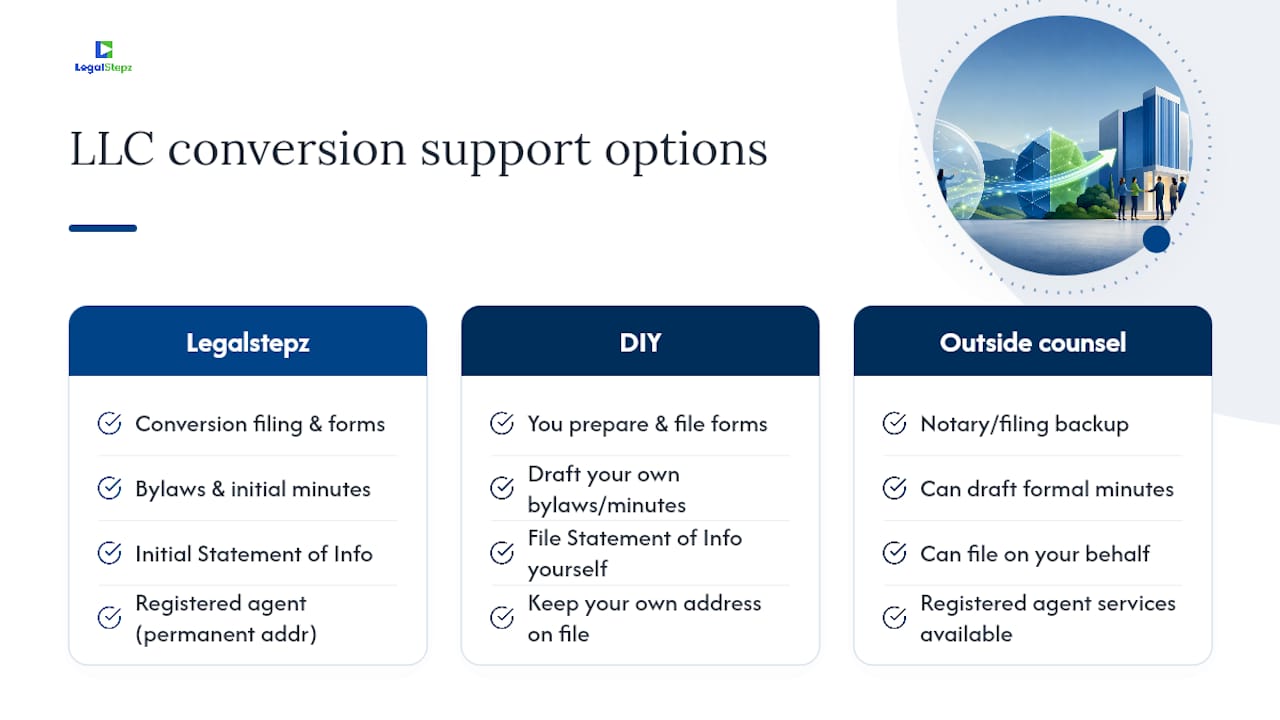
There are services that handle the paperwork side of this process: preparing and filing the Statement of Conversion package with the Secretary of State, drafting bylaws and initial board minutes, and filing the initial Statement of Information once your corporation exists. Registered agent service can keep a permanent address on file to avoid scrambling to update it later.
DIY makes sense for a simple, single-member or closely held LLC converting without outside investors. Bring in securities counsel, though, if you're issuing stock to new investors, restructuring ownership percentages, or planning a tax-sensitive S-election alongside the conversion. Legalstepz's incorporation services are built for the filing and compliance side; the tax-structuring calls still belong with your accountant.
What California LLC Owners Get Wrong About Conversion
The mistake I see most often isn't a filing error. It's owners who assume the operating agreement's default rules apply, then discover mid-process that their agreement quietly requires unanimous consent for exactly this kind of change. That single oversight has stalled more conversions than any SOS paperwork issue.
The second mistake is timing. Owners nail the legal conversion, then blow the 90-day Statement of Information deadline or skip the DFPI notice question entirely because nobody flagged it. My practical advice: loop in your accountant before you pick an effective date, not after. Coordinating the conversion date with your S-election window saves you a messy split-year filing.
— Peter
Get Help Filing Your California LLC-to-Corporation Conversion
There are other ways to handle this: hire a business attorney for the full process, or piece it together yourself using SOS forms and a lot of coffee. Both work, but both cost you either significant legal fees or hours you probably don't have as a business owner already running daily operations.
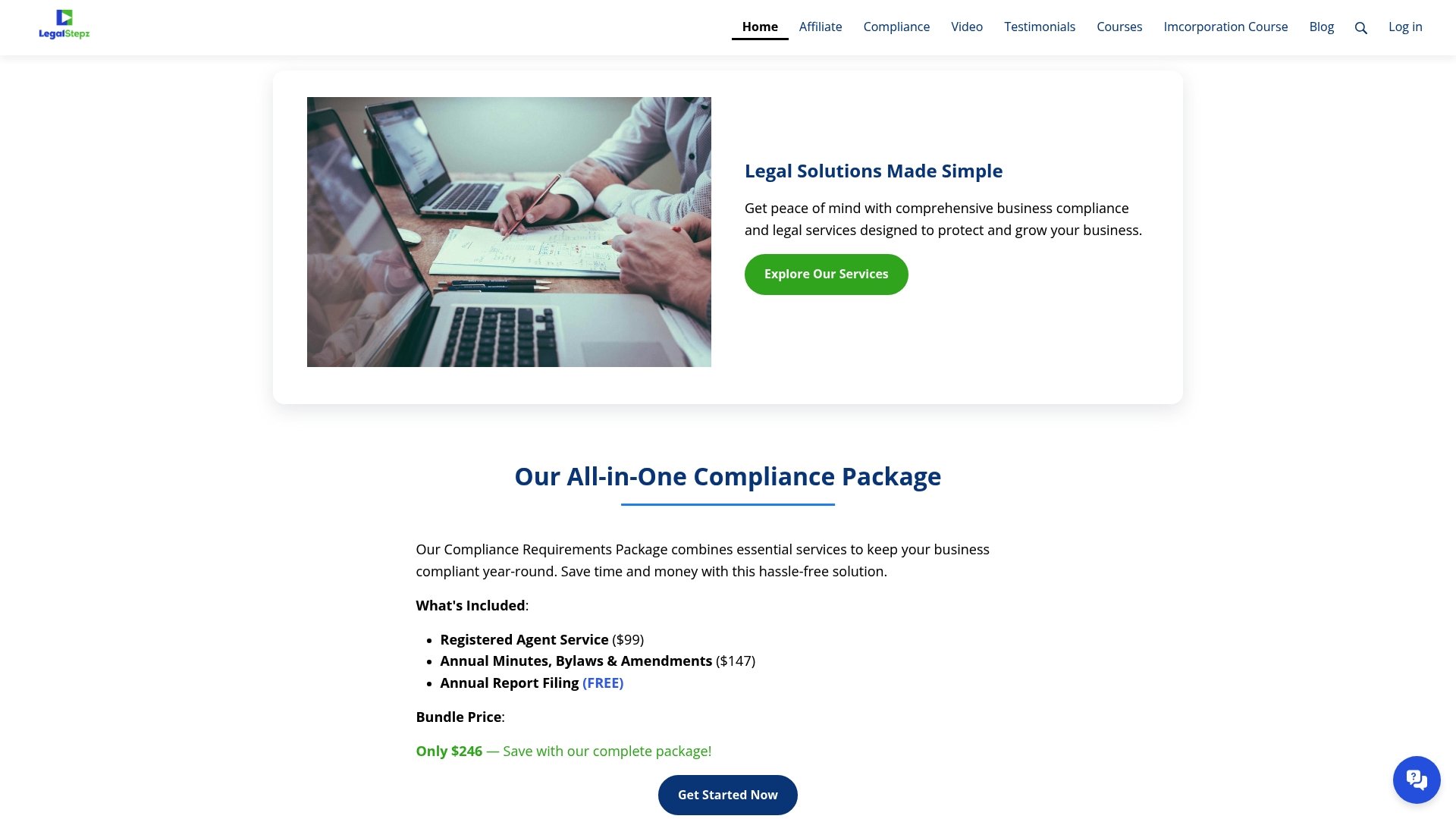
Some conversion support packages cover the filing itself, a bylaws template built for California corporations, registered agent service, and initial Statement of Information filing assistance, often combined into one bundle. Before you start, gather your current operating agreement, a list of all LLC members and their ownership percentages, and your target conversion date. Head to Legalstepz to start your filing package and get your Plan of Conversion drafted correctly the first time.
This article is general information, not a substitute for advice from a qualified lawyer. Consult a qualified legal professional about your own circumstances before acting on anything here.
Sources
- Conversion Information - California Secretary of State
- California Corporations Code §17710.03
- LLC filing as a corporation or partnership - IRS
- How to Convert an LLC to a Corporation in California - Nolo