

A corporate compliance calendar is a structured schedule that organizes every legal, tax, and regulatory deadline your California business must meet to stay compliant and avoid costly penalties. Think of it as the operational backbone of your corporation's legal health. Without one, deadlines slip, filings get missed, and the California Secretary of State or Franchise Tax Board can come knocking. This article gives you a complete corporate compliance calendar guide built specifically for California owners, covering what goes in it, how to build it, and how to keep it working year after year.
What is a corporate compliance calendar?
A corporate compliance calendar is a centralized tracking system for all recurring statutory obligations your business must fulfill, including tax filings, board meetings, and HR compliance tasks. It goes beyond a simple to-do list. Each entry carries a due date, a named owner, a backup owner, and a place to store completed evidence. The calendar covers both fixed deadlines and event-triggered ones, which is the distinction most business owners miss entirely.
Fixed deadlines repeat on a predictable schedule. Your California Statement of Information, payroll tax deposits, and annual minutes all fall here. Event-triggered deadlines activate when something happens, such as an employee termination, a data breach, or a change in registered agent. Event-triggered deadlines are often missed if not properly managed because they do not appear on a standard annual calendar. That gap is where most compliance failures start.

The calendar also needs to separate preparation deadlines from filing deadlines. Working backward from a filing deadline ensures all data gathering, review, and approval steps complete on time. A filing due on march 31 might require data collection starting march 1 and an internal review by march 20. Without those intermediate checkpoints, the final deadline becomes a scramble.
What are the essential components of a compliance calendar?
Every entry in a well-built compliance calendar needs six core fields to function properly.
- Obligation name: The specific filing, task, or notice required
- Due date: The statutory or regulatory deadline
- Preparation deadline: The internal cutoff for gathering data and completing review
- Primary owner: The person responsible for completing the task
- Backup owner: The person who takes over if the primary is unavailable
- Evidence storage: Where the completed filing, signed certification, or approval record lives
The difference between a passive list and a working compliance tool comes down to those last three fields. Shared calendar access moves compliance knowledge out of individual officers' heads and into an accessible operational system. When a CFO leaves or an HR manager changes roles, the calendar keeps the business on track.
| Deadline type | How it triggers | California examples |
|---|---|---|
| Fixed recurring | Set calendar date each year or quarter | Statement of Information, payroll tax deposits, annual minutes |
| Event-triggered | Activated by a specific business event | COBRA notice after termination, data breach notification, registered agent change |
Pro Tip: Add a "preparation start" date to every calendar entry, set at least 15 business days before the filing deadline. That buffer catches document delays before they become compliance violations.
How do you build and maintain a compliance calendar?
Building a compliance calendar starts with a full audit of every law and regulation that applies to your business. California corporations face a different set of obligations than LLCs or out-of-state entities, so the starting point matters. Pull your California corporation requirements and map every deadline you find.
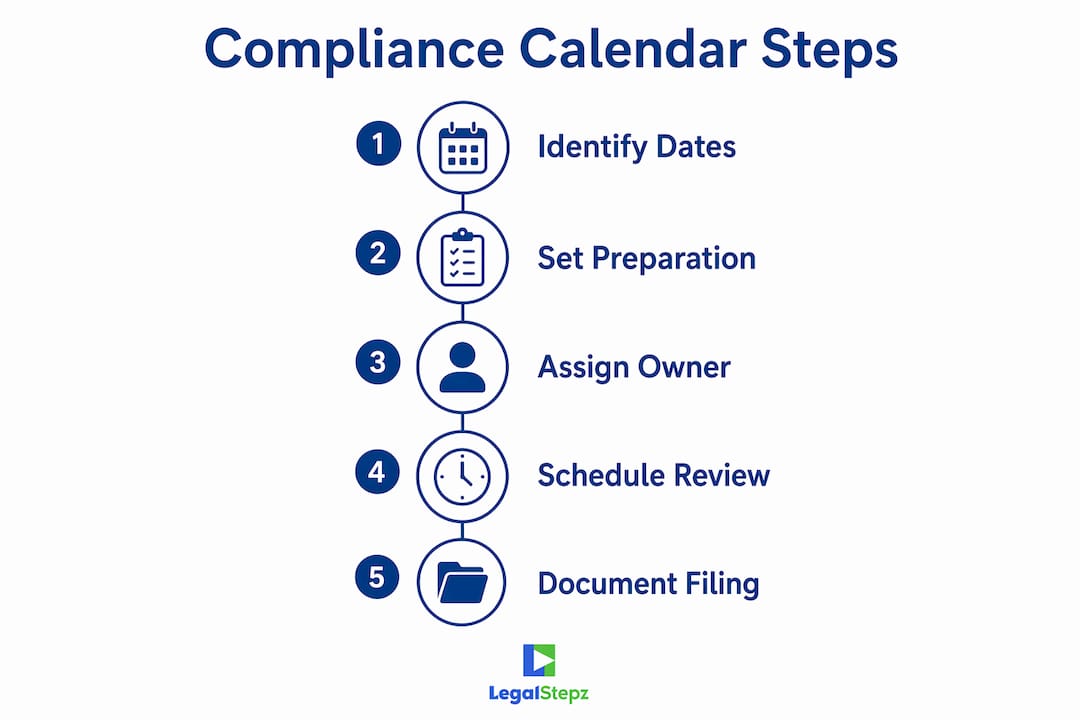
Follow these steps to build a calendar that actually works:
- List every applicable obligation. Include federal, California state, and local requirements. Cover tax, employment, corporate governance, and industry-specific rules.
- Assign a due date and preparation start date to each item. Work backward from the statutory deadline to set internal milestones.
- Name a primary owner and a backup owner for every entry. Ownership without a backup is a single point of failure.
- Centralize everything in one digital system. Spreadsheets work for small businesses. Purpose-built compliance platforms add automated reminders and approval routing.
- Set layered alerts. Send the first reminder 30 days out, a second at 14 days, and a final alert at 7 days. Escalate automatically to the backup owner if the primary does not confirm action.
- Review the calendar quarterly. Quarterly reviews improve accountability and reduce remediation costs compared to reactive tracking.
The quarterly review is the step most California business owners skip. Regulations change, new employees take on compliance roles, and event-triggered obligations appear mid-year. A calendar reviewed only in january will miss a regulatory update published in august.
Pro Tip: Assign your quarterly calendar review as a standing agenda item at your board meeting. That way it gets documented in your annual corporate minutes and creates an automatic audit trail.
What are the common pitfalls in compliance calendar management?
The most common compliance calendar failure is not a missed deadline. It is the absence of an approval workflow and attached audit evidence. Audit-ready calendars require documented approval trails and attached signed certifications for each filing. A calendar entry that says "filed" without the actual document attached is useless in an audit.
The two most common failure points in compliance management are forgotten deadlines and stalled approvals. Automating alerts and approval routing with backup owners directly addresses both problems before they become violations.
Other pitfalls California business owners regularly encounter include:
- Treating the calendar as static. A calendar built in january and never updated misses mid-year regulatory changes and event-triggered obligations.
- No backup ownership. When the primary owner is on vacation or leaves the company, tasks stall. Assigning backup owners and escalation processes prevents this.
- Separating the calendar from evidence storage. Keeping filings in a separate folder with no link to the calendar entry creates gaps during audits.
- Ignoring event-triggered deadlines. Many compliance gaps occur with event-triggered obligations that require monitoring from the moment an event happens, not just fixed calendar dates.
The fix for most of these problems is the same: attach completed documents directly to each calendar entry the moment a task finishes. Link your business records to the calendar entry, not to a separate filing system. That single habit closes the most common audit gap.
Key California compliance deadlines every business owner must track
California corporations carry a specific set of recurring obligations that must appear in every compliance calendar. Missing any of these triggers penalties, late fees, or suspension of corporate status.
| Obligation | Typical due date | Responsible party |
|---|---|---|
| Statement of Information (biennial) | Every 2 years, by anniversary month | Corporate officer or registered agent |
| Franchise Tax Board minimum tax | April 15 (calendar year) | CFO or accountant |
| Payroll tax deposits (state) | Monthly or quarterly, per schedule | Payroll manager |
| Unemployment insurance filing (DE 9) | Quarterly | HR or payroll manager |
| Workers' compensation notice | Annual posting requirement | HR manager |
| Sexual harassment prevention training | Every 2 years (supervisors), every 2 years (non-supervisors) | HR manager |
| Annual corporate minutes | Within 12 months of prior meeting | Corporate secretary |
| Sales and use tax return | Quarterly or monthly, per permit | Accountant |
California corporations must file a biennial Statement of Information with the Secretary of State. Missing this filing can result in suspension of corporate status, which voids contracts and blocks the ability to defend lawsuits. That consequence alone justifies building the entire calendar around this one deadline.
Employment law compliance adds a second layer of California-specific obligations. Mandatory sexual harassment prevention training, wage notice requirements, and workers' compensation postings all carry their own deadlines. These are not optional. California's Labor Commissioner actively enforces them.
Fiscal year documentation ties the calendar together at year end. Every tax filing, board resolution, and signed certification from the fiscal year should be assembled and stored before the calendar rolls to the next cycle. That practice turns your compliance calendar into a complete historical record, not just a forward-looking schedule.
Key Takeaways
A corporate compliance calendar is the single most effective tool for preventing penalties, audit failures, and corporate suspension in California.
| Point | Details |
|---|---|
| Separate deadline types | Track fixed recurring deadlines and event-triggered deadlines with different reminder rules for each. |
| Attach evidence immediately | Link signed filings and approval records to each calendar entry the moment a task completes. |
| Assign backup owners | Every compliance task needs a primary and a backup owner to prevent stalled approvals. |
| Review quarterly | Update the calendar every quarter to catch regulatory changes and new event-triggered obligations. |
| California filings are non-negotiable | Missing the biennial Statement of Information or payroll tax deposits can suspend your corporate status. |
Why most compliance calendars fail before they start
Most California business owners build a compliance calendar once and never touch it again. That is the core mistake. A compliance calendar that is reviewed regularly becomes a living operational tool rather than a static document. The ones that collect dust are the ones that fail audits.
What I have seen repeatedly is that the calendar itself is rarely the problem. The problem is that no one owns the calendar as a system. Individual tasks have owners, but the calendar as a whole belongs to no one. When that happens, quarterly reviews get skipped, new regulations never get added, and event-triggered deadlines fall through the cracks entirely.
The fix is simple but requires discipline. Assign one person as the calendar owner, separate from the people who own individual tasks. That person runs the quarterly review, adds new obligations as they arise, and confirms that evidence is attached after every filing. This role does not require a compliance officer title. It requires consistency.
Transparent, shared access is the other piece most businesses underestimate. When the compliance calendar lives in one person's inbox, the business is one resignation away from a compliance gap. Moving it into a shared system that every relevant team member can see distributes the risk and creates accountability without adding bureaucracy.
— Peter
How Legalstepz helps California businesses stay compliant
Building and maintaining a compliance calendar takes time, and the California-specific requirements add real complexity.
Legalstepz helps California corporations manage the filings and documentation that belong in every compliance calendar. From filing your Statement of Information to drafting annual minutes, maintaining bylaws, and providing registered agent services, Legalstepz covers the recurring obligations that carry the highest risk if missed. California business owners use Legalstepz to centralize their compliance tasks, assign clear ownership, and keep audit-ready records without building a compliance department from scratch.
FAQ
What is a compliance calendar used for?
A compliance calendar tracks every legal, tax, and regulatory deadline a business must meet to avoid penalties and maintain good standing. It assigns ownership and stores evidence for each completed obligation.
How often should a compliance calendar be reviewed?
Businesses should review their compliance calendar at least quarterly. Quarterly reviews catch regulatory changes, new event-triggered obligations, and ownership gaps before they become violations.
What California filings must appear in a compliance calendar?
California corporations must track the biennial Statement of Information, Franchise Tax Board minimum tax, payroll tax deposits, unemployment insurance filings, and mandatory employment training deadlines.
What is the difference between fixed and event-triggered deadlines?
Fixed deadlines repeat on a set schedule, such as annual tax filings. Event-triggered deadlines activate when a specific event occurs, such as an employee termination or a data breach, and require dynamic monitoring rules.
What makes a compliance calendar audit-ready?
An audit-ready compliance calendar attaches signed certifications, approval trails, and completed filings directly to each calendar entry immediately after the task finishes. A deadline entry alone is not sufficient evidence.