

A corporate minutes template covering initial meetings, annual meetings, board sessions, shareholder actions, and written consents is available from certain providers. California Corporations Code §1500 requires every corporation to keep written minutes as part of its permanent books and records, but these are internal documents, not something filed with the state.
TL;DR:
- Proper minutes must be drafted promptly after meetings, with clear vote counts and signed and dated for validity and future enforcement.
- In the first organizational meeting, founders should document bylaws adoption, officer appointments, share issuance, filing responsibilities, and bank authorizations.
- Minutes are internal records that courts and the IRS scrutinize during disputes or audits, making sloppy documentation a significant risk.
- Written consents are valid for unanimous approval, especially for single-shareholder corporations, but must be signed, fully describing the action, and stored properly.
- California law mandates recordkeeping for corporations but not for LLCs or partnerships, which rely more on internal agreements and documented approvals.
Table of Contents
- What's In the Corporate Minutes Template for California
- What Are Corporate Minutes, Exactly?
- Why Does California Law Require Corporate Minutes?
- How Do You Write Minutes That Hold Up?
- What Belongs in Your Initial Board Meeting Minutes?
- When Can You Use Written Consents Instead of a Meeting?
- What Mistakes Undermine Your Minutes, and How Do You Spot a Scam?
- How Long Should You Keep Minutes, and Who Can Inspect Them?
- How Legalstepz Helps You Keep Minutes Compliant
- How Are LLC and Partnership Recordkeeping Rules Different?
- What Happens If You Don't Keep Proper Minutes?
- A Practitioner's Take on Where Minute-Keeping Actually Breaks Down
- Get Your Minutes Drafted and Filed Without the Guesswork
- Where These Rules Actually Come From
- Sources
What's In the Corporate Minutes Template for California
The template comes as an editable Word document and a locked PDF version, so you can draft in one and export a clean, signature-ready copy in the other. Word lets you track changes and drop in your own logo or letterhead; the PDF is what you'll want in the permanent minute book once everyone has signed off.
Every version follows the same skeleton, built around the structure attorneys typically use for a board meeting minutes model form, just adapted for plain-English use by founders who aren't drafting legal documents for a living. That skeleton includes:
- Header block: corporation name, meeting type, date, time, and location or video platform used.
- Attendance and quorum: who was present, who was absent, and a one-line quorum confirmation.
- Agenda items: numbered, in the order discussed, matching whatever agenda was circulated beforehand.
- Motions and resolutions: the exact language of each motion, who made it, who seconded it, and the vote count.
- Signature block: space for the secretary (and often the chair) to sign and date.
- Exhibit references: a line noting any attached documents, such as a stock certificate specimen or a written consent.
Four variants ship inside the download. The initial organizational meeting version front-loads bylaw adoption, officer appointments, and stock issuance. The annual meeting version assumes a recurring format for electing directors. The shareholder consent version replaces the meeting narrative with consent language for actions taken without a formal gathering. The single-shareholder version strips out multi-party voting mechanics since one person is both attendee and decision-maker.
Before you send any version to the minute book, run through a short customization pass: swap in the actual corporate name everywhere (a surprisingly common miss is leaving a placeholder name in one exhibit reference), confirm every date matches your actual meeting calendar, and attach exhibits in the order they're cited in the text, not the order you happen to have them saved.
What Are Corporate Minutes, Exactly?
Corporate minutes are the official written record of what happened at a shareholder or board meeting, approved by the body that met and stored permanently in the corporation's books and records. They are not the same thing as meeting notes, resolutions, or written consents, though people use these terms loosely and interchangeably.
Meeting notes are whatever a secretary jots down in real time. They're a drafting aid, not a legal record. Minutes are the polished, approved version of those notes, written in the past tense as an account of decisions made. A resolution is the specific formal language of a decision (say, authorizing a bank account), while minutes are the broader document that records the meeting where that resolution was adopted. A written consent is a substitute for a meeting entirely, used when directors or shareholders agree to act without convening.
- Minutes are drafted by the secretary, reviewed by attendees, and typically approved at the next meeting or by written sign-off.
- They belong in the corporate minute book, alongside bylaws, stock ledgers, and the Statement of Information filing history.
- Once approved, they become the corporation's official version of events, which matters enormously if a dispute or audit ever revisits what the board actually decided.
Why Does California Law Require Corporate Minutes?
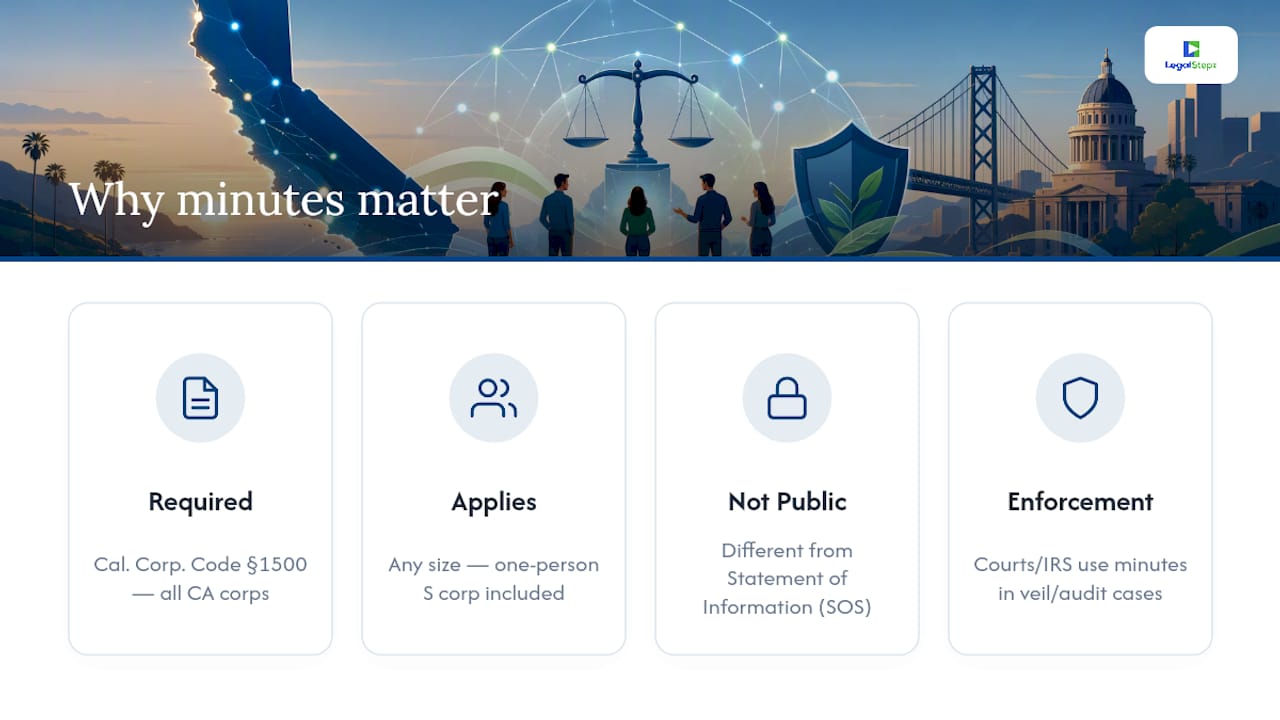
California Corporations Code §1500 requires corporations to maintain "adequate and correct books and records of account" and written minutes of shareholder, board, and committee proceedings. This applies to every California corporation, regardless of size, revenue, or how many shareholders are on the cap table. A one-person S corporation is just as obligated as a 200-employee company.
Every California corporation is legally required to maintain written minutes under Cal. Corp. Code §1500, regardless of size, and courts routinely examine these records when a corporation's liability shield is challenged.
This is different from the Statement of Information, which is a public filing with the California Secretary of State listing officers, directors, and the registered agent. Minutes stay internal. Confusing the two is where a lot of founders trip up, and it's also the seam that deceptive mail solicitations exploit.
Shareholders also have inspection rights over corporate records, including minutes, for any purpose reasonably tied to their interest in the company under Cal. Corp. Code §1601. If a minority shareholder ever asks to see the minute book, you need an actual minute book to show them.
Beyond the statute, minutes matter practically. Courts and the IRS both look at minute-keeping when deciding whether a corporation was truly run as a separate legal entity. Sloppy or missing minutes are a factor courts weigh when a plaintiff argues for piercing the corporate veil, and they're a red flag in an audit when the IRS questions whether a distribution or expense was properly authorized.
How Do You Write Minutes That Hold Up?
Start with the mechanical basics before touching substance. Open every set of minutes with the date, time, method (in person, by phone, or by video), and who presided and who kept the record. A sample opening line looks like this: "The annual meeting of the board of directors of [Corporation Name] was held on March 4, 2026, at 10:00 AM via video conference, with [Name] presiding and [Name] acting as secretary."
- Confirm and record quorum. State it plainly: "The secretary confirmed that a quorum of the board was present." Under Corp. Code §307, quorum rules and remote-participation allowances are spelled out in detail, and your bylaws set the actual threshold.
- Note notice or waiver. If notice was properly given, or everyone signed a waiver, say so in one line. This matters more than most first-time drafters realize.
- Record each motion exactly. Quote the motion's language, name who made it and who seconded it, then give the vote count: "Motion carried, 4 in favor, 1 opposed, 0 abstaining." If a director dissents, name them and note the dissent; if they ask for a written statement of dissent attached to the record, do that too.
- Attach exhibits as you go. Any document referenced (a term sheet, a resolution exhibit, a stock certificate specimen) gets cited by name in the text and physically attached to the file.
- Close with adjournment and approval. State the time of adjournment, then leave a line for approval at the next meeting: "These minutes were approved by the board on [date]."
Pro Tip: Draft minutes within 48 hours of the meeting while details are fresh, then circulate them for approval before the next scheduled meeting. Waiting weeks to write minutes from memory is how vote counts get fuzzy and dissents get forgotten.
The approval workflow matters as much as the drafting. Minutes are usually approved at the start of the following meeting, with a formal motion: "Motion to approve the minutes of the March 4, 2026 meeting as presented, or as corrected." Once approved, they go into the permanent minute book. If your board doesn't meet again for a year, consider circulating minutes for written sign-off instead of letting them sit unapproved.
What Belongs in Your Initial Board Meeting Minutes?
The inaugural meeting is where founders most often shortchange the paperwork, and attorneys who handle governance cleanup consistently flag the same pattern: companies that skip proper documentation of their first board meeting spend far more fixing it later than they would have spent doing it right the first time.
Your first set of minutes needs to cover five specific actions:
- Adopt the bylaws and record the resolution approving them, with the bylaws attached as an exhibit.
- Appoint officers (president, secretary, treasurer, and any others) and record the vote or unanimous consent confirming each appointment and term.
- Authorize share issuance, including how many shares, to whom, at what price, and what the stock certificates will look like.
- Decide to file the Initial Statement of Information within 90 days of formation, and record who's responsible for it, along with the registered agent and principal office address that will appear on that filing.
- Authorize a bank account and delegate signing authority, naming exactly who can open and operate it.
Miss any one of these and you're left retroactively documenting decisions that should have been contemporaneous, which is a much weaker legal position if anyone ever questions when and how the company actually took these actions.
When Can You Use Written Consents Instead of a Meeting?
California law lets boards and shareholders act by unanimous written consent instead of holding a formal meeting, under Corp. Code §307 for directors and §603 for shareholders. This is especially useful for single-shareholder corporations, where convening a "meeting" of one person is a formality nobody needs.
- A valid consent must state the action being approved in full, be signed and dated by every director or shareholder entitled to vote, and be kept with the minute book exactly as if it were minutes.
- For a single-shareholder company, the consent can be short: "The undersigned, being the sole shareholder of [Corporation Name], hereby consents to and approves the following resolutions..." followed by the resolution text and a signature line.
- Keep the countersigned original (or a clean scanned copy) attached to the minute book, not floating in an email thread.
- If a consent isn't unanimous for actions where the law allows less than full consent, non-signing shareholders generally must receive prompt notice of the action taken.
What Mistakes Undermine Your Minutes, and How Do You Spot a Scam?
The same handful of errors show up again and again in minute books that get scrutinized during an audit or a dispute.
- Vague motion language. "Motion to approve the budget" tells a future reader nothing; quote the actual figures and terms approved.
- Missing vote counts. "Motion carried" without a tally leaves no record of who actually voted which way.
- Unsigned minutes. A draft sitting in a folder with no signature is not a legal record; it's a memo.
- Consents not attached. If a decision was made by written consent, the signed consent itself needs to be in the minute book, not just referenced.
Pro Tip: If you receive an official-looking notice demanding a fee to "file" your annual minutes, that's almost certainly a deceptive solicitation, not a real state requirement. Minutes are internal records; California doesn't collect them. Check any suspicious notice against the actual Secretary of State filing requirements before paying anyone.
These notices often mimic government letterhead and reference real statutory language to look legitimate, which is exactly why they work on busy founders who don't have time to check.
How Long Should You Keep Minutes, and Who Can Inspect Them?
Minutes can be stored on paper, scanned as PDFs, or kept in cloud storage. California law only requires that electronic records be convertible into a clearly legible tangible form on demand, per §1500. A shared drive works fine as long as you can print a clean copy when someone asks.
On retention, the practical answer is indefinitely. Corporate minutes document the entire history of governance decisions, so there's no natural expiration date. If storage space is genuinely a concern, keep records tied to stock issuance, major contracts, or tax positions for at least 6 to 7 years, aligning with IRS recordkeeping guidance on audit lookback periods.
Shareholders have a statutory right to inspect the minute book for any purpose reasonably related to their interest as a shareholder. A reasonable process means making records available at the principal office during business hours or providing copies within a reasonable timeframe, not stonewalling the request.
How Legalstepz Helps You Keep Minutes Compliant
Some services work specifically with California corporations on paperwork to help keep a company in good standing, such as drafting annual minutes, filing the Statement of Information, and providing registered agent services to help ensure notices are properly received.
- Templates and drafting support built around California's specific statutory requirements, not a generic multi-state form.
- Guidance on why annual minutes matter for small corporations that don't have in-house counsel.
- A breakdown of bylaws versus minutes for officers who aren't sure which document governs which decision.
If your governance question involves a genuine dispute among shareholders or directors, or a decision with real tax consequences (like how a stock issuance affects shareholder basis), that's the point to bring in an attorney or tax professional rather than relying on a template alone.
How Are LLC and Partnership Recordkeeping Rules Different?
California corporations face a specific statutory minute-keeping requirement that LLCs and partnerships simply don't have. Corp. Code §1500 names shareholders, directors, and committees explicitly; there's no equivalent section in the California Revised Uniform Limited Liability Company Act mandating written minutes for every LLC meeting.
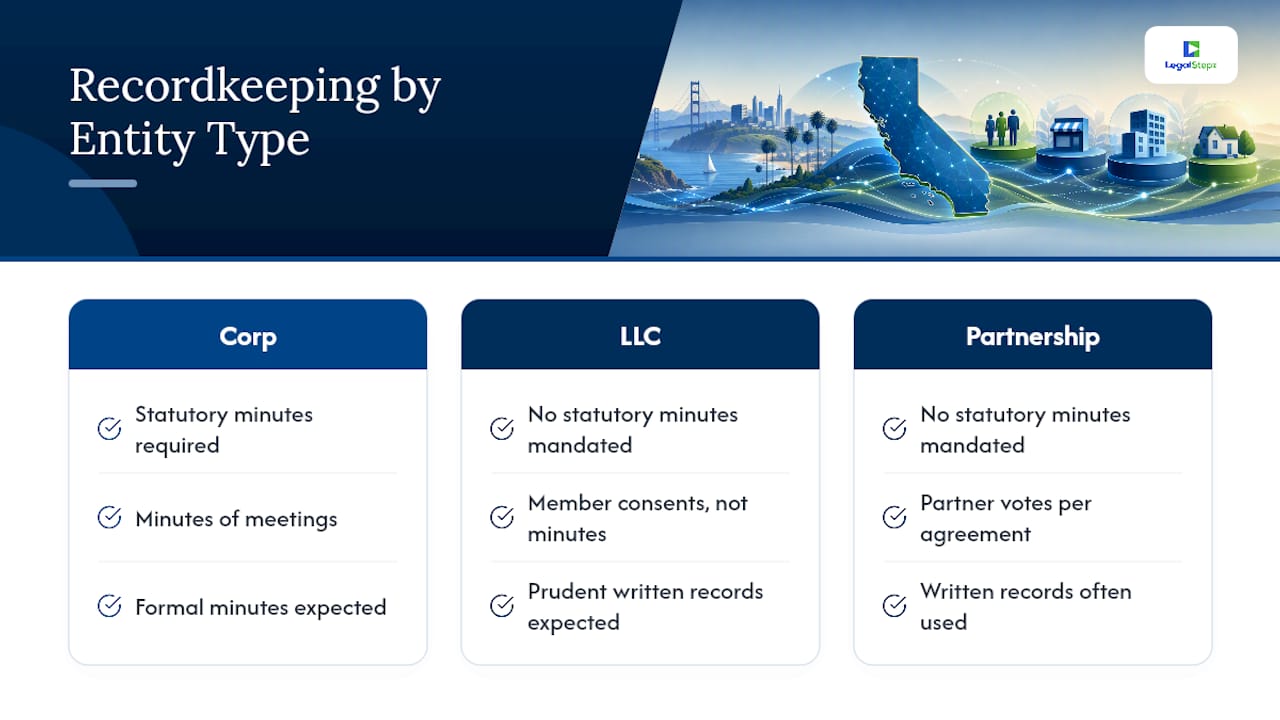
That doesn't mean LLCs and partnerships can skip documentation entirely. A multi-member LLC's operating agreement often requires member approval for major decisions, and prudent LLCs keep written records of those approvals anyway, usually in the form of member consents rather than formal "minutes." Partnerships work similarly: a partnership agreement might call for documented partner votes on major actions, but state law doesn't impose the same books-and-records mandate that applies to corporations.
This distinction matters most for single-member LLC owners who assume they're off the hook for any documentation. Governance formality is lower for LLCs by statute, but lenders, investors, and the IRS still expect to see a paper trail for major decisions like admitting a new member, taking on debt, or distributing profits disproportionately to ownership percentages.
If you've formed both a corporation and an LLC (a common structure for real estate holdings, for instance), don't assume the LLC needs the same minute-keeping rigor as the corporation. It needs its own documentation discipline, just under a different, generally lighter statutory framework.
What Happens If You Don't Keep Proper Minutes?
The immediate consequence is rarely dramatic. No agency shows up demanding to see your minute book on a random Tuesday. The risk surfaces later, usually at the worst possible moment: during litigation, an IRS audit, a due diligence process before a sale or funding round, or a dispute among shareholders.
Courts weigh sloppy or absent minutes as a factor when a plaintiff argues for piercing the corporate veil, meaning a shareholder's personal assets could become exposed to satisfy a business debt or judgment. Minutes alone won't save a corporation that's genuinely being run as someone's personal checkbook, but a complete minute book is real evidence that the company observed corporate formalities.
During an IRS audit, missing minutes complicate defending decisions like officer compensation, distributions, or loans between the company and shareholders. Auditors look for contemporaneous documentation showing that a decision was properly authorized, not reconstructed after the fact once a return gets flagged. Due diligence teams during a fundraise or acquisition ask for the minute book early, and gaps slow deals down or trigger price adjustments while buyers assess governance risk.
None of this is exotic. Most of it is preventable with a consistent habit of drafting, approving, and filing minutes after every meeting.
A Practitioner's Take on Where Minute-Keeping Actually Breaks Down
The mistakes that cause real problems aren't exotic. They're almost always the same three things: nobody writes minutes until months after a meeting happened, vote counts get summarized as "approved" with no tally, and initial organizational minutes get skipped entirely because the founders were focused on launching the product, not the paperwork.
One pattern shows up constantly: a founder authorizes a stock issuance verbally in a hallway conversation, tells the accountant it's "handled," and eighteen months later can't produce a single document proving the board actually approved it. A properly dated written consent, signed the same week, would have closed that gap permanently and taken ten minutes to draft.
If you take one thing from this guide, make it this: minutes that are signed and dated close to the meeting date, with actual vote counts recorded, will hold up. Minutes reconstructed from memory six months later, no matter how well-written, invite exactly the scrutiny you're trying to avoid.
— Peter
Get Your Minutes Drafted and Filed Without the Guesswork
Legalstepz is the practical alternative to hiring outside counsel for routine California compliance work. Instead of paying attorney rates to draft annual minutes or track a 90-day filing deadline, you get California-specific templates, drafting support, and registered agent service built around exactly the statutory requirements covered above.

The process generally involves specifying the type of meeting to be documented (initial organizational, annual, or shareholder consent), and receiving minutes that align with California's statutory requirements, ready for signing and filing. Registered agent services help ensure official notices are properly received, and that Statement of Information filings are managed on schedule.
If you're setting up a new corporation or catching up on a minute book that's fallen behind, start at the Legalstepz landing page and describe your situation. Most drafting requests move quickly once you provide basic meeting details: date, attendees, and the decisions that need to be documented.
Where These Rules Actually Come From
For verification, the core statutory requirements live directly in California law and Secretary of State guidance, not in third-party summaries.
- Corp. Code §307: board meeting and consent mechanics.
- Practical Law model board minutes: a structural reference for standard formatting.
This article is general information, not a substitute for advice from a qualified lawyer. Consult a qualified legal professional about your own circumstances before acting on anything here.