

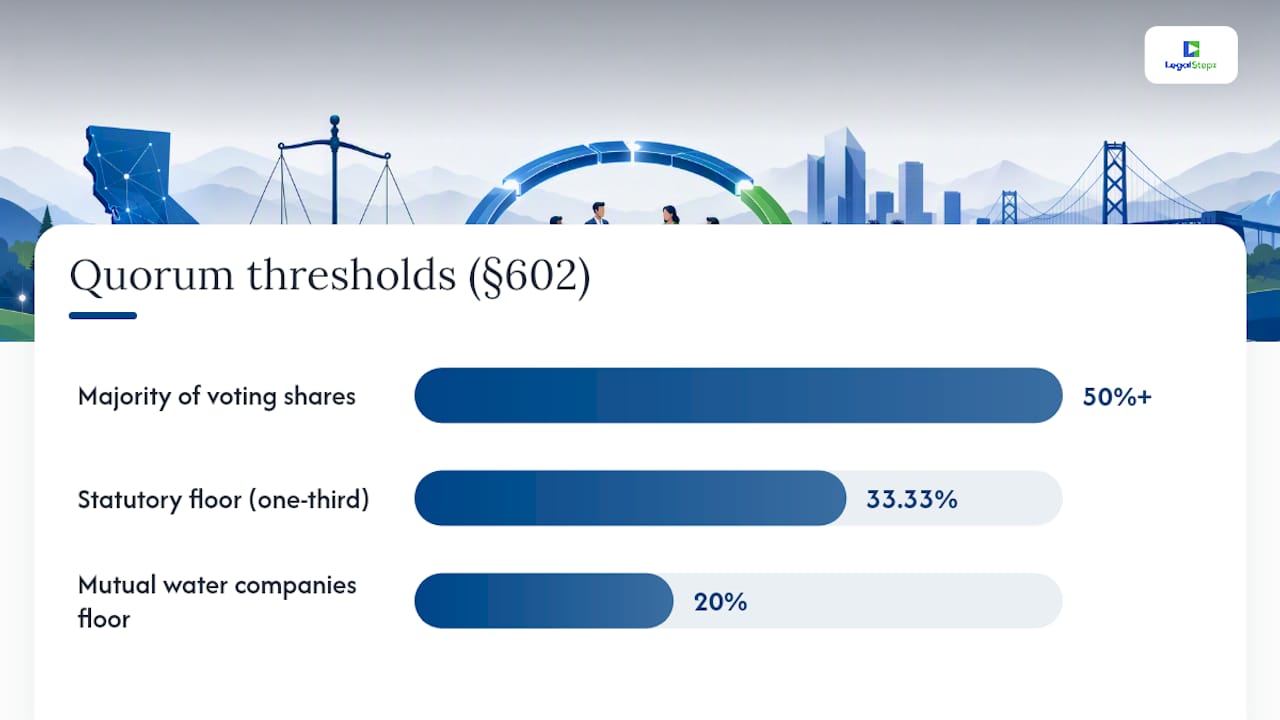
Board quorum in a California corporation is a majority of the authorized number of directors, subject to a statutory minimum that cannot be set below one-third of the authorized number or two directors, whichever is larger, under Corp. Code §307. Shareholder quorum is generally a majority of shares entitled to vote, with a statutory floor no less than one-third of those shares, or 20% specifically for mutual water companies, under Corp. Code §602. Pull your bylaws today, recalculate quorum against your authorized director count, and make sure your last set of minutes actually documents who was counted and how.
TL;DR:
- Quorum for the board requires a majority of the authorized directors, with a statutory minimum of one-third or two, whichever is larger, regardless of vacancies.
- Shareholder quorum is typically one-third of entitled shares, but proxies count, and some companies may have higher requirements specified in articles of incorporation.
- If a meeting opens without quorum, additional actions are limited to adjourning, and substantive decisions cannot be made until quorum is restored in a properly reconvened meeting.
- Maintaining accurate minutes and updating bylaws to reflect current director numbers helps prevent procedural failures and legal disputes.
- Using written consent or remote attendance can serve as alternatives to physical meetings, but they must be properly authorized and documented to ensure validity.
Table of Contents
- Board Meeting Quorum Requirements in California
- Shareholder Quorum: The Majority Rule and What Counts as Presence
- No Quorum? Here's What You Can and Can't Do
- Written Consent and Remote Attendance as Quorum Alternatives
- Documenting Quorum in Your Minutes the Right Way
- Where California Corporations Actually Go Wrong
- Keep Your Bylaws and Minutes Quorum Ready
- Key Statutory and Client Resources
- Sources
- FAQ
Board Meeting Quorum Requirements in California
The rule sounds simple until a board has vacancies. Corp. Code §307 sets quorum at a majority of the authorized number of directors, not the number currently sitting. Bylaws can adjust that number down, but never below one-third of the authorized directors or two, whichever is larger, and never below one if the corporation authorizes only a single director.
Here's where boards trip up: say your bylaws authorize several director seats, but only some are filled because others resigned. Quorum is still calculated off the authorized number, so you need a majority of that number present, not just a majority of those currently serving. That gap between authorized seats and filled seats is a common quorum miscalculation seen in California corporate filings.
A few other pitfalls show up repeatedly:
- Assuming a "majority of current members" satisfies quorum when the authorized number is higher.
- Running meetings off bylaws that were never updated after a board expansion or contraction.
- Failing to check whether the articles of incorporation, not just the bylaws, set a different authorized number.
Pro Tip: Before every board meeting, recheck your authorized director count against your bylaws, not your memory of who's currently serving. A five-minute check avoids a meeting that gets challenged later.
If vacancies are chronically blocking quorum, either fill the seats, amend the bylaws within the statutory floor, or shift urgent decisions to written consent instead of forcing a meeting that can't legally convene.
Shareholder Quorum: The Majority Rule and What Counts as Presence
Shareholder quorum defaults to a majority of shares entitled to vote, represented in person or by proxy, and Corp. Code §602 sets the statutory floor at one-third of those shares (20% specifically for mutual water companies). Articles of incorporation can raise that floor for specific corporate actions, but they can't push it below the statutory minimum.
Proxies count the same as physical attendance for quorum purposes. A shareholder who can't attend but submits a valid proxy still gets counted toward the threshold, and their shares vote according to the proxy's instructions. This matters most for closely held corporations where one or two absent shareholders can otherwise sink a meeting.
A few things to verify before you call a shareholder meeting:
- The record date used to determine who's entitled to vote and receive notice.
- Whether any share class carries a separate voting requirement or higher quorum threshold under the articles.
- Whether proxy forms and voting materials went out with proper advance notice.
Mutual water companies aside, most California corporations run on the standard one-third floor. If your articles impose a class vote for a merger, dissolution, or amendment, that class needs its own quorum calculation, independent of the general shareholder count. Legalstepz's breakdown of the §602 rule walks through record-date mechanics in more detail.
No Quorum? Here's What You Can and Can't Do
A meeting that opens without quorum isn't dead, it's just limited. A majority of those actually present, even without quorum, can vote to adjourn to a later date. What they cannot do is transact any substantive business, approve a resolution, or ratify a prior action. There's no shortcut around this.
Once adjourned, follow this sequence:
- Record in the minutes exactly who was present, that quorum was absent, and the vote to adjourn.
- If the new meeting is set more than 24 hours later, send notice of the new time and place to every director or shareholder who wasn't present at the adjournment, per the notice rule under §307.
- Hold the reconvened meeting and confirm quorum is met before reopening any agenda item.
- Never attempt to "ratify" business informally discussed during the quorum-less session. It has no legal weight and can be challenged later.
Pro Tip: File the adjournment notice the same day you decide the new meeting date. Directors who claim they never got proper notice are the most common basis for challenging a reconvened meeting's validity.
Written Consent and Remote Attendance as Quorum Alternatives
You don't always need a live meeting to act. California law allows action by written consent instead of a meeting: board consent generally requires all directors to sign, while shareholder consent requires holders with at least the minimum votes needed for that specific action. That's a high bar for boards, so written consent works best for urgent or uncontroversial decisions rather than contested ones.
Remote participation is the other lever. Directors or shareholders joining by phone or video count as present for quorum purposes when the board has authorized electronic participation and adopted procedures for it in advance.
To use either option cleanly:
- Adopt a board resolution or bylaws provision authorizing remote attendance before you need it, not during a crisis.
- Collect signed written consents and file them with your corporate records the same day they're obtained.
- Flag and disclose any interested-director situations before a consent vote, since interested-party actions carry extra scrutiny.
Documenting Quorum in Your Minutes the Right Way
Minutes are your evidence. Actions taken at a meeting where quorum was present are valid corporate acts, but only if your records actually show quorum existed and how it was calculated, a point that becomes decisive if a shareholder or director later disputes a vote.
Every set of minutes should capture:
- The authorized director or share count used to calculate quorum that day.
- Names of everyone present, plus proxy holders and the shares they represented.
- The method of any remote participation and confirmation it was properly authorized.
- The actual vote tally on each item, not just "approved."
Statistic Callout: Corp. Code §307 makes clear that board actions are only valid when approved by directors at a meeting where quorum was actually present, which is why sloppy quorum notes in minutes are one of the most litigated governance issues in closely held corporations.
File written consents alongside your minute book, and keep both indefinitely rather than on a rolling deletion schedule. Legalstepz's annual minutes drafting guide and corporate minutes template give directors a starting structure instead of building one from scratch every year.
Where California Corporations Actually Go Wrong
Most quorum problems seen aren't complicated legal disputes. They're small, avoidable gaps: bylaws nobody's updated since incorporation, a board that never filled a vacant seat, or a notice that went out a day late. None of these require a lawsuit to fix. They require someone actually reading the bylaws before scheduling the next meeting.
The fastest fix is usually the boring one. Amend the bylaws to match your real operating structure, within the statutory floors. Use written consent for routine items so meetings aren't the only path to action. Send notices and proxy materials on a set schedule instead of scrambling the week before. Escalate to counsel or a compliance service when a vote is contested, a class-voting question comes up, or you're not sure whether an interested director needs to be disclosed. Most quorum failures are procedural, not legal, and procedural problems are the ones you can actually prevent.
— Peter
Keep Your Bylaws and Minutes Quorum Ready
Reviewing bylaws for outdated director counts, drafting minutes that hold up if challenged, and filing your Statement of Information on time all take real hours most directors don't have. There are practical alternatives to hiring outside counsel for routine governance work, which package the actual filings and drafting directors need to stay quorum compliant, without the retainer.

Some services file California Statement of Information, draft annual corporate minutes and bylaws with quorum language correct, and provide registered agent service so notices don't fall through the cracks. If your bylaws still reference an old director count or your last set of minutes doesn't show how quorum was calculated, that's worth fixing before your next meeting, not after a dispute. Start by reviewing a compliance package built for California corporations.
Key Statutory and Client Resources
- California Corporations Code §307 — board quorum statute
- California Corporations Code §602 — shareholder quorum statute
- California Bylaws Requirements: What Every Founder Must Know
- Shareholder Engagement Checklist for Governance
This article is general information, not a substitute for advice from a qualified lawyer. Consult a qualified legal professional about your own circumstances before acting on anything here.
Sources
FAQ
What Is the Minimum Board Quorum in California?
A majority of the authorized number of directors, with a statutory floor of one-third of that number or two, whichever is larger, under Corp. Code §307.
Does a Vacant Board Seat Lower Quorum?
No. Quorum is calculated using the authorized number of director seats, not the number currently filled, so vacancies can make quorum harder to reach rather than easier.
Can Shareholders Vote by Proxy for Quorum Purposes?
Yes. Shares represented by a valid proxy count toward the quorum threshold the same as shares represented in person, under Corp. Code §602.
What Happens if a Meeting Lacks Quorum?
A majority of those present may adjourn the meeting, but no substantive business can be transacted, and notice of a rescheduled meeting more than 24 hours later must go to absent directors or shareholders.
Can a service help fix outdated bylaws?
Yes. Some services draft updated bylaws and annual minutes for California corporations so quorum language matches the current authorized director count and statutory requirements.