

Every California corporation must keep adequate and correct books of account, meeting minutes, and a shareholder record at its principal office, and a single organized minute book (physical or electronic) satisfies that legal duty. This is the corporate records book most owners refer to, and it also happens to be the fastest, cheapest defense you'll ever build against a lawsuit or a suspended charter.
Before you do anything else, get these into one place:
- Articles of Incorporation, bylaws, and stock ledger (the foundational trio)
- Meeting minutes and resolutions, signed and dated
- Officer and director list, updated as people change roles
Once assembled, schedule a review at least once a year, timed to your Statement of Information deadline.
Key Takeaways
A compliant California corporate records book requires the documents named in Corp. Code §1500, an annual review tied to your Statement of Information deadline, and a storage method that produces clearly legible paper on request.
| Point | Details |
|---|---|
| Core legal duty | Corp. Code §1500 requires adequate books, minutes, and a shareholder record at your principal office. |
| Inspection rights | Under Corp. Code §1601, shareholders can inspect and copy records during reasonable business hours. |
| Filing deadline | File your Statement of Information (SI-550) through bizfileOnline.sos.ca.gov to avoid suspension. |
| Documentation habit | Sign and date minutes immediately, and document owner loans to avoid veil-piercing risk. |
| Where to get one | Legalstepz's Corporate Record Book & Compliance Package bundles the record book with filing and minutes support. |
Table of Contents
- What Documents Belong in a California Corporate Records Book?
- What Does California Law Require for Corporate Recordkeeping?
- How Do You Build and Maintain a Compliant Record Book?
- Where Can You Get a Corporate Record Book in California?
- What Mistakes Sink California Corporate Records?
- Where Do These Rules Actually Come From?
- How Legalstepz Simplifies California Record Compliance
- Sources
What Documents Belong in a California Corporate Records Book?
The Articles of Incorporation (or Certificate of Incorporation) and bylaws go first. They're the constitutional documents everything else refers back to. Behind them, keep your initial officer and director list, then minutes from your organizational meeting and every annual meeting since.
From there, the checklist gets more specific:
- Resolutions documenting major decisions (loans, officer appointments, stock issuances)
- Stock ledger tracking every share issued, transferred, or canceled
- Issued stock certificates, if your corporation issues physical certificates
- Stock transfer ledger and current shareholder list
- Officer consents and indemnification records
- Loan documentation for any owner or shareholder advances
- EIN paperwork and key contracts or tax filings
- Corporate seal, optional but still requested by some banks and title companies
Nonprofits skip the stock ledger and certificates entirely since there are no shares to track, but they still need minutes, bylaws, and officer/director records with the same rigor. Closely held corporations should pay extra attention to loan documentation. The Cornell Legal Information Institute notes that undocumented owner transactions are a common trigger for veil-piercing claims and IRS reclassification of loans as disguised distributions.
Pro Tip: Organize your book in the order a lawyer or bank would look for things: formation documents first, then governance records (minutes and resolutions), then financial and share records grouped together at the back. It saves time during due diligence and audits.
What Does California Law Require for Corporate Recordkeeping?
Two statutes govern this, and both are worth knowing by number, not just by vibe.
California Corporations Code §1500 requires every corporation to keep adequate and correct books of account, minutes of proceedings, and a record of shareholders at its principal office, or at the office of its transfer agent or registrar. Electronic records are fine, as long as they can be converted into clearly legible paper on demand.
Corporations Code §1601 gives shareholders the right to inspect and copy your accounting books, records, and minutes during reasonable business hours. If a shareholder can't show up in person, the corporation can produce records by mail or electronically, though the shareholder covers reasonable copying or conversion costs.
California law doesn't ask for perfection. It asks for records that are adequate, correct, and accessible within reasonable business hours, whether that access happens across a conference table or over email.
Separately, most stock corporations must file a Statement of Information (Form SI-550) with the Secretary of State on a required schedule, filed through bizfileOnline.sos.ca.gov. Miss the deadline and you're looking at:
- Late fees and penalty notices
- Delinquent status flagged publicly on the Secretary of State's website
- Suspension or forfeiture of your corporate powers in more serious cases
How Do You Build and Maintain a Compliant Record Book?
Start today, not next quarter. Here's the sequence:
- Gather your core documents: Articles, bylaws, EIN confirmation, and any existing minutes.
- Order them logically: formation documents, then governance records, then financial and share records.
- Build a table of contents so anyone (including a future you) can find a document in under a minute.
- Date and sign every set of minutes and resolutions as you create them, not months later from memory.
- Issue and log stock certificates in the ledger immediately after any share transaction.
- Decide where originals live. One principal office or registered agent address, with copies backed up elsewhere.
- Set an annual review tied to your Statement of Information deadline, so both tasks happen in the same sitting.
For storage, secure cloud backup with version history beats a single binder in a filing cabinet that could burn, flood, or simply get lost in an office move. California law explicitly permits electronic recordkeeping, provided you can convert it into clearly legible paper when someone needs it, whether that's a shareholder, a bank, or a court.
Pro Tip: Write minutes as if a stranger will read them in five years during a lawsuit. Note who attended, what was discussed, what was decided, and why. Vague minutes protect no one.
Minutes matter more than most owners assume. According to the Harvard Law School Forum on Corporate Governance, careful documentation of board deliberations helps directors demonstrate informed decision-making and reduces both litigation and regulatory exposure. That's not a compliance nicety. It's evidence.

Where Can You Get a Corporate Record Book in California?
You've got three practical paths, and they land at very different points on the effort-versus-completeness scale.
- Download templates and assemble it yourself. Cheapest option, but you're responsible for knowing what's missing, and generic templates rarely reflect California-specific statutory language.
- Buy a prefilled kit. These typically bundle a binder, sample bylaws, and sometimes stock certificates or a transfer ledger. Contents vary a lot between vendors, so confirm what's actually included before you buy. Some kits skip the ledger entirely; others skip filing help altogether.
- Hire a service that prepares and files for you. More expensive up front, but you get filing support, drafted minutes, and a record book built to reflect current California requirements, not a template last updated a decade ago.
Legalstepz's Corporate Record Book & Compliance Package combines the second and third options: a complete record book paired with Statement of Information filing support, so you're not stitching together a binder from three different vendor websites.
What Mistakes Sink California Corporate Records?
The most common failure is commingling personal and corporate finances. Once your bank statements blur the line between "the business" and "you," you've handed a plaintiff's attorney exactly what they need to argue the corporate form is a fiction.
Other frequent errors:
- Skipping minutes for "informal" decisions that later turn out to matter a great deal
- Letting owner loans go undocumented, with no interest rate, term, or repayment schedule
- Failing to update the stock ledger after a transfer or new issuance
- Losing track of the last Statement of Information filing date
Run a quick internal audit once a year: Are minutes dated and signed? Is the officer list current? When did you last file your Statement of Information? If you can't answer all three in under a minute, your record book needs attention before your business does.
Where Do These Rules Actually Come From?
The core statutes are California Corporations Code §1500 and §1601, plus the Secretary of State's own filing FAQs covering certified copies and bizfileOnline procedures.
- Confirm requirements at their source rather than a third-party summary when stakes are high.
- Professional corporations and unusual entity structures sometimes carry additional rules, so check with counsel or the Secretary of State directly.
Pro Tip: Bookmark the actual statute pages, not just blog summaries. Laws get amended, and a five-year-old article won't tell you.
A Note From Legalstepz on Why This Matters
We've spent years helping California corporations draft annual minutes and file Statements of Information, and the pattern is consistent: the businesses that treat their record book as a living document, not a drawer filler, are the ones that sail through audits, financing rounds, and disputes. Good records aren't paperwork. They're your first line of defense.

How Legalstepz Simplifies California Record Compliance
Legalstepz is the practical alternative to piecing together templates, kits, and filing deadlines on your own. Our Corporate Record Book & Compliance Package bundles a complete record book, stock ledger and certificate templates, drafted minutes, and Statement of Information filing support into one package, with a registered agent option if you need one.
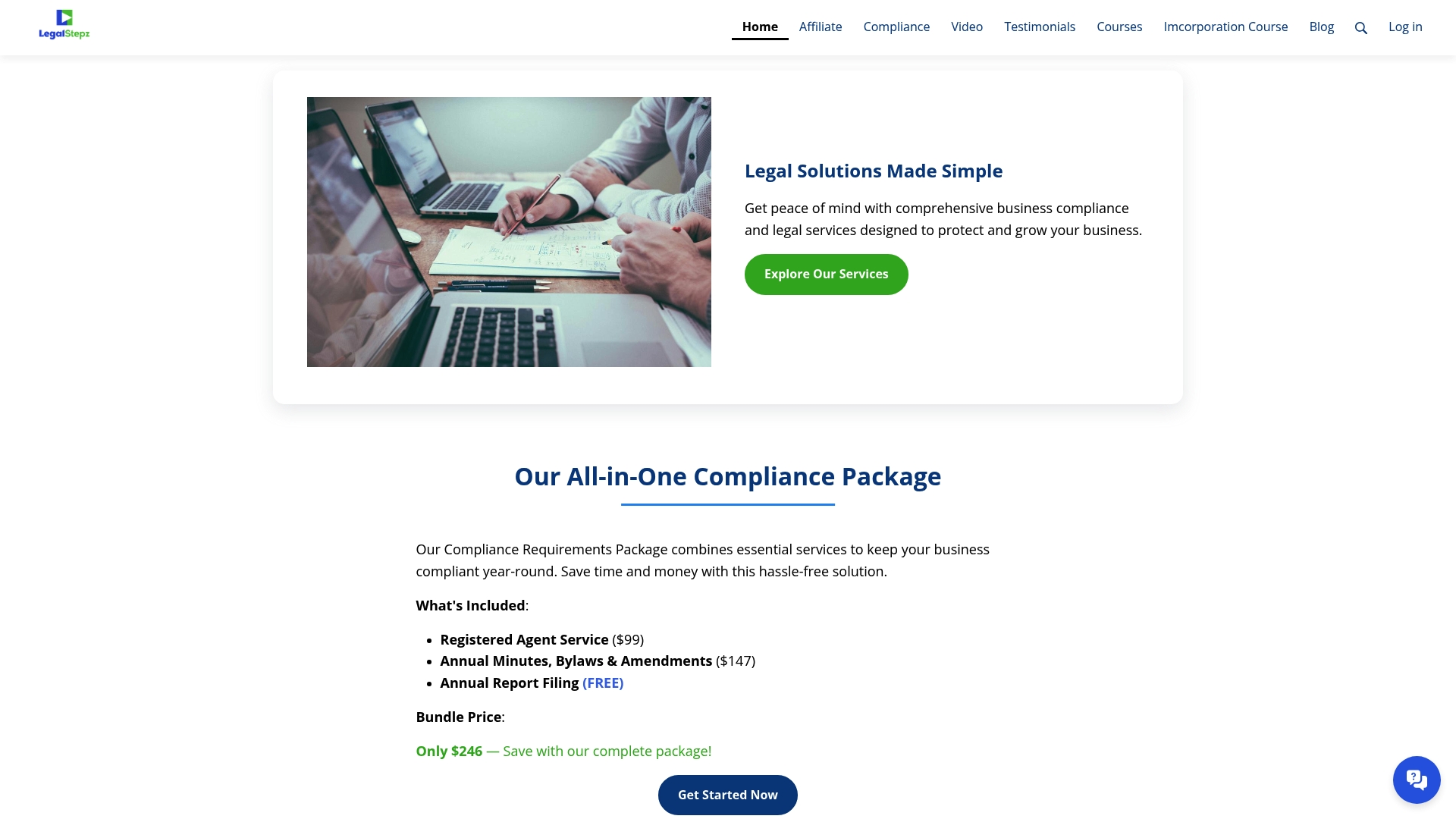
For a busy officer juggling operations and compliance at the same time, that means one place to go instead of five vendor websites and a calendar full of deadline reminders. You also get guidance drawn from our published annual minutes drafting guide and our work helping California corporations stay current on their Statement of Information filings.
Pricing and full package details are on the landing page. Visit Legalstepz to view the package and book a setup consultation before your next filing deadline.
Sources
- California Corporations Code § 1500 :: Justia
- California Corporations Code §1601 :: Legislature (LegInfo)
- Minutes are worth the minutes — Harvard Law School Forum on Corporate Governance
- Piercing the corporate veil — Cornell Legal Information Institute