

Yes, California associations can keep electronic minutes, but two statutes control how you do it: Corporations Code §8320 requires you to keep them, and the Davis-Stirling Act sets the rules for timing and access. The immediate action item: get a draft marked "DRAFT" out to members within 30 days, and plan to keep every set permanently. Recording and executive-session rules add a separate layer of limits on top of that.
TL;DR:
- Electronic minutes must be kept permanently under Corporations Code §8320 and recognized as legal writings under Civil Code §1633.7, regardless of storage format.
- Draft minutes or summaries must be made available to members within 30 days of the meeting, with approval at the next board meeting, to avoid penalties.
- Recording meetings for drafting purposes is common and permitted, but boards should adopt clear policies and delete draft recordings after minutes are approved unless retention is specified.
- Minutes should include key details like date, attendance, motions, votes, and outcome, with no need for a court transcript but enough for a member to understand what occurred.
- Executive session minutes must be stored separately, with general notes in open minutes, and maintained permanently, but are not subject to member inspection rights.
Table of Contents
- What California Law Actually Requires for Electronic Minutes
- What Belongs in Open Meeting Minutes?
- Can HOA Board Meetings Be Recorded in California?
- How Fast Must You Produce Minutes When a Member Asks?
- Building a Repeatable Process for Drafting and Sharing Minutes
- Handling Executive Session Records Correctly
- Your Post-Meeting Compliance Checklist
- How Legalstepz Templates Map to These Requirements
- The Real Tension Boards Don't Talk About Enough
- Get Your Electronic Minutes Compliant Without Guessing at Statutes
- Primary Sources for Verification
- Sources
- FAQ
What California Law Actually Requires for Electronic Minutes
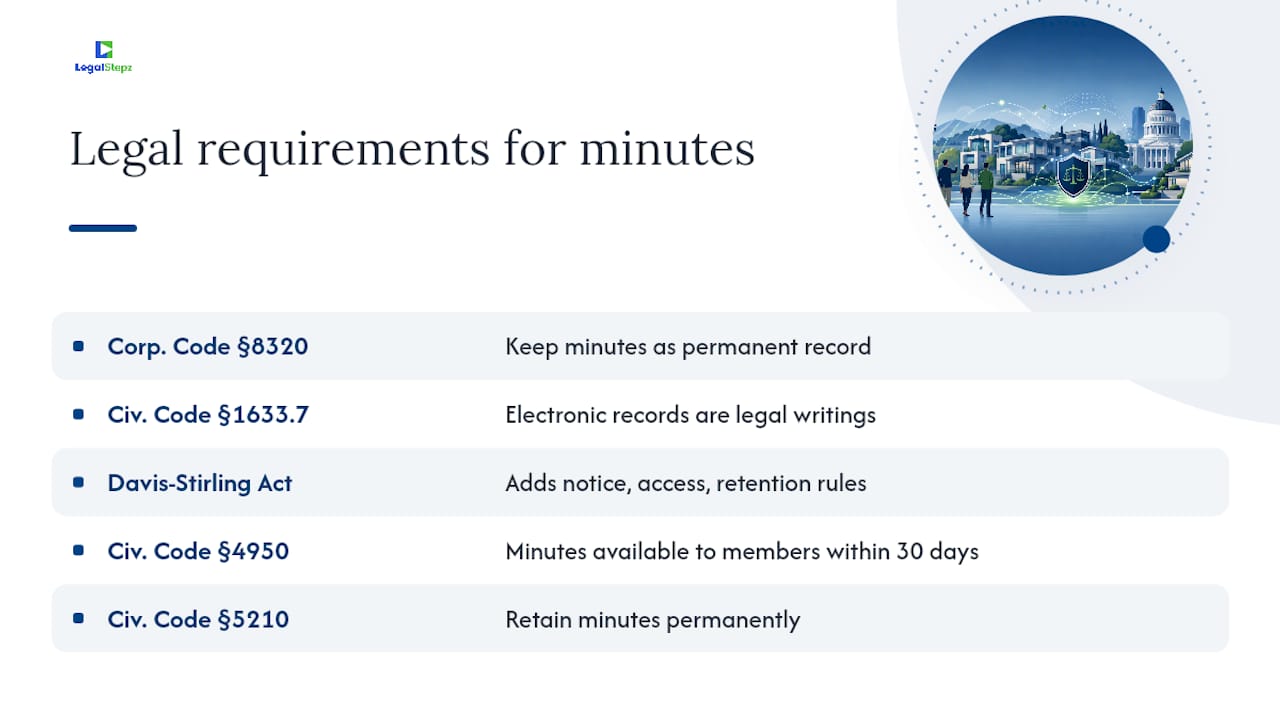
Corporations Code §8320 applies to nonprofit mutual benefit corporations, which covers most California HOAs, and it requires the association to keep minutes of every board and member meeting as a permanent corporate record. The statute doesn't specify paper. That gap gets filled by Civil Code §1633.7, which recognizes electronic records as legal writings, so your association can't deny minutes legal effect just because they live in a shared drive instead of a binder.
The Davis-Stirling Common Interest Development Act (Civil Code §§4000-6150) layers association-specific rules on top of that corporate baseline. It governs notice, member access, and how long you keep records. Three obligations matter most day one: minutes (or a draft, or a summary) must be available to members within 30 days of the meeting under Civil Code §4950, minutes must be retained permanently under Civil Code §5210, and members have a statutory right to inspect them. Skip any of these and you're exposed to civil penalties and attorney fee awards under the Davis-Stirling penalty provisions.
What Belongs in Open Meeting Minutes?
Section 4950 doesn't demand a court transcript. It demands enough detail that a member who missed the meeting can tell what happened and why. That means your minutes need:
- Date, time, and location (or teleconference method) of the meeting
- Which directors were present and which were absent
- Every motion, who made it, who seconded it, and the vote count
- The outcome of each vote (passed, failed, tabled)
- A general notation that an executive session occurred, without disclosing its content
- The time the meeting adjourned
You have three legitimate ways to satisfy the 30-day rule: distribute the fully approved minutes, distribute draft minutes clearly labeled "DRAFT," or distribute a summary of the meeting. For boards that meet monthly and only approve minutes at the following meeting, distributing the labeled draft is almost always the practical route, since waiting for board approval would blow past the 30-day window. Signature practice is flexible too: the secretary's signature confirms the minutes as the official record, and both electronic signatures and faxed signatures satisfy that requirement under the Davis-Stirling guidance.
Can HOA Board Meetings Be Recorded in California?
Teleconference meetings are legal, with one hard condition: every participant has to be able to hear every other participant in real time. Some teleconference formats trigger extra notice and location rules under Civil Code §§4090 and 4926, so check which format your meeting uses before you assume a simple conference call covers you.
Recording is where boards get nervous, and the rules split cleanly along one line: who's doing the recording and why.
- The secretary may record the meeting specifically to help draft accurate minutes, and this is common, permitted practice.
- The board has discretion to prohibit recordings by members or other attendees.
- A recording policy should be adopted and announced at the start of each meeting so everyone knows the ground rules.
Statistic to know: there's no statewide statute forcing associations to destroy secretary drafting recordings, but the common practitioner recommendation is to erase them once minutes are approved, unless your association's records policy calls for retention. That single habit closes off a meaningful chunk of the privacy and discovery exposure boards worry about. Legislative proposals around recording and disclosure keep surfacing at the state and bar association level, so treat your current recording policy as something to revisit annually, not something you set once and forget.
How Fast Must You Produce Minutes When a Member Asks?
Member inspection rights come with different clocks depending on what's being requested. Association financial and membership records generally follow the production timelines set out in the Davis-Stirling inspection provisions, while meeting minutes themselves fall under the 30-day availability rule already discussed. Practically, once minutes exist in draft or approved form, you should be ready to hand them over on request without a fresh production delay.
Executive session minutes are the exception. They're excluded from the general member inspection right, but that exclusion doesn't mean you can skip keeping them. You still must maintain them permanently.
For storage, a few habits keep you out of trouble:
- Back up your electronic archive in at least two locations, including one offsite or cloud copy.
- Keep an access log so you know who viewed or downloaded which records and when.
- Restrict deletion permissions to a single administrator role, and never delete a permanent record without documented legal counsel sign-off.
Building a Repeatable Process for Drafting and Sharing Minutes
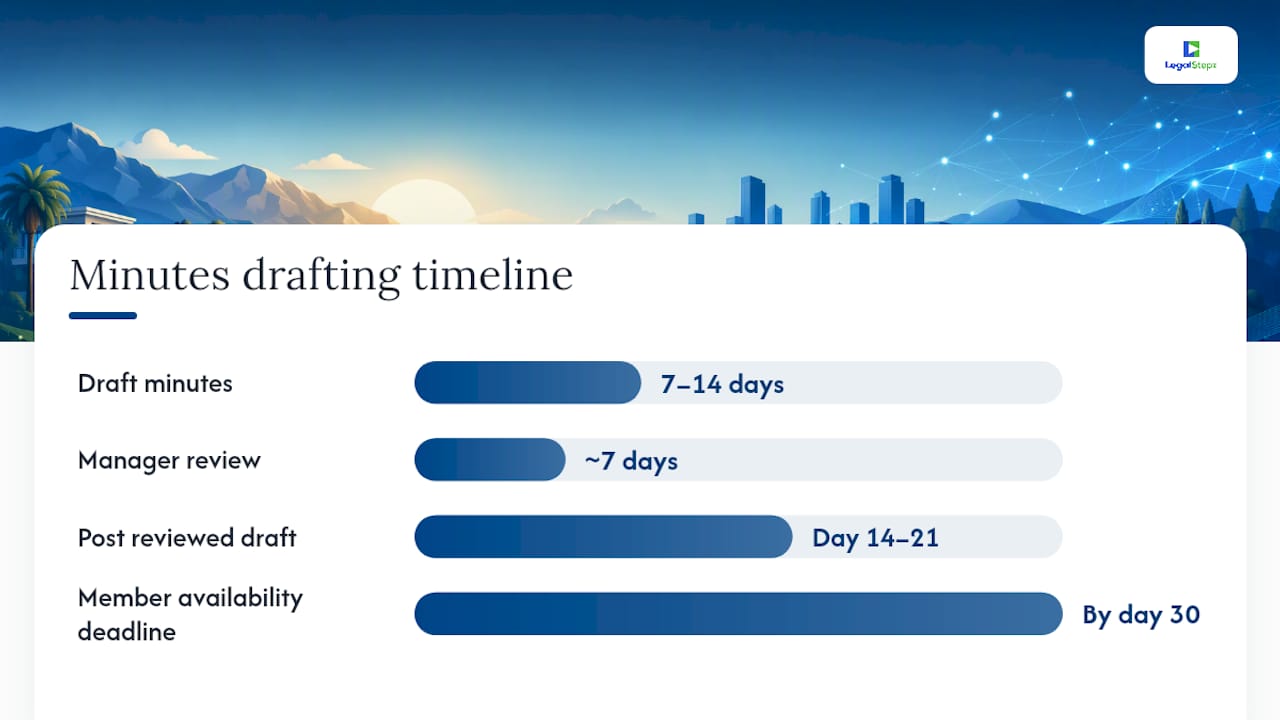
A workflow beats good intentions every time a new secretary takes over. Here's a timeline that keeps you inside every statutory deadline with room to spare:
- Draft the minutes within 7 to 14 days of the meeting while details are fresh.
- Have a manager or director review the draft during the following week.
- Mark and post the reviewed draft "DRAFT — Subject to Board Approval" by day 14 to 21.
- Confirm availability to members no later than day 30, whether through a member portal, a posted notice, or email on request.
- Present the draft for formal approval at the next board meeting, then replace it with the approved version in your permanent archive.
Portal posting and email-on-request both count as satisfying the availability requirement, and if a member requests a physical copy, associations may charge a reasonable copying fee rather than provide it free. For storage, use version control so nobody confuses draft with approved, keep the final archive write-protected, and encrypt backups. If the secretary recorded the meeting to help draft, erase that recording after board approval unless your written policy says otherwise.
Pro Tip: Build a single shared folder structure by year and meeting date before your next board cycle starts. Retrofitting an archive after three years of scattered files is far more painful than setting the structure up once.
Handling Executive Session Records Correctly
Executive session minutes follow their own track. Under Civil Code §4935(e), the board must include a general notation in the next open meeting's minutes about what topics were discussed in executive session, without revealing confidential content, like "the board discussed a member's payment plan" instead of naming the member or the amount.
Those confidential minutes themselves are excluded from member inspection rights under Civil Code §5200(a)(8), but they still fall under the permanent retention duty. Store them in a separate, access-restricted file, ideally with a smaller list of authorized viewers than your general board archive, and never merge executive session detail into the open minutes document.
Your Post-Meeting Compliance Checklist
Run through this after every board meeting:
- Draft minutes within 14 days; mark clearly as "DRAFT" until approved.
- Record every motion, maker, seconder, and vote count accurately.
- Add a general executive session notation to the next open minutes.
- Post or distribute the draft within 30 days of the meeting.
- Archive the approved version permanently in a write-protected, backed-up system.
- Log every member request for minutes and when you fulfilled it.
| Requirement | Statute | Deadline |
|---|---|---|
| Draft/summary available to members | Civil Code §4950 | 30 days after meeting |
| Permanent minutes retention | Civil Code §5210 | Indefinite |
| Executive session notation in open minutes | Civil Code §4935(e) | Next open meeting |
| Corporate minute-keeping duty | Corporations Code §8320 | Ongoing |
How Legalstepz Templates Map to These Requirements
Legalstepz builds its corporate minutes drafting guide and minutes template around the exact fields §4950 requires: date, attendance, motions, votes, and adjournment time, pre-formatted so nothing gets left out. Pairing a template with a consistent signature process, covered in the signing guidance for California minutes, cuts down the drafting errors that cause disputes later. None of this replaces legal counsel for an active dispute or litigation. Treat these resources as a compliance starting point, not a substitute for an attorney reviewing your specific facts.
The Real Tension Boards Don't Talk About Enough
Every board wrestles with the same unspoken conflict: transparency wants minutes posted fast and everywhere, while privacy wants sensitive discussion kept close. Splitting your archive into a public-facing open-minutes system and a locked-down executive session file resolves most of that tension without needing a policy debate at every meeting.
A single recording policy, applied consistently, prevents more disputes than any amount of after-the-fact explaining. I'd also push boards to audit their entire minutes archive once a year, not just to check retention, but to catch drift between what your policy says and what your secretary is actually doing.
— Peter
Get Your Electronic Minutes Compliant Without Guessing at Statutes
Reading through Corporations Code §8320 and half a dozen Civil Code sections is not how most board secretaries want to spend a weekend. Legalstepz built its templates specifically so California boards don't have to reverse-engineer statutory language into a usable document. You get drafting guides mapped to §4950's content requirements, signature guidance that matches accepted practice, and support for the annual filings and registered agent duties that run alongside your minute-keeping obligations.

If your board is still working from an inconsistent paper trail or a folder of mismatched Word documents, that's the moment to switch to a structured system rather than patch the old one again. Legalstepz also handles the California Statement of Information filing many boards forget until it's overdue, plus bylaws prep and registered agent service, so your compliance calendar isn't scattered across three different tools. Visit Legalstepz to get a template built around the checklist in this article and start your next meeting cycle already compliant.
Primary Sources for Verification
For direct statutory text, consult Corporations Code §8320, Civil Code §1633.7, the Davis-Stirling meeting minutes guidance, and this board meetings compliance checklist. Board governance and records-access questions that touch privacy policy can also benefit from broader governance perspectives on board-level record responsibility.
Sources
- Board & Committee Meeting Minutes
- Corporations Code §8320
- California HOA Meeting Minutes Requirements (Davis‑Stirling Guide)
- When can you legally record HOA meetings in California?
- Civil Code §1633.7
FAQ
What Are the Requirements for HOA Meeting Minutes in California?
Minutes must be kept under Corporations Code §8320, made available to members as an approved copy, draft, or summary within 30 days under Civil Code §4950, and retained permanently under Civil Code §5210. They need to record attendance, motions, votes, and adjournment time.
How Many Days Do Boards Have to Release Draft Minutes?
Boards have 30 days from the meeting date to make minutes, a labeled draft, or a summary available to members under Civil Code §4950. Many boards target a draft within 14 days internally to leave a buffer before that deadline.
Should Board Minutes Be Signed?
Yes, the secretary typically signs to confirm the official record, and California accepts both electronic and faxed signatures for this purpose according to Davis-Stirling guidance. A resource like Legalstepz's signing guide walks through the timing and weight of a properly signed record.
Can HOA Meetings Be Recorded in California?
Secretaries may record meetings to help draft accurate minutes, and this is standard, permitted practice under guidance from California recording law analysis. Boards retain discretion to prohibit recordings by other attendees, and many practitioners recommend erasing drafting recordings once minutes are approved unless a retention policy says otherwise.