

Filing Articles of Organization, Form LLC-1, with the California Secretary of State legally creates your LLC, and you can submit it in minutes through bizfileOnline for a $70 filing fee. Once that's approved, file your initial Statement of Information within 90 days, apply for an EIN, draft an operating agreement, and set aside $800 for the Franchise Tax Board's annual tax, due by the 15th day of the fourth month of your tax year.
TL;DR:
- Filing online through bizfileOnline is faster, costs $70, and provides immediate confirmation, while mailed filings take several weeks longer and require separate payments.
- The initial Statement of Information must be filed within 90 days of formation for $20, with subsequent biennial filings every two years that, if missed, can lead to penalties or suspension.
- California LLCs owe a mandatory $800 annual tax to the Franchise Tax Board, regardless of income, along with potential additional fees if gross receipts exceed certain thresholds.
- Names must be distinguishable, include "LLC," and without restricted words; registering a registered agent with a physical California address is mandatory for legal notices.
- Operating agreements are legally required to define ownership and rules but are often overlooked; having a detailed agreement improves credibility with banks, investors, and courts.
Table of Contents
- How Do You Form an LLC in California, Step by Step?
- Should You File Online or by Mail?
- How Do You Pick a Name, Agent, and Ownership Structure?
- What Happens After You File: Statement of Information and Biennial Filings
- What Taxes and Fees Does Your California LLC Owe?
- What Do You Need to Do Right After Forming Your LLC?
- What Mistakes Actually Delay California LLC Filings?
- When Should You DIY Your LLC and When Should You Get Help?
- How Legal Stepz Keeps Your California LLC Compliant
- Where to Find the Official California LLC Forms and Guidance
- Sources
- FAQ
How Do You Form an LLC in California, Step by Step?
Forming an LLC in California requires completing four filings and meeting two deadlines you cannot miss. Get the order right, and the whole process takes as little as a day online, or a few weeks if you mail paper forms and wait on the California processing queue.
Here's the exact sequence, with the current forms and fees attached to each step.
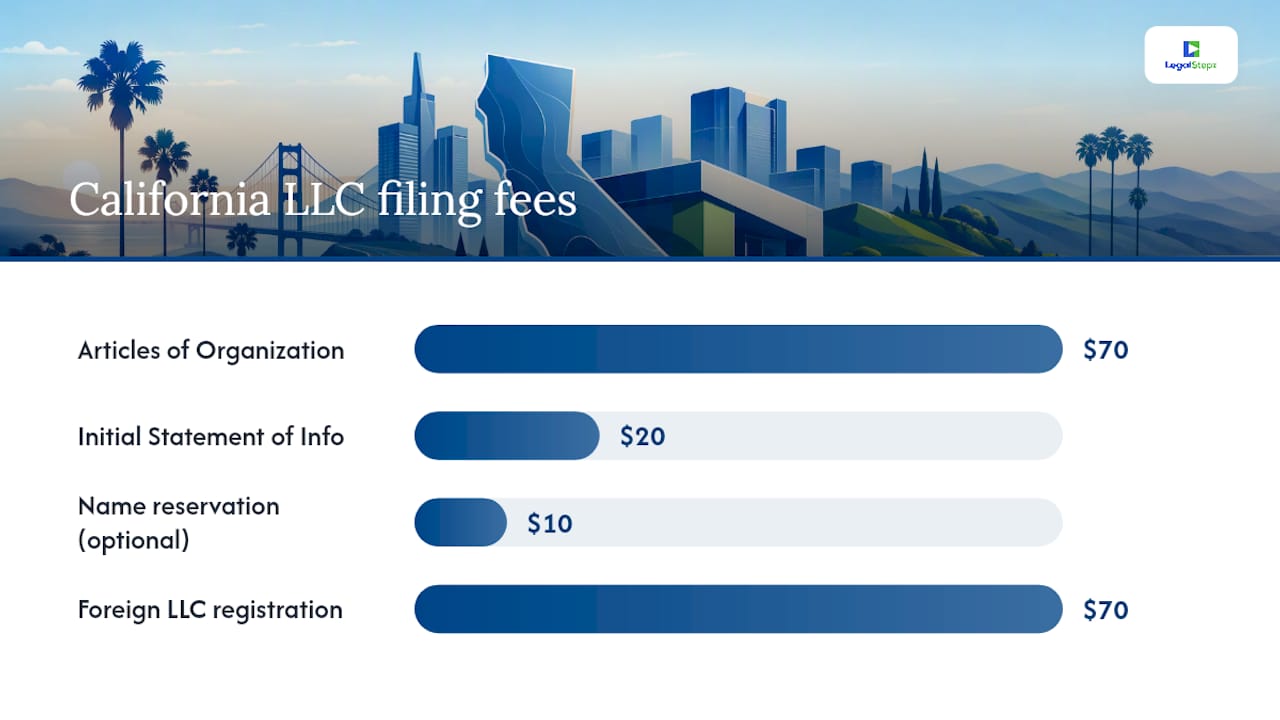
- File Articles of Organization (Form LLC-1). This is the document that legally forms your LLC. It requires your LLC's name, business address, registered agent information, and management structure (member managed or manager managed). The Secretary of State charges $70 to process it, whether you file online or by mail.
- File your initial Statement of Information. Every new LLC must file this within 90 days of the Articles of Organization being approved. It costs $20 and confirms your registered agent, principal address, and management details are current.
- Reserve your name, if you need time. If you're not ready to file Articles of Organization but want to lock in a name, the Secretary of State lets you reserve it for 60 days for a $10 fee.
- Register as a foreign LLC, if you formed elsewhere. LLCs organized outside California but doing business here file Form LLC-5 instead of Form LLC-1, along with a Certificate of Good Standing from the home state.
Here's how those pieces line up on paper:
| Filing | Form | Fee | Deadline |
|---|---|---|---|
| Articles of Organization | LLC-1 | $70 | Before the LLC legally exists |
| Initial Statement of Information | LLC-12 | $20 | Within 90 days of formation |
| Name Reservation (optional) | Name Reservation Request | $10 | Valid for 60 days |
| Foreign LLC Registration | LLC-5 | $70 | Before doing business in California |
None of these fees are one-time-only, either. The Statement of Information repeats every two years, and the $800 franchise tax comes due annually regardless of how much (or how little) your LLC earns. Budgeting for the recurring costs up front saves you from a nasty surprise eighteen months in. For a fuller breakdown of what first-year formation actually costs beyond these filing fees, Legal Stepz has a cost breakdown guide worth bookmarking.
One detail that trips people up: the $70 Articles of Organization fee and the $20 Statement of Information fee are separate transactions, filed at separate times, sometimes with separate payment methods if you're mailing checks. Treat them as two distinct tasks, not one bundled filing.
Should You File Online or by Mail?
Filing through bizfileOnline is faster, cheaper in time cost, and gives you an immediate confirmation, which is why the Secretary of State recommends it over paper submissions. Here's how to actually do it.
- Create a bizfileOnline account. Go to bizfileonline.sos.ca.gov and register with an email address and password. You don't need a business entity number yet since this filing creates one.
- Navigate to "Register a Business," then "Articles of Organization – LLC." The portal walks you through each required field: LLC name, business address, registered agent, and management structure.
- Enter your registered agent information. You'll need a name and a physical California street address (no P.O. boxes) for whoever accepts legal documents on the LLC's behalf.
- Pay the $70 filing fee by credit card. bizfileOnline accepts major cards directly through the portal.
- Submit and download your confirmation. Approved filings typically post within a few business days, and you get a stamped copy of your Articles of Organization along with your new 12-character bizfile ID, a system the Secretary of State built specifically to track entities from formation onward.
If you'd rather file on paper, or you're submitting a name reservation request that isn't available online, mail your completed Form LLC-1 to the Secretary of State's Sacramento office, or hand-deliver it to the Sacramento public counter. Include a check or money order for $70, and attach a cover letter listing a return address and daytime phone number in case the examiner has questions. Mailed filings routinely take several weeks longer than online submissions during busy filing periods.
Pro Tip: If you're in a genuine hurry, California offers expedited processing for an added fee, same day or 24-hour service at the Sacramento counter. Call ahead to confirm current expedite availability and pricing before you drive down, since capacity changes based on volume.
Whichever method you choose, keep a personal copy of everything you submit. If the state ever questions your filing date or the details you listed, your own record is the fastest way to resolve it.
How Do You Pick a Name, Agent, and Ownership Structure?
Your LLC's name has to be distinguishable from every other entity on file with the Secretary of State, and it must include "LLC," "L.L.C.," or the full phrase "limited liability company." You can check name availability through the Secretary of State's business search tool before you file anything, which saves you from a rejected Articles of Organization and a lost filing fee.
A few naming restrictions catch people off guard:
- You cannot use words like "bank," "trust," "insurance," or "incorporated" without specific state authorization.
- Names implying you're a government agency (like "FBI" or "State Department") are automatically rejected.
- If your desired name is taken but you're not ready to file, a 60-day name reservation for $10 buys you breathing room.
Every California LLC also needs a registered agent, sometimes called an agent for service of process. This is the person or company authorized to accept legal documents on your LLC's behalf, and California requires that agent to have a physical street address inside the state, not a P.O. box, not an out-of-state office. You can serve as your own agent if you have a California address and don't mind your name and address becoming part of the public record, or you can hire a registered agent service to keep your home address private and make sure nothing gets missed while you're traveling or simply not checking mail.
Then there's the operating agreement, which is arguably the most skipped step in the entire process because it isn't filed with the state at all. California law requires every LLC to keep a written operating agreement at its principal place of business, but the Secretary of State never sees it. That doesn't make it optional. Courts examining liability disputes look at whether an LLC actually operated like a distinct legal entity, and a thin or missing operating agreement is one of the fastest ways to lose that argument. A solid one spells out ownership percentages, capital contributions, profit distribution, voting rights, and what happens if a member wants out.
Pro Tip: Single-member LLCs skip the operating agreement more than any other group, assuming it's pointless when there's only one owner. It isn't. Banks, investors, and courts all treat an LLC with a real operating agreement as more credible than one without.
What Happens After You File: Statement of Information and Biennial Filings
Your first Statement of Information is due within 90 days of your Articles of Organization getting approved, and missing that window is one of the most common (and most avoidable) compliance failures new LLC owners make. The filing costs $20 and requires:
- Your LLC's principal business address and a separate mailing address if different
- Your registered agent's name and California street address
- Whether the LLC is member managed or manager managed, along with the names and addresses of managers or managing members
- The type of business the LLC conducts, described in general terms
After that first filing, you're on a two-year clock. California's biennial system assigns your filing window based on the month your LLC was originally formed. Form your LLC in March 2026, for example, and your first Statement of Information is due by June 2026 (within 90 days), with your next one due sometime in the March to May window of 2028.
Missing a biennial filing doesn't dissolve your LLC outright, but it puts you at risk of penalties and can eventually push the Secretary of State to suspend your entity's status, which cuts off your ability to file lawsuits or enforce contracts until you fix it. Correcting a missed filing means submitting the overdue Statement of Information along with any late penalty, then waiting for the state to lift the suspension. It's a fixable problem, but it's a slow one, so mark the deadline the day your LLC forms rather than waiting for a reminder that may never come. Legal Stepz breaks down the biennial timing further in its annual report filing guide.
What Taxes and Fees Does Your California LLC Owe?
Every LLC that does business in California or is organized here owes an $800 annual tax to the Franchise Tax Board, and that bill shows up whether your LLC made a dollar of revenue or not.
$800 minimum: every active California LLC owes this annual franchise tax to the FTB, due by the 15th day of the fourth month of the tax year, regardless of income or profit.
That distinction between the Secretary of State and the Franchise Tax Board matters more than most new owners realize. Registering your LLC with the Secretary of State does not automatically register it with the FTB for tax purposes. You have to handle FTB compliance separately, and that means knowing three specific forms:
- Form 3522 is the voucher you use to pay the $800 annual tax.
- Form 3536 covers the estimated LLC fee, which applies on top of the $800 tax once your total California income crosses certain thresholds. The fee scales upward as gross receipts increase.
- Form 568 is your LLC's actual tax return, filed annually regardless of income level.
First-year exemption rules for the $800 tax have shifted in past tax years, so don't assume your brand-new LLC automatically skips the first payment. Check the FTB's current guidance for the specific tax year you formed in before you file anything.
The mistakes Legal Stepz sees most often here are simple ones: paying the $800 tax under the wrong tax year, forgetting Form 3536 entirely once income grows, or assuming that because the Secretary of State accepted your Articles of Organization, you're square with the state on taxes. You're not. Two separate agencies, two separate registration processes, and missing either one creates penalties that compound the longer they sit unresolved. If you formed as a single-member LLC, the penalty pitfalls tend to concentrate around exactly this gap between SOS filing and FTB registration.
What Do You Need to Do Right After Forming Your LLC?
Getting your Articles of Organization approved is the legal starting line, not the finish. A few tasks turn your paper entity into a business that can actually operate.
- Apply for an EIN from the IRS. Your Employer Identification Number is free, takes about ten minutes online through the IRS website, and you need it to open a bank account, hire employees, or file federal taxes, even if you're a single-member LLC with no employees.
- Open a dedicated business bank account. Bring your approved Articles of Organization, your EIN confirmation letter, and your operating agreement. Banks typically want to see all three before opening an account, and mixing personal and business funds is one of the fastest ways to undermine the liability protection your LLC is supposed to provide.
- Check city and county licensing requirements. California doesn't issue one statewide business license, so requirements vary by municipality. A consulting LLC in Los Angeles and a retail LLC in Fresno face completely different local permit rules, so check with your specific city or county clerk's office directly.
- Register for payroll if you're hiring. Bringing on employees means registering with the Employment Development Department for state payroll taxes and securing workers' compensation insurance, which California requires for nearly every employer regardless of headcount.
What Mistakes Actually Delay California LLC Filings?
The filings themselves aren't complicated. What delays them is almost always something small and avoidable, and Legal Stepz sees the same handful of errors repeatedly.
- Inconsistent entity names across filings. Listing your LLC as "Smith Consulting LLC" on the Articles of Organization and "Smith Consulting, LLC" on your EIN application creates a mismatch that banks and the FTB both flag.
- A registered agent address that doesn't match reality. Listing a P.O. box, an out-of-state address, or an old address for your agent gets filings kicked back or, worse, means you miss a legal notice entirely.
- Missing the Statement of Information deadline because nobody set a reminder. The 90-day window feels distant on day one and arrives faster than expected.
- Assuming the $800 franchise tax is optional in year one. It typically isn't, and the exemption rules that occasionally apply are narrow and year-specific.
A single standardized checklist, one document listing your exact entity name, agent address, and filing dates, prevents most of the rejections and missed deadlines that trip up new LLC owners in their first year.
Legal Stepz built its registered agent and compliance services around closing exactly these gaps: keeping your agent address current, filing your Statement of Information on time, and providing operating agreement templates so that document isn't a placeholder sitting empty in a drawer. None of that replaces legal advice for a genuinely complicated ownership situation, but for the standard formation and upkeep work, it covers the parts that cause the most delays.
When Should You DIY Your LLC and When Should You Get Help?
If you're a single owner running a straightforward business, freelance consulting, an online shop, a small service company, filing everything yourself is entirely reasonable. The forms aren't complex, the fees are published, and bizfileOnline walks you through the fields. There's no real reason to pay someone else to type your name into a portal.
Where it stops being simple is multiple owners, out-of-state activity, or any structure where the operating agreement needs to do real legal work, spelling out unequal ownership stakes, buyout terms, or what happens if a partner wants to walk away. That document protects you precisely in the moments when things go wrong, and a generic template downloaded for free often doesn't hold up when it's actually tested.
The math that matters here isn't the $70 filing fee. It's the cost of fixing a mistake later. A missed Statement of Information deadline, a mismatched registered agent address, or a thin operating agreement that fails to protect you in a dispute all cost far more to untangle than the small fee you'd pay upfront to have someone check the work. That's not an argument against doing it yourself. It's an argument for knowing exactly where your own complexity starts, and treating a service like Legal Stepz as a legitimate option once it does, rather than an unnecessary expense.
— Peter
How Legal Stepz Keeps Your California LLC Compliant
Legal Stepz handles the paperwork that keeps causing headaches long after your Articles of Organization get approved. That's the real gap: formation is a one-time filing, but staying compliant, the biennial Statement of Information, the registered agent requirement, the operating agreement your business actually needs on file, is ongoing.

Some registered agent services provide a real California address to ensure legal notices are received promptly. They may also file Statements of Information on time, including both the initial 90-day filing and biennial renewals, and offer operating agreement templates tailored to specific ownership structures, along with annual minutes drafting for LLCs and corporations that need to maintain proper corporate records.
If you'd rather have someone else own the compliance calendar while you run the business, visit Legal Stepz to see current service bundles and get started.
Where to Find the Official California LLC Forms and Guidance
Every filing described here traces back to a handful of official sources, and it's worth bookmarking them directly rather than relying on secondhand summaries.
- bizfileOnline is the Secretary of State's official portal for filing Articles of Organization, Statements of Information, and most other business entity documents online.
- Forms, Samples and Fees on the Secretary of State's site hosts downloadable PDFs for Form LLC-1, Form LLC-5, and every other entity form, along with current fee schedules.
- Ftb covers the $800 annual tax, the LLC fee thresholds, and links to Forms 3522, 3536, and 568.
For a deeper walkthrough of the formation process from start to finish, Legal Stepz's own step-by-step guide covers additional scenarios not detailed here.
Sources
- Ftb
- bizfileOnline
- Starting a Business – Entity Types :: California Secretary of State
- Forms, Samples and Fees :: California Secretary of State
FAQ
How do I form an LLC in California?
File Articles of Organization (Form LLC-1) with the California Secretary of State, either through bizfileOnline or by mail, and pay the $70 filing fee. Once approved, file your initial Statement of Information within 90 days, then handle FTB tax registration separately.
Do I have to pay the $800 California LLC fee every year?
Yes. Every LLC doing business in or organized under California law owes an $800 annual tax to the Franchise Tax Board, due by the 15th day of the fourth month of the tax year, regardless of whether the LLC earned any income.
What forms are needed to form an LLC in California?
You need Form LLC-1 (Articles of Organization) to create the LLC and a Statement of Information within 90 days after that. For taxes, you'll separately handle FTB Form 3522 for the annual tax and Form 568 for your LLC's return, and Form 3536 if your income crosses the LLC fee threshold.
Can I form my LLC online?
Yes, and it's the faster route. The Secretary of State's bizfileOnline portal lets you submit Articles of Organization, pay the $70 fee by credit card, and get confirmation within a few business days, compared to several weeks for mailed paper filings.
What's the difference between forming a single-member and multi-member LLC?
The filing forms and fees are identical, but multi-member LLCs need a more detailed operating agreement covering ownership splits, voting rights, and profit distribution among owners. Single-member LLCs still need a written operating agreement to protect liability status, even though they're sometimes tempted to skip it.