

Corporate bylaws are defined as the internal governance rules that control how a California corporation operates, makes decisions, and protects its owners from personal liability. When you adopt corporate bylaws for a California corporation, you create the legal foundation that separates your business from yourself. Unlike your Articles of Incorporation, bylaws never get filed with the California Secretary of State. They stay private, locked in your corporate records, yet they carry more day-to-day legal weight than almost any other document your company will ever produce.
What are corporate bylaws and why does your California corporation need them?
Bylaws are not the same as Articles of Incorporation. Your Articles are the public document that creates the corporation. Bylaws are the private rulebook that governs everything that happens inside it. They cover who sits on the board, how meetings are called, how votes are counted, and what happens when a dispute breaks out between shareholders. Understanding the difference between these two formation documents is the first step toward sound governance.
California law technically says corporations "may" adopt bylaws, but practitioners treat adoption as functionally mandatory. Courts use the absence of bylaws as direct evidence that a corporation is not a genuine separate legal entity. That finding leads to veil piercing, which means a judge can hold you personally responsible for corporate debts. Veil piercing risk is the single strongest argument for adopting bylaws the day you incorporate.
Relying on California's statutory default rules is a common and costly mistake. Default rules are designed for the average corporation, not yours. They frequently create governance deadlocks for startups and small businesses because they do not account for concentrated ownership, rapid growth, or informal decision-making styles. Tailored bylaws replace those defaults with rules that actually fit your company.
- Bylaws vs. Articles: Articles create the corporation publicly; bylaws govern it privately.
- Liability shield: Properly adopted bylaws reinforce the legal wall between you and the corporation.
- Dispute prevention: Clear voting and quorum rules stop shareholder conflicts before they start.
- Investor confidence: Sophisticated investors expect to see bylaws before writing a check.
Pro Tip: Draft your bylaws before your first board meeting, not after. Adopting them at the organizational meeting is the cleanest, most defensible approach under California law.
Key legal requirements and components of California corporate bylaws
California Corporations Code sets out the categories that bylaws must or should address. Missing a required category does not automatically void your bylaws, but it creates gaps that courts and opposing counsel will exploit. The table below maps the core components to their governance function.
| Bylaw Component | Governance Function |
|---|---|
| Board of directors structure | Sets the number of directors, their terms, and removal procedures |
| Shareholder meeting rules | Defines notice periods, quorum thresholds, and voting methods |
| Officer roles and duties | Assigns authority to the CEO, CFO, Secretary, and other officers |
| Indemnification provisions | Protects directors and officers from personal liability for corporate acts |
| Amendment procedures | Specifies who can change the bylaws and what vote is required |
The board of directors section is the most litigated part of any bylaw document. California law allows boards as small as one director when a corporation has fewer than three shareholders, but you still need to spell out how that director is elected, how long the term lasts, and what triggers removal. Leaving these details to statutory defaults invites ambiguity.
Indemnification provisions deserve special attention. Vague statutory defaults on indemnification deter qualified board members from joining your company. Explicit indemnification language, combined with directors' and officers' insurance, signals to experienced executives that your corporation takes governance seriously. That combination is especially important for startups seeking credible leadership.
Shareholder meeting rules must address cumulative voting. California law permits cumulative voting by default, but it only works in practice when your bylaws explicitly reference it. Customizing voting methods and quorum requirements in your bylaws prevents the kind of minority-shareholder standoffs that shut down small corporations every year.
How do you draft and formally adopt bylaws in California?
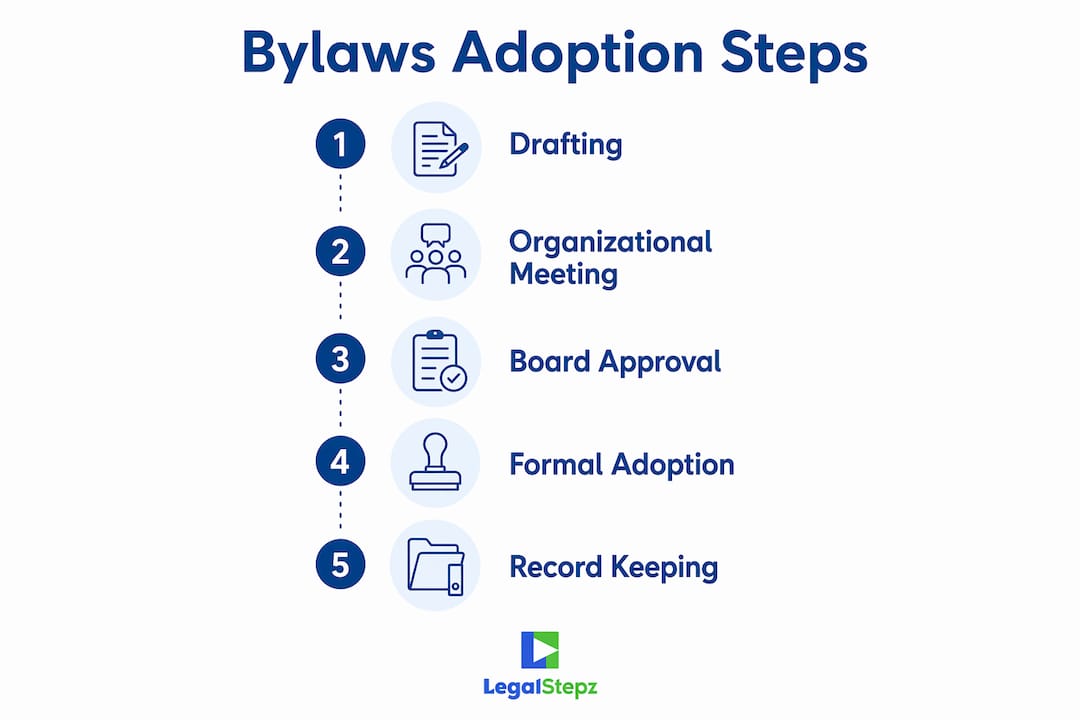
The adoption process follows a clear sequence. Skipping a step creates a procedural gap that can undermine the bylaws' enforceability later.
- Draft the bylaws. Start with a template built for California corporations, then customize it for your board size, ownership structure, and industry. A California startup with two co-founders needs different quorum rules than a family business with five shareholders.
- Get a legal review. Have a California-licensed attorney review the draft before the organizational meeting. This is not optional if you want bylaws that hold up in court.
- Hold the organizational board meeting. The board of directors or the incorporators formally adopt the bylaws at this meeting. The adoption is recorded in the meeting minutes.
- Pass a corporate resolution. Corporate resolutions document the board's formal approval of the bylaws. The resolution becomes part of your permanent corporate records.
- Store the bylaws at your principal office. California Corporations Code requires corporations to keep bylaws accessible for shareholder inspection. A digital copy in a secure folder works, but a physical corporate records binder is the standard practice.
- File your Statement of Information. The Statement of Information (Form SI-550) is due within 90 days of incorporation with a $25 fee. Bylaws are not submitted with it, but the filing deadline is a useful trigger to confirm your bylaws are already in place.
Timing matters. Many founders file their Articles of Incorporation and then wait weeks before thinking about bylaws. That gap is a governance and liability exposure. The organizational meeting, bylaw adoption, and initial officer appointments should all happen within the first two weeks after incorporation.
Pro Tip: Use the Statement of Information deadline as a hard deadline for completing your organizational meeting. If your SI-550 is due, your bylaws should already be signed and filed in your corporate records binder.

Common pitfalls to avoid when adopting California corporate bylaws
Most bylaw mistakes fall into a small number of repeatable patterns. Knowing them in advance is far cheaper than fixing them after a dispute.
- Copying a generic template without customizing it. A Delaware corporation template does not comply with California Corporations Code. Always start with a California-specific document.
- Skipping the indemnification section. Lacking clear indemnification deters qualified directors and leaves officers exposed to personal suits for decisions made in good faith.
- Setting ambiguous quorum rules. If your bylaws say "a majority of directors" without defining the board size, you create a moving target that paralyzes decision-making.
- Never updating the bylaws. Bylaws adopted for a two-person startup rarely fit a company with ten employees and outside investors. Failing to amend bylaws as the business grows creates a mismatch between written rules and actual practice.
- Failing to keep proper records. California law requires corporations to maintain minutes, bylaws, and governance records for shareholder inspection. Missing records are a red flag in due diligence and a liability in litigation.
Entrepreneurs frequently underestimate the strategic importance of tailoring bylaws beyond statutory defaults. That gap leads to operational inefficiencies and legal exposure that could have been avoided with a single afternoon of careful drafting.
The most underrated pitfall is treating bylaws as a one-time task. Your corporation's governance needs will change. Build an amendment procedure into your bylaws from day one, and schedule an annual review alongside your annual report filing to catch any gaps before they become problems.
Key Takeaways
Properly adopted bylaws are the single most effective tool for protecting your personal assets and governing your California corporation with confidence.
| Point | Details |
|---|---|
| Bylaws are private but legally critical | They are never filed with the state, yet courts treat their absence as evidence of veil piercing. |
| Customize beyond statutory defaults | California's default rules do not fit most startups; tailored bylaws prevent governance deadlocks. |
| Adopt at the organizational meeting | Passing a corporate resolution at your first board meeting is the cleanest adoption method. |
| Indemnification protects leadership | Explicit indemnification provisions attract qualified directors and shield officers from personal suits. |
| Update bylaws as the company grows | An annual review aligned with your Statement of Information filing keeps governance current. |
Why I think most founders get bylaws backwards
Most founders treat bylaws as a compliance checkbox. They grab a template, sign it, and file it in a drawer. I have seen that approach backfire badly, and not just in court. The real cost shows up earlier, when a co-founder dispute erupts and nobody can agree on what the voting rules actually say, or when a potential investor's attorney asks for the corporate records and finds a Delaware template with the wrong state name still in the header.
The founders who avoid those problems share one habit: they treat bylaws as a governance design exercise, not a paperwork exercise. They think about how decisions will actually get made, who has authority to hire and fire, and what happens if a shareholder wants out. Those questions are uncomfortable to answer at the start, but they are far less uncomfortable than answering them in front of a mediator two years later.
California corporations also have a specific wrinkle that out-of-state templates miss: cumulative voting rights for shareholders. California law preserves cumulative voting by default, which can give minority shareholders more board influence than founders expect. If you want to modify or eliminate that right, your bylaws must say so explicitly. Most generic templates do not address this at all.
My honest recommendation is to spend the money on a California-licensed attorney for the initial bylaw draft, then use a service like Legalstepz for ongoing compliance tasks like annual minutes and Statement of Information filings. That combination gives you a legally sound foundation without paying attorney rates for routine paperwork every year.
— Peter
Legalstepz makes bylaw adoption straightforward for California founders
Getting your bylaws right from the start does not require a law firm on retainer. Legalstepz provides California-specific bylaw templates, guided adoption workflows, and corporate recordkeeping support built around the California Corporations Code.

Legalstepz handles the documents that keep your corporation compliant: bylaws and annual minutes, Statement of Information filings, and registered agent services. Every template is built for California, not adapted from another state. You get a complete corporate records package without the overhead of a full-service law firm. If you are ready to adopt your bylaws and complete your organizational formalities, Legalstepz gives you the tools to do it correctly the first time.
FAQ
What are corporate bylaws in a California corporation?
Corporate bylaws are the internal rules that govern how a California corporation operates, including board structure, meeting procedures, voting rights, and officer authority. They are not filed with the state but are legally required to be kept at the corporation's principal office.
Do California corporations have to adopt bylaws?
California law uses permissive language, but courts treat the absence of bylaws as evidence that the corporation is not a genuine separate entity, which can lead to personal liability for owners through veil piercing.
When should a California corporation adopt its bylaws?
Bylaws should be adopted at the organizational board meeting, which should occur within the first two weeks after filing Articles of Incorporation and before the Statement of Information deadline at 90 days.
What happens if bylaws are not updated as the company grows?
Outdated bylaws create a mismatch between written governance rules and actual business practice, which courts and investors treat as a governance failure and a potential liability during disputes or due diligence.
Are California corporate bylaws available to the public?
No. Bylaws are private internal documents retained at the corporation's principal office. Shareholders have the right to inspect them, but they are never submitted to the California Secretary of State.