

Most California LLC owners don't realize they're operating under rules they never agreed to. When you don't draft operating agreement California LLC documents at formation, the state fills in the blanks for you. Those default rules include equal profit sharing regardless of contribution and majority voting with no special thresholds. That may not be what you want. California Corporations Code § 17701.13(d)(5) mandates that every LLC maintain a written operating agreement from day one. This guide walks you through exactly how to write one that reflects your actual intentions.
Table of Contents
- Key takeaways
- What to gather before drafting your California LLC operating agreement
- Step-by-step guide to drafting the operating agreement
- Common mistakes that create expensive problems
- Verifying and finalizing your operating agreement
- My take on drafting operating agreements that actually hold up
- Get expert help drafting your California LLC agreement
- FAQ
Key takeaways
| Point | Details |
|---|---|
| California law requires it | Every LLC must maintain a written operating agreement at formation under California Corporations Code § 17701.13(d)(5). |
| Default rules rarely fit | Without a custom agreement, California's statutory defaults apply, including equal profit splits and basic majority voting. |
| Voting clarity prevents disputes | Specify different consent thresholds for major versus ordinary decisions to avoid deadlocks and litigation. |
| It's an internal document | The agreement is never filed with the state but must be kept with your company records and signed by all members. |
| Review it as you grow | Amend the agreement with proper member consent whenever ownership, management, or business scope changes significantly. |
What to gather before drafting your California LLC operating agreement
Before you open a blank document, you need to make several foundational decisions. Trying to draft without this information leads to vague language that causes problems later. Think of this stage as the blueprint phase.
Here is what you need to pin down before writing a single clause:
- Member identities and ownership percentages. List every member's legal name and their ownership stake. This directly controls how profits, losses, and voting power are allocated.
- Management structure. Decide whether your LLC will be member-managed (all owners share control) or manager-managed (one or more designated managers run day-to-day operations). This is one of the most consequential choices in the document.
- Capital contributions. Document what each member is contributing at formation, whether cash, property, or services, and what happens if additional capital is needed later.
- Profit and loss allocation. California's default is an equal split, but profit allocations can differ if members agree on a custom arrangement that reflects unequal contributions or sweat equity.
- Voting thresholds. Decide what percentage of member votes is needed for routine decisions versus major ones like admitting new members, selling assets, or amending the agreement itself.
- Amendment mechanics. Determine how the agreement can be changed in the future and what level of consent is required. This protects minority members from being steamrolled.
Pro Tip: Don't assume your co-founders agree on management structure just because you've talked about it. Write it down before drafting starts. Verbal alignment disappears fast when money is on the table.
Getting these decisions documented in a simple term sheet before drafting saves hours of back-and-forth revisions. It also forces members to confront disagreements early, when they're far easier to resolve.
Step-by-step guide to drafting the operating agreement
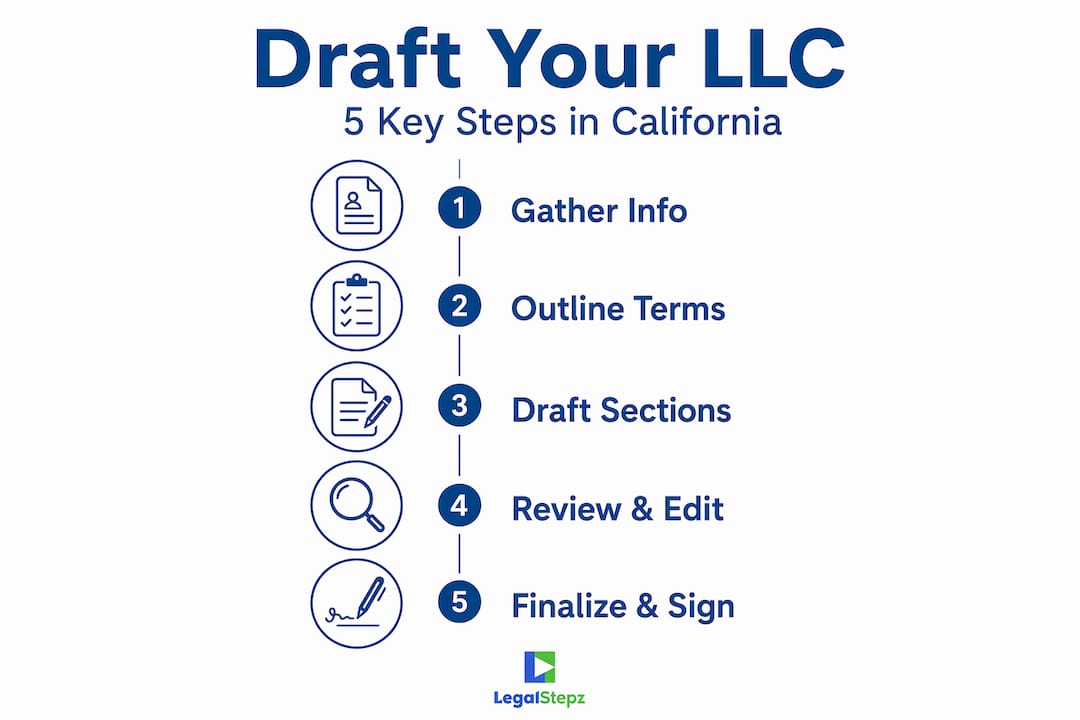
Once you have your foundational decisions locked in, drafting the California LLC operating agreement becomes a structured writing task rather than a guessing game. Here is a practical sequence to follow:
-
Write the title and effective date. Start with a clear title that identifies the company and the document type. Include the exact date the agreement takes effect. This matters for legal enforceability.
-
Add a definitions section. Define key terms like "Member," "Manager," "Membership Interest," and "Capital Account" at the top. Undefined terms create ambiguity that courts resolve against the drafter.
-
Describe the management structure. State explicitly whether the LLC is member-managed or manager-managed. If manager-managed, name the manager(s) and spell out their authority and any limits on that authority. Unclear authority limits have caused courts to vacate votes and create standing disputes in real California cases.
-
Set voting standards for different decision types. This is where most generic California LLC agreement templates fall short. You need separate thresholds for ordinary decisions, major transactions, member admissions, and amendments. Tailored voting thresholds for each decision type are critical to preventing deadlock and litigation.
-
Detail capital contributions and financial provisions. Document each member's initial contribution, the process for requesting additional capital, and how profits and losses are allocated and distributed. Be specific about timing of distributions too.
-
Add buy-sell and dissociation provisions. What happens when a member wants to leave, dies, or becomes incapacitated? What if members disagree so fundamentally that the business can't function? A buy-sell provision sets the price and process so you're not litigating it later.
-
Write the amendment procedure. Amendments generally require unanimous or defined member consent. State the exact threshold and process. This prevents a majority owner from unilaterally rewriting control terms, which California courts take seriously.
-
Include signature blocks for all members. Every member must sign and date the agreement. A signed, dated copy is what makes it a legally binding operating agreement rather than a draft.
Pro Tip: Write the management authority section as if a judge will read it during a dispute. Because someday, one might. Vague phrases like "the manager has broad authority" are the ones that get litigated.
If you're working from a California LLC agreement template, treat it as a starting point only. Every provision needs to be reviewed against your actual business structure and member intentions. A template that worked for a two-person consulting firm won't necessarily work for a four-member real estate holding company.

Common mistakes that create expensive problems
Even well-intentioned founders make drafting errors that surface only when something goes wrong. Here are the pitfalls that show up most often in California LLC disputes:
-
Using a generic template without California-specific customization. Many free operating agreement examples online are built for other states. California operates under the Revised Uniform Limited Liability Company Act (RULLCA), which has specific default rules. A non-California template may reference statutes that don't apply or miss provisions that California law expects.
-
Failing to differentiate voting thresholds. Default rules may be inadequate for multi-member LLCs that need distinct standards for major versus ordinary decisions. Using one threshold for everything creates deadlocks on routine matters or lets simple majorities make decisions that should require broader consensus.
-
Leaving management authority vague. When the agreement doesn't clearly define what a manager or member can do without approval, disputes arise over whether a particular action was authorized. Courts look at the operating agreement as the controlling contract. If it's silent, the outcome is unpredictable.
-
Skipping buy-sell and dissociation provisions. This is the most common omission in early-stage LLCs. When a founding member wants out, or worse, when a member dies, the absence of clear exit mechanics can freeze the business for months.
-
Not updating the agreement as the business grows. An operating agreement drafted for a two-person startup doesn't automatically adapt when you bring on investors, add members, or change your business model. If the agreement is silent on new issues, California's default statutory rules fill the gap again.
The operating agreement is not a formality you complete once and forget. It's a living contract that should reflect your business as it actually operates, not as it existed on day one.
For guidance on how forming a California LLC connects to your operating agreement obligations, it helps to understand the full formation timeline before you start drafting.
Verifying and finalizing your operating agreement
Drafting is only half the job. Before you call the document final, run through this verification process to confirm it's both legally sound and practically useful.
| Checklist item | What to verify |
|---|---|
| California RULLCA coverage | Confirm the agreement addresses management structure, voting, allocations, and amendment procedures as required |
| Member alignment | Every member has reviewed the document and agrees the terms reflect their actual intentions |
| Signatures and dates | All members have signed and dated the agreement on the same or consecutive dates |
| Secure storage | A signed copy is stored with your company records and accessible to all members |
| Periodic review schedule | A review date is noted, ideally annually or when major business changes occur |
| Professional review | Complex arrangements involving investors or unusual profit structures have been reviewed by a California attorney |
Once signed, the agreement is an internal document. You do not file it with the California Secretary of State. It serves as proof of your LLC's legitimacy for banks, courts, and maintaining liability separation between personal and business affairs.
Pro Tip: Store your signed operating agreement in at least two places: a physical copy with your company records and a digital copy in a secure cloud folder accessible to all members. The one time you need it urgently, you'll be glad you did.
California's annual maintenance requirements for LLCs include keeping your operating agreement current. Treat each annual review as a checkpoint to confirm the document still matches how your business actually operates.
My take on drafting operating agreements that actually hold up
I've seen a lot of operating agreements, and the ones that cause problems share one trait: they were written to check a box, not to govern a real business.
The biggest misconception I encounter is that a California LLC agreement template downloaded from the internet is "good enough." It usually isn't. Templates are built for the average case. Your business is not average. The moment your situation deviates from the template's assumptions, which it will, you're operating under language that was never written for you.
What I've learned is that the sections founders rush through are the ones that matter most in a dispute. Voting thresholds, management authority limits, and amendment procedures sound like boilerplate. They're not. Courts treat that language as the controlling contract. I've seen poorly defined authority turn a simple business decision into a standing dispute that cost far more to resolve than a proper agreement would have.
The other thing I'd push back on is the idea that you can "fix it later." Amending an operating agreement requires meeting whatever consent threshold the agreement itself specifies. If you didn't define that threshold clearly, or if you need unanimous consent and one member is uncooperative, you're stuck. Majority owners cannot unilaterally rewrite control terms unless the amendment procedure allows it. That protection cuts both ways.
Write the agreement for the business you're building, not the business you have today. Include provisions for member exits, capital calls, and major decisions even if they feel hypothetical. The founders who skip those sections are the ones who call attorneys two years later.
— Peter
Get expert help drafting your California LLC agreement
Drafting a compliant, custom operating agreement takes more than filling in a template. Legalstepz offers step-by-step guidance built specifically for California entrepreneurs who want to get their LLC structure right from the start.
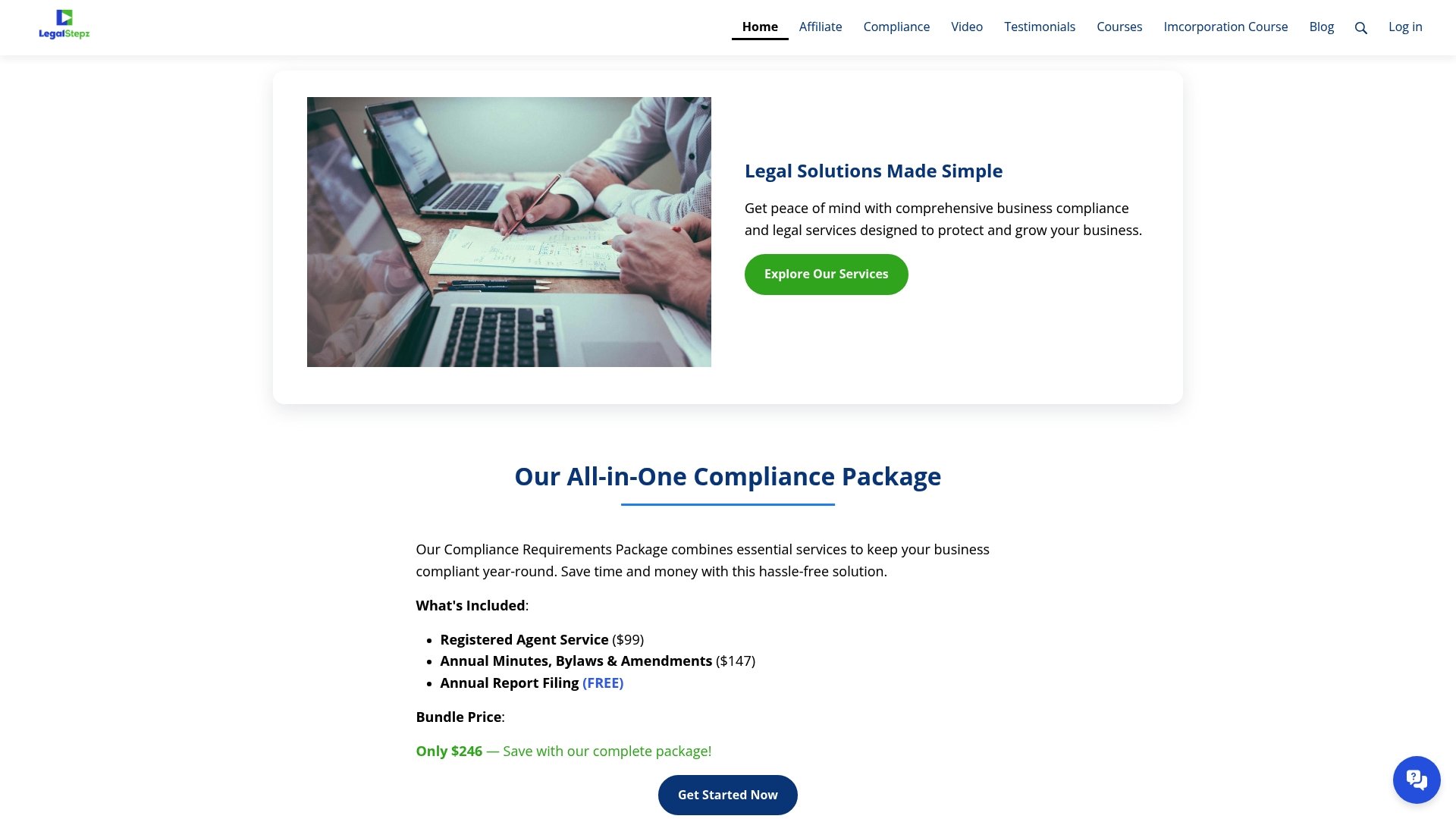
The Legalstepz Incorporation Course walks you through every element of LLC formation, including how to draft operating agreement provisions that override California's default rules and actually protect your interests. You'll learn how to customize voting thresholds, management authority, and financial provisions for your specific business. For founders who want professional support alongside self-guided learning, Legalstepz also provides registered agent services, annual minutes drafting, and statement of information filing to keep your LLC in good standing year after year.
FAQ
Does California require a written operating agreement?
Yes. California Corporations Code § 17701.13(d)(5) requires every LLC to maintain a written operating agreement at the time of formation. Failing to have one means California's default statutory rules govern your LLC instead.
What happens if my LLC doesn't have an operating agreement?
California's default rules apply, which include equal profit sharing among members and basic majority voting standards. These default rules rarely match what founders actually intend, especially in multi-member LLCs with unequal contributions.
Do I need to file my operating agreement with the state?
No. The operating agreement is an internal document kept with your company records. It is never filed with the California Secretary of State but should be signed by all members and stored securely.
Can one member change the operating agreement without consent?
Generally no. Amendments require the level of consent defined in the agreement itself, often unanimous or supermajority approval. Majority owners cannot unilaterally rewrite control terms unless the amendment procedure explicitly permits it.
How often should I update my California LLC operating agreement?
Review it at least annually and any time a significant change occurs, such as adding a member, changing management structure, or shifting the business model. An outdated agreement creates gaps that California's default statutory rules will fill in ways you may not want.