

Incorporating a business creates a separate legal entity that shields your personal assets from business debts and lawsuits — the immediate next step is to choose your entity type and state, appoint a registered agent, then file Articles of Incorporation and obtain an EIN from the IRS. That sequence covers the core of the business incorporation process, and everything else builds from it.
- Choose entity and state: Decide between a corporation, LLC, or other structure, and pick the state where you primarily operate.
- Appoint a registered agent: Every state requires one with a physical in-state address.
- File and get your EIN: Submit Articles of Incorporation to the state, then apply for your Employer Identification Number through the IRS.
tl;dr: Most states process online filings in 1–10 business days. State filing fees commonly range from $50 to $300, plus registered agent and first-year compliance costs on top.
Table of Contents
- Why incorporate? Benefits and tradeoffs worth knowing
- Which entity type fits your business goals?
- How to incorporate your business: the step-by-step checklist
- How state rules, fees, and timelines differ
- How taxes work after you incorporate
- Ongoing compliance tasks that preserve your liability protection
- DIY, formation service, or attorney: which help do you actually need?
- Key Takeaways
- What practitioners see founders get wrong
- Legalstepz makes California compliance straightforward
- Useful sources and official resources
Why incorporate? Benefits and tradeoffs worth knowing
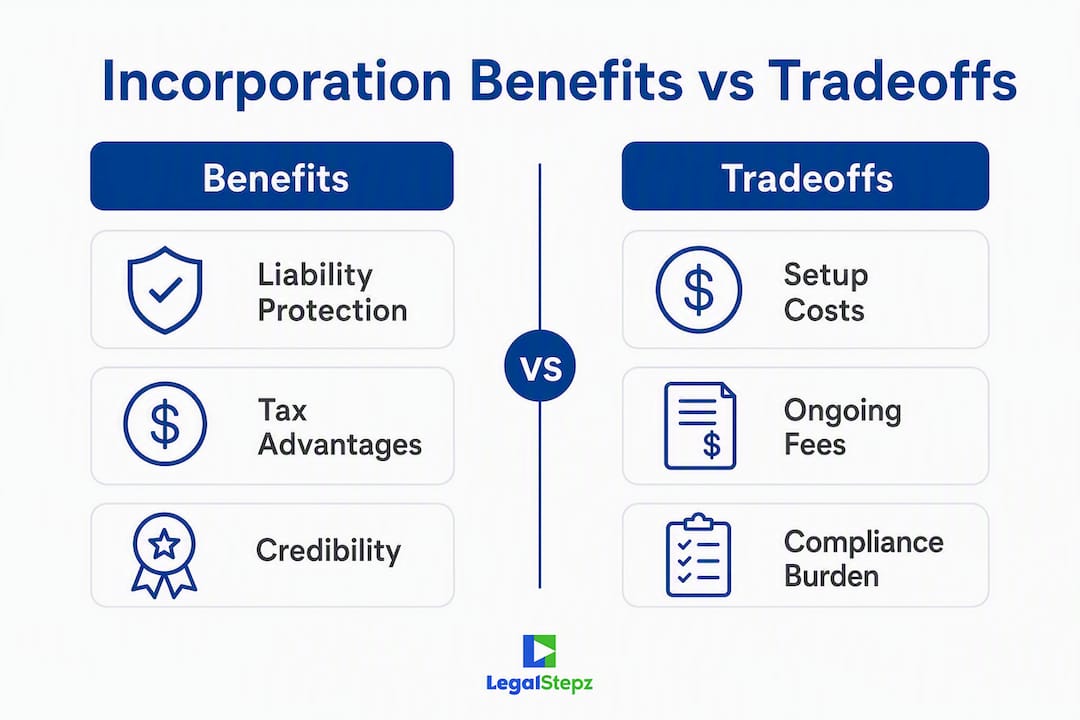
The single biggest reason founders incorporate is the corporate veil. When you keep your business finances separate and follow required formalities, creditors generally cannot reach your personal assets to satisfy a business debt. That protection alone justifies incorporation for most businesses that carry meaningful liability risk — a contractor, a product company, anyone with employees.
Beyond liability, incorporation delivers real structural advantages:
- Credibility: Vendors, banks, and enterprise clients treat a corporation or LLC differently than a sole proprietor. The legal designation signals permanence.
- Equity issuance: Corporations can issue stock, which is the mechanism for bringing in investors, granting founder equity, and eventually running an employee stock option plan.
- Separate business credit: Your EIN anchors a business credit profile independent of your personal score.
- Perpetual existence: The entity survives ownership changes. A sole proprietorship legally dissolves when the owner exits.
The tradeoffs are real, though. Setup costs include filing fees, a registered agent, and basic legal or accounting work, which can add up in the first year. Corporations face ongoing formalities: annual reports, board minutes, separate bookkeeping. C corporations specifically face potential double taxation — the company pays corporate income tax, and shareholders pay again on dividends. For a solo founder pulling all profits as salary, that structure rarely makes sense without a specific tax strategy.
The practical question for a small business is whether the liability exposure justifies the overhead. If you are a freelance writer with no employees and no physical product, a sole proprietorship may be fine. If you manufacture goods, hire staff, or sign contracts that could generate significant claims, the cost of incorporation is almost certainly worth it.
Pro Tip: Liability protection is not automatic the moment you file. The corporate veil only holds if you maintain separate bank accounts, document major decisions in minutes, and never commingle personal and business funds. Filing the paperwork is step one; the ongoing behavior is what actually protects you.
Which entity type fits your business goals?
The choice between a corporation, LLC, S corp election, nonprofit, or benefit corporation is really a decision about three things: how you want to be taxed, who your owners will be, and whether you plan to raise outside capital. Here is how the main options compare:

| Entity | Best for | Tax treatment | Liability protection | Initial cost | Ongoing compliance |
|---|---|---|---|---|---|
| C Corporation | Startups raising VC, IPO-track companies | Corporate tax rate; potential double taxation on dividends | Strong when formalities are maintained | Moderate ($100–$300 filing) | High: annual reports, minutes, board meetings |
| S Corporation | Small businesses wanting pass-through tax with corporate structure | Pass-through to owners' personal returns | Strong when formalities are maintained | Same as C corp (it's an election, not a separate entity) | High: same as C corp plus IRS eligibility rules |
| LLC | Solo founders, small partnerships, real estate, flexible management | Pass-through by default; can elect corporate taxation | Strong when operating agreement is followed | Low to moderate ($50–$300 filing) | Lower: operating agreement, annual reports vary by state |
| Nonprofit | Mission-driven organizations, charities | Tax-exempt on qualifying income | Strong | Moderate plus IRS application fee | High: IRS reporting, board governance, restricted use of funds |
| Benefit Corporation | Mission-aligned for-profits, B Corp certification seekers | Standard corporate or pass-through | Strong | Similar to standard corporation | High: annual benefit report required in most states |
One clarification that trips up a lot of founders: an S corporation is a tax election, not a separate legal entity. You form a standard corporation (or in some states, an LLC), then file IRS Form 2553 to elect S status. The underlying entity is still a corporation with all the same formalities.
When an LLC makes more sense: flexible management structure, no plans to issue preferred stock to investors, pass-through taxation preferred, and fewer than the IRS limit of 100 shareholders. Most small businesses and single-founder companies land here.
When a corporation makes more sense: you plan to raise venture capital (VCs almost universally require a Delaware C corp), you want to issue multiple classes of stock, or you are building toward an IPO. The differences between incorporation and an LLC go deeper than taxes — the equity structure is fundamentally different.
Quick decision checklist:
- Raising outside capital or planning an IPO? → C Corporation, likely Delaware
- Want pass-through taxation with corporate structure and fewer than 100 owners? → S election
- Solo or small partnership, flexibility priority? → LLC
- Mission-driven with charitable purpose? → Nonprofit
- Mission-driven but for-profit? → Benefit Corporation
How to incorporate your business: the step-by-step checklist
Multiple authoritative guides converge on the same practical order of steps. Here is the full sequence, with what to prepare at each stage.
-
Run a name availability search. Check your target state's Secretary of State database to confirm the name is not already taken. Most state sites have a free search tool. While you are at it, search the USPTO trademark database — a clear state filing does not mean you are safe from federal trademark infringement.
-
Reserve the name (optional but smart). Most states let you reserve a name for 30–120 days for a small fee ($10–$50) while you finalize your documents.
-
Choose your state of formation. For most small businesses, incorporate where you primarily operate. Forming in Delaware when you operate in California just means registering as a foreign corporation in California anyway, doubling your compliance burden. More on state selection in the next section.
-
Appoint a registered agent. Every state requires a registered agent with a physical street address in the state. You can serve as your own, but a commercial service costs $100–$400 per year and keeps your personal address off public records. Legalstepz offers registered agent services specifically for California businesses.
-
Prepare your Articles of Incorporation. This is the core formation document filed with the state. Typical fields include:
- Legal name of the corporation
- Registered agent name and street address
- Incorporator name and signature
- Number of authorized shares (and par value, if applicable)
- Business purpose clause (often "any lawful purpose" suffices)
- Initial board of directors (required in some states)
-
File and pay the state fee. Submit online through your state's Secretary of State or Department of State portal. Most states offer online filing with faster processing than paper. Fees commonly run $50–$300 depending on the state.
-
Apply for your EIN. An Employer Identification Number is your corporation's federal tax ID. Apply online through the IRS — approval is immediate. You need it to open a business bank account and file federal taxes.
-
Draft and adopt bylaws (corporations) or an operating agreement (LLCs). Bylaws are private internal documents that govern how the corporation runs: board structure, voting rules, officer roles, meeting procedures. Failure to adopt bylaws is one of the most common formal defects that undermines liability protection in disputes. Key sections to include: meeting notice requirements, quorum rules, officer duties, amendment procedures.
-
Hold your organizational meeting. The initial board meeting (or written consent in lieu of meeting) formally adopts the bylaws, appoints officers, authorizes the issuance of stock, and approves opening a bank account. Document everything in minutes.
-
Issue stock and maintain a stock ledger. Board authorization is required before shares can be issued. Record each issuance in a stock ledger with the shareholder name, number of shares, date, and consideration paid.
-
Open a business bank account. Banks typically require your EIN, Articles of Incorporation (certified copy), and organizational minutes authorizing the account. Never use a personal account for business transactions after this point.
-
Register for state tax accounts and local licenses. Depending on your state and industry, you may need a state sales tax permit, employer withholding account, professional license, or local business license. The SBA's registration guide maps out which registrations apply by structure and location.
Pro Tip: When filling out your Articles, authorize more shares than you think you need. Founders who authorize a small share pool often have to amend their articles later when they bring in investors or set up an option plan — an amendment costs time and another filing fee.
How state rules, fees, and timelines differ
State-by-state variation is where most first-time founders get surprised. The filing fee is just the beginning. Here is what actually changes by state:
- Filing fees: Range from under $50 (Kentucky, Iowa) to $100–$300 for most mid-tier states, to higher in states with minimum franchise taxes baked in.
- Processing time: Standard filing runs several business days online in most states; expedited processing is available for an extra fee.
- Annual/biennial report requirements: Some states require annual reports with fees; others are biennial. Missing these triggers administrative dissolution.
- Franchise tax or minimum fees: Delaware charges an annual franchise tax calculated on authorized shares or assumed par value — it can run into thousands of dollars for startups with large authorized share pools. California has its own structure (see below).
- Name designators: Most states require "Inc.," "Corp.," or "Incorporated" for corporations and "LLC" or "L.L.C." for limited liability companies.
- Authorized share disclosure: Some states require you to list authorized shares in the Articles; others do not.
The Delaware vs. home-state question comes up constantly. Delaware's Court of Chancery has well-developed corporate case law, which is why venture-backed startups and companies planning institutional fundraising almost always incorporate there. For everyone else, the best state to file your incorporation is usually the state where you operate. Forming in Delaware when you run a California business means paying Delaware franchise tax AND registering as a foreign corporation in California, with California's own fees on top.
California-specific notes
California is one of the more demanding states for ongoing compliance. Key obligations for California corporations and LLCs:
- Statement of Information: Corporations must file within 90 days of formation, then every year. LLCs file every two years. The California Statement of Information filing is a hard deadline — missing it triggers a $250 penalty and eventual suspension.
- Minimum franchise tax: California corporations owe a minimum $800 franchise tax annually, starting the second taxable year (with some first-year exemptions for new corporations formed after January 1, 2000 under certain conditions — confirm current rules with the California Franchise Tax Board).
- Foreign qualification: Any out-of-state entity doing business in California must register there and pay California taxes and fees regardless of where it was formed.
| State category | Example states | Typical filing fee | Standard processing | Annual report fee |
|---|---|---|---|---|
| Low-fee states | Kentucky, Iowa, Mississippi | $50–$75 | 3–5 business days | $15–$50 |
| Mid-fee states | Texas, Florida, Colorado | $100–$300 | 2–5 business days | — |
| Higher-fee states | California, Massachusetts | $100 filing + $800 min. franchise tax (CA) | 3–10 business days | $50–$300+ |
| Delaware | Delaware | $50–$300 | 1–3 business days | $50 + franchise tax (varies widely) |
Fees change; verify current amounts directly with each state's Secretary of State before filing.
How taxes work after you incorporate
Entity choice drives your tax situation more than almost any other decision. Here is the practical breakdown:
- C corporation: Pays federal corporate income tax on profits. Shareholders pay personal income tax on dividends. This is the "double taxation" concern — though many founders in growth-stage companies reinvest profits rather than pay dividends, making it less of an issue in practice.
- S corporation election: Pass-through taxation. Profits and losses flow to shareholders' personal returns. No corporate-level federal income tax. Requires filing IRS Form 2553 within 75 days of formation (or by March 15 for an election effective the following tax year). Eligibility rules: no more than 100 shareholders, all must be U.S. citizens or residents, only one class of stock allowed.
- LLC (default): Single-member LLCs are taxed as sole proprietorships; multi-member LLCs as partnerships. Both are pass-through. An LLC can also elect to be taxed as a corporation by filing IRS Form 8832.
Key IRS forms and timing after incorporation:
- EIN: Apply online at IRS.gov immediately after filing. Approval is instant.
- Form 2553 (S election): Must be filed within 75 days of formation for the election to apply in the first tax year. Miss that window and you default to C corp taxation until the next year.
- Form 1120 (C corp return): Due the 15th day of the 4th month after fiscal year end.
- Form 1120-S (S corp return): Due the 15th day of the 3rd month after fiscal year end.
- Payroll forms: If you pay employees or yourself a salary (required for S corp owner-employees), file Form 941 quarterly and Form 940 annually.
- Estimated taxes: Corporations and pass-through owners generally owe quarterly estimated tax payments. Missing these triggers underpayment penalties.
Tax decision checklist before you elect:
- Do you meet S corp eligibility requirements (U.S. shareholders only, one class of stock, 100 or fewer owners)?
- What is your owner pay strategy? S corp owners who work in the business must pay themselves "reasonable compensation" as W-2 wages — the IRS scrutinizes distributions used to avoid payroll taxes.
- Is pass-through taxation actually better for your situation, or does your state's treatment of S corps change the math?
Pro Tip: The S election deadline catches founders off guard constantly. If you form a corporation in, say, October and want S status for that tax year, you have until roughly mid-January to file Form 2553. Miss it and you owe corporate taxes for the full first year. Put the deadline on your calendar the day you file your Articles.
Ongoing compliance tasks that preserve your liability protection
Filing Articles of Incorporation is not the finish line. The corporate veil only holds when you maintain the formalities that justify it. Here is what that looks like in practice:
Annual calendar items to track:
- State annual or biennial report (due dates vary by state and entity type)
- Franchise tax or minimum fee payment
- Corporate minutes: at minimum, an annual meeting of shareholders and directors (or written consent in lieu)
- Registered agent renewal
- Business license renewals (city, county, state)
- Federal and state tax filings and estimated payments
The veil-piercing red flags to avoid:
- Commingling personal and business funds — even one personal expense paid from the business account can be used as evidence in litigation
- Missing annual minutes or resolutions for major decisions (loans, real estate, officer changes)
- Failing to follow your own bylaws or operating agreement
- Undercapitalizing the business (starting with no real assets in the entity)
- Personal guarantees on every business obligation (these bypass the veil by design)
- Letting the registered agent lapse or the entity fall into administrative suspension
For California businesses, the annual requirements to maintain limited liability include the Statement of Information, franchise tax, and keeping a valid registered agent on file at all times.
Reinstatement risk: Most states will administratively dissolve or suspend an entity that misses annual reports or fees. Reinstatement is possible but involves back fees, penalties, and paperwork. In California, a suspended corporation cannot legally enter contracts, sue, or defend itself in court — a serious operational problem.

Pro Tip: Build a compliance calendar in your project management tool the week you incorporate. Set reminders 60 days before each deadline. The founders who lose liability protection are rarely the ones who ignored the rules on purpose — they just forgot.
DIY, formation service, or attorney: which help do you actually need?
Most formation tasks sit on a spectrum from "anyone can do this" to "get a lawyer." Here is how to map your situation:
| Task | DIY | Formation service | Attorney/CPA |
|---|---|---|---|
| Name search and reservation | ✓ Easy | ✓ | — |
| Filing Articles of Incorporation | ✓ Possible | ✓ Common | ✓ For complex structures |
| Registered agent | ✓ (if you have a stable in-state address) | ✓ Recommended | — |
| Bylaws / operating agreement | ✓ Template-based | ✓ Standard templates | ✓ For custom provisions |
| EIN application | ✓ Easy (IRS online) | ✓ | — |
| Annual minutes and reports | ✓ With guidance | ✓ Common | — |
| Complex equity structures | — | — | ✓ Required |
| Securities compliance (issuing stock to investors) | — | — | ✓ Required |
| Multi-state operations | — | ✓ Partial | ✓ Recommended |
| S election and tax planning | — | — | ✓ CPA recommended |
When to hire an attorney or CPA — practical triggers:
- Multiple founders with different equity splits or vesting schedules
- Outside investors (even friends and family rounds)
- IP-heavy business where ownership of inventions needs to be assigned to the entity
- Interstate operations from day one
- Regulated industries (financial services, healthcare, cannabis)
- Any situation where you are unsure whether you qualify for S election
For straightforward single-founder or small-team formation, a formation service handles the paperwork reliably and at a fraction of attorney rates. The question of whether you need a lawyer to incorporate often comes down to complexity, not preference.
Tasks commonly outsourced even by experienced founders:
- Registered agent (privacy and reliability)
- Annual minutes preparation
- Statement of Information filings (California)
- Ongoing compliance tracking
Key Takeaways
Incorporating a business requires choosing the right entity, filing Articles of Incorporation with your state, obtaining an EIN, and maintaining ongoing formalities to keep the corporate veil intact.
| Point | Details |
|---|---|
| Entity choice drives everything | Tax treatment, investor eligibility, and compliance burden all flow from whether you form a corporation, LLC, or elect S status. |
| Filing fees range from $50 to $300 | Most states process online filings within a few business days. Commercial registered agent service typically costs $100–$400 per year, and California adds an $800 minimum franchise tax annually. |
| S election has a hard deadline | File IRS Form 2553 within 75 days of formation to get pass-through status in your first tax year. |
| Formalities preserve the veil | Separate accounts, annual minutes, and registered agent continuity are what actually protect personal assets after filing. |
| Legalstepz for California filers | Legalstepz handles Statement of Information filings, registered agent services, and annual minutes for California corporations and LLCs. |
What practitioners see founders get wrong
The paperwork is the easy part. What actually costs founders money and protection are the decisions made in the first 90 days after filing.
The most common mistake: treating the Articles of Incorporation as the finish line. Founders file, get their EIN, and then operate for months without bylaws, without minutes, and with a bank account that doubles as a personal expense account. When a dispute arises, that paper trail is exactly what a plaintiff's attorney looks for to pierce the corporate veil.
A second pattern: founders who serve as their own registered agent using a home address. That address becomes part of the public record in most states. More practically, if you are not reliably at that address during business hours, you risk missing service of process — which can result in a default judgment entered against your company before you even know you were sued. A commercial registered agent costs less per year than a single hour of attorney time to deal with the fallout.
On equity: founders routinely authorize too few shares at formation, then scramble to amend their articles when they want to issue options or bring in an investor. Authorizing a larger share pool upfront costs nothing extra in most states and avoids the amendment fee and delay later. Think through your cap table before you file, not after.
The S election timing issue deserves its own mention. Founders who form a corporation in Q3 or Q4 and do not immediately consult a CPA often miss the 75-day window for a first-year S election. That mistake means paying corporate taxes for the full first year when pass-through treatment would have been more favorable.
One practical tip that almost no formation guide mentions: hold your organizational meeting (or execute a written consent in lieu) within the first two weeks of formation. Adopt the bylaws, appoint officers, authorize the bank account, and issue the founder shares in one documented action. That single step closes the most common formal defect that undermines liability protection in disputes.
Legalstepz makes California compliance straightforward
California has some of the most demanding ongoing compliance requirements of any state, and the penalties for missing them are immediate. Legalstepz is built specifically for California corporations and entrepreneurs who want to stay compliant without paying attorney rates for routine filings.

Legalstepz handles the filings that California businesses cannot afford to miss: the Statement of Information, annual corporate minutes, bylaws preparation, and registered agent services. For founders who want to handle formation themselves, the Legalstepz Incorporation Course walks through every step of the process with clear video instruction, so you know exactly what you are filing and why. No guesswork, no missed deadlines.
Ready to get your California business properly formed and compliant? Visit Legalstepz to see the compliance packages and get started today.
Useful sources and official resources
These are the primary sources to use when filing, researching state requirements, or downloading official forms:
- SBA: Register Your Business — The SBA's official guide to business registration by structure and state; a good starting point for understanding which registrations apply to your entity type.
- IRS: Apply for an EIN Online — The IRS online EIN application; approval is immediate and the result is your federal tax ID.
- IRS Form 1120-S — The S corporation annual tax return; download directly from the IRS.
- USPTO Trademark Search — Search existing federal trademarks before committing to a business name.
- NY Department of State: Form a Corporation or Business — Example of a state filing portal; find your own state's equivalent through a web search for "[your state] Secretary of State business filing."
- Legalstepz: California Statement of Information — Detailed guidance on California's periodic filing requirement for corporations and LLCs.
- Legalstepz: Best State to File Your Incorporation — Practical heuristics for choosing a formation state, including the Delaware vs. home-state tradeoff.
- Legalstepz: Incorporation vs. LLC — Side-by-side comparison of tax and legal differences between corporations and LLCs for California entrepreneurs.
- Legalstepz: Annual Requirements to Maintain Limited Liability — What California businesses must do each year to preserve their liability protection.
This article provides general information about business formation in the United States and is not legal, tax, or financial advice. Confirm current fees, deadlines, and eligibility rules with the relevant state agency, the IRS, or a qualified attorney or CPA before making formation decisions.