

Bylaws are the internal governance rules that define how your California corporation operates, makes decisions, and resolves disputes. Every founder forming a new business bylaws California startup structure needs to understand one critical distinction: articles of incorporation create your legal entity with the California Secretary of State, but bylaws govern everything that happens inside the company. Bylaws cover shareholder and director meeting protocols, quorum thresholds, voting rights, officer responsibilities, and amendment procedures. Without them, your startup has no internal rulebook, and courts may hold directors personally liable for corporate debts.
What legal requirements apply to business bylaws for startups in California?
California corporations are not required to file bylaws with the Secretary of State. They must exist as internal records, kept at your principal office and available to shareholders on request. This surprises many founders who assume every legal document gets filed somewhere. The California Corporations Code sets the framework, but your bylaws live inside your company, not in a government database.
The California Corporations Code requires bylaws to address several core areas:
- Meeting protocols: Rules for calling, noticing, and conducting board and shareholder meetings, including allowances for remote participation.
- Quorum requirements: The minimum number of directors or shareholders needed to conduct official business and pass resolutions.
- Voting rights: How votes are counted, weighted, or restricted across different share classes.
- Officer roles and responsibilities: Titles, duties, and authority limits for the CEO, CFO, Secretary, and any other officers your startup designates.
- Amendment procedures: The process required to change the bylaws, including who must approve changes and what vote threshold applies.
- Indemnification provisions: Protections for directors and officers against personal liability arising from their corporate roles.
Beyond these required elements, California law provides default governance rules. The problem is those defaults often do not fit startups, especially those with multiple founders, outside investors, or complex share structures. Relying on defaults is a governance risk, not a shortcut.
Pro Tip: Keep a signed, dated copy of your bylaws in your corporate records book from day one. If you ever face an audit, investor due diligence, or a dispute, you need to produce them immediately.
Your bylaws also interact with other compliance obligations. California requires corporations to file a Statement of Information with the Secretary of State within 90 days of incorporation and annually thereafter. Bylaws do not replace that filing, but they set the governance structure that makes those filings accurate. For a full picture of your ongoing filing requirements, review California's annual report rules alongside your bylaws.
How to draft effective bylaws tailored for a California startup
Generic bylaws create real problems. Customized bylaws reduce costly disputes by addressing the specific governance needs of your startup from the start. A boilerplate template downloaded from the internet will not account for your share classes, your co-founder relationships, or your investor expectations. Here is a practical roadmap for drafting bylaws that actually serve your startup.
-
Define your board structure clearly. Specify the number of directors, how they are elected, and how vacancies are filled. Early-stage startups often start with one to three directors. Your bylaws should state whether the board can act by written consent without a meeting, which saves time during fast-moving decisions.
-
Customize voting rights by share class. If your startup issues both common and preferred stock, your bylaws must reflect how each class votes on major decisions. Customized share classes and multi-founder voting provisions are frequently missing in standard templates, and their absence causes conflicts during fundraising rounds.
-
Include strong indemnification clauses. Proper indemnification provisions improve your ability to recruit experienced directors and officers. Talented advisors and board members will ask about indemnification before they agree to serve. Your bylaws should state that the corporation will indemnify directors and officers to the fullest extent permitted by California law.
-
Set a clear amendment process. Specify what vote is required to amend the bylaws, whether that is a majority of the board, a supermajority of shareholders, or both. Vague amendment rules become a weapon in co-founder disputes.
-
Address co-founder conflict protocols. Include provisions for deadlock resolution, especially if you have an even number of co-founders with equal voting power. A tiebreaker mechanism, such as binding arbitration or a designated neutral director, prevents governance paralysis.
-
Plan for investor rights. If you anticipate venture capital or angel investment, draft provisions that accommodate future preferred stock rights, information rights, and board observer seats without requiring a full bylaws rewrite.
Pro Tip: Have a California-licensed attorney review your bylaws before adoption, even if you draft them yourself. A one-hour review catches provisions that conflict with the California Corporations Code and saves thousands in future legal fees.
Understanding your California startup legal structure before you draft bylaws ensures the governance rules you write actually fit the entity type you formed.

How to adopt, maintain, and update your startup bylaws in California
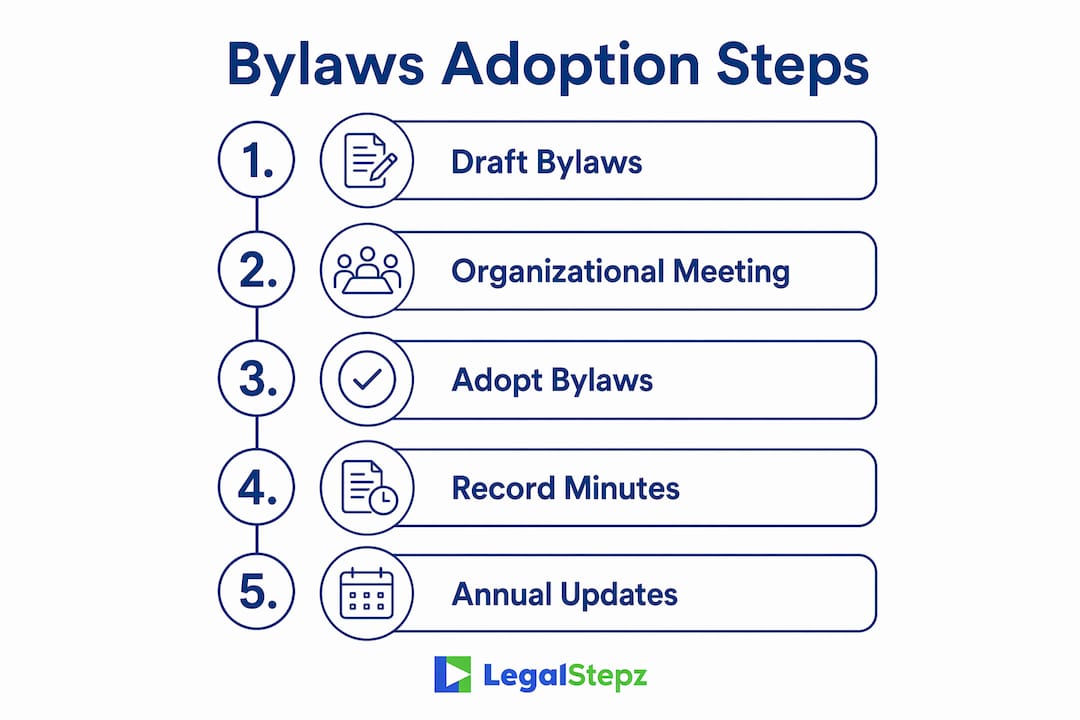
Adopting bylaws is not a one-time checkbox. Corporations must adopt bylaws at the first board meeting and keep them current as governance evolves. Here is the step-by-step process California founders should follow.
-
Hold your organizational meeting. The initial board of directors adopts the bylaws at the first organizational meeting. If you are the sole incorporator, you may adopt bylaws by written consent before the first meeting. Record this action in your organizational minutes.
-
Record the adoption in your minutes. Minutes are the official record that bylaws were properly adopted. Failure to maintain bylaws and organizational minutes risks losing corporate veil protection. That means courts can hold you personally liable for corporate debts.
-
Store bylaws as internal corporate records. Keep the signed bylaws in your corporate records book alongside your articles of incorporation, stock ledger, and meeting minutes. California law does not require you to file bylaws with the state, but you must produce them on shareholder request.
-
Review bylaws annually. Governance needs change as your startup grows. A company with three founders and no outside investors has different governance needs than one that has closed a Series A round. Schedule an annual review alongside your other compliance tasks.
-
Follow the amendment process you wrote. When you need to change the bylaws, follow the exact procedure your bylaws specify. Document every amendment with a board or shareholder resolution and attach it to the original bylaws as an exhibit.
| Bylaws milestone | Action required | Who is responsible |
|---|---|---|
| Incorporation | Draft and adopt bylaws | Board of directors or incorporator |
| First board meeting | Record adoption in minutes | Corporate secretary |
| Annual review | Assess and update provisions | Board of directors |
| New funding round | Amend for investor rights | Board with shareholder approval |
| Officer or director change | Update officer provisions | Corporate secretary |
California also requires corporations to file a Statement of Information annually. Your bylaws governance structure feeds directly into that filing. Staying current on both keeps your corporation in good standing with the state.
Common mistakes and compliance risks California startups make with bylaws
Most bylaw problems are avoidable. The mistakes below appear repeatedly in California startup disputes, and each one carries real financial and legal consequences.
- Assuming bylaws must be filed with the state. They do not. California corporations keep bylaws as internal records. Filing them is not required and not standard practice. Founders who wait to draft bylaws until they think a filing is due often end up operating without them for months.
- Using generic templates without customization. Generic bylaws omit clear voting rights and officer responsibilities. Those gaps cause problems during fundraising or co-founder conflicts. Boilerplate bylaws are insufficient for startups with any complexity in their ownership or governance structure.
- Ignoring the corporate veil. Maintaining the corporate veil depends on following internal formalities. Skipping annual meetings, failing to record minutes, or operating without current bylaws gives courts grounds to pierce the veil and hold founders personally liable.
- Missing franchise tax deadlines. Every California corporation must pay an $800 minimum annual franchise tax, due by the 15th day of the 4th month after the fiscal year begins. Missing this deadline puts your corporation at risk of suspension, which can invalidate contracts and block you from accessing courts. Review your California franchise tax obligations early.
- Skipping securities filing requirements. California startups using the Section 25102(f) securities exemption must file a notice electronically within 15 days of the first security sale. Missing this filing does not void the exemption but can result in fines.
- Overlooking labor law compliance. California's Labor Code 2775 and related worker classification rules affect how your startup structures employment relationships. Bylaws that ignore these realities create governance gaps.
Proactively managing compliance with labor and tax laws alongside corporate governance reduces the risk of penalties and business disruption. Founders who treat bylaws as a living document, not a one-time task, consistently avoid the disputes that derail early-stage companies.
Key Takeaways
Well-drafted, customized bylaws are the single most effective governance tool a California startup can put in place at formation.
| Point | Details |
|---|---|
| Bylaws are internal, not filed | California does not require filing bylaws with the Secretary of State, but they must exist as internal records. |
| Customization prevents disputes | Generic bylaws omit voting rights and officer duties, causing conflicts during fundraising and co-founder disagreements. |
| Adoption requires minutes | Bylaws must be adopted at the first board meeting and recorded in organizational minutes to protect the corporate veil. |
| Annual review is required | Review and update bylaws each year to reflect changes in ownership, funding, and governance needs. |
| Compliance extends beyond bylaws | Franchise tax, securities filings, and labor law obligations all interact with your governance structure. |
Why I think most California founders underestimate their bylaws
Most founders I have worked with treat bylaws as a formality. They grab a template, sign it at the organizational meeting, and file it away. Then a co-founder dispute surfaces two years later, and the bylaws are useless because they never addressed deadlock, share transfers, or what happens when someone leaves the company.
The bylaws I have seen cause the most damage are not missing entirely. They are present but generic. They say nothing specific about the company's actual ownership structure, say nothing about how disputes get resolved, and say nothing about what happens when an investor wants a board seat. Courts cannot fill those gaps for you. They apply default California law, which almost never matches what the founders actually intended.
The indemnification issue is equally underestimated. Experienced operators and advisors will ask about director and officer protections before they join your board. If your bylaws are silent on indemnification, you will lose access to the people who could help you most. That is a recruiting problem disguised as a legal one.
My advice is to treat bylaws as a governance contract between you, your co-founders, and your future investors. Write them as if you expect someone to read them carefully during a dispute, because eventually someone will. Pair your bylaws with a solid compliance calendar that tracks franchise tax deadlines, Statement of Information filings, and securities notices. The founders who do this from day one spend far less on legal fees in years two and three.
— Peter
How Legalstepz supports your California startup bylaws and incorporation
Drafting compliant, customized bylaws does not have to mean expensive hourly legal fees before your startup earns its first dollar.

Legalstepz offers a step-by-step incorporation course built specifically for California startups, covering everything from articles of incorporation to bylaw drafting and annual minutes. The course walks you through each required provision, explains what to customize for your specific governance structure, and shows you how to adopt and maintain your bylaws correctly. Legalstepz also provides registered agent services and Statement of Information filing support, so your compliance obligations stay organized in one place. Visit Legalstepz to see the full range of startup formation and governance tools available.
FAQ
Are bylaws required to be filed in California?
No. California corporations keep bylaws as internal records and do not file them with the Secretary of State. They must be available to shareholders on request.
What should new business bylaws for a California startup include?
Bylaws must address meeting protocols, quorum requirements, voting rights, officer responsibilities, indemnification provisions, and amendment procedures. Startups should also customize provisions for their specific share classes and co-founder arrangements.
When should a California startup adopt its bylaws?
Bylaws should be adopted at the first organizational board meeting and recorded in the meeting minutes. This is a required step to maintain the corporate veil and protect founders from personal liability.
What happens if a California startup uses generic bylaws?
Generic bylaws frequently omit voting rights and officer duties, which causes governance deadlocks and disputes during fundraising or co-founder conflicts. Courts apply California default rules to fill the gaps, which rarely match what founders intended.
How does the California franchise tax relate to bylaws compliance?
The $800 minimum annual franchise tax is a separate obligation from bylaws, but both are part of maintaining good corporate standing. A suspended corporation loses the ability to enforce contracts, making governance documents like bylaws unenforceable until the suspension is resolved.