

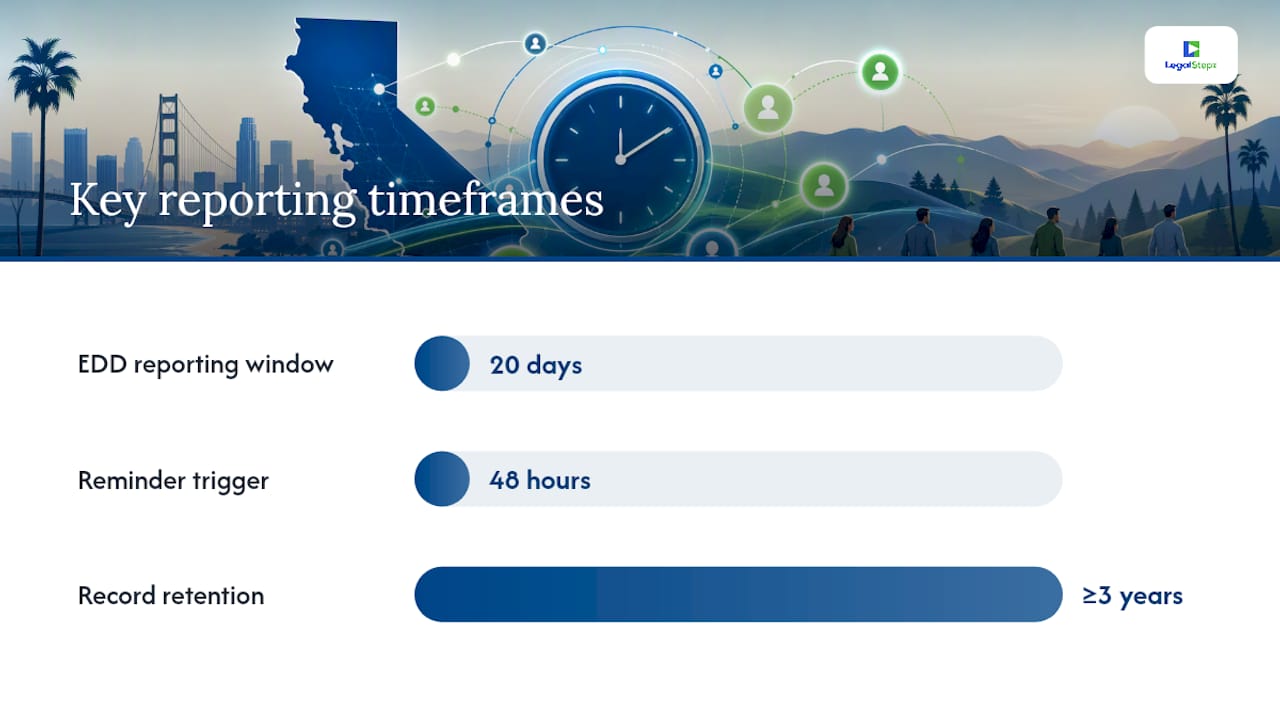
Every California employer must report newly hired and rehired workers to the EDD's New Employee Registry within 20 calendar days of the employee's start-of-work date. That deadline is firm, it counts calendar days (not business days), and missing it carries statutory penalties under Unemployment Insurance Code §1088.5.
Here is what to do in the next 48 hours if you have a new hire starting soon:
- Confirm the employee's start-of-work date (the first day services are performed for wages, not the offer date or signed paperwork date).
- Gather required employee data: full legal name, Social Security Number (SSN) or ITIN, home address, and start-of-work date.
- Gather required employer data: EDD payroll tax account number, Federal Employer Identification Number (FEIN), business name, address, and contact information.
- Choose your filing method: EDD e-Services for Business (recommended), paper DE 34 form, or a W-4 copy with required added fields.
- Assign one person or team as the responsible party for every new hire going forward.
- Confirm submission by saving the e-Services confirmation number or keeping a copy of the mailed or faxed DE 34.
Key Takeaways
California employers must report every new hire and qualifying rehire to the EDD New Employee Registry within 20 calendar days of the employee's start-of-work date, or face statutory penalties of $24 to $490 per violation.
| Point | Details |
|---|---|
| 20-calendar-day deadline | Report from the first day services are performed for wages, not the offer or paperwork date. |
| Required fields | Employee name, SSN, home address, start date; employer FEIN, EDD account number, business name and address. |
| Recommended filing method | Use EDD e-Services for Business for real-time validation and a confirmation record. |
| Penalty exposure | $24 per standard failure; $490 per intentional false or incomplete report under UIC §1088.5. |
| Multistate employers | Notify OCSS in writing before consolidating to one state; report California hires to California NER regardless. |
Table of Contents
- What does new hire reporting in California actually require?
- What information does the EDD require on each report?
- When do you have to file, and how do electronic filers handle the schedule?
- How do you actually file a new hire report?
- What if you have employees in multiple states?
- What are the penalties for missing a new hire report?
- How do you prevent filing errors and build a reliable process?
- Where do you find the forms and EDD contact information?
- An editorial perspective on getting this right
- Sources
What does new hire reporting in California actually require?
California's new hire reporting obligation applies to every employer with workers who perform services in the state. There are no size exemptions. A solo-employee startup and a 5,000-person corporation face the same rules under the California new hire law.
The obligation covers two categories of workers. First, any newly hired employee who has never worked for you before. Second, any rehired employee who was separated from your payroll for 60 or more consecutive days. That 60-day rehire rule catches a common gap: employers who skip reporting when a seasonal worker returns after a summer break or a contractor converts to W-2 status after a gap.
Independent contractors are also in scope. Under EDD guidance, you must report contractors expected to earn $600 or more in a calendar year, within the same 20-day window. This is the single most overlooked category in California hiring compliance. Many HR teams build a new-hire checklist around W-2 employees and never add a parallel step for 1099 contractors.
Common exceptions and edge cases:
- Employees rehired within 60 consecutive days of separation do not need a new report.
- Workers acquired through a business purchase who were already reported by the prior employer are generally not treated as new hires for reporting purposes (though confirming with your payroll counsel is advisable).
- Casual domestic workers in private homes may fall outside the standard employer definition, but any doubt should be resolved by checking EDD's employer definition directly.
- Temporary agency workers: the agency, as the employer of record, carries the reporting obligation, not the client business.
What information does the EDD require on each report?
The DE 34 form and the EDD's electronic system both require the same core fields. Missing even one can result in rejection or a penalty assessment.
Required employer fields:
Required employee fields:
| Field | Common HR System Label | Formatting Notes |
|---|---|---|
| Full legal name | Employee name | First, middle initial, last |
| Social Security Number | SSN / Tax ID | 9 digits, no dashes |
| Home address | Residential address | Street, city, state, ZIP |
| Start-of-work date | First day worked | MM/DD/YYYY |
Pro Tip: The start-of-work date is the first day the employee actually performs services for wages. Do not use the offer acceptance date, the I-9 completion date, or the date paperwork was signed. Using any of those alternative dates shifts your 20-day clock and can produce a late filing even when you thought you were on time.
When do you have to file, and how do electronic filers handle the schedule?
The deadline is 20 calendar days from the employee's start-of-work date, as defined by the DE 231Y information sheet. Calendar days means weekends and holidays count. If day 20 falls on a Sunday, file by that Sunday or earlier.
20 calendar days. That is the window from the first day an employee performs services for wages. Not business days. Not 20 days from the offer letter.
For rehired employees, the same 20-day rule applies, provided the separation was 60 or more consecutive days.
Employers who file electronically in bulk face an additional scheduling rule: transmissions must occur at least twice per month, with each transmission no less than 12 days and no more than 16 days apart. That structure prevents employers from batching all monthly hires into a single end-of-month file.
Quick deadline scenarios:
- Employee starts January 5: report due by January 25.
- Employee starts January 28: report due by February 17.
- Rehired employee returns March 10 after a 70-day absence: report due by March 30.
- Bulk electronic filer with hires on March 1 and March 20: first transmission by approximately March 13, second by approximately March 29 (12–16 days after the first).
The calendar-day rule catches employers who mentally convert to business days. Five business days of buffer can disappear fast during a busy onboarding week.
How do you actually file a new hire report?
There are three accepted methods. Each has a different workflow, and the EDD recommends one clearly.
Method 1: EDD e-Services for Business (recommended)
- Enroll at the EDD e-Services for Business portal if you have not already done so. Enrollment requires your EDD payroll tax account number.
- Log in and navigate to the "Report New Employee(s)" section.
- Enter all required employer and employee fields. The system validates fields in real time, which catches formatting errors before submission.
- Submit and save the confirmation number. That number is your proof of timely filing.
E-Services accepts individual entries and bulk file uploads. For employers with frequent hires, the bulk upload option supports common file formats and aligns with the two-transmission monthly schedule.
Method 2: Paper DE 34 form
- Download the DE 34 from the EDD website or order pre-printed forms for bulk use.
- Complete all employer and employee fields. Leave no field blank; incomplete forms are rejected.
- Mail to: Employment Development Department, P.O. Box 997016, West Sacramento, CA 95799-7016.
- Or fax to: (916) 319-4400.
Keep a copy of every completed DE 34 before mailing or faxing. Fax confirmation sheets serve as your submission record.
Method 3: W-4 copy with added fields
A copy of the employee's federal W-4 is acceptable, but only if you add three pieces of information that the W-4 does not contain by default:
- The employee's start-of-work date.
- Your EDD payroll tax account number.
- Your FEIN.
Write or stamp these fields clearly on the W-4 copy before submitting. Send to the same mailing address or fax number listed above.
Common rejection reasons to avoid:
- SSN entered with dashes (enter as 9 consecutive digits).
- Start-of-work date missing or entered as the hire paperwork date.
- EDD payroll tax account number absent on W-4 copies.
- Employee address incomplete (no ZIP code).
- Employer FEIN missing or formatted incorrectly.
To correct a previously submitted report, contact the EDD New Employee Registry directly. For e-Services submissions, log in and use the amendment function. For paper submissions, resubmit a corrected DE 34 with a note indicating it is an amendment, and include the original submission date.
What if you have employees in multiple states?
Multistate employers have a choice, but it comes with a condition. You may designate a single state to receive all your electronic new hire reports, rather than filing separately in each state where employees work. The catch: you must notify the U.S. Department of Health and Human Services' Office of Child Support Services (OCSS) in writing before using that consolidated approach.
If you designate another state and skip the OCSS notification, you remain legally responsible for filing in every state where your employees work, including California.
California's EDD encourages employers to report California hires directly to the California New Employee Registry regardless of your multistate strategy. Doing so keeps your California data current with state child support agencies and avoids reconciliation friction when DCSS runs matches against the registry.
Action checklist for multistate employers:
- Decide whether to use consolidated single-state reporting or state-by-state filing.
- If consolidating, submit written notification to OCSS before your first consolidated transmission.
- Document your decision internally with the date and the designated state.
- If California is not your designated state, confirm that California hires are still being captured and reported somewhere in your system.
- Review the California Foreign Corporation Registration Checklist if you are an out-of-state employer with California hires who also need to address registration and tax compliance.
Pro Tip: Even if you designate another state for consolidated reporting, consider running a parallel report for California hires directly to the California NER. The administrative cost is low, and it eliminates the risk of a data mismatch triggering a child support enforcement inquiry against one of your employees.
What are the penalties for missing a new hire report?
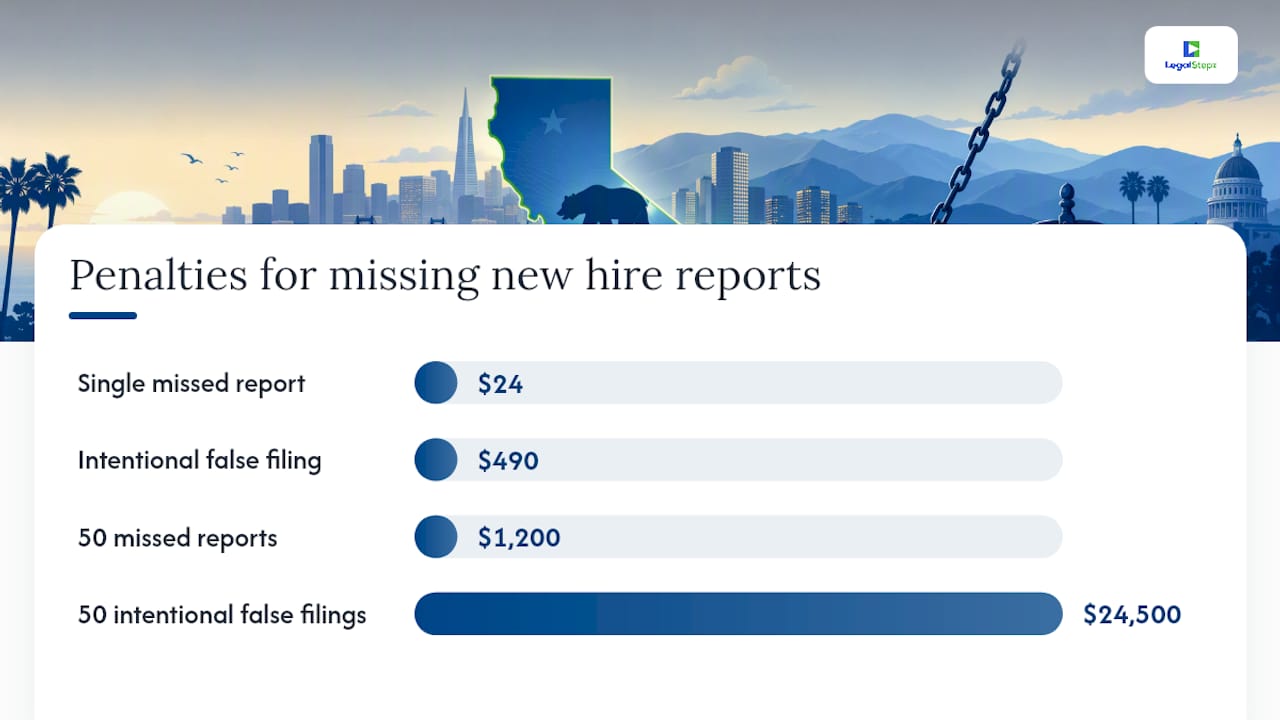
Unemployment Insurance Code §1088.5 sets two penalty tiers. A standard failure to report costs $24 per violation. Intentional conspiracy to avoid reporting, or submitting false or incomplete reports deliberately, carries a penalty of $490 per violation.
Those numbers look modest in isolation. Run the math on a mid-size employer with 50 new hires in a quarter and a broken reporting process: 50 failures at $24 each equals $1,200 in a single quarter. If any of those failures involve intentional false reporting, the exposure jumps to $24,500 for the same 50 hires.
$24 per missed report. $490 per intentional false or incomplete filing. Both figures come directly from California Unemployment Insurance Code §1088.5.
The registry exists primarily to enforce child support obligations. State and county child support agencies run new hire data against their caseloads to locate non-custodial parents and initiate or enforce income withholding orders. That data also feeds the National Directory of New Hires, which supports cross-state matching when a parent and child live in different states. Because child support enforcement agencies actively use this data, audits and penalty assessments are not theoretical. Employers who miss filings are typically discovered through routine data matching, not random audits.
EDD notifies employers of violations by mail. Late or missing filings surface when the registry's matching process flags an employee whose income withholding order is active but whose employer has no corresponding new hire report on file. The annual filing obligations context is useful here: California takes its employer reporting requirements seriously across the board, and new hire reporting sits in the same enforcement framework.
How do you prevent filing errors and build a reliable process?
The most common mistakes in California new hire reporting are not complicated. They are process gaps that compound over time.
Top filing errors:
- Using the offer date or I-9 date as the start-of-work date, which shifts the 20-day clock incorrectly.
- Entering SSNs with dashes, which causes electronic rejections.
- Submitting a W-4 copy without adding the EDD payroll tax account number, FEIN, and start-of-work date.
- Filing late during high-volume onboarding periods (January and September are the most common crunch months).
- Forgetting to report independent contractors expected to earn $600 or more.
Payroll integration best practices:
Map your HR system fields to EDD required fields before your first hire. Most payroll platforms (including those that generate W-2s and 1099s) have a new hire reporting module or can export a file compatible with e-Services. Test that export with a sample record before relying on it for live hires.
Set a calendar reminder to trigger within 48 hours of each employee's start-of-work date. That buffer gives you time to catch a missing SSN or address before the clock runs out. For California business recordkeeping, retain submission confirmations, copies of every DE 34 or W-4 copy filed, and an internal log of each report for at least three years.
Pro Tip: Assign one named person, not a team or a role, as the owner of new hire reporting. When responsibility is shared, reports fall through the cracks during vacations and turnover. Put the owner's name in your onboarding SOP and review the assignment annually.
Quick onboarding SOP checklist:
- Confirm start-of-work date with hiring manager on day one.
- Pull SSN and home address from onboarding paperwork.
- Log into e-Services and submit within 48 hours of start date.
- Save confirmation number in the employee's HR file.
- Flag any contractor engagements expected to exceed $600 for parallel reporting.
Where do you find the forms and EDD contact information?
Key EDD resources:
- New Employee Registry page: overview, filing options, and multistate guidance.
- DE 34 form PDF: downloadable paper form with submission instructions.
- EDD e-Services for Business: enrollment and electronic filing portal.
- DE 231Y information sheet: plain-language summary of federal and state reporting requirements, required fields, and deadlines.
- Step 4: Report Employees and Independent Contractors: EDD's employer onboarding guide covering both W-2 and 1099 reporting.
Mailing address for DE 34: Employment Development Department, P.O. Box 997016, West Sacramento, CA 95799-7016
Fax number for DE 34: (916) 319-4400
EDD New Employee Registry phone: (916) 657-0529
California Department of Child Support Services (DCSS): DCSS uses NER data for income withholding and child support enforcement. Their guidance on employer obligations is available at childsupport.ca.gov.
Federal resource: The federal Office of Child Support Services maintains the National Directory of New Hires and publishes guidance for multistate employers on consolidated reporting and OCSS notification procedures.
An editorial perspective on getting this right
Most California employers treat new hire reporting as a checkbox buried in onboarding paperwork. That framing is what causes the problems. The 20-day deadline is tight, the contractor reporting requirement is genuinely underappreciated, and the penalty structure rewards consistent process over reactive scrambling.
The operational setup that works for small and medium employers is simpler than most think: one named owner, one trigger (48 hours from start-of-work date), and e-Services as the default channel. Paper DE 34 forms are fine for occasional use, but any employer with more than a handful of hires per year should be using e-Services. The real-time field validation alone prevents the SSN and date errors that generate the bulk of rejected reports.
For employers building out their first formal HR process, the question of who owns reporting connects directly to broader governance questions: who signs off on payroll, who manages onboarding documentation, and who is accountable when something is missed. Legalstepz helps California businesses get that structure right from the start, from corporate officer documentation to compliance filings, so reporting obligations like this one have a clear owner before the first hire walks in the door.
The multistate employer situation deserves more attention than it typically gets. Designating a single state for consolidated reporting sounds administratively convenient, but the OCSS notification requirement is a hard legal step, not a suggestion. Employers who consolidate without notifying OCSS are exposed in every state where they have employees, including California.
Sources
Check these EDD pages periodically, as procedures and form versions are updated without broad announcement:
- California's New Employee Registry - EDD - CA.gov
- California Code, UIC 1088.5.
- Information Sheet: Reporting New Employees and Independent Contractors (DE 231Y) Rev. 15 (5-22)
- DE 34: Report of New Employee(s) (DE 34) Rev. 10 (3-17) (INTERNET) Page 1 of 2
- Step 4: Report Employees and Independent Contractors - EDD
This article provides general compliance information about California new hire reporting requirements. It is not legal advice. Confirm current rules and procedures with the EDD directly or consult a qualified employment attorney or payroll professional for your specific situation.
This article is general information, not a substitute for advice from a qualified lawyer. Consult a qualified legal professional about your own circumstances before acting on anything here.