

Personal asset protection is the legal practice of separating your private wealth from your business liabilities so that creditors, lawsuits, and judgments cannot reach your home, savings, or retirement accounts. California entrepreneurs face some of the most aggressive creditor laws in the country, making this separation not optional but necessary. The right business structure for protection combined with insurance, disciplined recordkeeping, and fast legal responses creates a layered defense that holds up in court. Retirement accounts in California are exempt from creditor claims under Code of Civil Procedure Section 704.115, but that protection only covers one slice of your personal wealth.
What legal structures best protect personal assets in California businesses?
The legal entity you choose is the foundation of every asset protection strategy. Without the right structure, every dollar you own is exposed to every business debt you carry.
LLCs: the most common shield for California owners
A California LLC creates a corporate veil between your business debts and your personal bank accounts. Courts will respect that veil as long as you maintain corporate formalities and keep finances strictly separated. The moment you mix personal and business funds, a creditor can argue the LLC is a fiction and pierce straight through to your personal assets. For most small business owners, the LLC is the right starting point because it combines liability protection with flexible tax treatment.

Corporations and trusts as additional layers
A C corporation or S corporation offers similar liability protection but requires more formal governance, including a board of directors, annual meetings, and documented resolutions. That added structure is not just paperwork. It actually strengthens your legal defense because courts see a well-governed corporation as a genuine separate entity. Irrevocable trusts and domestic asset protection trusts add a third layer by removing assets from your personal ownership entirely, placing them beyond the reach of future creditors. Trusts work best for real estate, investment accounts, and other high-value assets that sit outside your operating business.
Pro Tip: Forming an LLC is only half the job. Funding your assets into the correct entity matters just as much. Errors in funding leave assets vulnerable even when the paperwork looks perfect.
- LLC: Flexible, tax-efficient, and the most common choice for California small businesses
- S corporation: Offers liability protection plus potential payroll tax savings for profitable businesses
- C corporation: Best for businesses seeking outside investment; requires strict governance
- Irrevocable trust: Removes assets from personal ownership; strongest protection but least flexibility
- Domestic asset protection trust: Allows the grantor some benefit while shielding assets from future creditors
Choosing the right entity is not a one-size-fits-all decision. A business attorney and a CPA working together will give you a structure that fits your income, your risk profile, and your long-term goals. Legalstepz helps California owners choose the right LLC structure and handles the formation filings that make protection real.
How does business liability insurance complement asset protection?
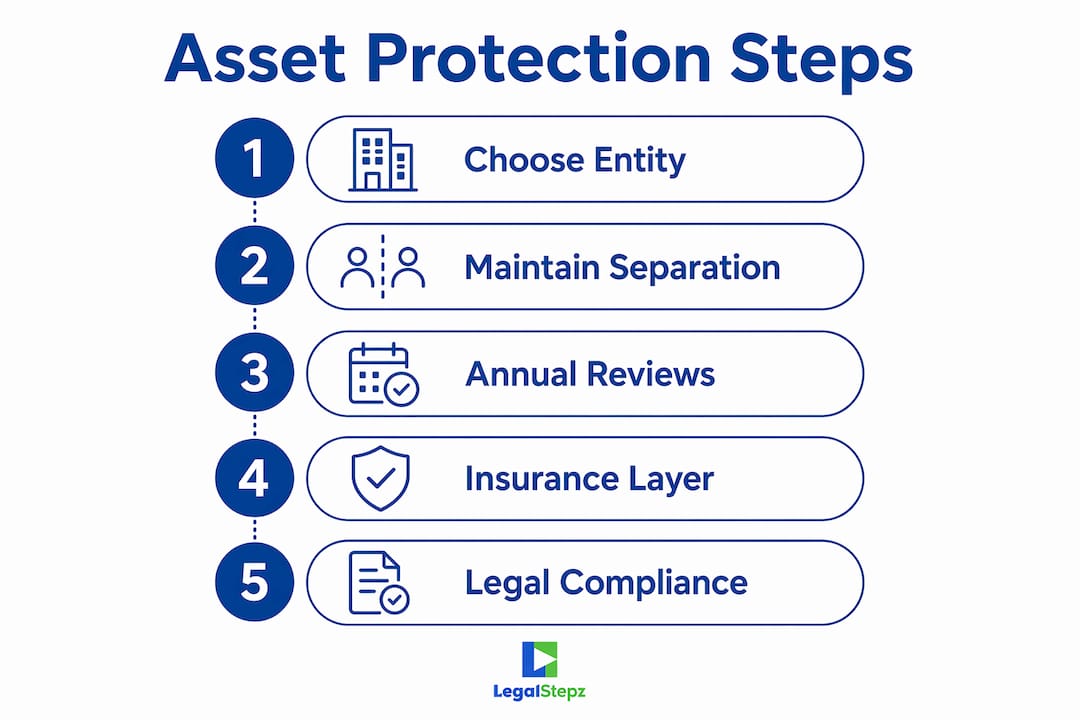
Insurance is the financial layer that sits in front of your legal entity. When a claim arises, insurance pays first. Your LLC or corporation only comes into play if the claim exceeds your coverage or falls outside your policy.
What California business liability insurance actually covers
General liability insurance in California covers up to $1–2 million in aggregate for third-party bodily injury and property damage claims. That range covers the majority of slip-and-fall lawsuits, client property damage claims, and advertising injury disputes that small businesses face. Monthly premiums can start as low as $19 for low-risk businesses, which means the cost of protection is far lower than most owners expect. Professional liability insurance, also called errors and omissions coverage, protects service-based businesses against claims of negligence or bad advice.
- General liability: Covers bodily injury, property damage, and advertising injury
- Professional liability: Covers negligence claims against consultants, accountants, and other service providers
- Commercial umbrella: Extends coverage limits above your primary policy when a claim is unusually large
- Business owner's policy (BOP): Bundles general liability and commercial property coverage at a lower combined premium
Why insurance alone is not enough
Insurance does not replace structural asset protection. Every policy carries exclusions, and coverage limits can be exhausted by a single large judgment. A contractor facing a $3 million construction defect claim with a $1 million policy still has a $2 million gap. That gap is where your legal entity structure must hold. The combination of insurance plus a properly maintained LLC or corporation gives you two lines of defense instead of one.
What practical steps maintain separation between personal and business assets?
The corporate veil does not maintain itself. Courts look at your actual behavior, not just your formation documents, when deciding whether to pierce your entity protection.
- Open a dedicated business bank account. Every dollar of business revenue goes in, and every business expense comes out. Personal transactions never touch this account.
- Get a separate business credit card. Using a personal card for business expenses creates a paper trail that creditors use to argue commingling.
- Pay yourself a formal salary or distribution. Transfers from the business account to your personal account should follow a documented process, not happen randomly.
- Keep accurate meeting minutes and resolutions. California courts expect LLCs and corporations to document major decisions. Legalstepz drafts annual minutes and resolutions that satisfy this requirement.
- File your Statement of Information on time. California requires LLCs to file every two years and corporations annually. Missing this filing weakens your standing as a legitimate entity.
- Review and update your bylaws annually. Bylaws that reflect your current operations show courts that your entity is real and active.
Pro Tip: Set a calendar reminder every january to audit your business accounts, review your entity filings, and confirm your insurance coverage limits. One hour a year prevents years of legal exposure.
Proper business bylaws are not just a formality. They define how your business makes decisions, which directly affects whether a court treats your entity as a genuine legal barrier. Skipping this step is one of the most common and most expensive mistakes California business owners make.
What legal deadlines must California business owners meet to protect personal assets in lawsuits?
Speed is a legal asset. Missing a deadline in California litigation can permanently destroy protections that took years to build.
"California business owners have a strict 30-day window to respond to a lawsuit after being served. Missing that deadline results in a default judgment that immediately exposes personal assets to creditor claims, regardless of how well your entity was structured."
The 30-day response window to file an Answer or Demurrer is not negotiable. A default judgment bypasses every legal protection you have built and gives the creditor direct access to your personal accounts and property. The second critical deadline is the 10-day window to file a Claim of Exemption after receiving a bank levy notice. Missing that window means the funds are gone permanently.
- Day 1: Lawsuit served. Start the 30-day clock immediately.
- Day 1–10: Bank levy notice received. File Claim of Exemption within 10 days or lose the funds.
- Ongoing: Request discovery from the creditor. Many creditors cannot produce original loan documents, which opens defense opportunities.
- Throughout: Use California's eFiling system to submit documents quickly and get confirmation of receipt.
The discovery process is an underused defense tool. Demanding that a creditor produce original loan agreements, payment histories, and assignment records often reveals gaps in their case. Those gaps create negotiating leverage and sometimes result in reduced settlements or dismissed claims.
Common mistakes that expose personal assets in California
Most asset protection failures are not caused by bad luck. They are caused by predictable, avoidable errors.
Asset protection is a coordinated architecture, not a single document. Owners who form an LLC and then ignore it for five years discover that courts treat the entity as a shell. The protection was real on paper but nonexistent in practice.
The most damaging mistake is transferring assets after a lawsuit is filed or threatened. California courts treat those transfers as fraudulent conveyances and reverse them, leaving you worse off than if you had done nothing. Protection must be built before legal or financial pressure arrives.
- Mixing personal and business finances: The single most common reason courts pierce the corporate veil
- Waiting until a lawsuit to create protections: Transfers made under legal threat are fraudulent conveyances under California law
- Skipping annual reviews: Laws change, your wealth changes, and your protection structure must keep pace
- Underfunding insurance: A policy limit that made sense three years ago may leave a dangerous gap today
- Ignoring entity maintenance: Expired filings, outdated bylaws, and missing minutes all weaken your legal defense
Annual plan reviews are not optional maintenance. They are the mechanism that keeps your protection current as your business grows, your assets increase, and California law evolves. Owners who skip reviews often discover gaps only when a creditor finds them first.
Key Takeaways
Protecting personal assets from California business liabilities requires a coordinated strategy built on the right legal entity, adequate insurance, strict financial separation, and fast responses to legal deadlines.
| Point | Details |
|---|---|
| Choose the right entity | An LLC or corporation creates the legal barrier between business debts and personal wealth. |
| Layer insurance on top | General liability coverage starting at $19/month provides the first financial line of defense. |
| Maintain strict separation | Separate accounts, formal minutes, and timely filings keep the corporate veil intact in court. |
| Act fast on legal deadlines | A 30-day lawsuit response window and a 10-day levy exemption window are non-negotiable in California. |
| Plan before pressure arrives | Asset transfers made after a lawsuit is filed can be reversed as fraudulent conveyances under California law. |
What I've learned after years of watching California owners get this wrong
The most common mistake I see is not the absence of an LLC. Most California business owners have one. The mistake is treating formation as the finish line instead of the starting line.
I have seen owners with perfectly formed LLCs lose personal asset protection because they used one bank account for everything, skipped two years of annual minutes, and never updated their bylaws after adding a business partner. A creditor's attorney found all three gaps in discovery and the court agreed the veil should be pierced. The LLC existed. The protection did not.
The second pattern I see constantly is reactive planning. An owner gets served with a lawsuit, calls an attorney, and asks what they can do right now to protect their house. The honest answer is: not much. The window for meaningful protection closed the moment the legal threat appeared. Everything built after that point is a fraudulent conveyance risk.
The owners who come out of litigation with their personal assets intact are the ones who built their structure years before they needed it, reviewed it annually, and treated their LLC like a real company rather than a filing cabinet. They also had attorneys and CPAs working together, not separately. A CPA who does not know your entity structure and an attorney who does not know your tax situation will each give you half an answer. You need both perspectives in the same conversation.
— Peter
How Legalstepz helps California business owners stay protected
California business owners who want real protection need more than a formation document. They need ongoing compliance that keeps their entity legally sound year after year.

Legalstepz handles the filings and documentation that make protection real: Statements of Information, annual meeting minutes, bylaws, and registered agent services that keep your entity in good standing with the California Secretary of State. Every service is available at flat pricing with no hidden fees. Visit Legalstepz to see how California entrepreneurs use these services to maintain the legal separation that protects their personal wealth.
FAQ
What is the fastest way to protect personal assets in California?
Forming an LLC or corporation immediately separates your personal liability from business debts. Pair that with a dedicated business bank account and general liability insurance to create protection from day one.
Can an LLC be pierced in California?
Yes. Courts pierce the corporate veil when owners mix personal and business finances, skip annual filings, or fail to maintain meeting minutes. Strict separation and proper documentation prevent this outcome.
What happens if I miss the 30-day lawsuit response deadline?
A default judgment is entered against you, giving the creditor direct access to your personal assets regardless of your entity structure. Filing an Answer or Demurrer within 30 days is the only way to prevent this.
Does business liability insurance protect my personal assets?
Insurance pays claims up to its policy limit, reducing the chance a judgment reaches your personal wealth. Coverage exclusions and limits mean insurance must be combined with a legal entity structure for complete protection.
When is it too late to protect personal assets in California?
Transferring assets after a lawsuit is filed or threatened is treated as a fraudulent conveyance under California law and can be reversed by a court. Effective protection must be built before legal or financial pressure arises.