

Yes. California expects the person or company you name as your registered agent to actually agree to the job before you file, even though the Secretary of State doesn't require you to submit a separate consent form with most filings. Get a signed acceptance from your agent, keep it in your records, and only then file your Form LLC-1 or Articles of Incorporation. Skip that step and you risk a rejected filing or an agent who ignores a lawsuit notice.
TL;DR:
- Naming an agent without obtaining their prior written consent risks rejection of your formation documents and potential legal issues if they do not accept the role.
- The agent’s consent must be documented with a signed form or email and kept in your internal records to prove the appointment if questioned.
- Individual agents must be California residents with a physical street address and be available during business hours, while corporate agents need a filed certificate under Corporations Code §1505.
- Changing your registered agent requires obtaining written acceptance first and filing a Statement of Information, with timely updates preventing service lapses.
- Using a corporate agent can protect privacy by keeping your personal address off public records, but the agent’s address and certification must be verified before designation.
Table of Contents
- Why a Registered Agent's Consent Actually Matters
- Who Can Legally Serve as a Registered Agent in California?
- How to Get and Document Consent From Your Registered Agent
- Forms, Filing Steps, and Fees for Recording Your Agent
- Changing Your Registered Agent Without Creating Legal Gaps
- Protecting Your Privacy When Naming an Agent
- What Incorporators Get Wrong About Agent Consent
- How Legalstepz Handles Agent Consent, Filings, and Privacy for You
- Where to Verify Current Forms and Fees
- Sources
- FAQ
Why a Registered Agent's Consent Actually Matters
A registered agent is the person or company legally designated to accept lawsuits, subpoenas, and official state notices on behalf of your LLC or corporation. If someone sues your business, the agent is the one who gets served, and what happens next depends entirely on whether that agent is paying attention.
That's the whole reason consent matters. Naming someone as your agent without asking first creates a real gap: if they don't know they've been listed, they won't be watching for a certified letter or a process server at the door. A missed service notice can turn into a default judgment against your company before you even know a case exists.
There's also a public-record dimension. Once you file, the agent's name (and, for an individual agent, their street address) becomes part of a searchable state record. Anyone can pull it up through bizfileOnline. That's permanent exposure for whoever agrees to the role, which is exactly why the agreement should happen before the filing, not after.
A reliable agent needs to handle a few core things without fail:
- Accept service of process during normal business hours, every business day
- Forward legal documents to you immediately, not "when I get around to it"
- Maintain a real street address in California that matches state records
- Stay reachable and update the state if their address or status changes
Legalstepz's overview of registered agent responsibilities breaks down how these duties play out over the life of a business, not just at formation.
Who Can Legally Serve as a Registered Agent in California?
California splits eligible agents into two categories, and the rules differ sharply between them.
An individual agent must be at least 18 years old, a California resident, and listed with a physical street address inside the state. P.O. boxes are explicitly prohibited, because the whole point of the role is being physically reachable for service of process. The agent also needs to be available during standard business hours, which rules out someone who travels constantly or works odd shifts with no backup coverage.
The second category is a corporate agent operating under Corporations Code §1505. These are companies that have filed a certificate with the Secretary of State specifically authorizing them to act as registered agents for other businesses. Once that certificate is on file, only the corporate agent's name appears on your formation documents. Its address stays off your public filing, which is a meaningful privacy advantage over listing an individual.

A §1505 corporate agent must have that certificate filed before you can legally designate it as your agent. Advance approval isn't optional. You can't just decide a company will serve as your agent and list them; the state needs that certificate on record first, or your filing can get bounced back.
Here's the practical takeaway on eligibility:
- Individual agents: 18+, California resident, physical address, no P.O. boxes
- Corporate agents: must have a filed §1505 certificate before designation
- A business generally cannot serve as its own agent unless it separately qualifies as a §1505 corporate agent
How to Get and Document Consent From Your Registered Agent
Getting consent right isn't complicated, but skipping it creates problems that surface months or years later, usually at the worst possible time. Here's the sequence that holds up.
- Ask for explicit, written acceptance before you file anything. A signed consent form or even a signed email works. Make sure it includes the agent's full legal name, their street address, the exact entity name they're agreeing to represent, a clear statement of acceptance, and a signature with a date.
- If you're using a §1505 corporate agent, confirm their certificate status directly. Don't take a sales page at face value. Check that the corporate agent's certificate is actually on file with the Secretary of State before you list them, since advance approval from a registered corporate agent is required prior to designation.
- Attach the consent record to your formation package and keep a copy in your internal files. Don't rely on a verbal "yes, that's fine." A phone call agreement leaves you with nothing to show if the agent later claims they never agreed, or if a court asks whether service was properly directed.
For your internal records, a simple checklist covers the essentials: scan the signed consent, save it to your entity binder, back it up to cloud storage, and log the agent's current phone number and email alongside the physical address on file. Legalstepz's guide on the registered agent role walks through how this fits into broader recordkeeping for California entities.
Remote acceptance is common and generally fine. A scanned signature or a DocuSign document holds up as well as a wet-ink signature, as long as the document itself contains the required fields and a clear date. What matters is that the acceptance existed before you submitted your formation paperwork, not that you got it notarized.
Pro Tip: Keep the signed consent in the same folder as your Articles of Incorporation or LLC-1 confirmation. If a court clerk or opposing counsel ever questions whether your agent actually agreed to the role, you want that document one click away, not buried in an old email thread.
Forms, Filing Steps, and Fees for Recording Your Agent
Your registered agent gets recorded at two different points: when you form the entity, and any time afterward that you need to change who's listed.
At formation, LLCs list their initial agent directly on Form LLC-1. Corporations list theirs on the Articles of Incorporation. Both forms ask you to specify whether the agent is an individual (name plus California street address) or a corporate agent (name only, since the corporate agent's own address stays off your filing).
To change agents later, you file a Statement of Information. LLCs use Form LLC-12; corporations file the equivalent corporate Statement of Information. Both LLCs and corporations owe an initial Statement of Information within 90 days of formation, then on a recurring biennial schedule after that. The typical filing fee referenced in practice guides sits around $20, though you should always confirm the current fee on the Secretary of State's own forms page before submitting.
| Filing task | Form | When it's due |
|---|---|---|
| Initial agent designation (LLC) | Form LLC-1 | At formation |
| Initial agent designation (corporation) | Articles of Incorporation | At formation |
| Agent change / update (LLC) | Statement of Information (LLC-12) | Within 90 days of formation, then biennially |
| Agent change / update (corporation) | Corporate Statement of Information | Within 90 days of formation, then biennially |
You have three filing routes available:
- bizfileOnline, the Secretary of State's online filing portal, which is the fastest option for most filers
- Mail submission to the Secretary of State's office
- In-person drop-off for certain documents
One detail that trips people up: an individual agent's street address shows up on the public record tied to your entity, while a §1505 corporate agent's address never appears there at all, only its name does. If privacy matters to you, that difference alone often decides which type of agent makes sense.
Changing Your Registered Agent Without Creating Legal Gaps
Switching agents happens for plenty of reasons: your old agent moved out of state, retired from the role, or you simply want the privacy a professional agent offers. The process itself is straightforward if you follow it in order.
- Get written acceptance from the new agent first, using the same standard you used at formation: signed document, full legal name, address, and a clear statement of acceptance.
- File a Statement of Information reflecting the new agent's information, through bizfileOnline, by mail, or in person.
- Confirm the filing processed by checking your entity's status on the Secretary of State's portal, then update your own internal records and binder to match.
Timing varies by method. Online filings through bizfileOnline typically process faster than mailed documents, though exact turnaround depends on current state processing volume. Until the state processes your update, your old agent technically remains the agent of record, so don't let a gap sit unresolved for weeks while you're "getting around to it."
Failing to keep this current carries real consequences. If your listed agent has moved, quit, or stopped answering the door, a lawsuit against your company can proceed to a default judgment without you ever knowing it was filed. The state can also move toward administrative dissolution or suspend your good standing if agent information lapses long enough. Recovering from that means filing back paperwork, paying reinstatement fees, and in some cases explaining the gap to a court. Legalstepz's rundown of common agent change mistakes covers the specific errors that lead to these situations.
Protecting Your Privacy When Naming an Agent
An individual registered agent's home or office address becomes part of a public, searchable state record, and it stays there for as long as that person holds the role. The Secretary of State's own FAQ page acknowledges this exposure directly, which is exactly why so many small business owners hesitate before listing themselves.
A §1505 corporate agent solves this. Since only the corporate name appears on your public filing, your personal address never enters the record at all. Professional registered agent services build their entire business model around this distinction, treating address privacy and reliable mail handling as the core value they offer.
A few practical notes if you're weighing your options:
- A rented mailbox or virtual office generally won't satisfy the physical street address requirement for an individual agent
- Using your home address works legally, but it's permanent public information the moment you file
- A §1505 corporate agent keeps its own address on file with the state instead of yours
Pro Tip: If you're running your business from home, don't default to listing yourself as agent just because it's free. Weigh the $20 or so a professional agent service typically costs against having your home address permanently searchable by anyone, including people you'd rather not have that information. Legalstepz's deeper look at registered agent privacy walks through the trade-offs in more detail.
What Incorporators Get Wrong About Agent Consent
The most common mistake isn't malicious. It's assumption. Owners name a friend, a relative, or themselves as agent without ever confirming that person understands what the role requires, especially the part about being reachable during business hours, every business day. The second most common error is address confusion, listing a P.O. box or a co-working space that doesn't qualify as a proper street address.
Before you file anything, run through this: confirm the agent has agreed in writing, confirm the address is a real street address (not a box), and confirm the entity name on the consent form matches exactly what's going on your Articles or LLC-1.
— Peter
How Legalstepz Handles Agent Consent, Filings, and Privacy for You
If you're forming a California LLC or corporation and would rather not chase down consent forms, monitor 90-day deadlines, and track biennial Statement of Information cycles yourself, Legalstepz picks up that work directly.
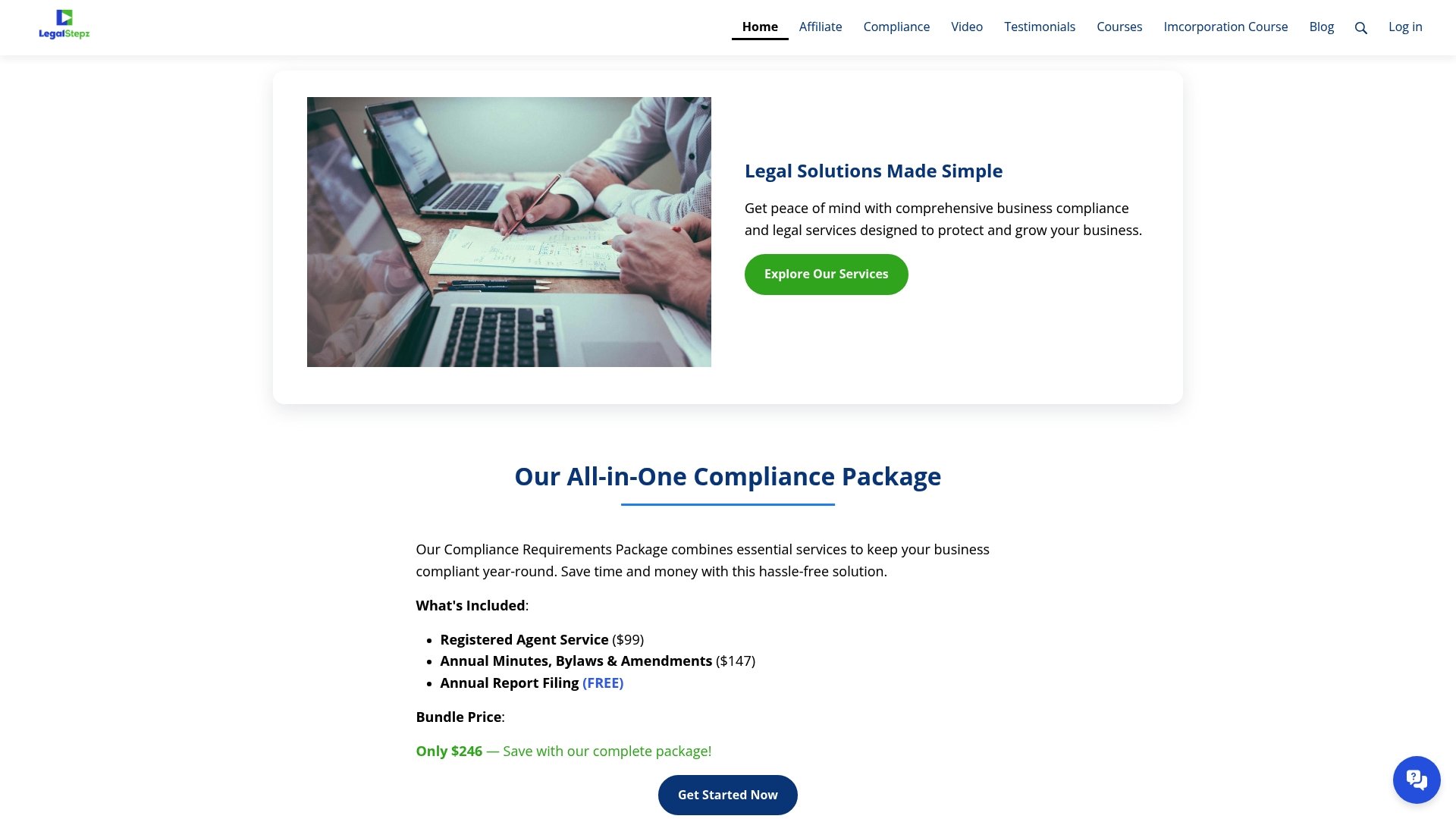
Some registered agent services keep your personal address off the public record from day one, handle Statement of Information filings before deadlines slip, and can draft the corporate minutes and bylaws that go alongside a properly maintained entity. That combination matters because agent consent and ongoing compliance aren't separate problems. Missing one filing deadline creates the same exposure as skipping consent in the first place. If you're building out your compliance workflow more broadly, Legalstepz's approach mirrors how legal offices manage intake and recordkeeping, a model outlined well in this overview of compliance-focused legal support tasks.
Head to Legalstepz to see the current compliance and registered agent packages and get your entity's paperwork handled correctly from the start.
Where to Verify Current Forms and Fees
Before you file anything, confirm the details directly with the state rather than relying on secondhand summaries, including this one.
- The Secretary of State's FAQ page covers agent qualification rules and §1505 corporate agent requirements in the state's own language.
- bizfileOnline is the official portal for filing Form LLC-1, Articles of Incorporation, and Statements of Information.
- The business entity forms page hosts current PDF forms and fee schedules, including Form LLC-12.
Sources
- Frequently Asked Questions :: California Secretary of State
- bizfileOnline
- Business entity forms :: California Secretary of State
- California Registered Agent: Requirements & Cost (2026) | LegalGlass
FAQ
Is a Registered Agent Required in California?
Yes. Every LLC and corporation formed in California must designate a registered agent for service of process on its formation filing, and that designation stays current only if you file updates through the Statement of Information process.
Can My Registered Agent Be Located in Another State?
No. An individual registered agent must be a California resident with a physical street address inside the state; a business entity acting as agent must qualify as a §1505 corporate agent registered with the California Secretary of State.
What Is a California Registered Corporate Agent?
A registered corporate agent is a company that has filed a certificate under Corporations Code §1505, allowing it to accept service of process on behalf of other businesses without listing its address on each client's public filing.
Can I Be My Own Registered Agent for My LLC in California?
Yes, as long as you're a California resident, at least 18, and willing to list a physical street address on the public record during normal business hours. Many owners choose a professional agent instead specifically to keep that address private, a service often included in compliance packages offered by various providers.