

To resign as a registered agent, you file the state's prescribed resignation form or statement with the Secretary of State and give the entity the notice its statute requires. Your liability typically ends on the filing date or after a statutory waiting period, commonly 31 days. Keep proof of both the filing and the notice, since that paperwork is what protects you if the entity later claims it never got word.
TL;DR:
- All states require verifying the entity's current name and file number before submitting a resignation to avoid rejection delays.
- Most jurisdictions enforce a 31-day effective waiting period after filing, during which the entity can appoint a new registered agent to prevent legal gaps.
- Certain states, like California and Washington, process resignations online with instant confirmation, while others rely on mail or in-person filings with varying fees.
- Filing forms and notice procedures differ considerably; some states mandate specific templates or forms, while others accept general written statements meeting statutory requirements.
- The entity must promptly file an amended statement or change-of-agent form after resignation to avoid penalties and ensure continuous legal compliance.
Table of Contents
- Quick Step Checklist Any Resigning Agent Should Follow Now
- How Do State Rules Differ on Registered Agent Resignation?
- State Form Examples and Step-by-Step Filing
- When Does Your Liability as Registered Agent Actually End?
- What the Entity Must Do Next to Avoid Penalties
- Checklist and Sample Resignation Wording
- Common Mistakes and Red Flags That Cause Rejections
- How Legal Stepz Handles Registered Agent Resignations
- When to Handle This Yourself and When to Get Help
- Get Your Registered Agent Resignation Filed Correctly
- Sources
Quick Step Checklist Any Resigning Agent Should Follow Now
Every registered agent resignation follows roughly the same skeleton, no matter which state you're filing in.
- Verify the entity's exact legal name and file number. Pull it from the state's business search tool, not from memory or an old file. A typo here is the single most common reason a resignation gets bounced back.
- Complete the correct form or written statement. Some states name a specific form (California's RA-100, Texas's Form 402); others accept a signed statement that meets statutory language requirements. Use the one your state actually requires.
- Notify the entity at its address on file, then file with the Secretary of State inside any timing window the state sets. Texas, for example, requires the filing officer to receive your notice within 11 days of the entity being notified, under Tex. Bus. Orgs. Code §5.204.
- Keep proof of everything. Certified mail receipts, tracked delivery confirmations, and the Secretary of State's filing acknowledgment all matter if a dispute surfaces later.
Skipping step one is how otherwise clean resignations end up stuck in rejection limbo for weeks. A mismatched entity name or an outdated file number sends the filing back to square one, and now you're refiling under a deadline you may have already missed.
Pro Tip: Screenshot or save a PDF of the state's business search result showing the entity's current name and file number on the day you file. If the entity changes its name later, you'll have dated proof you had the correct information at the time.
This sequence works whether you're a professional registered agent service resigning from dozens of accounts or a small business officer stepping down as your own company's agent. The order matters. Notify, then file, then document. Reverse that order and you risk a technical defect that a court or the Secretary of State could later use against you.
How Do State Rules Differ on Registered Agent Resignation?
No single federal standard governs registered agent resignation. Every state runs its own process, and the differences aren't cosmetic. They change your timeline, your paperwork, and exactly when your legal exposure ends. Before you file anywhere, check four things: the notice requirement, the effective-date rule, whether a named form is mandatory, and the filing route available to you.
Notice requirements vary in who gets told and how fast. Most states require you to notify the entity itself, not just the state. Texas is explicit about the sequence: you notify the entity first, then the filing officer must receive your notice before the 11th day after that, per Tex. Bus. Orgs. Code §5.204. Miss that window and you may need to restart the notice clock. Other states are looser about sequencing but still expect the entity to receive some form of written notice before or around the time you file with the state.
Effective-date rules split into two camps. Some states make your resignation effective the moment the Secretary of State accepts your filing. Others build in a waiting period, most commonly 31 days, so the entity has a real window to appoint a replacement before it is left without an agent of record. Washington follows the latter model: a resignation filed through the state's online system takes effect 31 days after filing, or sooner if the entity names a new agent before that, according to WAC 434-112-055. Texas uses the same 31-day effective window once the filing officer has received notice.
That 31-day buffer exists for a reason. Without it, an entity could lose its registered agent overnight with zero warning, which creates a gap where lawsuits and official state mail have nowhere valid to land. The waiting period gives the entity a fair shot at compliance instead of instant exposure.
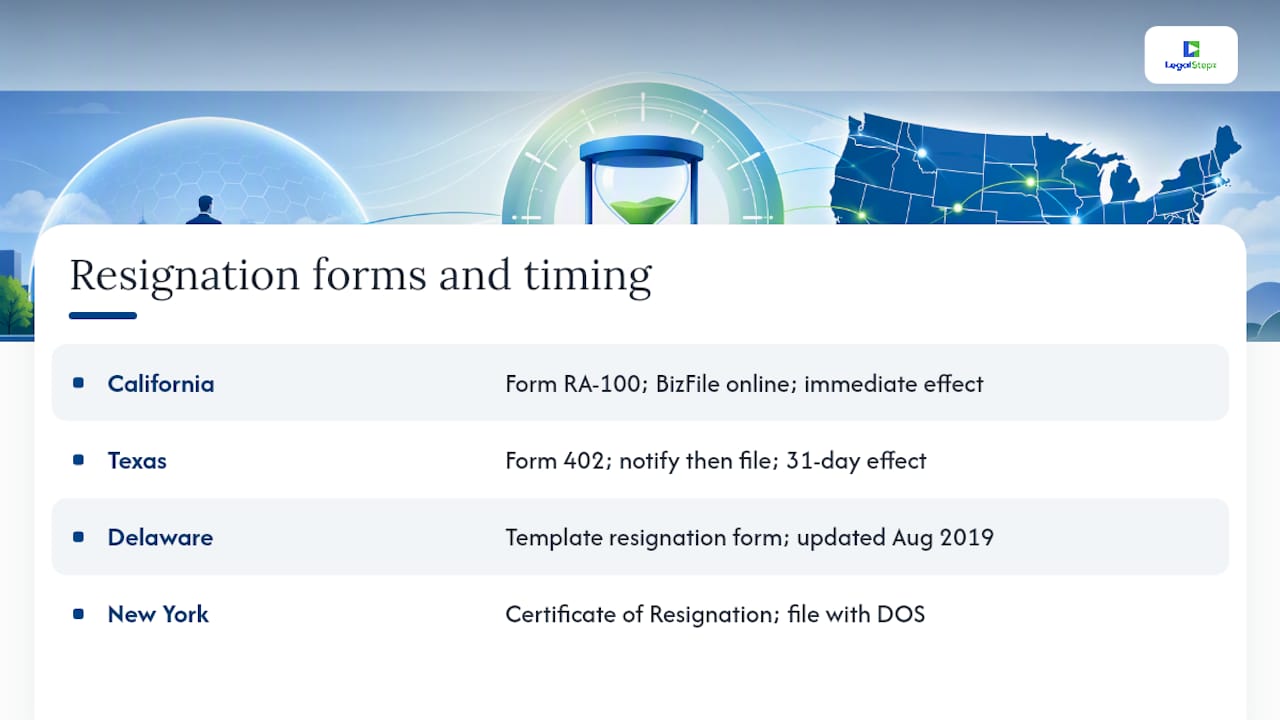
Whether you need a specific named form depends entirely on the state. California requires the statutory RA-100 form, signed and acknowledged, and your authority as agent ends once that filing is accepted, under California Corporations Code §1503. Texas provides Form 402 along with detailed filing instructions covering the required notice language. Delaware goes a step further and requires specific templates depending on entity type and whether you're resigning "without appointment," meaning no replacement agent has been named yet. Those Delaware templates were updated with new required language effective August 1, 2019, and the current versions are the only ones the Division of Corporations will accept.
Other states skip the named-form requirement entirely and accept a free-form written statement, as long as it hits the statutory content requirements: entity name, file number, a clear statement of resignation, and your signature. Always check your specific state's Secretary of State site before assuming a generic statement will work. What passes in one state gets rejected in another.
Filing routes and fees split along similar lines. A short rundown of what you'll typically encounter:
- Online portals – California's BizFile system and Washington's online filing both accept resignation statements electronically, and processing tends to be faster with immediate confirmation.
- Mail filing – Still the default in states without a mature online system, and it's the slowest route by a wide margin.
- In-person filing – Available in some states for same-day handling, though it's rarely necessary for a routine resignation.
- Fees – California typically does not charge a fee for the RA-100 filing. Other states charge modest processing fees, so check the current fee schedule before you submit.
The practical lesson here: never assume your home state's rules apply somewhere else. If you're a registered agent service resigning across a book of clients in multiple states, you're managing four or five entirely different procedural playbooks at once, each with its own notice windows and effective-date math.
State Form Examples and Step-by-Step Filing
Knowing the general rules only gets you so far. What actually matters when you sit down to file is the specific form, the specific fields, and the specific statute backing it up. Here's how five states handle it.
California: Form RA-100. This is the form California's Secretary of State prescribes for resignation of agent for service of process, and it applies to both corporations and LLCs. The form requires the entity's exact name, its file number, a statement of resignation, and your signature with acknowledgment. Submit it online through BizFile, and there's typically no filing fee attached. Once accepted, your authority as agent ceases immediately, and the Secretary of State mails notice to the corporation's principal office so the entity knows it needs a replacement. That immediate-effect rule comes straight from Corporations Code §1503, and the parallel provision for LLCs sits in Corp Code §17701.15. If you're resigning as a registered agent for a California LLC and want the underlying duties spelled out first, our registered agent guide for California businesses walks through what the role actually involves.
Texas: Form 402. Texas provides both the form and a detailed instruction sheet covering the notice language you're required to include; for more on Texas-specific tax and compliance requirements, see Franchise Tax for LLC in Texas Explained. The statute behind it, §5.204 of the Business Organizations Code, sets the now-familiar two-part timing rule: notify the entity, then get your notice to the filing officer within 11 days, with the resignation becoming effective 31 days after the filing officer receives it. The Secretary of State's Form 402 instructions also stress verifying the entity's exact name and file number before submission, which lines up with the single most common rejection reason across every state.
Delaware: resignation without appointment forms. Delaware splits its process depending on whether a new agent has already been designated. If not, you file using the "resignation without appointment" template specific to the entity type (corporation or LLC), and you need the current version. The Division of Corporations updated these required templates effective August 1, 2019, so an older downloaded copy sitting in someone's files folder may no longer be accepted. Delaware's process is stricter about form fidelity than most states, which makes sense given how many entities are formed there purely for its business-law framework.
New York: Certificate of Resignation of Registered Agent. For domestic LLCs, the New York Department of State provides guidance and the certificate needed to formally resign as registered agent. New York's process leans on direct filing with the DOS along with the standard identifying information: entity name, and a clear statement that you're resigning the position. Contact details and current filing practice are best confirmed directly with the Department of State since procedural specifics can shift.
Washington: WAC 434-112-055. Washington runs its resignation process through an online filing system, and the statement of resignation takes effect 31 days after filing, or immediately if the entity designates a new agent before that period runs out, per WAC 434-112-055. The online-first approach here mirrors California's, and both states share that same instant-confirmation advantage over paper filing.
One number worth remembering across every one of these states: the 31-day effective period shows up again and again, whether it's Washington's statutory default or Texas's post-notice waiting window. It's close enough to a national norm that treating it as your working assumption, unless a specific state tells you otherwise, is a safe default.
When Does Your Liability as Registered Agent Actually End?
This is the question that keeps agents up at night, and the honest answer is: it depends on which state's statute you're under, but it's rarely instant.
- File-date effect – California treats your resignation as effective the moment RA-100 is accepted, per Corp Code §1503. No waiting period.
- Statutory waiting period – Washington and Texas both use a 31-day rule, counted from filing or from the filing officer's receipt of notice, respectively.
- Notice to the entity – The Secretary of State typically mails notice to the entity's principal office once your resignation is processed, starting the clock on the entity's own obligation to appoint a replacement.
- Administrative penalties – If the entity fails to act, some states begin delinquency notices, fines, or eventual suspension once the resignation is on record and no replacement follows.
The gap between filing and legal effect matters more than most agents realize. During a 31-day waiting period, you're technically still the agent of record, which means service of process could still reach you even after you've submitted your resignation paperwork. That's not a loophole states built to trap agents. It's a deliberate buffer meant to keep entities from going dark on legal notice with zero warning.
Pro Tip: Mark your calendar for the exact date your resignation becomes legally effective, not the date you filed. If you get served with anything in between, don't ignore it. Forward it to the entity immediately and keep a dated record that you did so.
Retaining your filing confirmation isn't just good record keeping. It's your defense if a plaintiff's attorney or the entity itself later claims you were still the agent when something went wrong. California's online filing system provides immediate electronic confirmation, which gives resigning agents a clean, dated record the moment the state accepts the filing. Mailed filings don't offer that same instant proof, so a tracked delivery receipt becomes your substitute evidence.
What the Entity Must Do Next to Avoid Penalties
Once your resignation lands, the ball is entirely in the entity's court. If you're reading this as the business owner or officer rather than the departing agent, this is the section that matters most to you.
- File an amended statement of information or a change-of-agent form with the Secretary of State to name the replacement. California requires this through the standard statement of information process; other states use a dedicated change-of-agent form.
- Act inside the window before penalties start. Many businesses treat roughly two months as a practical target to avoid delinquency notices, though the exact grace period and consequences vary by state and by entity type, so verify your state's specific deadline rather than assuming a uniform number.
- Confirm the new agent consented and is properly recorded, not just named informally on an internal document. An agent who never agreed to serve can later file a disclaimer, which puts you right back where you started.
- Check the state's business search tool a few days after filing to confirm the new agent's name shows up correctly on the public record.
Entities that ignore a resignation notice long enough tend to find out the hard way, usually when a lawsuit gets served on an agent who's already resigned, or when the state flags the entity as delinquent and suspends its good standing. If you're unclear on what a registered agent is actually responsible for during the transition, our breakdown of the role covers the duties a replacement agent takes on.
Checklist and Sample Resignation Wording
Whether you're filling out a named state form or drafting a free-form written statement, the core content is nearly identical everywhere. Run through this checklist before you sign anything:
- Confirm the entity's exact legal name matches the state's business search record.
- Confirm the file number is current and correctly transcribed.
- Draft or complete the signature block with your name, title (if applicable), and date.
- Note the date you gave notice to the entity and the method used (certified mail, email with read receipt, hand delivery).
- Confirm the delivery method for the state filing itself: online, mail, or in-person.
A short sample statement, adaptable to most free-form filing states, might read like this:
I, [Your Name], hereby resign as the registered agent for service of process for [Entity Name], file number [File Number], effective as permitted by [State] law. Notice of this resignation was provided to the entity at its address on file on [Date of Notice]. This statement is signed and submitted on [Filing Date].
Adjust the exact statutory language to match your state's requirements, since some states mandate specific phrasing that a generic template won't satisfy.
One important branch point: if you were never actually appointed as agent in the first place, whether through a filing error, identity mix-up, or an entity naming you without your consent, you don't file a standard resignation. You file a disclaimer of appointment. California's regulation on disclaimers draws this distinction clearly: a disclaimer states you never consented to the role, which follows a different procedural path than resigning from a position you actually held. Filing the wrong one can create confusion on the public record that takes longer to untangle than getting it right the first time.
Common Mistakes and Red Flags That Cause Rejections
Most rejected resignation filings share the same handful of root causes, and nearly all of them are avoidable with a five-minute check before you submit anything.
- Mismatched entity name or wrong file number. This is the single most frequent rejection reason. Pull both directly from the state's current business search, not from an old document.
- Missing or late notice to the entity. States like Texas build strict timing into the statute itself, so a late notice to the filing officer can invalidate the sequence entirely.
- Incorrect signature authority. Some states require notarized acknowledgment; submitting an unnotarized statement where one is required gets bounced immediately.
- Failing to keep filing confirmation. Without it, you have no clean proof of when your liability actually ended if a dispute surfaces later.
For a deeper look at how these errors play out in practice, our guide to common registered agent change mistakes walks through real filing scenarios where small errors caused expensive delays.
How Legal Stepz Handles Registered Agent Resignations
Registered agent resignations are typically processed by working through the same sequence outlined above, starting with verifying the entity's exact legal name and file number against the state's own business search to prevent common rejections. Then the correct state-prescribed form is prepared, whether that's California's RA-100 or another state's equivalent statement, complete with the required notice language and signature fields.
The most common corrections before filing involve stale entity information: business owners submitting an old file number, an outdated principal address, or a name that no longer matches the current state record because of a prior amendment nobody filed. Catching those mismatches before submission can make the difference between a same-day online confirmation and a weeks-long rejection cycle.
Once a resignation is filed, we confirm the state's acceptance and keep documentation of both the filing and the notice given to the entity. For California entities specifically, that means confirming the BizFile submission cleared and that the Secretary of State's notice to the entity's principal office is on record. If you're also handling ongoing compliance work, like forming or maintaining a California LLC, the resignation and replacement filings tend to move faster when they're handled together rather than as separate, disconnected transactions.
When to Handle This Yourself and When to Get Help
Filing a straightforward registered agent resignation with clean entity records is genuinely something most business owners can do themselves. If your entity name and file number are current, if you're filing in a single state with no named form requirement conflicts, and if there's no dispute about who's authorized to sign, the DIY path works fine. The forms aren't complicated once you know which one applies.
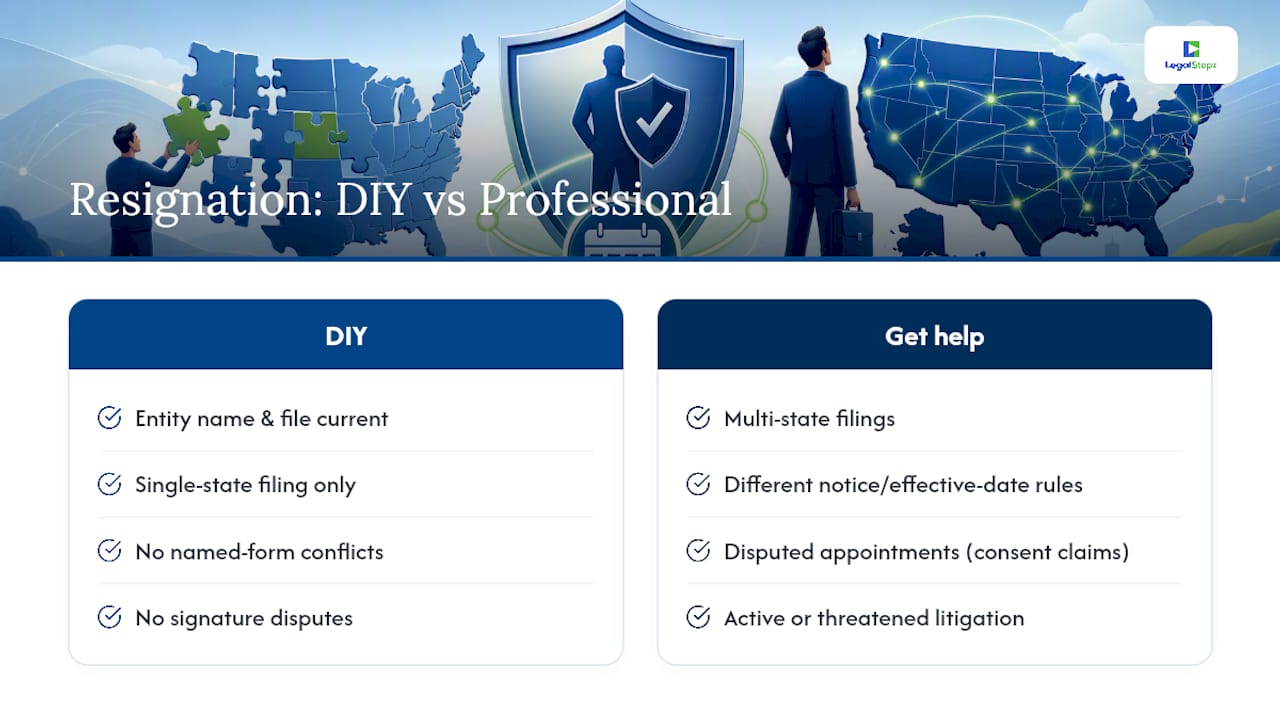
Where I'd push someone toward professional help is anywhere the situation has moving parts. Multi-state entities juggling different notice windows and effective-date rules at once are a recipe for a missed deadline in at least one jurisdiction. Disputed appointments, where someone claims they never consented to serve as agent, need the disclaimer process handled correctly rather than a standard resignation that muddies the public record further. And if there's active or threatened litigation where service of process timing actually matters to a case, that's not the moment to be testing whether your free-form statement meets a state's exact statutory language.
The conventional advice treats every resignation as equally simple. It isn't. A single-entity, single-state resignation with clean records is a 20-minute task. A multi-state portfolio resignation with a disputed appointment buried in it is a different problem entirely, and pretending otherwise is how agents end up with lingering liability they thought they'd already closed out.
— Peter
Get Your Registered Agent Resignation Filed Correctly
Registered agent resignations are generally handled by verifying the entity details, preparing the correct state form, submitting it, and confirming the state accepted it, so the filer is not left guessing whether the paperwork cleared. This process is especially important for California entities managing RA-100 filings alongside annual minutes, bylaws, or a statement of information due around the same time.

Instead of piecing together separate filings across separate deadlines, Legal Stepz bundles resignation processing with the ongoing compliance work most California businesses already need, so your agent transition and your annual filing obligations stay on the same track instead of falling through separate cracks. If you're resigning as an agent, replacing one, or just need to confirm your entity's compliance status is current, start at Legalstepz to get your filing prepared and submitted correctly the first time.
This article is general information, not a substitute for advice from a qualified lawyer. Consult a qualified legal professional about your own circumstances before acting on anything here.
Sources
- Tex. Bus. Orgs. Code §5.204 — Resignation of Registered Agent
- California Corporations Code §1503
- WAC 434-112-055 — Registered agent resignation