

A registered agent is a designated individual or company that officially receives legal, government, and compliance documents on behalf of your business. Every LLC and corporation formed in California must designate one before the state will approve formation. Without a registered agent on file, your business cannot legally operate. California uses the term "agent for service of process" interchangeably with registered agent, but the duties are identical. Companies like Northwest Registered Agent, Legalstepz, and CT Corporation provide this service professionally across the state.
What does a registered agent actually do?
The registered agent role explained simply: your agent is the official point of contact between your business and the government. They receive lawsuits, subpoenas, tax notices, state correspondence, and compliance filings on your behalf. The moment a document arrives, they are responsible for forwarding it to you promptly so you can respond within any legal deadlines.
Availability requirements are typically Monday through Friday, 9 a.m. to 5 p.m. This means your agent must be physically present at a California street address during those hours, every business day. A P.O. box does not qualify. If you use a professional service, they staff an office to meet this requirement year-round, including during holidays you might take.

The types of documents your agent handles fall into three categories. First, legal process documents: lawsuits, summons, and subpoenas that require a formal legal response. Second, state correspondence: annual report reminders, tax notices, and compliance warnings from the California Secretary of State. Third, regulatory filings: notices from the Franchise Tax Board or other agencies tied to your business license or standing.
Pro Tip: Keep a dedicated email address tied to your registered agent account. When your agent forwards a document, you want it landing somewhere you check daily, not buried in a general inbox.
Who can serve as a registered agent in California?
Any individual 18 or older residing in California with a physical street address can serve as a registered agent. That means you, a business partner, an employee, or a professional service all qualify. The state does not require legal training or a license to hold the role.
Self-appointment vs. professional services
Here is a direct comparison of your two main options:
| Factor | Self or employee | Professional service |
|---|---|---|
| Cost | Free | $99 to $300 per year |
| Privacy | Home or office address is public record | Service's address appears on public filings |
| Availability | Must be present 9–5, Mon–Fri | Staffed office handles it automatically |
| Compliance reminders | Manual tracking required | Automated calendar and notifications |
| Multi-state coverage | Requires separate arrangements | Single provider covers all states |
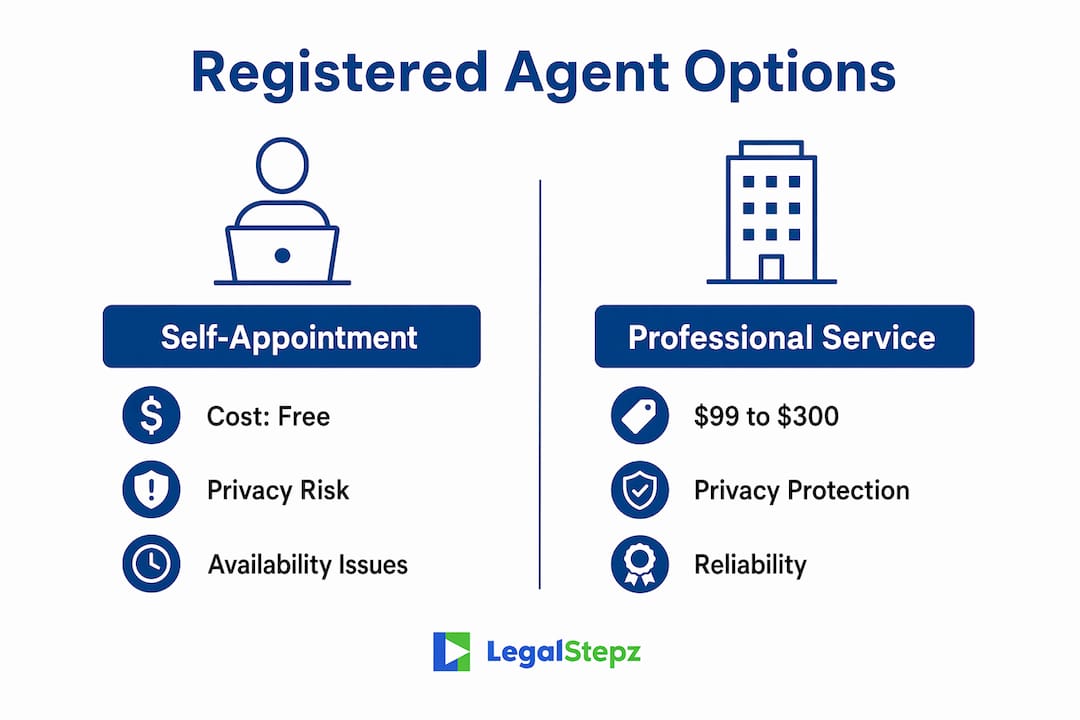
Professional registered agent services range from $99 to $300 annually and typically include mail forwarding, compliance calendars, and continuous document monitoring. That cost is often less than one hour of attorney time, which makes it a straightforward trade-off for most small business owners.
The privacy issue is one most founders overlook. Business owners serving as their own agent risk exposing their home address in public state records, which means anyone can look it up. That includes process servers, competitors, and marketers. A professional service substitutes their address for yours on every public filing.
The downside of self-appointment goes beyond privacy. If you are traveling, in a meeting, or simply away from your registered address during business hours, you are technically in violation of state requirements. One missed delivery of a lawsuit can trigger consequences far more expensive than a year of professional service fees.
Pro Tip: If your business operates in more than one state, use a single registered agent service that covers all your states. Managing separate agents in California, Nevada, and Texas creates compliance gaps that are easy to miss.
What are the risks of neglecting your registered agent?
The consequences of a lapsed or unresponsive registered agent are not administrative inconveniences. They are legal and financial threats to your business.
Strict legal response deadlines for served documents can be 20 to 30 days. If a lawsuit is delivered to your registered agent and you never receive it because the agent is unreachable or the address is outdated, the clock still runs. The court does not pause proceedings because you were unaware. You can lose a case you never knew existed.
The specific risks break down as follows:
- Default judgment: A plaintiff can win a lawsuit automatically if you fail to respond within the deadline. Courts treat proper service of process as sufficient notice, regardless of whether you actually received it.
- Administrative dissolution: States send warnings before dissolving entities with no registered agent on file, but those warnings go to the registered agent address. If that address is wrong, you never see the warning.
- Loss of good standing: California can revoke your business's good standing status, which blocks you from signing contracts, obtaining financing, or renewing licenses.
- Fines and reinstatement costs: Reinstating a dissolved California LLC or corporation requires back fees, penalties, and paperwork that can cost significantly more than maintaining compliance in the first place.
"Failure to promptly receive and act on service of process can lead to default judgments without the business owner's knowledge, undermining their ability to defend themselves legally." — LegalClarity
The most common scenario Legalstepz sees is a founder who moved offices, updated their business address everywhere except with the California Secretary of State, and then missed a critical notice. Registered agents must maintain an updated physical address, and any change requires a formal filing with the state. Skipping that step is one of the most preventable compliance failures in California business law.
How to choose and maintain a registered agent for your California LLC
Choosing the right agent is a decision that affects your legal exposure, privacy, and day-to-day operations. Here is a practical process for making that choice and keeping it current.
-
Assess your availability honestly. If you cannot guarantee a physical presence at a California address from 9 a.m. to 5 p.m. every business day, self-appointment is not a realistic option. Most founders cannot meet this standard consistently.
-
Decide on privacy requirements. If you operate from a home office or a shared workspace, putting that address on public state records creates exposure. A professional service solves this immediately.
-
Compare service tiers. Basic registered agent services handle document receipt and forwarding. Premium tiers add compliance calendars, deadline alerts, and annual report reminders. For a growing California business, the premium tier is worth the additional cost.
-
Appoint your agent during formation. In California, you designate your agent for service of process on your Articles of Organization (LLC) or Articles of Incorporation (corporation). The agent must consent to the appointment before you file.
-
File a change when needed. To switch agents, California LLCs file a Statement of Information with the Secretary of State. Corporations use a similar process. The filing fee is modest, but the update must happen before you stop using your old agent, not after.
-
Build a compliance calendar. Professional agents act as a resource for deadline tracking and compliance reminders, reducing risk for business owners. If you self-appoint, you need to replicate this function manually using a calendar system tied to your state filing deadlines.
For businesses expanding beyond California, a single national registered agent service eliminates the need to manage separate agents in each state. This matters when you register a foreign LLC in Nevada or Texas to pursue contracts or financing. Consistency across states reduces the chance of a missed filing in any jurisdiction. You can also explore how to find an LLC registered agent to compare your options before committing.
Key takeaways
A registered agent is a legal requirement for every California LLC and corporation, and neglecting this role exposes your business to default judgments, dissolution, and loss of good standing.
| Point | Details |
|---|---|
| Legal requirement | Every California LLC and corporation must designate a registered agent before formation is approved. |
| Availability is non-negotiable | Your agent must be physically present at a California address during business hours, Monday through Friday. |
| Privacy matters | Using a professional service keeps your personal or office address off public state records. |
| Missed documents carry real risk | Legal response deadlines run from the date of service, not the date you receive the document. |
| Updating agent info is mandatory | Address changes require a formal state filing or you risk missing critical notices and compliance warnings. |
Why I think most California founders underestimate this role
Most entrepreneurs treat the registered agent requirement as a checkbox during formation and then forget it exists. That is the wrong frame entirely. The registered agent is the single point through which the state and the courts can reach your business. Treat it as infrastructure, not paperwork.
The mistake I see most often is founders appointing themselves as agent to save money, then moving offices or working remotely without updating the state. The address on file becomes a ghost location. Documents pile up at an old address or get returned undeliverable. By the time the founder discovers the problem, a deadline has passed or the business has been administratively suspended.
Professional services are not just a convenience. For any business generating real revenue or entering contracts, they are a form of legal insurance. The $150 annual cost of a quality registered agent service is trivial compared to the cost of a default judgment or a reinstatement filing. I have seen founders spend thousands of dollars in attorney fees to undo problems that a current registered agent address would have prevented entirely.
My practical advice: if you are past the startup phase and your business is signing leases, hiring employees, or working with clients on contracts, switch to a professional service immediately. The corporate registered agent responsibilities in California are specific enough that having a dedicated professional handle them is simply the lower-risk path.
— Peter
How Legalstepz supports your California compliance
Legalstepz offers registered agent services built specifically for California LLCs and corporations, with compliance tracking and document forwarding included.

Beyond registered agent coverage, Legalstepz handles the full compliance stack: filing your Statement of Information, drafting annual minutes, and preparing bylaws that meet California requirements. If you are forming a new entity or need to get an existing business back into good standing, the Legalstepz Incorporation Course walks you through every step, including how to appoint your agent correctly from day one. For a full overview of services, visit the Legalstepz homepage and see how California-specific expertise translates into fewer compliance surprises for your business.
FAQ
What is a registered agent in California?
A registered agent in California is a person or company designated to receive legal and government documents on behalf of your business. California uses the term "agent for service of process" to describe the same role.
Does every California LLC need a registered agent?
Yes. Every LLC and corporation formed or registered in California must designate a registered agent before the state approves formation. Operating without one puts your business at risk of administrative dissolution.
Can I be my own registered agent in California?
You can serve as your own agent if you are 18 or older, a California resident, and have a physical street address in the state where you are available during business hours. The practical challenge is maintaining that availability every business day.
What happens if my registered agent misses a legal document?
If a served document goes undelivered or unforwarded, legal response deadlines still run from the date of service. Missing those deadlines can result in a default judgment against your business, often without your knowledge.
How do I change my registered agent in California?
California LLCs update their registered agent by filing a Statement of Information with the Secretary of State. Corporations follow a similar process. The change must be filed before you stop using your current agent to avoid any gap in coverage.