

File IRS Form 2553 to elect S-corp status. California automatically recognizes that federal election, but the corporation must still file Form 100S every year and pay the state's $800 minimum franchise tax or its 1.5% net income tax, whichever is greater. Timing is the trap: Form 2553 is due within a strict time window after the start of your tax year, or can be filed during the prior tax year to take effect at the start of the next year.
TL;DR:
- Filing Form 2553 must occur within two months and 15 days of the tax year's start, or during the previous year for next year's effect.
- California treats federal S-corp elections as automatic but imposes an $800 minimum franchise tax and a 1.5% net income tax, payable annually.
- Proper filing requires completing entity formation, obtaining an EIN, submitting Statement of Information, and securing shareholder consent before the deadline.
- The tax advantage depends on net income and salary decisions, with California's higher percentage tax potentially outweighing savings at certain income levels.
- Mistakes like late filings, missing shareholder signatures, or creating multiple stock classes risk immediate termination of S status, which can last five years.
Table of Contents
- Quick Checklist for S Corp Election California Requirements
- Who Qualifies for the S Corp Election in California?
- What California Taxes Apply to S Corporations?
- Does the S Corp Tax Math Actually Work for You?
- How Do You Actually File for S Corp Status in California?
- What Mistakes Sink an S Corp Election?
- How Legal Stepz Approaches S Corp Elections for California Owners
- Get Help Filing Your California S Corp Election
- Where to Verify These S Corp Rules Yourself
- Sources
Quick Checklist for S Corp Election California Requirements
Before you touch Form 2553, get the groundwork done. Skipping any of these steps is how businesses end up with a rejected election or an ugly tax surprise the following March.
- Confirm eligibility: one class of stock, no more than 100 shareholders, no ineligible owners.
- Get an EIN if you don't have one, and file Articles of Incorporation or Statement of Information (SI-550) with the Secretary of State.
- File Form 2553 with signed consent from every shareholder, on time.
- Calendar your Form 100S deadline and the $800 minimum/1.5% tax payments.
- Set up payroll so you can pay yourself a reasonable salary. This is the entire point of electing S-corp status for self-employment tax savings.
Who Qualifies for the S Corp Election in California?
The IRS sets the eligibility bar, and it's stricter than most first-time filers expect. Missing one of these disqualifies the whole election, not just a shareholder.
- The entity must be a domestic corporation, or an LLC that has filed Form 8832 to be taxed as a corporation first.
- It can have no more than 100 shareholders, and every shareholder must be an individual, certain trusts, or an estate. No nonresident aliens allowed.
- The corporation may issue only one class of stock. Differences in voting rights are fine; differences in profit and liquidation rights are not.
- Form 2553 must reach the IRS within two months and 15 days of the tax year's start. For a calendar-year corporation beginning January 1, that's March 15.
- You can also file during the prior tax year to make the election effective the following January 1, which gives you more breathing room than most owners realize.
If you blow the deadline, late-election relief under Rev. Proc. 2013-30 can sometimes save the year, but it requires reasonable cause and proof you've been filing and reporting as if the election were already in effect.
What California Taxes Apply to S Corporations?
California doesn't ask you to file a separate state election. A valid federal Form 2553 is enough, and the Franchise Tax Board treats your S status as automatic. Where California diverges sharply from federal treatment is on the tax bill itself.
- Form 100S is due the 15th day of the third month after your tax year closes, which means March 15 for calendar-year filers, with an automatic extension available if you owe no tax.
- The minimum franchise tax applies annually applies annually, with a narrow first-year exemption for certain newly formed or newly qualified corporations.
- The 1.5% entity-level tax applies to net income; you pay whichever is greater, the $800 minimum or the 1.5% figure.
- Quarterly estimated payments are required once your tax liability exceeds the minimum, following the FTB's installment schedule.
A $50,000 net income year means the S-corp entity tax is $750, so the $800 minimum still wins. There is a crossover point in net income above which the percentage tax exceeds the minimum franchise tax, according to the FTB's own S corporation guidance. That crossover point is worth marking on your calendar before you ever file Form 2553.
Does the S Corp Tax Math Actually Work for You?
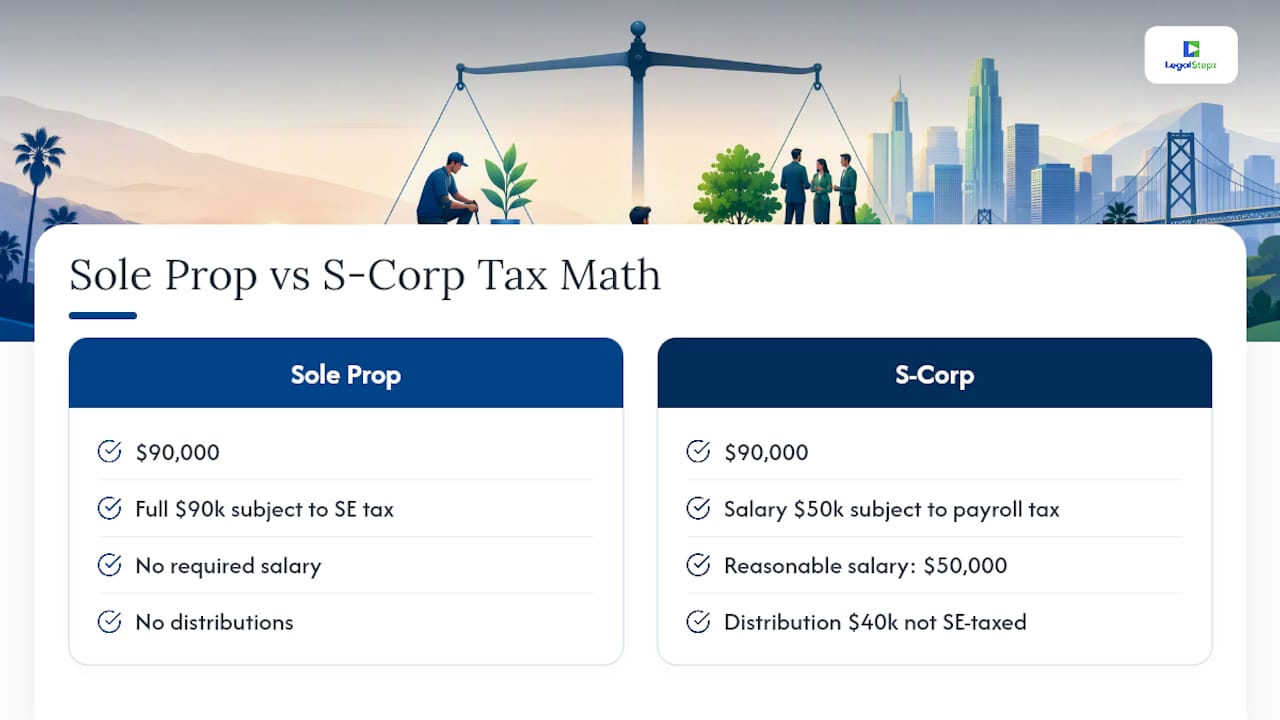
Here's where the decision gets real. Say you net $90,000 as a sole proprietor. You'd owe self-employment tax on the full amount. Elect S-corp status, pay yourself a reasonable salary of $50,000, and the remaining $40,000 passes through as a distribution not subject to self-employment tax. That can mean thousands in savings, but California takes its cut first.
At higher net income levels, the state's percentage tax can be well above the minimum franchise tax, well above the $800 floor. Add payroll processing costs, workers' comp adjustments, and the time cost of running quarterly payroll, and the real savings shrink fast. Practitioner modeling generally puts the break-even income range for California small businesses varies depending on salary, payroll, and tax variables.
The variables that move your break-even most: the salary you set, your payroll admin costs, the flat 1.5% tax, and whether you're still stuck at the $800 minimum. Test each one independently before committing.
Pro Tip: Model your salary conservatively, on the high side, not the low side. The IRS scrutinizes S-corp owners who pay themselves too little to dodge payroll tax, and an aggressive number invites an audit you don't want.
How Do You Actually File for S Corp Status in California?
Sequence matters here more than almost anything else in this process. File out of order and you risk a rejected election or a corporation that's legally formed but tax-misclassified for a full year.
- Form or qualify your entity in California first. If you're an LLC electing corporate treatment, file Form 8832 before or alongside Form 2553; check with a CPA on whether your state can process them together.
- Get your EIN from the IRS if the corporation doesn't already have one.
- File your Statement of Information (SI-550) with the California Secretary of State within 90 days of formation.
- Submit Form 2553 with every shareholder's signed consent attached, well before the deadline.
- Set up payroll so reasonable compensation is running before you file your first Form 100S.
- File Form 100S annually, keeping copies of your IRS acceptance letter and Statement of Information filings on hand.
Keep every filing receipt. If a deadline slips and you need late-election relief, evidence that you were already operating and reporting as an S-corp is what makes the IRS say yes.
What Mistakes Sink an S Corp Election?
The two-month-and-15-day window trips up more businesses than any other single rule. A close second is incomplete shareholder consent, where one owner forgets to sign and the whole election is invalid. Owners also routinely forget California still bills its own tax regardless of what the IRS says, then get hit with penalties for a missed Form 100S.
- Filing Form 2553 late without a plan for Rev. Proc. 2013-30 relief.
- Missing a shareholder's signature on the consent statement.
- Assuming the $800 minimum doesn't apply the first year.
- Skipping corporate formalities like separate bank accounts and documented minutes.
Termination risk is real too. Bring in an ineligible shareholder, or accidentally create a second class of stock, and S status ends immediately. Once terminated, you generally can't re-elect for five years.
Pro Tip: Put a recurring calendar reminder on the anniversary of your incorporation date to reconfirm shareholder eligibility. It takes five minutes and it's the cheapest insurance against an accidental termination.
How Legal Stepz Approaches S Corp Elections for California Owners
Run the tax math first, confirm eligibility second, get payroll set up third, then file Form 2553 on time. That order rarely fails. Where owners stumble is the paperwork layer underneath: Legal Stepz handles Statement of Information filings, drafts corporate minutes and bylaws, and provides registered agent service so nothing slips through the cracks. Bring your CPA in for the tax modeling. Bring us in for the filings that keep you compliant year after year.
— Peter
Get Help Filing Your California S Corp Election
If you're comfortable running payroll and modeling your own tax math, DIY filing works fine for a straightforward one-owner corporation. Once you add multiple shareholders, an LLC conversion, or a tight deadline you can't afford to miss, paid filing help earns its cost fast. Legal Stepz is built for exactly that gap: we file your Statement of Information, draft the minutes and bylaws the state expects you to keep on file, and act as your registered agent so official notices never land in the wrong inbox.

For a business juggling formation paperwork, the $800 franchise tax, and an approaching Form 2553 deadline, having someone else own the compliance calendar is worth more than the filing fee itself. Check the Legal Stepz service bundles to see which package matches your entity's stage, and get your Statement of Information and registered agent service squared away before your next filing deadline hits.
Where to Verify These S Corp Rules Yourself
Confirm every figure directly with the IRS Form 2553 instructions and the FTB's S corporation page before you file.
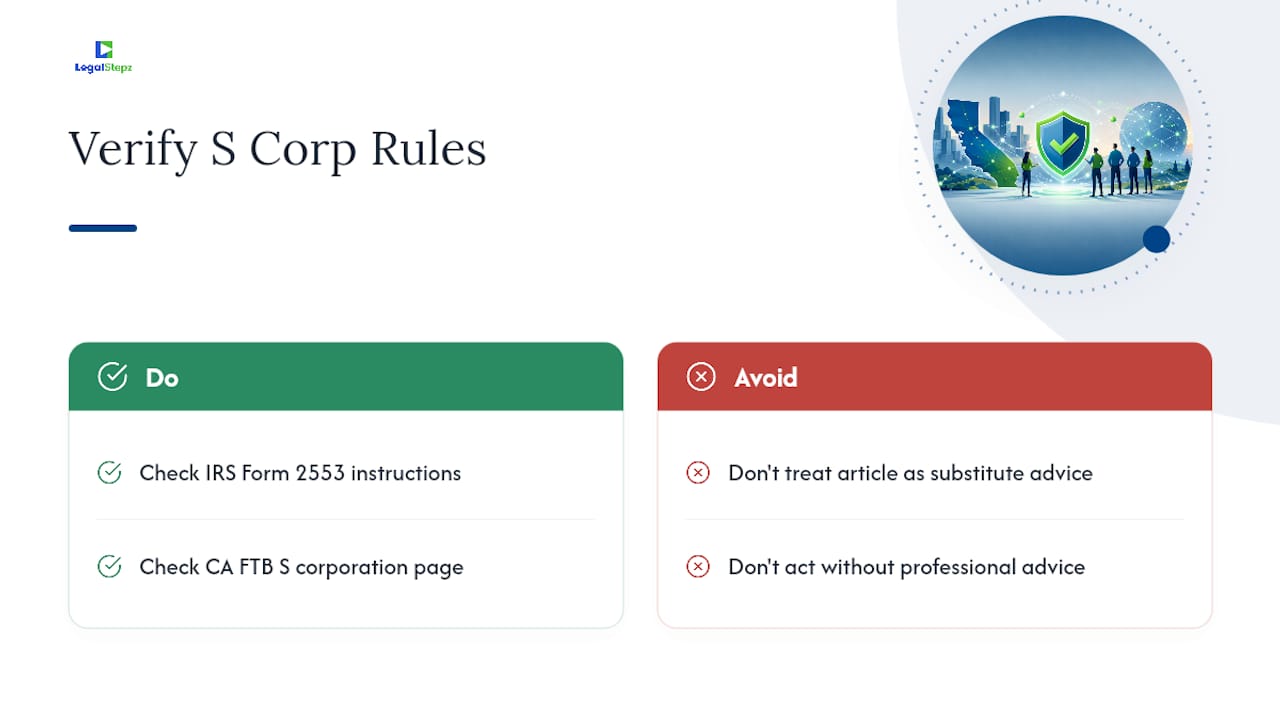
This article is general information, not a substitute for advice from a qualified financial advisor. Consult a qualified financial professional about your own circumstances before acting on anything here.
Sources
- S corporations Business type - Franchise Tax Board - CA.gov
- IRS Form 2553 (Election by a Small Business Corporation) — IRS
- California S-corp election for small business — MBS CPA blog