

For most solo operators and small partnerships earning under a modest annual profit amount, an LLC is the simpler, cheaper choice in California. Once net profit climbs past that range, electing S-corp tax treatment usually starts saving real money on self-employment tax. See the decision framework below for scenario-specific guidance.
TL;DR:
- An LLC’s gross receipts fee and California minimum franchise tax often make it more costly than an S-corp once net profit exceeds approximately $75,000 to $100,000.
- S-corp shareholders pay payroll taxes only on their reasonable salary, which can significantly reduce self-employment taxes at higher profit levels.
- An LLC can elect S-corp tax treatment without converting its legal structure, enabling flexibility for owners planning future growth and investment.
- LLCs are simpler to maintain with less administrative overhead, making them ideal for solo operators earning under $75,000 annually.
- Transitioning from an LLC to an S-corp requires timely filing of Form 2553 and setting up payroll, with mistakes risking loss of tax benefits.
Table of Contents
- LLC vs S Corp in California: What Is an LLC?
- What Is an S Corporation in California?
- The Real Differences That Change Your Decision
- When an LLC Fits Best in California
- When S-Corp Election Usually Pays Off
- How to Elect S-Corp Tax Treatment for Your LLC
- California Compliance Checklist: Forms, Fees, and Deadlines
- Choosing Between LLC and S Corp: A Quick Framework
- Legal Stepz Resources for California Formation and Compliance
- What California's Corporate Transparency Rules Mean for You
- California Employment Law and Your Payroll Obligations
- Dissolving or Converting Your California Entity
- A Straight Answer on Simplicity vs. Tax Optimization
- Ready to Form or Restructure Your California Entity?
- Sources
LLC vs S Corp in California: What Is an LLC?
A California LLC is a business entity you form by filing Articles of Organization (Form LLC-1) with the California Secretary of State. Within 90 days of formation, you also file a Statement of Information (Form LLC-12), then refile every two years after that. Miss it, and the state levies a penalty and can suspend your entity's ability to do business.
Tax-wise, the IRS treats a single-member LLC as a disregarded entity by default and a multi-member LLC as a partnership. Profits flow straight to your personal return, and you pay self-employment tax on all of it. California adds two costs on top of the federal picture: an $800 annual minimum franchise tax and a separate LLC fee tied to gross receipts, not net profit. That gross receipts fee runs in tiers:
- $0 for California gross receipts under $250,000
- $900 for receipts between $250,000 and $499,999
- $2,500 for receipts between $500,000 and $999,999
- $6,000 for receipts between $1 million and $4.99 million
- $11,790 for receipts of $5 million or more
Nothing stops an LLC from electing corporate or S-corp tax treatment at the federal level while remaining a legal LLC under California law. That distinction trips up a lot of new owners: you don't need to become a corporation to get S-corp tax benefits.
Routine LLC upkeep includes maintaining a registered agent, filing the biennial Statement of Information, and submitting Form 568 (the LLC Return of Income) to the Franchise Tax Board every year, even in years with no profit.
What Is an S Corporation in California?
An S corporation isn't a separate legal entity type. It's a federal tax election, made on IRS Form 2553, that lets a qualifying corporation (or an LLC taxed as one) pass income through to shareholders instead of paying corporate income tax twice. Eligibility comes with real limits: no more than 100 shareholders, and every shareholder must be a US citizen or resident individual, certain trusts, or an estate. No partnerships, no corporations, and no nonresident aliens as owners.
California layers its own rules on top of the federal election:
- File Form 100S annually. Every S corporation doing business in California must file this return with the FTB, regardless of profitability.
- Pay whichever is greater: $800 or 1.5% of net income. The FTB assesses S corporations at 1.5% of net income, but the $800 minimum franchise tax applies even if the business loses money.
- Run payroll for shareholder-employees. If you work in the business, you must pay yourself a reasonable salary through payroll, withhold employment taxes, and file the associated federal and state payroll returns.
- Issue Schedule K-1s. Remaining profit after salary passes through to shareholders' personal returns, reported via Form 1120-S at the federal level.
Here's the part that confuses almost everyone starting out: an LLC can make the S-corp election and get taxed exactly like an S corporation while its legal structure, liability protections, and operating agreement stay an LLC under California law. You're not converting entities. You're changing how the IRS and FTB tax the same entity.
The Real Differences That Change Your Decision
The comparison that matters most to your wallet isn't LLC versus S corp in the abstract. It's a set of concrete numbers specific to your revenue, margin, and payroll tolerance.
California state taxes and fees. An LLC pays $800 plus the gross receipts fee tier described above, calculated on revenue regardless of profitability. That gap is exactly why high-revenue, low-margin businesses sometimes pay more as a default LLC than they would after electing S-corp treatment.
S-corp shareholder-employees pay payroll tax only on their salary; profit distributions above that salary escape FICA entirely. Set the salary too low, though, and you invite IRS scrutiny under the reasonable compensation standard.
Break-even reality: Third-party CPA modeling suggests the S-corp election typically pencils out once net profit clears roughly $75,000 to $100,000, the point where payroll tax savings outweigh added payroll and compliance costs.
Ownership and investor friendliness. LLCs allow unlimited members, foreign owners, and other entities as members, plus flexible profit allocations that don't have to match ownership percentage. S corps cap out at 100 shareholders, only one class of stock, and no corporate or partnership owners, which makes them a poor fit if you're planning to raise venture capital.
Administrative burden. LLCs file one annual return (Form 568) and skip payroll unless they choose otherwise. S corps require ongoing payroll, quarterly payroll tax filings, annual K-1 preparation, and more rigorous bookkeeping to defend the reasonable salary figure.
- LLC: lower paperwork, higher self-employment tax exposure
- S corp: lower FICA exposure, higher payroll and compliance overhead
When an LLC Fits Best in California
An LLC wins on simplicity. You skip payroll setup, avoid the reasonable-compensation debate with the IRS, and keep your tax filing to a single annual return.
Advantages:
- Formation is straightforward through the Articles of Organization filing
- Profit and loss allocations can differ from ownership percentage
- No payroll required unless you choose to run one
- Membership is open to individuals, trusts, corporations, and foreign owners
California-specific downsides:
- The $800 minimum tax applies from the first year of existence in most cases
- The gross receipts fee tiers can hit revenue-heavy, margin-thin businesses hard, since the fee ignores profitability
- Every dollar of net profit gets hit with 15.3% self-employment tax, with no salary/distribution split available
Freelancers, consultants just getting started, real estate holding entities, and any business with non-standard profit-sharing arrangements between partners tend to stay LLCs indefinitely, often by design rather than oversight.
Pro Tip: If your California LLC's gross receipts are approaching a fee tier threshold, like crossing from $499,000 to $500,000, run the math before year-end. Small revenue timing shifts can push you into a $2,500 or $6,000 fee tier you could have deferred to the next tax year.
When S-Corp Election Usually Pays Off
The S-corp election exists for one core reason: cutting your self-employment tax bill once profit reaches a level where the math favors it.
Benefits:
- Only your salary is subject to payroll tax; distributions above that are not
- S-corp taxed entities calculate California liability on 1.5% of net income instead of the LLC gross receipts fee
- Clean separation between "employee wages" and "owner profit" often simplifies financial planning and lender conversations
Trade-offs:
- You must set up payroll, which means a payroll provider, quarterly filings, and W-2 issuance
- The IRS and FTB expect documented reasonable compensation for shareholder-employees; underpaying yourself to dodge payroll tax is an audit flag that can erase your savings if distributions get reclassified as wages
- Shareholder count caps at 100, and every owner must be an eligible individual, trust, or estate
- Corporate formalities tighten: more rigorous minutes, more disciplined bookkeeping to defend the salary figure
Picture a consulting business netting $150,000 a year. As a default LLC, that owner pays self-employment tax on the full $150,000. After an S-corp election with a documented $70,000 reasonable salary, payroll tax applies only to that $70,000, while the remaining $80,000 passes through as a distribution free of FICA. The state-side comparison runs the other direction too: published modeling on a $150,000 net-income business shows the S-corp's 1.5% tax and the LLC's gross receipts fee can land at meaningfully different totals depending on how much of that $150,000 counts as California gross receipts versus net income.
How to Elect S-Corp Tax Treatment for Your LLC
Making the election is a paperwork exercise, but the timing window is unforgiving.
- Confirm eligibility. Every LLC member must qualify as an eligible S-corp shareholder, and all members need to consent to the election in writing.
- Get an EIN if your LLC doesn't already have one; you can't file Form 2553 without it.
- File Form 2553 on time. The election must generally be filed within two months and 15 days of the effective date you want, or it applies to the following tax year instead.
- Set up payroll and document reasonable compensation. Register for a state payroll tax account through the Employment Development Department, choose a payroll provider, and write down how you arrived at your salary figure.
- Plan your ongoing filings. Expect to file Form 100S with the FTB going forward, alongside your existing federal Form 1120-S and K-1 preparation.
The most common mistake: electing S-corp status and then never actually running payroll, treating all withdrawals as distributions. That defeats the entire purpose of the election and creates exposure if the IRS reclassifies those distributions as unpaid wages.
Pro Tip: Before meeting with a CPA or formation service, gather your LLC operating agreement, EIN confirmation letter, prior-year tax returns, and a rough profit projection for the coming year. It cuts the consultation time in half. Legal Stepz walks through this exact S-corp election process step by step if you'd rather follow a guided checklist than assemble one from scratch.
California Compliance Checklist: Forms, Fees, and Deadlines
Every entity type in California carries its own filing calendar, and missing a date triggers penalties that compound quickly.
Formation filings:
- LLCs file Articles of Organization (LLC-1) with the Secretary of State
- Corporations electing S-corp status file Articles of Incorporation instead
- Both entity types must maintain a registered agent for service of process in California
Recurring obligations:
- Statement of Information due within 90 days of formation, then every two years for LLCs (annually for corporations)
- LLCs file Form 568 annually and pay the $800 minimum plus any gross receipts fee owed
- S corporations file Form 100S annually and pay $800 or 1.5% of net income, whichever is greater
- Payroll tax returns (federal Form 941, state DE 9/DE 9C) due quarterly for any entity running payroll
Noncompliance carries real teeth: the FTB can suspend your entity's powers, rights, and privileges, which blocks you from enforcing contracts in California courts until you're back in good standing. One quirk worth knowing: California waived the first-year $800 minimum franchise tax for corporations formed in certain years, but that exemption has not applied to LLCs, so budget for the $800 from day one on the LLC side.
Choosing Between LLC and S Corp: A Quick Framework
Run through five questions before you file anything:
- What's your projected annual net profit?
- What are your margins, and is most of your revenue gross receipts or net income?
- Do you plan to hire employees or bring on outside investors?
- How many owners will there be, and are any of them entities rather than individuals?
- How much administrative overhead can you realistically manage or afford to outsource?
Scenario A: Solo consultant netting $75,000 or less. Stay an LLC. The self-employment tax hit on $75,000 is real but modest, and adding payroll costs more in accounting fees than it saves in tax.
Scenario B: Owner-operator earning $75,000 to $200,000. Model the S-corp election. This is the range where documented case studies consistently show payroll tax savings outweighing the added payroll and compliance cost.
Scenario C: High-revenue, low-margin business (retail, e-commerce, distribution). Watch the LLC gross receipts fee closely.
Pro Tip: Form the LLC first for liability protection and operational simplicity, then file the S-election once profit projections clear your break-even threshold. This sequencing, common among Windes' clients transitioning entities, avoids paying for payroll infrastructure before you actually need it.
Whichever path fits, talk to a CPA before filing, and bring the documents mentioned in the election checklist above.
Legal Stepz Resources for California Formation and Compliance
Legal Stepz handles the paperwork side of both structures: LLC formation, S-corp election filings, registered agent service, and the annual Statement of Information filing that trips up so many owners who forget the deadline.
A few resources worth bookmarking as you move forward:
- California LLC S Corp overview, covering election mechanics and ongoing compliance side by side
- Step-by-step LLC formation guide for the Articles of Organization process and required timelines
- A dedicated S-corp election walkthrough for readers ready to file Form 2553
For a compliance-focused companion resource, the California LLC regulations checklist breaks down recurring obligations by deadline, useful alongside whatever entity structure you land on.
What California's Corporate Transparency Rules Mean for You
The federal Corporate Transparency Act's beneficial ownership reporting requirement has had a turbulent legal history, with enforcement paused and narrowed for most domestic companies following court challenges and regulatory changes. California itself does not currently operate a separate state-level beneficial ownership registry parallel to the federal one, but that doesn't mean ownership transparency is a non-issue for LLCs and S corporations here.
Both entity types already disclose management and agent information through the Statement of Information filed with the Secretary of State, which is public record. An LLC's Statement of Information lists managers or members; a corporation's lists officers and directors. That existing disclosure is separate from, and less detailed than, federal beneficial ownership reporting, which asks for actual beneficial owners regardless of title.
Given how quickly federal reporting requirements have shifted, the practical move for any California LLC or S corporation is to keep ownership records current and organized rather than guessing at your obligation. If you formed through a management structure with layered ownership (an LLC owned by another LLC, for instance), that's exactly the kind of structure federal reporting rules were built to capture, and it's worth confirming your current filing status with a formation professional rather than assuming you're exempt.

Neither entity type has an inherent advantage here. What matters is whether your ownership structure is simple (direct individual owners) or layered (entities owning entities), since layered structures draw more scrutiny under any beneficial ownership framework, state or federal.
California Employment Law and Your Payroll Obligations
The moment you put anyone on payroll, whether that's an S-corp shareholder-employee or a rank-and-file worker at an LLC, California's employment law framework applies in full. It doesn't discriminate by entity type.
That matters most for S corporations, since the S-election forces you into payroll for shareholder-employees. You're now subject to the same wage and hour rules as any other California employer: minimum wage requirements, meal and rest break rules, final paycheck deadlines, and workers' compensation insurance obligations if you have employees beyond just yourself. Reasonable compensation for an S-corp shareholder-employee also has to clear California's wage floor, not just satisfy the IRS.
LLCs taxed under the default pass-through method largely dodge this until they hire actual employees, since owners paying themselves through distributions aren't running payroll. But the instant an LLC brings on staff, whether it kept default tax treatment or not, the same wage and hour, break, and workers' comp rules kick in.
One frequently missed detail: California's strict worker classification standards under the ABC test apply regardless of whether you're organized as an LLC or an S corp. Misclassifying a worker as an independent contractor carries the same penalty exposure either way, so entity choice offers no shelter from California's aggressive stance on employee classification.
Dissolving or Converting Your California Entity
Winding down or converting a California LLC or S corporation involves separate procedural tracks, and mixing them up delays the process.
Dissolving an LLC requires a Certificate of Cancellation filed with the Secretary of State, plus a final Form 568 marked as the final return with the FTB. If all LLC members vote unanimously to dissolve, the process is faster; without unanimous consent, you generally need a formal vote per your operating agreement's terms.
Dissolving a corporation that elected S-corp status follows a different track: a Certificate of Dissolution (or Certificate of Election to Wind Up and Dissolve alongside it, depending on your situation), board and shareholder approval documented in minutes, and a final Form 100S marked as terminating. Corporations also need a tax clearance certificate from the FTB in more circumstances than LLCs typically do.
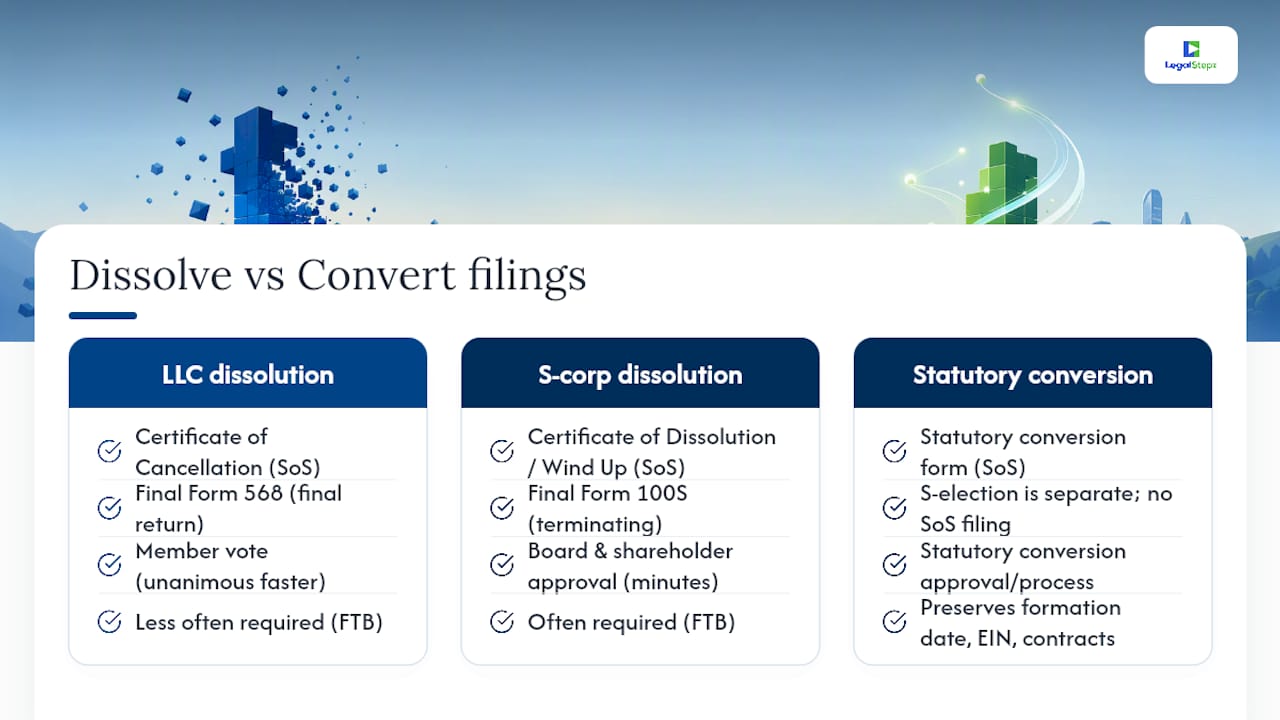
Converting between the two, say, an LLC electing to become a full corporation rather than just electing S-corp tax treatment, requires filing a statutory conversion form with the Secretary of State rather than dissolving one entity and forming another from scratch. That preserves your original formation date, EIN in most cases, and existing contracts. Simply making or revoking the S-election, by contrast, requires no Secretary of State filing at all since it's a federal and state tax matter, not a change in your legal entity type. Confusing these two processes, tax election versus legal conversion, is one of the more expensive mistakes owners make when restructuring.
A Straight Answer on Simplicity vs. Tax Optimization
Most California entrepreneurs overthink this decision before they've even hit their first profitable year. Start as an LLC. Keep it simple while you validate the business, because payroll infrastructure and reasonable-compensation documentation cost real money and attention you don't have to spend yet. Once net profit consistently clears that $75,000 to $100,000 range, run the S-corp numbers with a CPA rather than guessing. Legal Stepz can help with the formation paperwork either way, but the sequencing, LLC first, election later, is the part too many owners skip.
— Peter
Ready to Form or Restructure Your California Entity?
Doing this through a traditional attorney means retainer fees before you've filed a single form. Legal Stepz gives you a direct path instead: LLC formation, S-corp election filing, registered agent service, and the Statement of Information filings that keep your entity in good standing, all without the hourly billing.

Whether you're forming your first California LLC or you've hit the profit range where an S-corp election starts making sense, Legal Stepz packages the paperwork so you're not juggling separate forms, deadlines, and filing portals on your own. That includes the registered agent service every entity needs, annual compliance filings, and step-by-step S-corp election support when you're ready for it.
Start by reviewing your formation options and compliance packages at Legal Stepz and get your California entity filed correctly the first time.
This article is general information, not a substitute for advice from a qualified financial advisor. Consult a qualified financial professional about your own circumstances before acting on anything here.
Sources
- Ftb
- S corporations — IRS
- Set up your business in California — California Office of the Small Business Advocate
- California Secretary of State — Business programs: business entities