

A seller's permit is a state sales-tax account issued by the California Department of Tax and Fee Administration (CDTFA). A business license is local permission from your city or county to operate at all. Most retailers, and plenty of service businesses that sell goods on the side, need both. Start with CDTFA's online registration, then check your city or county business office for the local piece.
TL;DR:
- Most California businesses need both a seller's permit and a local business license unless they operate solely online without physical inventory or local sales.
- A seller's permit is required if you regularly sell tangible goods in California, even at occasional markets or from a warehouse, but not for one-time sales like garage sales.
- Applying for a seller's permit involves providing personal and business identification, with most permits issued immediately once registered online.
- A local business license is separate, determined by city or county regulations, and covers zoning, safety, and other local operating permissions, not sales tax.
- Failing to update details or misunderstanding permit transferability can lead to back-tax issues or penalties, particularly if inventory is stored in California warehouses.
Table of Contents
- Seller's Permit vs Business License California: Side-by-Side
- Who Actually Needs a Seller's Permit in California?
- How Do You Apply for a California Seller's Permit?
- What's a Local Business License, and Why Isn't the Seller's Permit Enough?
- What Other Permits Might Apply to Your Business?
- Common Mistakes That Cost California Sellers Money
- Your First 90 Days as a California Seller
- Let Legalstepz Handle the Paperwork While You Run the Business
- The Real Reason This Trips People Up
- Sources
Seller's Permit vs Business License California: Side-by-Side
The confusion between these two makes sense. Both involve government paperwork, both feel bureaucratic, and both get lumped together as "business registration" in casual conversation. They're issued by different levels of government for entirely different reasons, and mixing them up is the single most common compliance mistake new California sellers make.
| Feature | Seller's Permit | Business License |
|---|---|---|
| Purpose | Collect and remit state sales tax | Grant local permission to operate |
| Issuer | CDTFA (state) | City or county |
| When required | Selling or leasing tangible personal property | Operating any business within city/county limits |
| Cost / security deposit | No application fee; deposit may be required based on projected sales | Varies by jurisdiction, often a modest annual amount |
| How to apply | CDTFA online registration | City/county clerk or finance office |
Here's how it tends to shake out in practice:
- You need only a seller's permit if you sell exclusively online with no physical presence in a city that requires a license, and your county doesn't tax unincorporated business activity.
- You need only a business license if you offer a service with no taxable goods involved, like consulting or bookkeeping, in a jurisdiction that licenses all businesses regardless of product sales.
- You likely need both if you run a retail store, restaurant, salon, food truck, or online shop with local inventory. That's most small businesses in California.
Who Actually Needs a Seller's Permit in California?
CDTFA's standard is whether you're "engaged in business" in California and intend to sell or lease tangible personal property that would ordinarily be subject to sales tax. That's a broad net. It catches full-time retailers, side-hustle Etsy sellers, food trucks, and even someone who sells handmade goods at two craft fairs a year.

There's a narrow carve-out called the occasional sale exception: a garage sale, a one-time estate sale, or selling your own used furniture generally doesn't require a permit because you're not regularly engaged in the business of selling.
Warehousing complicates things. If you store inventory in a California fulfillment center, even through a third-party logistics provider, CDTFA typically considers that a physical presence that triggers the permit requirement. Internet sellers assume shipping from out of state gets them off the hook. It doesn't, if the goods sit in a California warehouse before they ship.
A few real scenarios:
- A San Diego candle maker selling on Etsy and at three farmers markets a year needs a permit; the volume and repetition make it a business, not an occasional sale.
- A Sacramento freelance graphic designer who sells zero physical products needs no seller's permit at all.
- An Ohio-based apparel brand using a Fresno fulfillment warehouse needs a California seller's permit because of the in-state inventory.
How Do You Apply for a California Seller's Permit?
Gather your documents before you sit down to register. It saves a follow-up email from CDTFA a week later.
- Your Social Security number or Federal Employer Identification Number (FEIN).
- A valid driver's license or state ID.
- Bank account information and details on your primary suppliers.
- A projected estimate of monthly taxable sales.
- Contact information for your bookkeeper or accountant, if you have one.
- Complete the CDTFA online application, or visit a field office if you'd rather register in person.
Most applicants get their permit immediately after finishing the online registration. If you're running a pop-up shop, holiday stand, or seasonal event lasting 90 days or less, ask about a temporary seller's permit instead of the standard one. It's built for exactly that kind of short-term selling.
CDTFA doesn't charge an application fee, but it may require a security deposit depending on your business type and projected sales volume. The deposit acts as a buffer against unpaid tax liability if the business closes owing money to the state. Not every applicant gets asked for one, and the amount, when required, scales with how much taxable revenue you expect to bring in.
Pro Tip: File for your seller's permit before your first sale, not after. Retroactive registration can trigger back-tax questions you don't want to deal with in your first month of business.
What's a Local Business License, and Why Isn't the Seller's Permit Enough?
A business license, sometimes called a business tax certificate, is your city's or county's way of saying you're allowed to operate within its limits. It has nothing to do with sales tax. It's about zoning compliance, local revenue collection, and, in some cases, health or safety inspections tied to your specific type of business.
Requirements vary wildly by jurisdiction. Los Angeles requires a business tax registration certificate for nearly every commercial activity within city limits. Smaller unincorporated areas in the county might have looser rules, or none, if the business operates in county territory outside any city's boundary. Home-based businesses often face additional home-occupation permit rules covering things like parking, signage, and noise. Retail storefronts usually need zoning clearance and sometimes a fire or building inspection before the city signs off.
Because there's no single statewide business license in California, you can't rely on one form or one state page to cover this step. That's where lookup tools come in. CalGOLD lets you search by business type and location to see exactly which permits apply, and Business offers a similar breakdown for state-level requirements. For anything hyperlocal, though, calling your city or county business license office directly is still the most reliable move. Our own breakdown of state entity compliance requirements walks through how state and local rules interact if you want the fuller picture.
Fees and renewal cycles differ by city, too. Some charge a flat annual fee under $100. Others calculate the fee as a percentage of gross receipts, which means your bill grows with your revenue. Mark your renewal date the same way you'd mark a sales-tax filing deadline, because missing it usually means a late fee on top of the original charge.
What Other Permits Might Apply to Your Business?
A seller's permit and a business license cover the basics, but plenty of businesses need more. If you sell cannabis products, you'll need a cannabis tax permit on top of your seller's permit. Cigarette and tobacco retailers need a separate state retailer's license. CDTFA administers dozens of these special tax and fee programs beyond general sales tax.
Hiring employees pulls in the Employment Development Department (EDD) for payroll withholding and unemployment insurance registration, plus federal obligations through the IRS. None of these substitute for a seller's permit or business license. They stack on top.
A quick self-check:
- Selling regulated products (cannabis, tobacco, fuel, alcohol): check CDTFA's special taxes and fees pages.
- Hiring staff: register with EDD for payroll accounts.
- Operating as a corporation or LLC: confirm your federal EIN status with the IRS.
Common Mistakes That Cost California Sellers Money
The costliest mistakes aren't usually about not knowing the rules exist. They're about assumptions that turn out to be wrong at the worst possible time.
- Waiting until after the first sale to apply for a seller's permit, which can trigger questions about back taxes owed.
- Assuming a seller's permit transfers with a business purchase. It doesn't. CDTFA is explicit that new owners must register their own account, and buyers should request written tax clearance from the seller before closing rather than assuming a clean slate.
- Forgetting to update CDTFA after a change of address or ownership, which can delay notices and filing reminders.
- Misusing resale certificates. Publication 107 is clear that issuing a resale certificate for something you don't actually intend to resell is illegal, and CDTFA treats it as a real enforcement issue, not a technicality.
- Losing track of sales records and resale certificates from suppliers, which becomes a problem fast during an audit.
Pro Tip: Set calendar reminders for your CDTFA filing periods and your local license renewal date the same week you register. Two separate agencies means two separate deadlines, and neither one waits for the other.
Your First 90 Days as a California Seller
Treat the first month as paperwork triage. Decide your business structure, gather your identification and bank details, apply for your seller's permit through CDTFA, and research your specific city or county's business license requirements in parallel. Don't wait for one to finish before starting the other.
By day 60 to 90, your permit should be displayed where required, your bookkeeping should track sales tax collected separately from revenue, and you should have a filing cadence set based on your assigned reporting period. Subscribe to CDTFA's email notices so rate changes and filing reminders land in your inbox automatically.
If your situation involves warehousing, occasional sales, or a regulated product, call CDTFA or your local office before you assume you're in the clear. A five-minute phone call beats a penalty notice six months later.
Let Legalstepz Handle the Paperwork While You Run the Business
Between a seller's permit application, a local license search, and the ongoing filings that keep both current, compliance can eat hours you'd rather spend on customers. There are services available that can handle filing Statements of Information, drafting annual corporate minutes and bylaws, and acting as registered agents to ensure state notices are not missed.
The practical benefit is straightforward. Missed filings and lapsed registrations create real risk, from late fees to administrative dissolution, and catching every deadline manually is easy to get wrong when you're also managing inventory, staff, or a storefront. Step-by-step courses for LLC and corporation formation and trademark registration exist that are designed to help entrepreneurs handle formation themselves with a clear, correct process rather than guesswork. If you're ready to get your compliance calendar off a sticky note and onto something reliable, start at Legalstepz.
The Real Reason This Trips People Up
Most guidance treats "getting licensed in California" like a single checkbox. It isn't, and the state's own structure guarantees confusion because two entirely separate governments, state and local, each think their piece is the important one. CDTFA cares about tax collection. Your city cares about zoning, safety, and local revenue. Neither agency's paperwork mentions the other's requirement, so a new seller who completes their CDTFA registration reasonably assumes they're done. They're not, and nobody at CDTFA is going to tell them that.
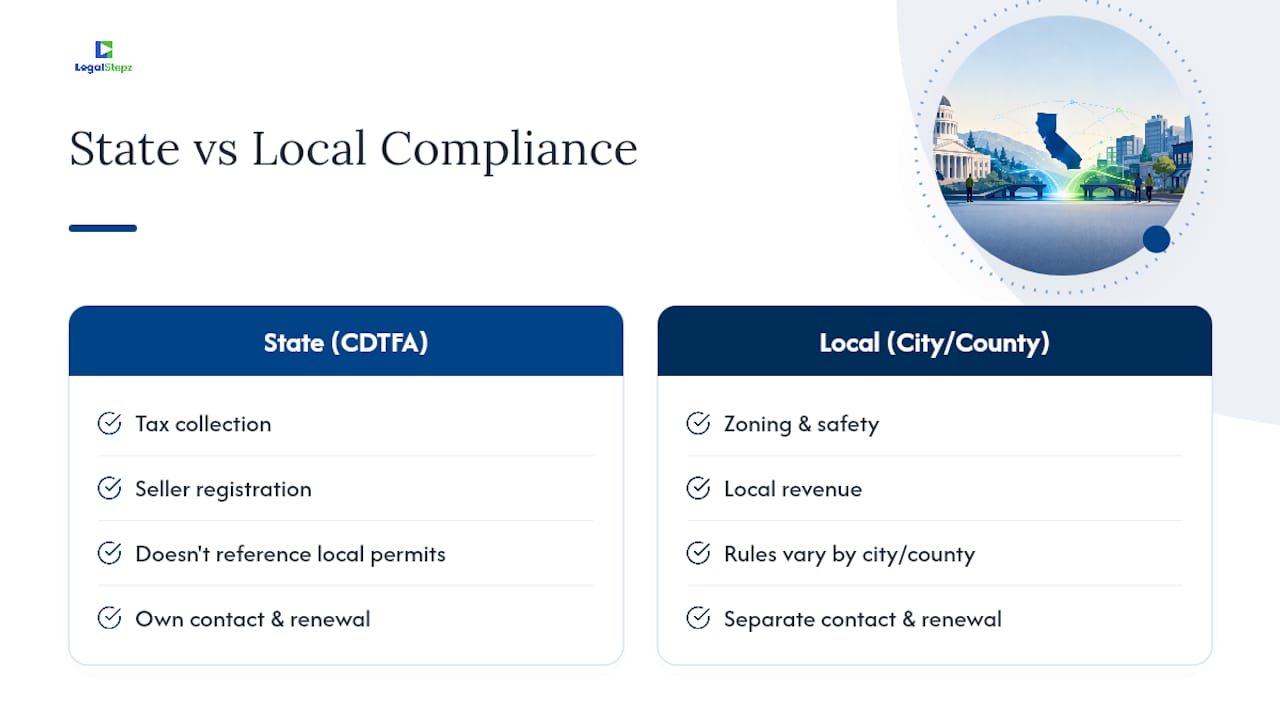
The deeper issue is that California's decentralized local licensing system was never designed with small business clarity in mind. It grew city by city, county by county, over decades, which is why a candle maker in Sacramento and one in Los Angeles can face completely different local requirements for the same business. Tools like CalGOLD help close that gap, but they're a lookup tool, not a substitute for actually calling your local office when your situation is unusual, like operating from home, using a shared warehouse, or selling a regulated product.
If there's one habit worth building early, it's treating the seller's permit and the business license as two completely separate relationships to maintain, each with its own renewal calendar, its own point of contact, and its own paperwork trail. Businesses that get burned aren't usually careless. They just assumed one form covered everything, because on paper, it should. It doesn't.
— Peter